





























Make your garden a lush oasis!
Create a fresh, thriving ambience.
Contents
In a context of repeated heatwaves and a dry garden, water reassures, shade soothes. Then arises the urge to craft a leafy sanctuary in a corner of the garden, to enjoy the cooling of the foliage when the sun is at its zenith. The garden then becomes a true oasis where we can recharge and breathe during the hot days. In this refreshing cocoon, lush young plants provide a welcome shade. Very few flowers, but luxuriant foliage, young plants with unusual and graphic shapes that recreate a mini ecosystem within very dense vegetation. Water is readily present in the form of small ponds, adding a refreshing and soothing touch. This island of freshness is often tucked into the heart of a large garden, but it is also well suited to small spaces when living in the city, for example. Here are our tips to help you transform a corner of the garden into a green oasis conducive to escapism!
→ Also view our inspiration Bubble of freshness on pages 22-23 of our Spring-Summer 2024 catalogue, as well as our selection of essential plants to recreate this atmosphere.

For what type of garden?
A plant oasis can be integrated into different types of gardens, provided you choose the right plants according to site conditions and climate. The key is to create a verdant, soothing plant display, conducive to relaxation, in harmony with the rest of the garden. An exotic or tropical garden is particularly well suited to host a plant oasis. The exotic plants and the aquatic elements are already present there, and the layout of a space dedicated to relaxation and coolness fits perfectly in this context. In a Mediterranean garden, a plant oasis can provide the touch of greenery and freshness needed, in contrast with drought-tolerant plants and the mineral materials (stones, gravels) typical of this garden style. But its cocooning side is perfect in a small urban garden, often well sheltered and presenting a microclimate suited to these plants. The oasis there is quickly set up, on a large balcony or terrace, for example, and in this case, thanks to the use of an abundance of potted plants or large containers carefully selected, you forget the din of the nearby city with the impression of being immersed in a preserved nature.
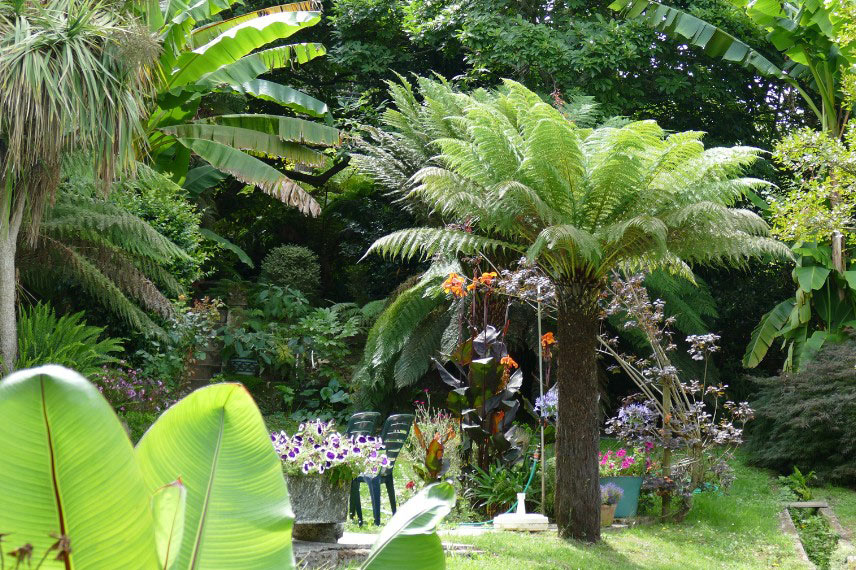
To create a plant oasis, focus on lush foliage, as here with a tree fern (photo: Sanxiaodevea)
What ambience?
An oasis of vegetation aims to recreate a lush, verdant and tranquil micro-environment reminiscent of natural oases found in desert regions. To escape the hustle and bustle of daily life, to reconnect with nature and breathe on hot days, one can enjoy a leafy retreat in a sheltered corner of the garden. Hidden from view, one cultivates maximalist planting and a sense of escapism. This space is designed to offer a striking contrast with the surrounding environment, by offering lush, exuberant plants with generous foliage, a strong exotic look, a few blooms (very few flowers) in vibrant colours and water features. The presence of palms and the broad foliage of ferns contribute to the creation of a dynamic display built largely on shades of green. This type of landscape design is characterised by lush, immersive vegetation as well as the presence of water, in the form of a basin, a stream, a simple trough or a fountain. Creating shaded zones, thanks to giant leaves or climbing plants, is also important to fully enjoy this relaxing space during the hot summer days.

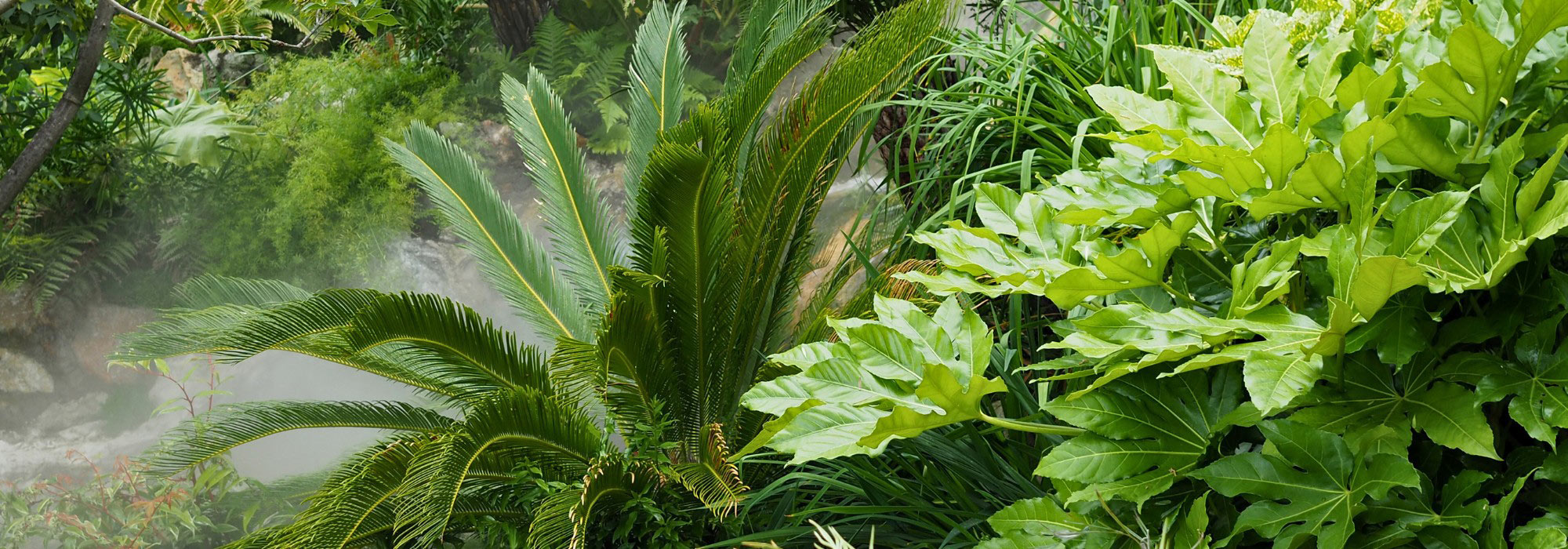
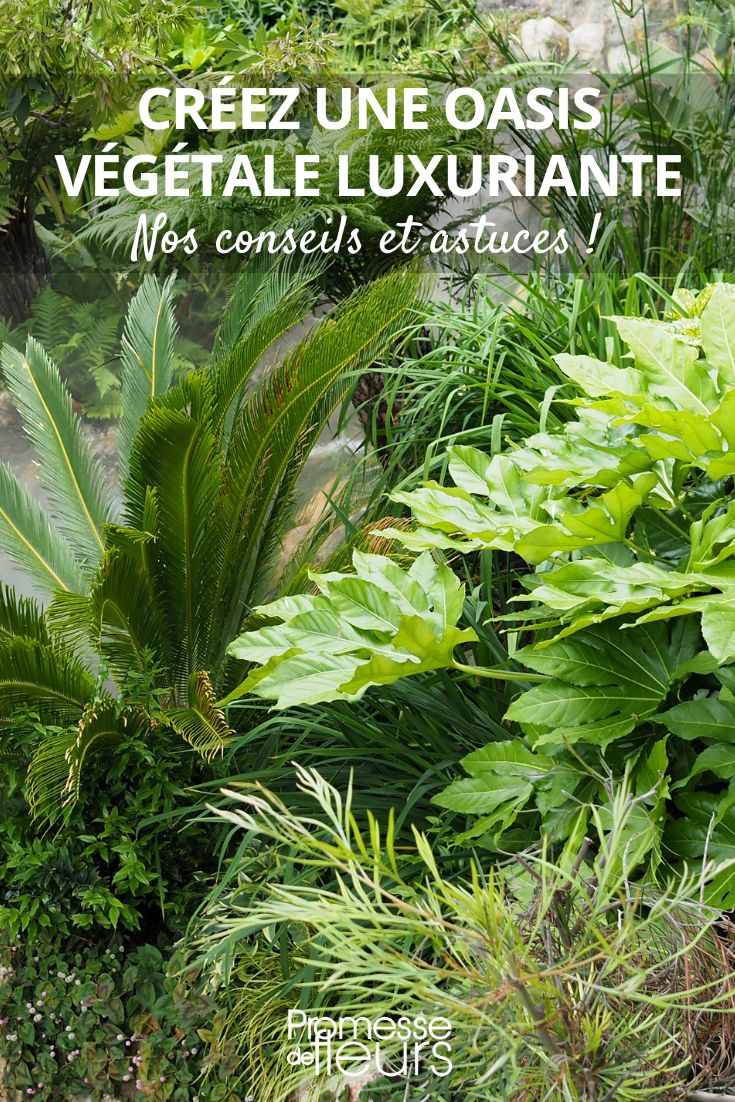
Cycas and Fatsia japonica in the Exotic Garden of Eze
Plant Palette
Climatic conditions in your region will influence the choice of plants for your green oasis. Some exotic bulbous plants, for example, do not tolerate sub-zero temperatures. In regions with mild, temperate climates, it will be easier to grow exotic and Mediterranean plants. In contrast, in colder regions, hardy plants suited to harsh winters should be preferred. Fortunately, a good number of tropical-looking plants are fairly hardy, such as banana plants, for example, and notably the Musa basjoo which tolerates down to -15°C. Although ample sunlight is always preferable, some plants, such as ferns and the bamboos, prefer shade or partial shade. And, if climate conditions are not all in place, convert your oasis into a container garden for overwintering. Many plants can be grown in large pots or containers, which allows them to be brought under cover in winter.
In this verdant corner, perfect for escaping, we come across plants from elsewhere that generally require plenty of cool conditions to thrive. These plants chosen to create a green oasis often need a well-drained, fertile, yet cool substrate. They mostly prefer to grow in partial shade, in sun that is not scorching, in a sheltered position, in a humid atmosphere. In regions with a dry climate, an automatic irrigation system may be necessary to maintain constant humidity. However, it is important to avoid overwatering, which could cause root rot.
Read also
Designing a North-facing gardenXXL foliage
In this oasis of freshness, vegetation is generous, all-pervading, teeming. To recreate this particular ecosystem, we therefore focus on an abundance of green foliage rather than flowers. Luxuriant foliage is the keystone of a verdant oasis. They contribute to recreating an exuberant and transportive micro-landscape. Dense, voluminous foliage provides shade, helping to shield from the sun and heat. To structure this emerald enclosure, one could introduce a few bushes such as an elder shrub, which will provide an airy mass of feathered leaves, or for example, a Fatsia japonica, impressive for the size of its large glossy leaves. We play with the different shapes and textures of the foliage and their volumes to create harmony. The larger the garden, the more you can afford oversized forms, eccentric growth habits. Various types of foliage contribute to the cocoon spirit; we play with soft textures with the large fronds of tree ferns, on the rigidity of the fan-shaped leaves of palms, on the graphic heart-shaped leaves of Colocasias, deeply lobed in Tetrapanax and crinkled in Gunnera, or linear in Ophiopogons.
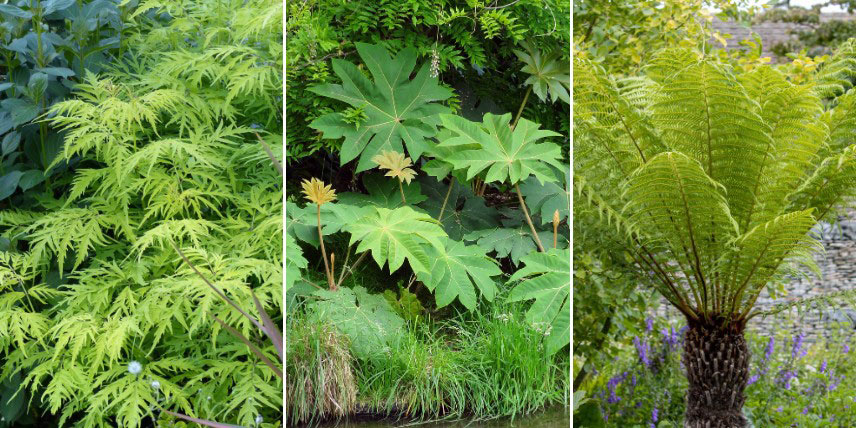
Sambucus ‘Lemony Lace’, Tetrapanax papyrifer ‘Rex’ and Dicksonia antarctica
Which plants for a green oasis?
To recreate this lush, exotic atmosphere, we are primarily looking for dense, ground-covering plants that will delineate the oasis and, at the same time, form the verdant refuge sought. It is important to choose those that suit your garden conditions and that can co-exist in this space. We therefore rely on a mix of perennial plants, bulbous perennials, shrubs and climbing plants to structure it. Here are the flagship plants that can be incorporated into a vegetation oasis:
- Plants with imposing foliage: you can choose Tetrapanax (Tetrapanax papyrifer ‘Rex’), Fatsia japonica, Gunnera manicata, or hardy banana trees (banana trees), notably the Musa basjoo, which fares well against our cold, damp winters, or the Musella lasiocarpa with its incredible yellow flowering. Rodgersias, these perennials with large palmately lobed leaves, a hosta ‘Big Daddy’ with its large blue-green leaves, and colocasias or elephant ears (Colocasia esculenta ‘Illustris’) will also help to structure the space and bring exotica and/or impact to the decor.
- Arborescent plants: Cycas revoluta, tree ferns (Dicksonia, Cyathea) with their palm-like look crowned by a crown of long, finely dissected fronds.
- Palms: include species suited to your climate, such as the Trachycarpus fortunei (Chinese windmill palm) or the palm, and the Chamaerops humilis—both fairly hardy. They can withstand negative temperatures down to around -12°C, and even more in well-drained soil.
- Plants with pointed foliage: Phormium tenax, Ophiopogon, Mangave with unusual shapes, Beschornerias, Arundo donax (Provence reed), and Aspidistra elatior ‘Milky Way’ are perfect for adding verticality and graphic impact.
- Stunning flowers: exotic and colourful blooms are essential to recreate a refreshed island. Play with heights and shapes of inflorescences. Use a few flowering accents, such as cannas, Abutilon megapotamicum ‘Ines’ with pendant yellow and orange-red bells, eucomis with tall summer spikes, and toad lily.
- Aquatic plants and shoreline plants: a pond, a fountain or a simple shallow water tub enhanced with aquatic plants, such as water lilies (Nymphaea), lotus (Nelumbo) and papyrus (Cyperus papyrus), will help create a calming and refreshing ambience in your vegetation oasis.
- Bamboos: a Chimonobambusa tumidissinoda ‘Microphylla’ is an interesting bamboo for its feathery, evergreen foliage, neatly tiered. It’s the ideal bamboo to provide a persistent, light backdrop to a small haven.
- Climbing plants: free-standing climbers of the liana type, or with a particularly trailing habit, climbing walls, pergolas or into trees, will be useful for providing shade in summer and bringing colourful blooms to your vegetation oasis. Opt for exotic climbers, such as the Fuchsia ‘Lady Boothby’, Bougainvillea, Passionflower, Campsis (trumpet vine)… Continental gardeners will cultivate the hardier varieties in a large pot, overwintering them in a cool, bright, frost-free space, kept free from frost.
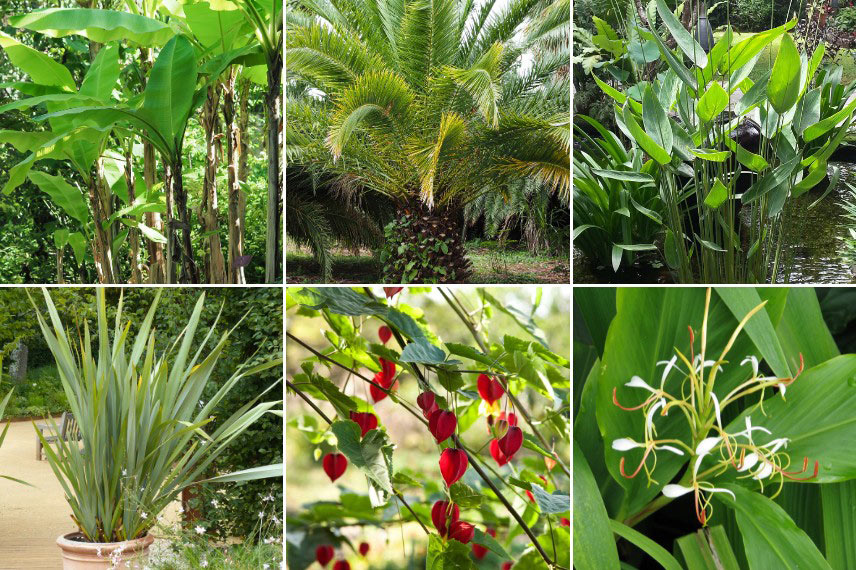
Some examples of plants to create a vegetation oasis: Musa basjoo, Phoenix canariensis, Thalia dealbata (photo: Lip Kee), Phormium tenax, Abutilon megapotamicum and Hedychium spicatum (photo: peganum)
- Subscribe!
- Contents
Comments