





























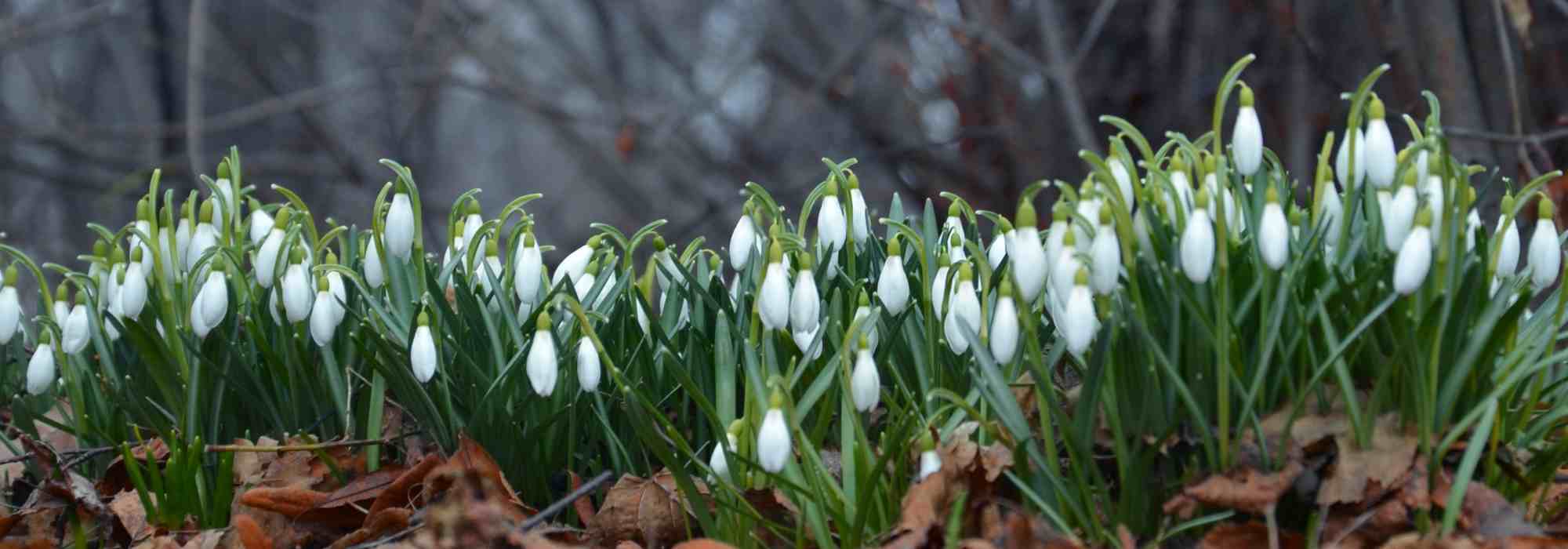
5 early winter flowering bulbs
The earliest bulbs enchant the winter garden
Contents
The first days of winter see the garden gradually colour as long as care has been taken to plant small bulbs in autumn that will brighten the shortest days. Although their flowers are small, snowdrops, crocuses, and other Eranthis are nonetheless heralds of milder days… For these small bulbs to bloom early in winter, it is important that they receive plenty of light and sunshine, are sheltered from cold winds, and are planted early in September or early October. Here are the fastest flowering bulbs in winter, braving snow and cold for our greatest pleasure!

Snowdrop
Who doesn’t recognise snowdrops? This charming little perennial, known as dewdrops in English, takes on the delightful nicknames of milk drop or snow galantine in our region. The Galanthus nivalis, as it is called in Latin, is the very first bulb to bloom in the heart of winter, ahead of all others.
Snowdrops can sometimes appear as early as mid-January, most often from early February until March, once they have endured a few days or weeks of sharp cold. They are adorable bell-shaped flowers, pure white, and the typical species is quite small (15 to 20 cm). Some varieties are a bit larger, both in size and flower dimensions, such as the Galantus nivalis ‘Sam Arnott’, whose inflorescence measures nearly 5 cm at ripeness and grows up to 25 cm tall. The Galantus nivalis ‘Flore Pleno’ boasts lovely double flowers.
Galanthus nivalis prefer soils that remain cool. They should ideally be planted in woodlands, in masses, creating a bright carpet at the base of deciduous bushes or trees, ensuring they receive enough light to thrive.
→ Did you know? In England, the snowdrop is the subject of galanthophilia among collectors passionate about this little bulb, always on the lookout for new varieties. The “snowdrop walks” are popular among Sunday strollers who visit famous gardens in February to witness the enchanting sight of hundreds of snowdrop varieties.
Also, read our complete guide: Snowdrop, Galanthus nivalis: planting and care.
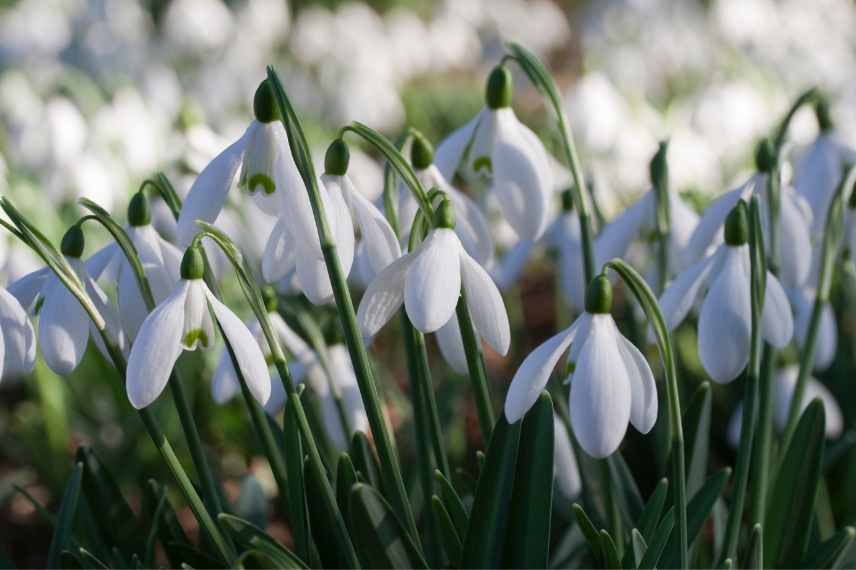
The snowdrop: pure grace, of great delicacy
Read also
7 spring bulbs with white flowersCrocuses
Crocus typically find their place in lawns and at the base of trees, offering a much-anticipated splash of colour. They provide the first touch of colour in early winter, around February. Like other bulbs in this selection, they make a significant impact when planted in masses. Commonly referred to as Spring Crocus, they bloom depending on the region and the mildness of winter, usually in early winter.
Crocus, almost ground-hugging as they do not exceed 10 cm in height, brighten winter with their yellow or mauve hues, sometimes purple. The delicate, elongated corollas emerge from a short lawn with their orange-yellow stigmas, contrasting against the delicate petals (actually tepals), which close when night falls. The foliage is linear. As beautiful when open as when closed, there are over 70 species.
It is not uncommon to see them bloom simultaneously with snowdrops and eranthis.
Among the wide variety of Crocus, the botanical species will be even earlier. The Crocus imperati, a small botanical crocus of Italian origin, is one of the earliest, flowering from December to February. Also notable is the Crocus tommasinianus, native to the Balkans, along with Crocus Chrysanthus and biflorus, which bloom a bit later in February.
Completely hardy, crocus will thrive in any soil, provided it is well-drained and sunny. They look wonderful alongside other dwarf bulbs, scattered irregularly in the ground, or in pots. I have a particular fondness for planting them in small groups at the base of trees!
→ Note: when planted in a lawn, patience is required for mowing, and one must wait for their foliage to yellow.
Also, read our complete guide: Spring Crocus, planting, growing, and care.
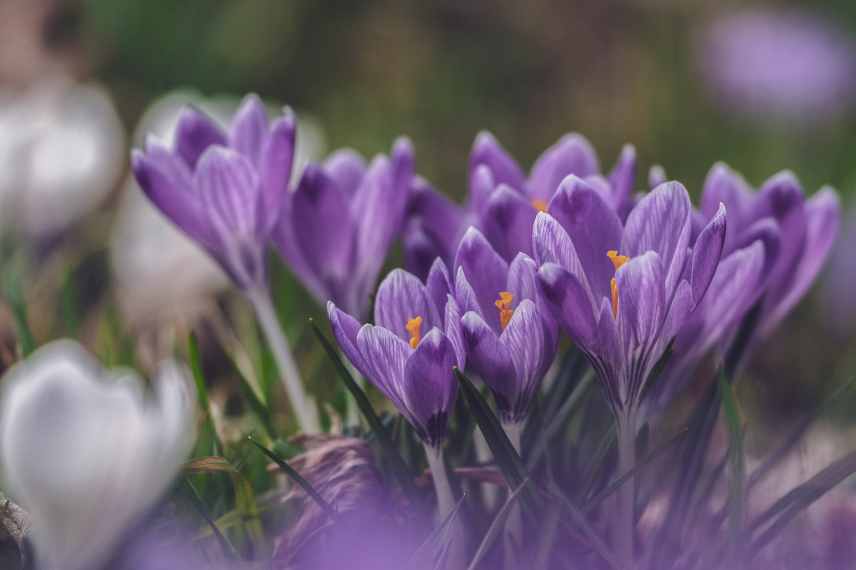
Botanical Crocus, delightful and refreshing in mid-winter
Iphieons
Another charming perennial bulb flowering early in winter is the Ipheion, also known by the lovely name of spring star. However, it often flowers earlier, and in mild climates, it is not uncommon to see it emerge from the ground in January. The most common species, Ipheion uniflorum, with its small bluish-white star-shaped flowers, has given rise to many varieties, ranging from pink to mauve, including pure white. The flowers are small, about 3 cm, on a stem of 10 to 15 cm, with bright green to bluish foliage. Plant it in masses to create colourful patches in borders; they too will disappear underground in summer. A little less hardy than their cousins, the Chionodoxas, they have the advantage of long-lasting flowering, with the flowering period extending over approximately two months. Another quality of this small bulb is that its tiny flowers have a slight honey scent, attracting bees, a boon at this time of year. In rockeries, borders, and also in containers, the Iphéion grows in any well-drained soil.
→ Note: Ipheions need plenty of sunlight to flower well. Consider them under deciduous trees or in a sunny border (at least 6 hours a day).
Also read our complete guide: Ipheion: planting, growing, and pairing.
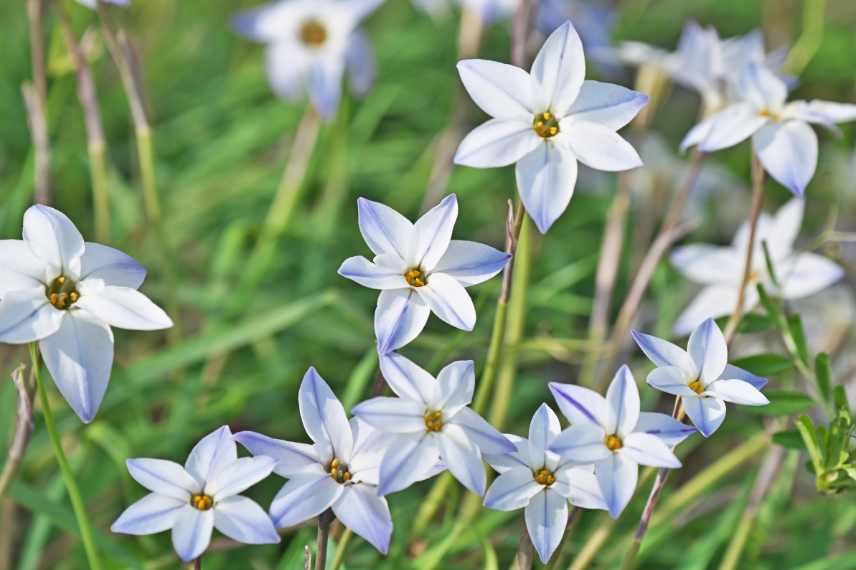
The spring star, a discreet flowering in lavender and white tones
Eranthis
Eranthis or winter aconite is a small tubercle with bright yellow flowers, blooming in the heart of winter. There are different species, including Eranthis hyemalis, the most common in our area. Also known as winter hellebore, it sometimes appears as early as the end of January, and between February and March. Like the snowdrop, the flowers emerge before the leaves. The Eranthis shares other similarities with the snowdrop: it requires soil that remains cool and rich in humus, is small (about 15 cm), naturalises when happy, enters dormancy in late spring, and completely disappears in summer… However, its flower and foliage are quite distinct and recognisable: a solitary star-shaped flower, 2 to 3 cm in size, with a bright, luminous yellow, seemingly resting on lobed foliage that is finely incised (it is also nicknamed winter aconite due to the resemblance of its leaves to those of aconite). Plant Eranthis hyemalis on slopes, in woodland, or in semi-shaded beds alongside other tubers that bloom slightly later (Cyclamen coum, muscari), and with other winter blooms in yellow to orange shades (Hamamelis, Chimonanthus praecox, Cornus mas…).
→ Did you know? : belonging to the same family as buttercups, the entire plant is toxic! Its bulb is among the smallest (2 to 3 mm in diameter).
Also read our complete guide: Eranthis or winter aconite: planting and growing.
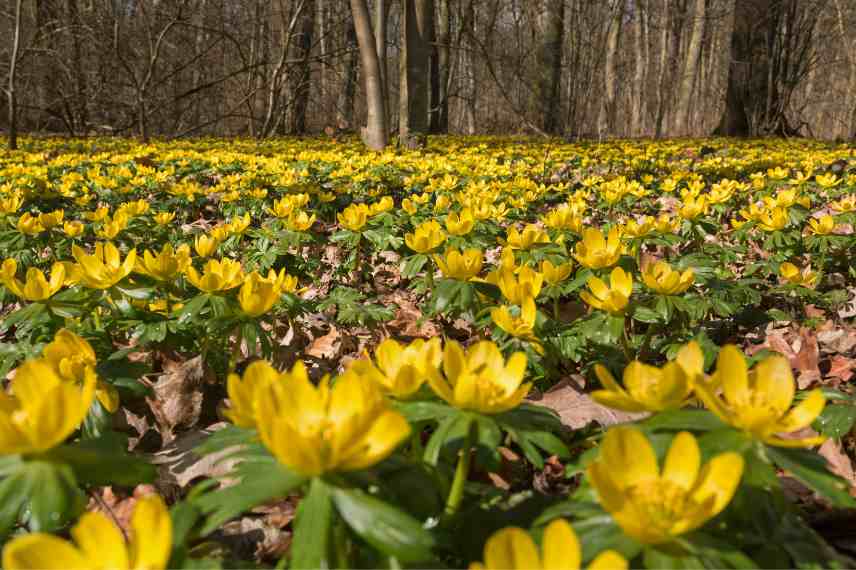 The bright yellow of Eranthis hyemalis, here in woodland
Amaryllis
Finally, and even though these bulbs thrive in the warmth of the home, let’s not forget the Amaryllis! Often given as lovely gifts for Christmas, they are among the largest bulbs available, producing vibrant flowers or pastel shades, even pure white… The Hippeastrum, as they are known in Latin, are indeed stunning and defy trends. The larger the bulb, the more spectacular the flowers!
With single or double blooms, amaryllis offer a wide range of colours: white, pink, salmon, orange, red, or bicoloured, always chic and slightly sophisticated. An Amaryllis bulb can produce up to three flower stems, each bearing 4 to 8 flowers, resulting in a flowering period lasting between 2 and 3 weeks.
They are available for sale as early as autumn; these are forced bulbs that will bloom in mid-winter. They should be planted with the enormous bulb buried only halfway, leaving the other half above ground. The substrate should be sandy and enriched with good nutrient-rich compost. Flowers will appear 6 to 9 weeks later.
Blooming in their native areas of South and Central America, Amaryllis are therefore grown in pots here, and with the right care, can bloom multiple times.
→ Did you know? The Amaryllis belladonna, which originates from South Africa, can be grown in the ground, well protected, mainly along the Mediterranean fringe or the Atlantic coast. It blooms in late summer, in a pink hue.
→ Read also: Planting an amaryllis in a pot for indoors, Amaryllis: how to care for, bloom, and rebloom, Amaryllis: 9 original varieties, and Growing an Amaryllis with children
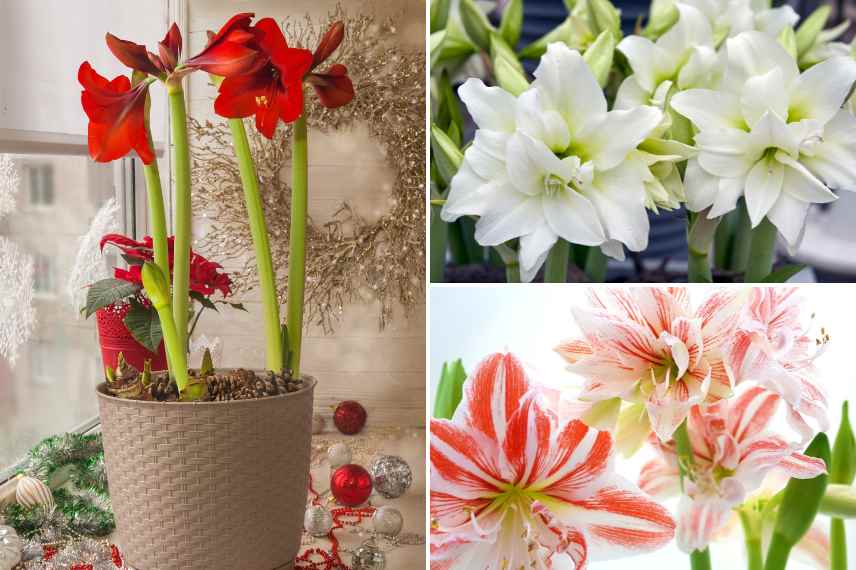
Chic, Amaryllis grace our tables and decorations for the festive season
- Subscribe!
- Contents
Comments