





























Ornamental grasses have, for a few years now, their moment in the sun. And it is well deserved! Natural, airy, these wind-born beauties, look good for at least nine months out of twelve, often presenting a very different appearance as the seasons change. They are now essential in many gardens, and the horticulturists know this well, offering new varieties each year that join an already extensive range. It is therefore tricky to navigate, especially when you are just beginning to take an interest!
So here is a small selection of perennials grasses: 10 safe bets, ideal for taking your first steps into the world of "wild grasses"!
1) Calamagrostis acutiflora Karl Foerster
It is certainly one of the best-known grasses… and justified, it’s a real dependable performer! Very ornamental, this Calamagrostis offers glossy green foliage in spring and turns gold in winter. Tall and slender, it plants tall plume-like spikes, rose-bronze, in late summer. Upright as an I-beam, but not stiff, this grass does not take up much space and truly structures a border. It also has the good habit of swaying with a gentle nonchalance… a gentle nonchalance it can share with the gardener because maintenance is minimalist. In short, a concentrate of everything we love about grasses!
In the garden, it’s planted in a border, with the full range of perennials for naturalistic gardens. Of rapid growth, it is also very suitable for forming attractive screens
- Height - width: 2 m x 50 cm
- Soil: all types
- Exposure: sun, partial shade
- Hardiness: down to -15°C
- Pruning: cut back in March - April
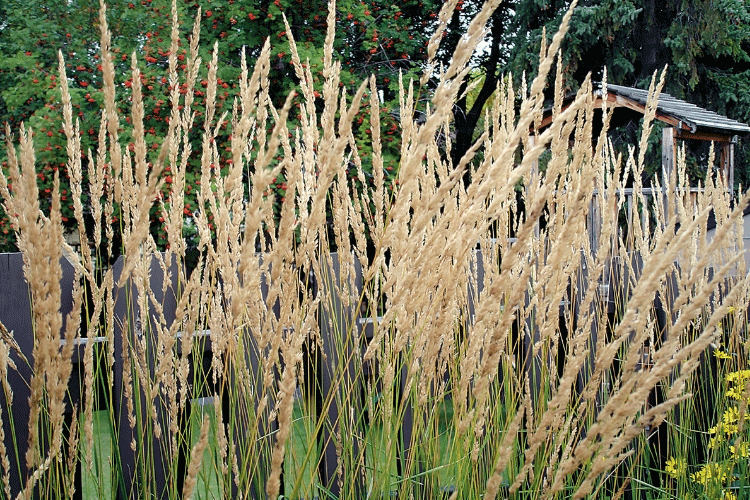
Calamagrostis acutiflora Karl Foerster
2) Carex oshimensis Everest
Bright, this carex captivates with its blue-green foliage, lightly edged with cream white, depending on exposure. Its leaves, slightly arching, give it a supple silhouette. Perfect in a border or in large pots, it grows happily in the dry shade under trees. Evergreen, it would benefit from year-round presence and will be a good companion for spring bulbs, the silvery foliage of Brunnera, for example. Graphical, it can even be planted in mass in modern gardens or in contemporary planters.
- Height - width: 30 cm x 35 cm
- Soil: cool to moist, but tolerates occasional drought
- Exposure: all, with a preference for partial shade
- Hardiness: down to -15°C
- Pruning: unnecessary, prune if needed
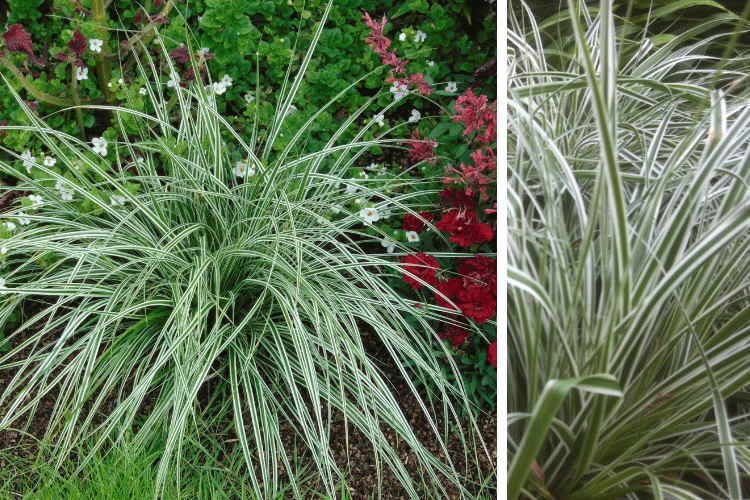
Carex oshimensis Everest® - Oshima Sedge
PS: Some readers of this blog are particularly attentive, so I should point out that the carex, botanically, is not a grass, but a Cyperaceae (not to be confused with the Cupressaceae, by the way!). Nevertheless, its fine foliage makes it common to include it in the grasses category.
3) Deschampsia caespitosa Goldschleier
This pretty variety will delight all those who love lightness and a natural look. Spectacular, this tufted grass forms a compact clump of green, very fine leaves. Evergreen, they remain present throughout the year. In late summer, they bear elegant, loose panicles, golden-yellow subtly silvered.
It is a bright grass that is very easy to use and whose appearance evokes the vast plains of wild meadows. Its translucence is very appealing in a border, and its golden then silver hue, at the end of flowering, contrasts particularly well behind dark plants.
- Height - width: 1 m x 80 cm
- Soil: rather moist, even heavy
- Exposure: sun, light shade
- Hardiness: down to -15°C
- Pruning: cut back only the dry flowering stems in March - April… and do nothing if you wish to allow spontaneous self-seeding
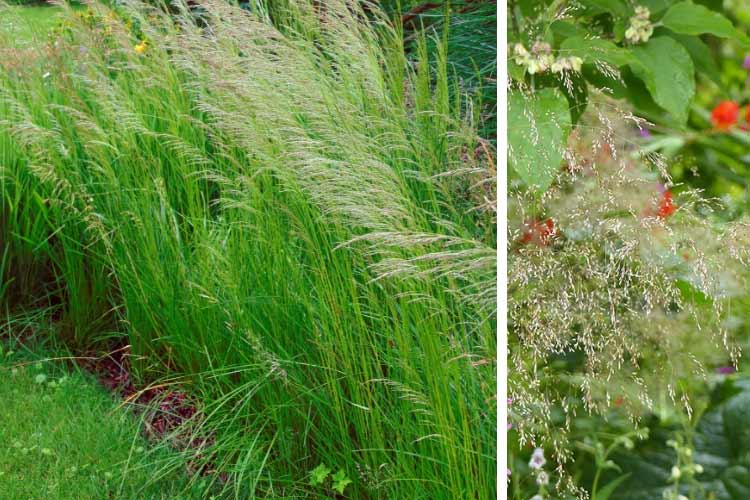
Deschampsia caespitosa Goldschleier
4) Blue Fescue Elijah Blue
This variety is an improved version of the classic blue fescue (Festuca glauca). Its tint, surprising to the uninitiated, takes on superb steel-blue highlights that further enhance its appeal. It flowers in early summer and then bears, on slender stems, fine silvery panicles.
Undemanding, it is a low-growing grass that forms fairly dense hemispherical tufts. It is perfect for difficult spots as it tolerates dry and poor soils. It is also the most durable variety!
Delightful in a border, this fescue can also be used to create “drifts” of blue grass. Its colour, unusual, is easier to pair than it seems. It enhances both greens and pinks and purples… In the garden or in a pot, do not hesitate to mix it with heathers or with Heucheras too!
- Height - width: 25 cm x 25 cm
- Soil: dry, poor
- Exposure: sun, light shade
- Hardiness: down to -15°C
- Pruning: cut back the flowering stems and, if needed, shorten the fine foliage in late February
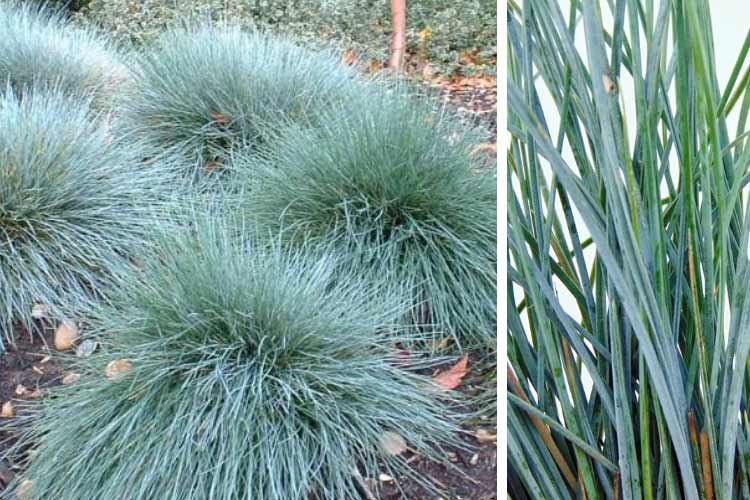
Blue Fescue Elijah Blue - Festuca glauca
5) Hakonechloa macra All Gold
Hakonechloa macra All Gold is a very decorative Japanese grass that stands out for the graphic quality and brightness of its foliage. It forms a large cushion of arching leaves, giving it a cascading look. It is a shade- and partial-shade-loving plant that thickens slowly and can live for many years in moist soil. In the garden, save it for woodland-style settings where it will pair wonderfully with Japanese maple trees, hostas, ferns…
- Height - width: 40 cm x 50 cm
- Soil: humus-rich, cool to moist
- Exposure: shade, partial shade
- Hardiness: down to -15°C
- Pruning: unnecessary… it is a nearly self-cleaning grass; the old foliage detaches very easily as the next shoots arrive in spring.
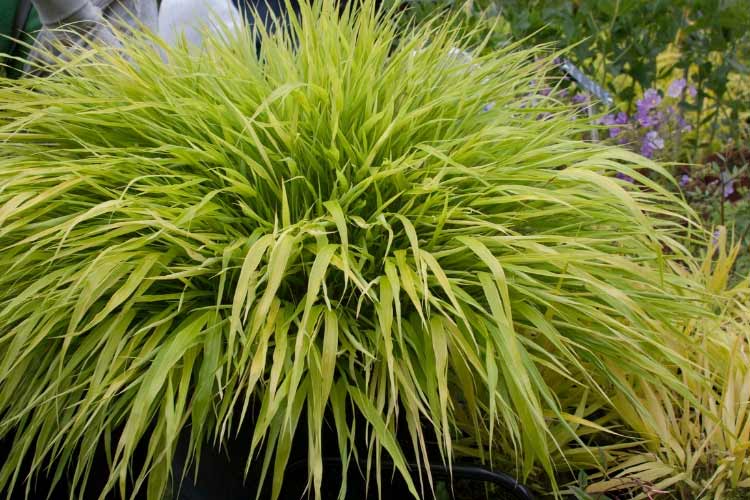
Japanese Forest Grass - Hakonechloa macra All Gold
6) Molinia arundinacea Transparent
Do you know many plants that stand out for their transparency? Here is one! Mist-like, this tall evergreen grass with arching leaves shines with the delicacy of its golden flowering and the slender stems that bear them. Preferring clayey and moist soils, this Molinia grows quickly. Architectural, graphical, it pairs with almost anything and will also benefit from the rays of a setting sun. Despite its height, the panicles form a very light cloud; you can plant it at the border of a border and pair it with plants in bright colours (Dahlia, Rudbeckia, Helianthus…) to temper the colours and bring a more natural touch.
- Height - width: 1.80 m x 60 cm
- Soil: humus-rich, cool to moist
- Exposure: shade, partial shade
- Hardiness: down to -15°C
- Pruning: cut back only the dry flowering stems in March - April
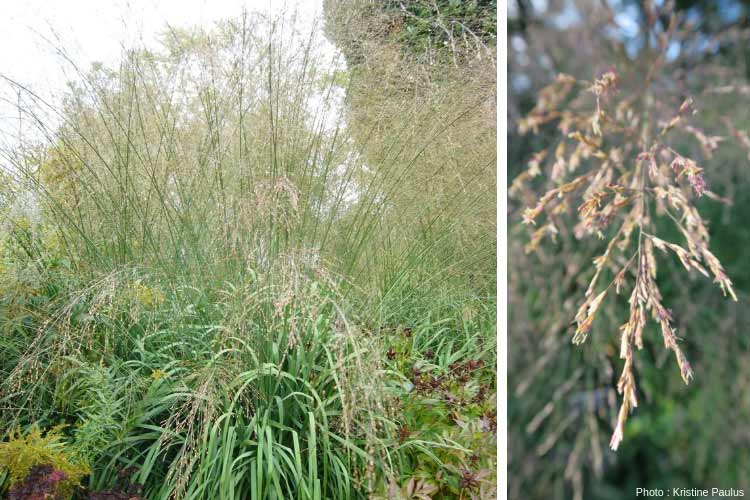
Molinia caerulea ssp arundinacea Transparent
7) Miscanthus sinensis Gracillimus
True "best-seller", highly regarded in contemporary gardens, this Miscanthus or Eulalia is also the oldest. Suffice to say, it has stood the test of time! It forms a handsome clump of very fine leaves, edged by a white central vein. Its flowering, quite late, occurs at the end of September. Then pretty plume-like inflorescences appear, coppery while the foliage turns gold.
This Miscanthus is also very versatile. It can be planted as a specimen, in a border with autumn-flowering perennials and even as a hedge. Also know that it is a plant that can be useful: its leaves, chopped, make an excellent mulch.
- Height - width: 1.80 m x 60 cm
- Soil: rich, cool, but well-drained
- Exposure: sun
- Hardiness: down to -15°C
- Pruning: cut back in March - April
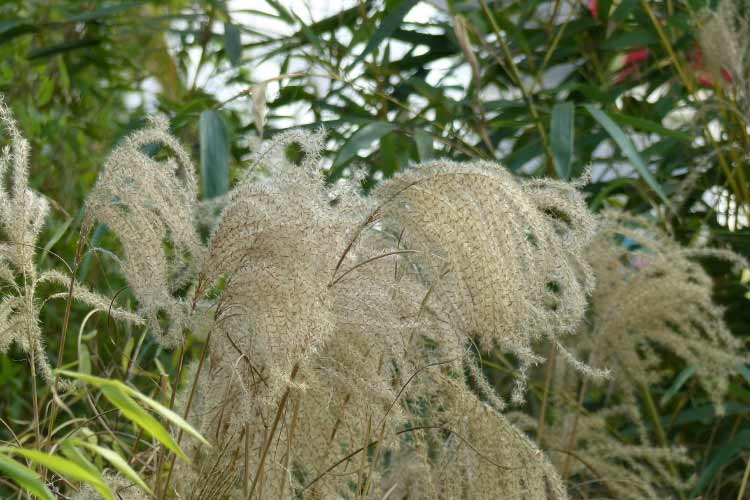
Miscanthus sinensis Gracillimus - Eulalia
8) Panicum virgatum Rehbraun
This Panicum virgatum (often called the “Switch Grass”) is an excellent variety. It stands upright and its foliage and flowers take on vibrant red and orange hues in late summer. Truly spectacular, this North American native grass also shows great tolerance. It withstands both drought and wet conditions… and boasts remarkable hardiness. In the garden, pair it with other grasses or plant it with shrubs showing autumn colours (Berberis, Euonymus fortunei 'Red Cascade'…), it will be perfect to complete the scene.
- Height - width: 1.20 m x 50 cm
- Soil: tolerant
- Exposure: sun
- Hardiness: down to -15°C
- Pruning: cut back in March - April
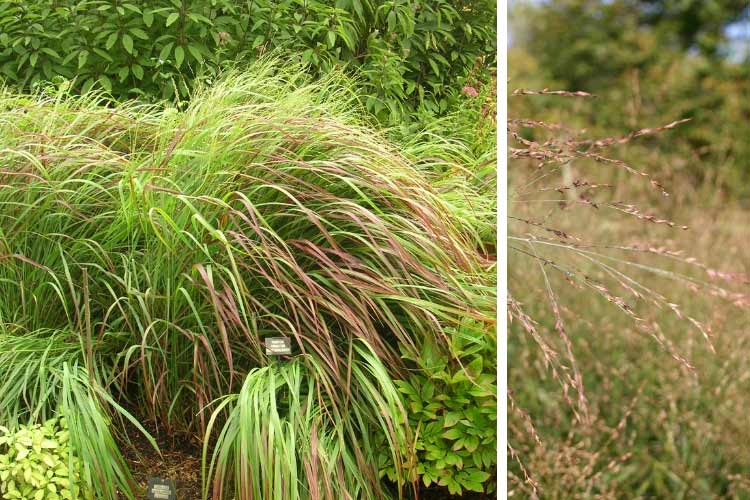
Switch Grass Panicum virgatum Rehbraun
9) Pennisetum alopecuroides Hameln
This fountain grass variety is a must-have! Medium-sized (about 50 cm tall), it forms a compact tuft of narrow leaves. It shows, in late summer and autumn, a flowering of gentle cream-white spikes turning brown at maturity. Its ornamental interest lasts into winter, especially when frost dresses its pretty seed-heads. Versatile and easy to grow, Pennisetum 'Hameln' can be used over large areas, as a ground-cover, or at the border. In a border, it is striking with perennials a little wild such as Echinacea, Gaura, or Verbena bonariensis. And like all autumn-flowering grasses, it is perfect with Asters.
- Height - width: 50 cm x 50 cm
- Soil: tolerant provided it is well-drained
- Exposure: sun
- Hardiness: down to -15°C
- Pruning: cut back in March - April
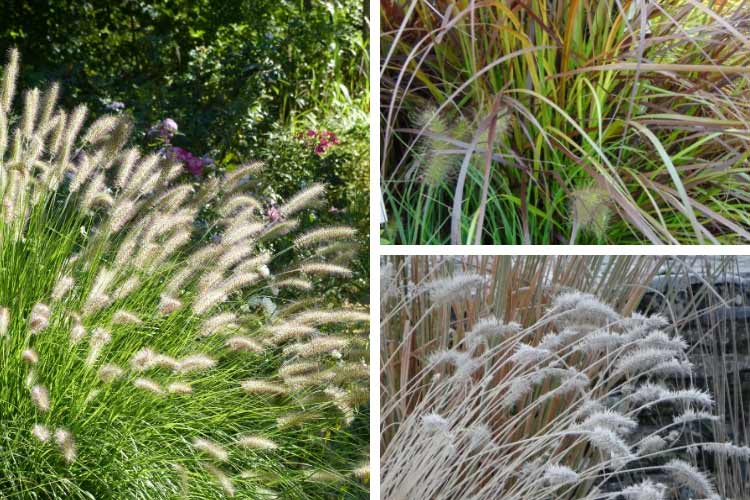
Pennisetum alopecuroides Hameln
10) Stipa gigantea
In the Stipa family, we know well the “angel hair” (Stipa tenuifolia), but much less its very tall sister: Stipa gigantea. Spectacular, this giant oat shines with its height (about 200 cm) and the lightness of its flowering. It forms a dense tuft of very fine blue-green leaves topped in summer by delicate purple-silver awns that turn gold. Native to the Mediterranean basin, this grass grows well almost anywhere and fears only two things: waterlogged soils in winter and climates too harsh. In the garden, it is ideal for introducing verticality and pairs very well with summer perennials such as Echinops, Gaura, or Verbena bonariensis, and with shrubs that colour beautifully in autumn (Berberis, Euonymus fortunei 'Red Cascade'…), it will be perfect to complete the scene.
- Height - width: 2 m x 1 m
- Soil: tolerant provided it is well-drained
- Exposure: sun
- Hardiness: down to -10°C
- Pruning: cut back only the dry flowering stems in March - April
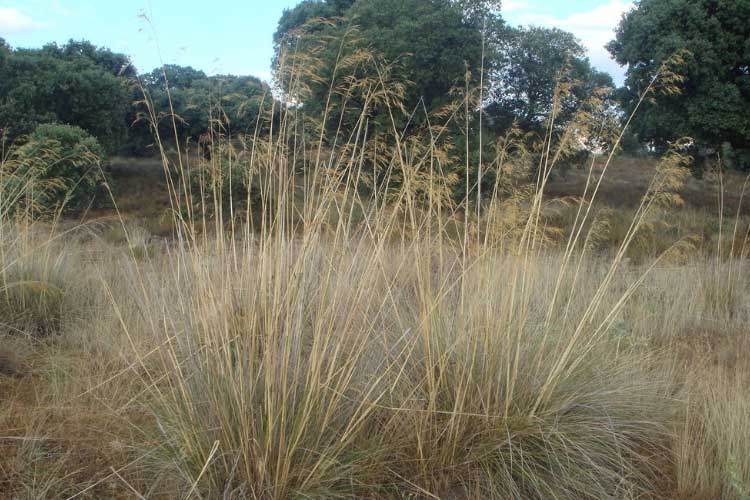
Stipa gigantea - Giant Stipa
→ Watch Stipa gigantea in our video 'Grasses for Summer'
If this shortlist has made you want to learn more about grasses, don’t hesitate to explore the different guides and tips we have dedicated to them on Promesse de fleurs, in the garden!

Comments