





























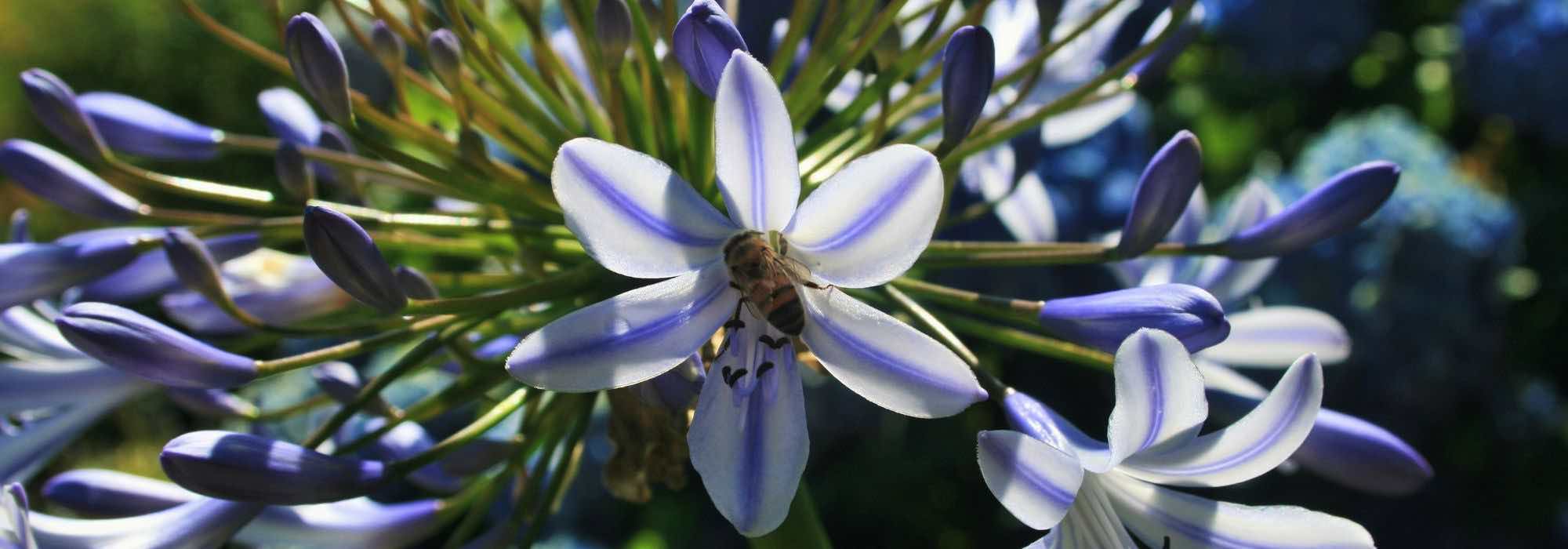
What is the best place for Agapanthus?
Perfect soil types and sun exposure for beautiful agapanthus
Contents
The agapanthus is a hardy perennial native to South Africa, widely prized for its tall flowering spikes topped with umbels of flowers in shades of blue, white or purple. This perennial, hardy to varying degrees depending on the species and varieties, has adapted to a wide range of growing conditions. However, it does require some precise conditions to perform at its best, conditions that mainly relate to its placement and the soil it is grown in.
Discover what agapanthus need to thrive, especially in terms of light, soil type and protection from the elements, to ensure healthy growth and abundant flowering season after season!

The Different Types of Agapanthus
- The first difference among agapanthus concerns colour: they come in white, in blue that is more or less mauve or darker, and in purple. Some are bicolour, with a touch of blue or violet in the white flowers and even pink.
- From an ornamental point of view, there are variegated agapanthus with green foliage edged in white or cream-yellow.
- There are tall agapanthuses such as ‘Blue Giant’ which can reach 1.50 m in height, or dwarfs such as ‘White Baby’ which peaks at 40 cm in height, and all intermediate sizes. They are therefore useful for the back of borders or the middle of planting beds, as well as for edging.
- An important difference to keep in mind concerns hardiness, an important factor of success depending on the region where you intend to plant them. The deciduous-leaved species are hardier than those with evergreen foliage. The former develop foliage that is much finer and narrower than the evergreen varieties, in a fairly light green, apple green. The hardiness of agapanthuses ranges from -5°C to -15°C depending on the species and varieties.
→ On the subject of hardiness, read Sophie’s advice sheet, Which agapanthus to plant according to your region? and Michael’s blog post, Hardy agapanthus for the north?
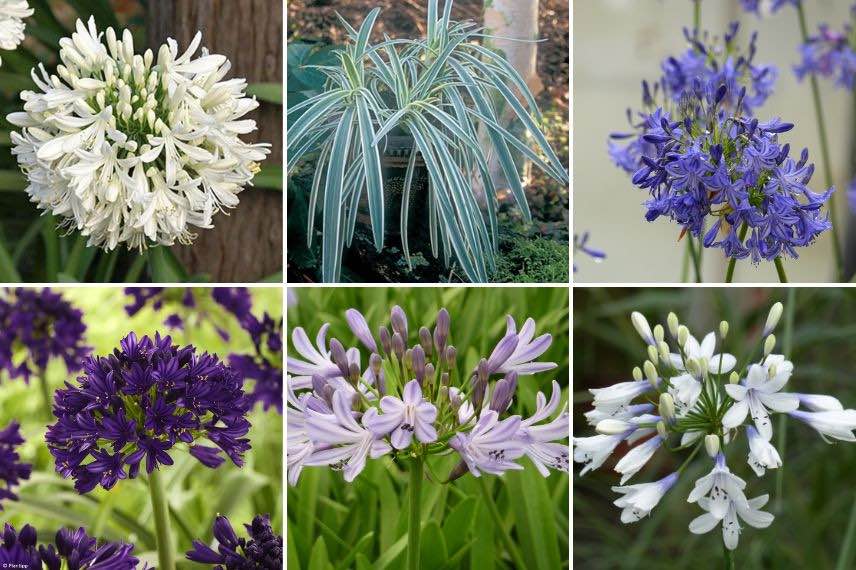
Clockwise from the top: Agapanthus umbellatus, ‘Tinkerbell’, ‘Northern Star’, ‘Twister’, ‘Megan Mauve’ and ‘Black Jack’
Read also
Agapanthus: the 7 hardiest varietiesWhat light exposure does an Agapanthus need?
Choosing the right spot for your agapanthus is key to successful cultivation. They dislike being moved once established.
Agapanthus, native to southern Africa, crave warmth and maximum direct sun. A south-facing exposure guarantees the best possible light all day long. In the north, the presence of a well-oriented wall behind agapanthus receiving southern light helps accumulate heat and radiate it back, and protects the plants from cold northerly winds. In our southernmost regions, a south-westerly exposure may be sufficient.
It is also essential to consider the shade cast by buildings, trees or other structures. It is therefore advisable to monitor shade patterns throughout the day to choose a spot that remains largely open and well-lit.
Avoid a site exposed to winds that are too strong, which can damage the flower umbels.
However, note that agapanthus thrive readily by the sea, as they tolerate salt spray and wind if not too strong.
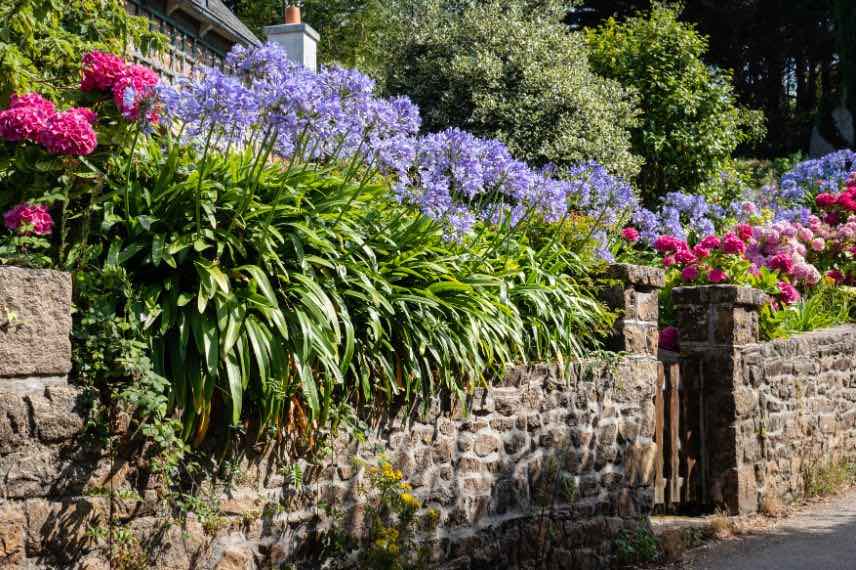
Agapanthus require plenty of sun and warmth
What soil should you plant your agapanthus in?
The soil type is the second key factor in successful cultivation of your agapanthus. They dislike stagnant moisture, and even more so when it combines with winter cold. One word: drainage, to give yourself the best possible chance.
Agapanthus grow in fertile, well-drained, light soil. If necessary, add amendments to achieve this result to the maximum, by using drainage materials such as sand, the pozzolana, and to increase fertility, add compost and manure, and even potting compost if the soil is poor.
Improving drainage also helps them better withstand winter, resist rain and cold. A dry winter improves summer flowering. Plan for thick mulch in autumn to also contribute to this better resistance to winter conditions, whatever hardiness rating your agapanthus has.
For all these reasons, planting on a raised bed, bank or slope—i.e., an elevated site—is ideal, as it helps prevent water from stagnating. But with good drainage, planting on flat ground is quite possible.
Michael advises, in his post cited in the first paragraph, that in northern regions where damp and cold are feared, plant in pure sand in the planting hole. Pure sand also helps avoid mixing sand with heavy clay soils, as sand makes clay soils even more compact.
Read also
5 Agapanthus to grow in potsWhat depth and width are recommended for planting agapanthus?
Dig a planting hole roughly three times the size of the root ball for planting agapanthus. In the case of planting into pure sand in northern regions, you can even increase this volume to four or five times the volume of the root ball.
Place the young plants at about fifty centimetres apart, which corresponds to three to five plants per square metre, depending on their size at maturity.
For bare-root plants, bury the roots to a depth of five to ten centimetres. For a root ball, ensure it is level with the soil.
In the ground or in a pot?
Agapanthus grown in the ground do not enjoy being moved; however, they grow very well in pots, especially because they like to be a little snug.
Pot cultivation also allows overwintering varieties sensitive to cold where necessary.
Pot cultivation also allows you to assemble a planting substrate to perfection when you do not have the right soil for in-ground planting. This, however, requires more frequent watering.
Finally, you can benefit from a terrace that’s sunnier than your garden, in which case pot planting is also recommended.
However, if you have all the right conditions in the ground, always favour that option: it will give you the best results, with less maintenance and a longer lifespan.
→ Read Marion’s advice sheet for everything you need to know about planting agapanthus in pots.
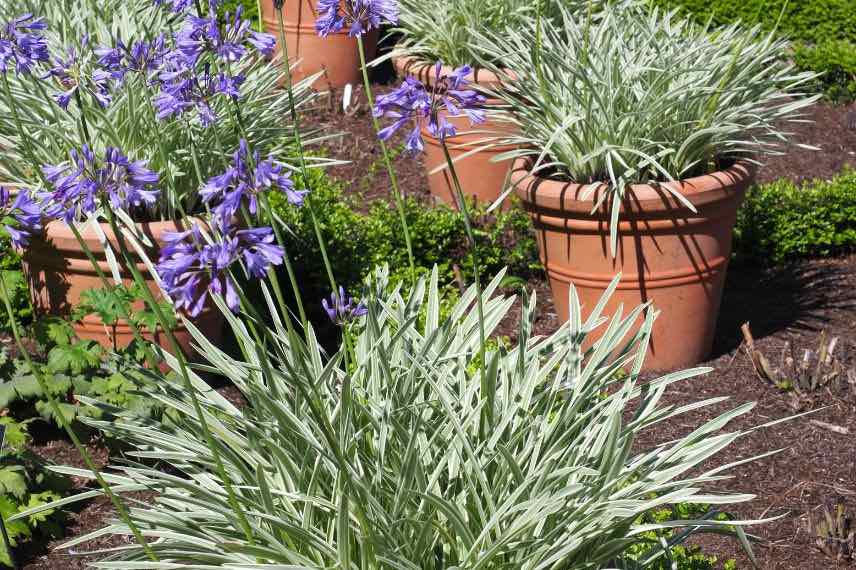
Agapanthus grow very well in pots
- Subscribe!
- Contents
Comments