





























Our secrets to keep gladioli in bloom all summer long
A few tips to encourage flowering in these beautiful colour-flowering plants.
Contents
Gladioli reward us with a splendid summer flowering, in a range of colours and shapes. They generally add as much brightness as verticality to the garden, on terraces or balconies. But they are also perfect cut flowers for bright summer cut flower arrangements.
These plants are easy to grow, but a few maintenance steps will allow you to enjoy their flowers for even longer during the summer. So here are our tips for an extended flowering of your gladioli.
And to learn more about the cultivation of these bulbous plants, discover our guide: Gladioli: Plant, Grow and Maintain

Plant gladioli properly to ensure future flowering.
The planting period can influence the proper development of your gladioli and, therefore, their flowering. Choose to plant once there is no longer any risk of frost in your region, that is, between March and early June, depending on the climate. Flowering occurs two to three months later. It is quite possible to force gladioli to hasten flowering, so you can enjoy them earlier in regions that experience late frosts. To do this, start growing indoors and gradually acclimatise them as soon as outside temperatures are high enough.
Always plant gladioli in groups, to achieve a striking mass effect. To enjoy longer flowering throughout the summer, we recommend staggered planting: plant your specimens about two weeks apart, so there are always gladioli taking over from older ones. Allow at least 15 cm between each plant.
For large gladioli hybrids, install discreet staking at planting time to support the flowering spikes and prevent them from being damaged too quickly.
In winter, if you live in a frost-prone region (below -5°C or a little more depending on the varieties), think about lifting the corms to keep them sheltered. You can also opt for growing in pots, which will protect them from frost during the winter.
Read also
7 pink flowered gladioliProvide them with sun and warmth.
Most gladiolus species originate from South Africa. Some wild species are, for their part, naturalised in some Mediterranean regions. This explains why these bulbous plants favour heat and sun.
Grow therefore your gladioli in a bright, well-lit position, especially in the cooler regions. In the ground, in the garden, or in a pot, choose a south-facing position. A slightly shadier exposure during midday will be possible in the warmest regions of our territory.
Also choose a location sheltered from prevailing winds, which could cause the flower spikes to bend.
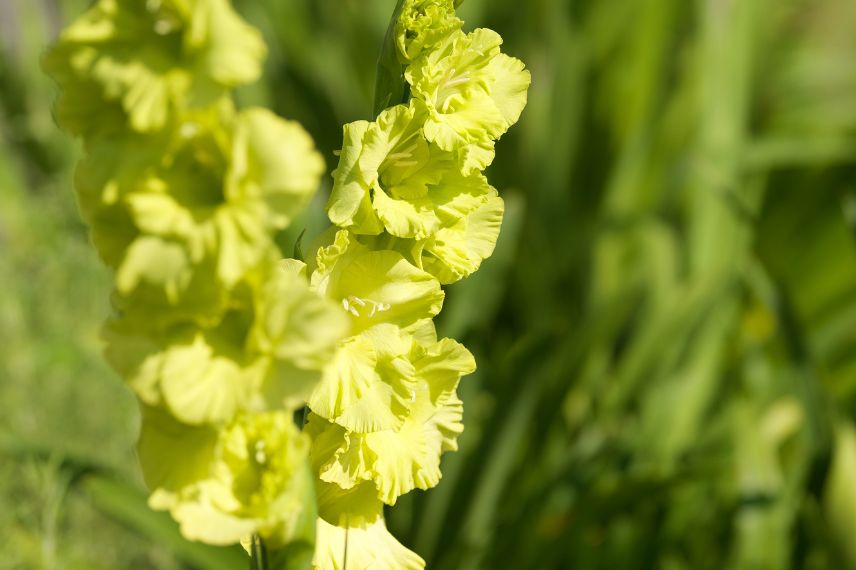
Sun and heat are appreciated by this plant native to South Africa
Grow gladioli in a fairly rich substrate.
Gladioli are fairly hungry plants, which prefer fertile soils, i.e., rich in organic matter. This helps them to be more floriferous and to keep their flowers longer in summer.
When planting, don’t hesitate to incorporate a handful of well-rotted compost or, if unavailable, a fertiliser for flowering plants or for bulbs. However, avoid applying horse manure, reputed to promote rotting of the corms.
From mid-spring to early summer, fertilise your gladioli. You can use a solid fertiliser (granules, a stick), which is worked into the soil by gently raking, and will have a long-lasting effect. For a quick effect, but shorter-lasting, opt for a liquid fertiliser to be diluted in the water used for watering every 15 days. In all cases, choose fertilisers rich in potash to stimulate flower production. Conversely, avoid fertilisers too rich in nitrogen, which will encourage leaf growth.
Note that gladioli do not like heavy, clay soils, which retain excess moisture. This, in fact, promotes the rotting of their corms. So make sure the substrate is light enough and well-drained, even sandy or stony, by mixing it, for example, with gravel, river sand or clay balls.
Read also
7 white flowered gladioliKeep the soil consistently moist.
Most gladioli prefer cool soils, i.e., those that never fully dry out. As soon as you feel the surface of the growing medium is dry to the touch, it’s time to water. Plan regular watering from the appearance of the first leaves and throughout the flowering period. Always avoid wetting the foliage during watering, to limit the risk of cryptogamic diseases to which these plants are susceptible.
You can install an organic mulch at the base of your gladioli, which reduces water evaporation and helps keep the soil cool and moist for longer.
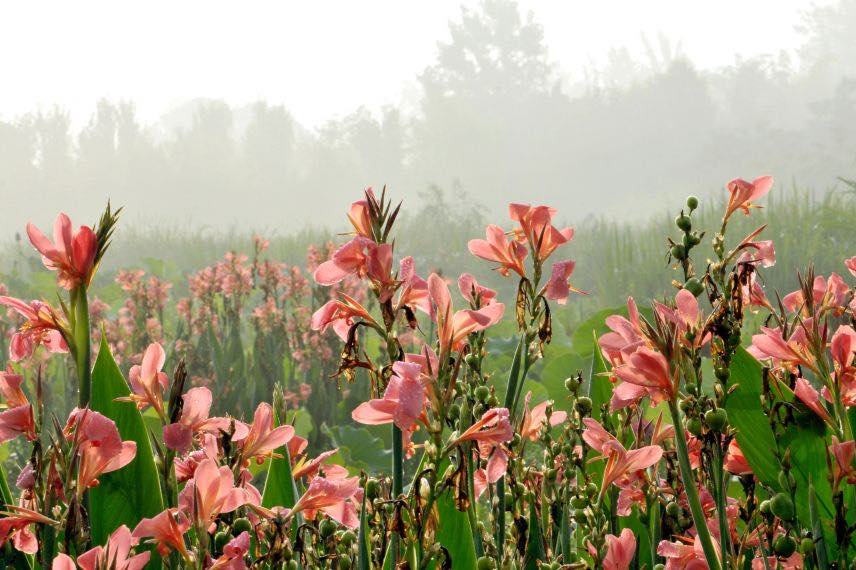
Gladioli prefer cool soil; feel free to mulch
Prune faded flowers
Regularly remove faded flowers with a pruning shear, to encourage production of new flower buds.
If you cut flowers to make cut flower arrangements, be sure to leave foliage in place until it withers, so that corms can build up reserves and rebloom well next year.
Prioritise certain varieties
To ensure a long flowering of gladioli over several weeks, you can pair the earliest-flowering varieties with the latest-flowering varieties.
On the side of those that flower from the early summer, for example the elegant little Gladiolus nanus ‘Prins Claus’, the delicate Gladiolus colvillei ‘The Bride’ and the sweet Gladiolus tubergenii ‘Charming Lady’, all capable of flowering from June. The harvest gladiolus Gladiolus italicus is a less conspicuous wild species, but able to flower from mid-spring to mid-summer, just like the Byzantine gladiolus.
Among the later bloomers, which can flower until October, choose between the Abyssinian gladiolus Gladiolus callianthus, the Gladiolus grandiflorus ‘Traderhorn’ with bright red flowers and the Gladiolus callianthus ‘Lucky Star’.
For their part, the Gladiolus papilio ‘Ruby’ and the Gladiolus primulinus ‘Fiona’ are renowned for their long flowering, which can last several months from July to September–October.
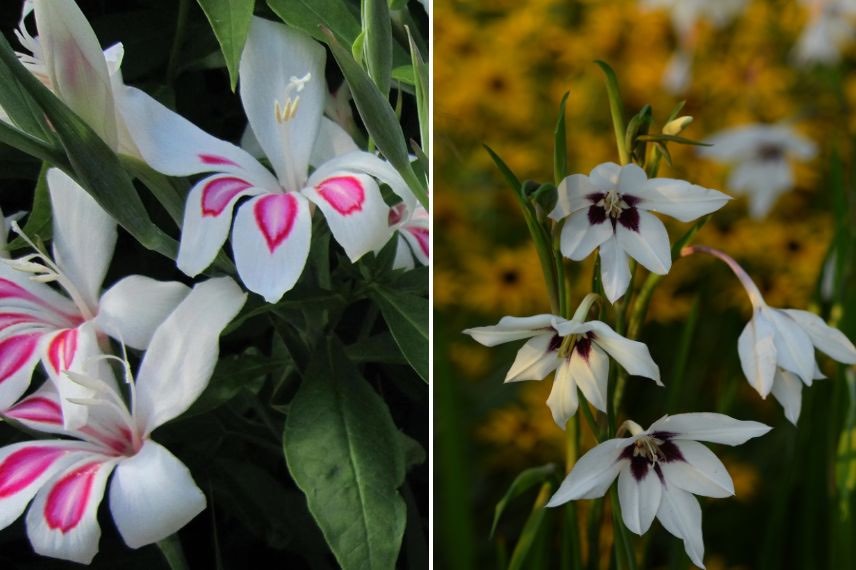
Gladiolus nanus ‘Prins Claus’ on the left, early-flowering, and the late Gladiolus callianthus on the right
- Subscribe!
- Contents
Comments