





























Designing a trendy low maintenance garden
The art of creating a low-maintenance wild garden
Contents
The garden no longer wants to be seen as a burden for many gardeners who have witnessed their parents toiling away and dedicating entire weekends to it. The recent emergence of a less demanding garden, or laissez-faire approcach garden, is a new way to embrace gardening, allowing it to connect with nature while giving it a more wild appearance.
To create a beautiful garden that allows for a bit more time in our hectic lives, it is essential to let nature reclaim (some of) its rights and to create lush spaces by choosing easy-to-care-for plants and adopting suitable gardening habits.
So how can we create zones of freedom within the garden? What strategies can be implemented to make gardening less time-consuming? What are the keys to achieving a wild yet beautiful garden?
Design a let-it-be garden in search of authenticity and follow our tips to successfully tackle this new challenge. You will discover that letting go is more than beneficial.
→ Discover the “laissez-faire” trend on pages 4 and 5 of our Spring-Summer 2023 catalogue and find out How to rewild your garden?

What is a "laisser-faire" garden?
The revival of the garden is currently reflected in a ‘laissez faire’ garden. To describe it, one could say that it sits halfway between the naturalistic garden of Piet Oudolf, which combines generous perennial plants and grasses, the punk garden of Eric Lenoir, which he himself describes as a lazy person’s garden, where intervention is kept to a minimum, and the moving garden of French gardener Gilles Clément, this garden free as air, in full communion with nature. These three well-known landscapers and gardeners ultimately advocate another perspective on the garden, long subjected to strict rules: nature is reconsidered, reintegrated, as the perfect setting that highlights our own Eden. Thus, we move away from the concept of a controlled garden, abolishing the rigour of precise pruning, freeing ourselves from ancestral codes… without ending up with a chaotic and completely uncontrollable space. This new trend is strongly rooted in ecological awareness, where the gardener works with nature rather than against it.
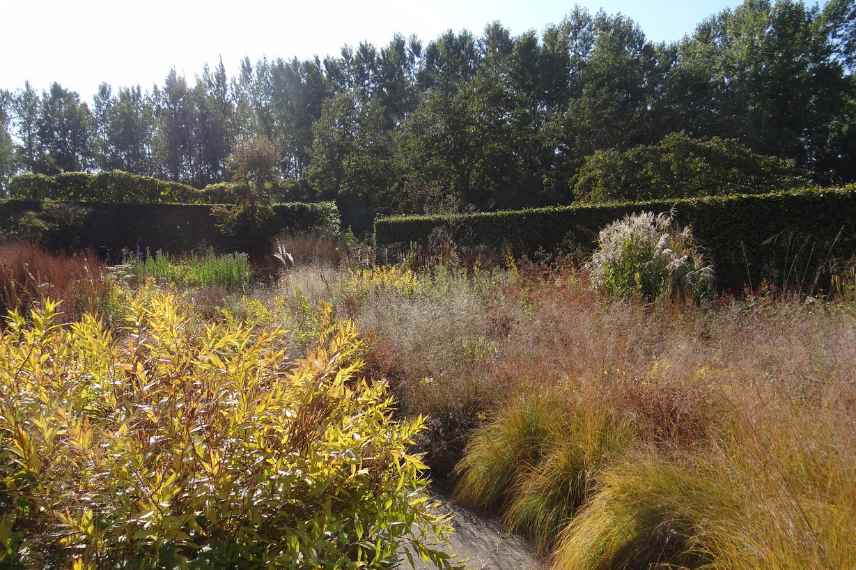
Hummelo garden designed by Piet Oudolf (© Ester Westerveld)
Keep it slow on pruning and mowing
The laissez-faire garden aims to be more accommodating, requiring less maintenance. This is especially true for grassy areas and various pruning tasks.
The natural ambiance of certain gardens actually relies on several factors, one of the primary ones being its structure provided by the upper strata, namely trees and bushes. To establish an informal character in the garden, the choice of species with a naturally free or flexible habit significantly reduces maintenance since seasonal pruning becomes optional. Many bushes can go without pruning, while trees generally only need to be left to grow peacefully.
Also, favour bushes that do not require pruning: these are mainly slow-growing ones like conifers and evergreen shrubs, including acid-loving shrubs, known as heather soil shrubs, or easy-to-grow shrubs like Amelanchier or Cotoneaster!
Finally, hedges should be designed and planted with a rather countryside spirit, or even in a bocage style.
The second crucial point in a large garden where less intervention is desired… is mowing. This task becomes even more tedious in large spaces. To limit the maintenance of a lawn, the most effective approach is ultimately to reduce the grassed areas in favour of large flowerbeds mixing bushes, perennials, and grasses, or large zones left in a sort of fallow: this is known as differentiated management in the garden.
Mowing management contributes, when certain parts of the garden are left grassy, more or less in a tamed fallow state, to reinforce this laissez-faire garden.
→ Also read about arched habit bushes, How and why to create a countryside hedgerow?, second home garden, alternatives to grass: 10 groundcovers to replace the lawn,
Fortune favours the bold
With perennials that self-seed, the laissez-faire garden makes our task easier and is adorned with flowers of a rustic charm, perfectly in line with the desired atmosphere. The spaces gradually fill with these relatively short-lived plants that have found the magical trick to extend their presence in the garden.
Many of these plants from spontaneous sowing have an airy, very light habit and bring a sense of freedom to the large beds that will flourish, such as vervains (Verbena hastata, Buenos Aires vervain), Knautia macedonica, linarias, Anthemis, or stonecrops, to name just a few that are quite useful, adapting wonderfully to climate change.
Note: these “arbitrary” sowings thrive well in soils that suit them (columbines in cool soil, anthemis in dry soil, for example).
Also count on bulbs that naturalise such as wood daffodils (Narcissus pseudonarcissus), Spanish bluebells, or botanical tulips: they spread quickly in large colourful patches in meadows or under tree canopies.
→ Read also Plants that self-seed!
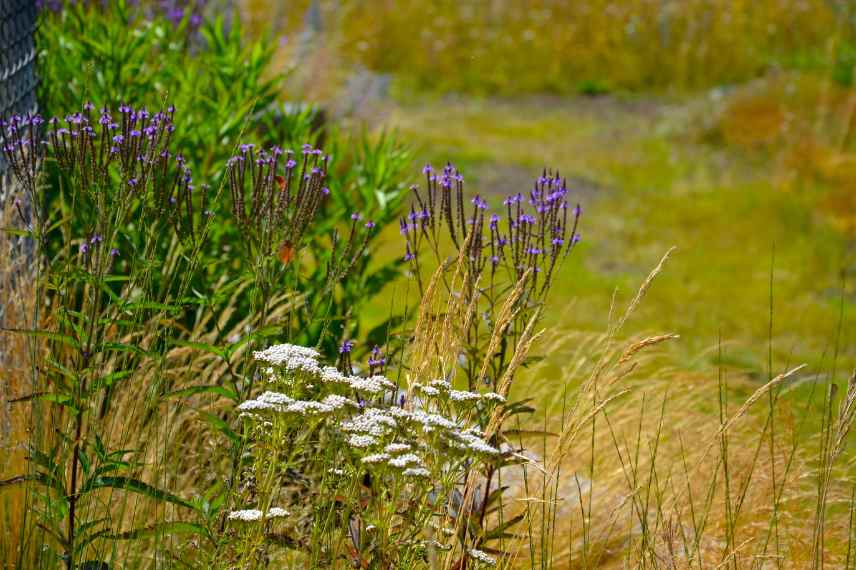 Verbena hastata alongside yarrow and grasses
Tightly packed!
Among the great adages of laissez-faire gardening is close planting, which reduces the amount of light and water that can penetrate, thereby gradually smothering any other vegetation except for what has been chosen. Planting at close intervals ensures effective ground cover, even if it sometimes requires dividing and thinning out some plants in the long run.
Another tip that requires a bit of thought before planning a new bed is to interplant species that will take turns throughout the seasons to keep the soil (even if mulched) as covered as possible. Spring bulbs, for example, are effective for leading the way, followed by perennials like pulmonarias in shaded areas.
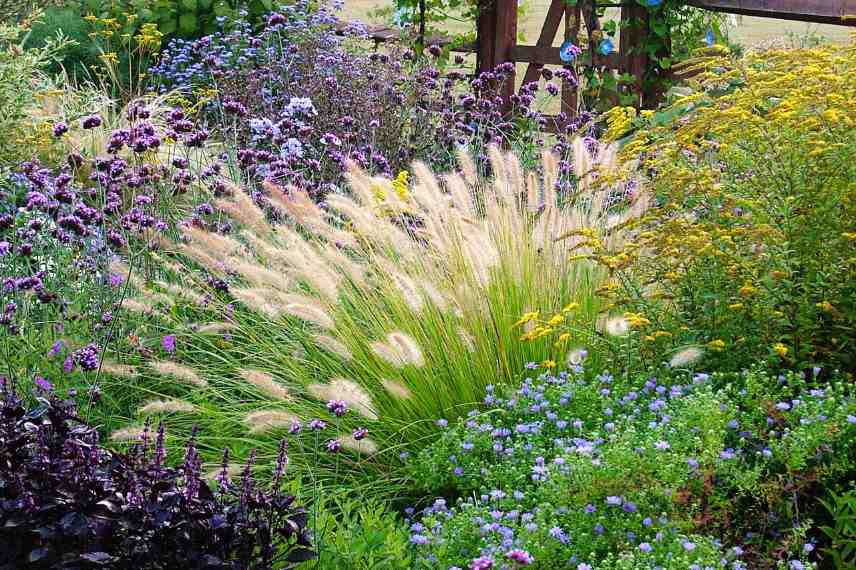
An ideal abundance, achievable through close planting
Long live wild and melliferous plants!
Beyond certain trees and bushes that attract pollinating insects, which can be planted around the edges or within flower beds (Black locust, Goat willow, etc.), many asteraceae from the vast American prairies are quite useful both for their wild appearance and their melliferous character. These are often found in dry areas, but sometimes also in moist ones, like the eupatoriums. Other non-melliferous plants deserve our attention for these relaxed areas of the garden: Aster sedifolius, Althaea, Acanthus…
→ Invite Echinaceas, Centaurea montana, Serratula seoanei, thistles, Dorycnium hirsutum, Vernonia baldwinii, Asclepias tuberosa, Monarda fistulosa. Eupatorium purpureum, and many others…
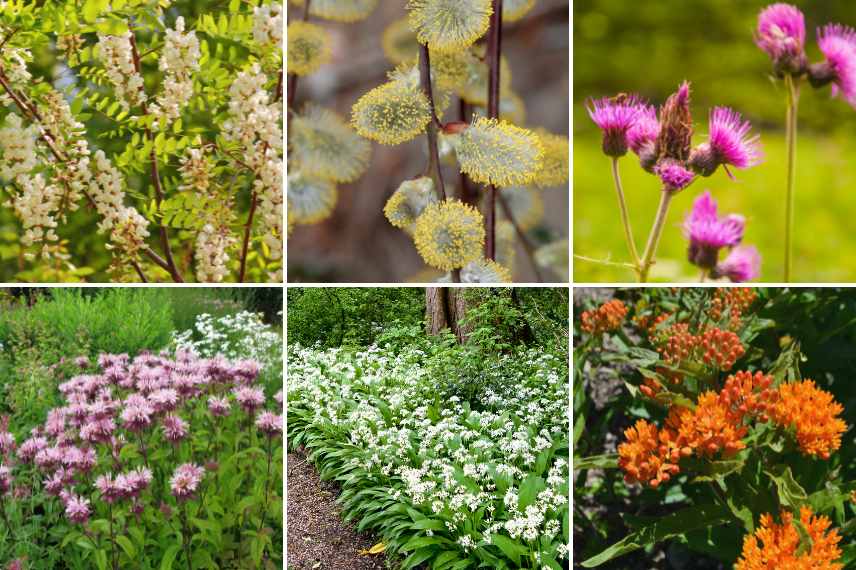
Black locust, goat willow, thistles, Monarda fistulosa, Allium ursinum (wild garlic) and Asclepias tuberosa
→ Also read our advice sheet: How to rewild your garden?
Focus on groundcover plants
The laissez-faire garden is also eager for plants that settle in once and for all: perennials or groundcover shrubs, whether evergreen or not. Their dense or spreading foliage (prostrate or creeping forms) is unmatched for smothering weeds. Besides being ornamental, they generally manage on their own, are undemanding, and require little maintenance, in line with our goal of minimal intervention.
You will find hardy geraniums, heathers, Epimedium, Muehlenbeckia, and many other wonders that should definitely be planted in our laissez-faire garden!
If installing perennial plants, returning each year after their winter dormancy for deciduous ones, or settling in permanently for evergreen foliage is an attitude we are all increasingly adopting, it is definitely another good way to make life easier in a laissez-faire garden.
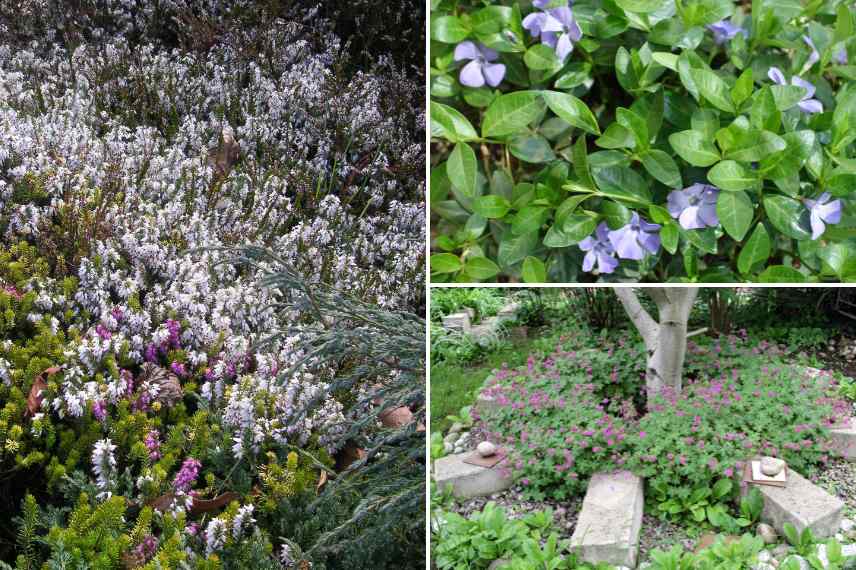
Heathers and Juniperus in the sun, small periwinkle and hardy geraniums in partial shade, the choice is vast in groundcovers to limit maintenance
In practice, how do we do it?
The laissez-faire garden is generally envisioned in very large spaces, or in a second part of a large garden that is often less managed due to a lack of time. It can also be considered at the back of a garden, to create a jungle-like impression and blur its boundaries with wild grasses.
- One observes the large area, identifies zones where wild or pioneering species are growing, creates some experimental areas to see what works… or not, and repeats when it’s a resounding success!
- Time is spent cleaning an area overrun with brambles or nettles, and introducing competitive plants, giant plants resistant to weeds, or even colonising plants or dense groundcovers to ensure peace of mind (goat’s beard, meadowsweet or polymorphous knotweed in cool, semi-shaded soil, Pratia in dry areas…). If some prove to be a bit suckering, it doesn’t matter in a very open space at the back of the garden.
- Seeds from perennials are harvested on-site, from friends or at seed swaps, and sown immediately after harvest, or in autumn, within grassy areas, taking care to clear a few openings for these sowings.
- A mowing in early summer, around mid-July, when the plants have already dispersed their seeds, allows some species to flower again in late summer and autumn, creating beautiful vigorous clumps: mow to about 15 cm (avoid mixes of flowering meadows, which look great for a year but are less sustainable over time). Learn more with our advice sheet Mowing a flowering meadow or a grassy area.
- We promote native flora, which will grow naturally in the garden, faster and more vigorously, thereby smothering its competitors even more.
- As for the weeds that still remain, we accept their presence, understanding that controlling everything in a (large) garden is a lost cause. Read about this in Olivier’s excellent article: 10 good reasons to let weeds grow.
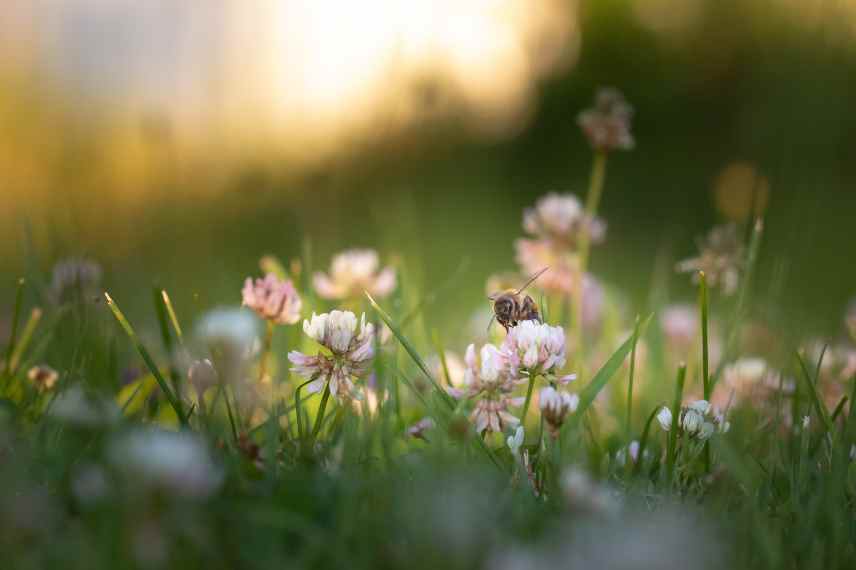 Laissez-faire by tolerating a bit more adventive plants… often bucolic and providing a larder for insects.</caption]
Some fine examples in France and abroad
- The Jardin de la Grille in Durtal (49) is an example of a laissez-faire garden, where plants, chosen for their robustness, occupy the space peacefully, without a constructed scheme, and where maintenance is kept to a minimum. It is also a fine example of a garden without watering.
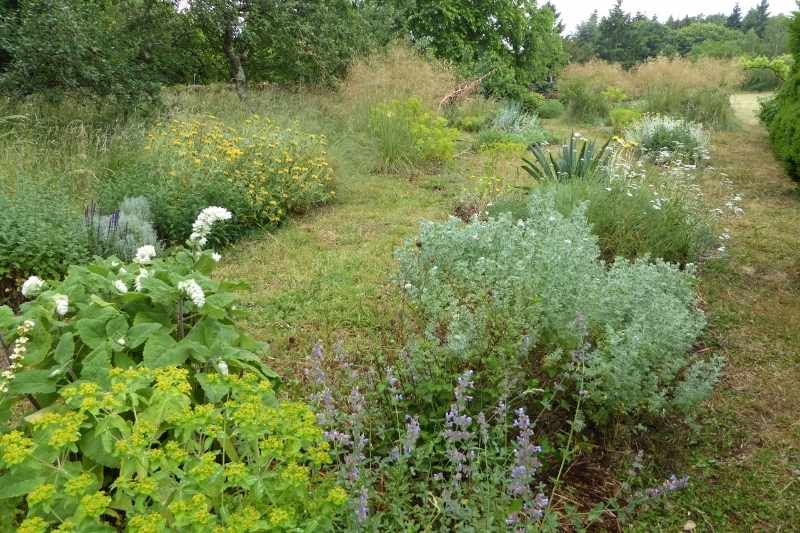
One of the extensions of the Jardin de la Grille (© Gwenaëlle David)
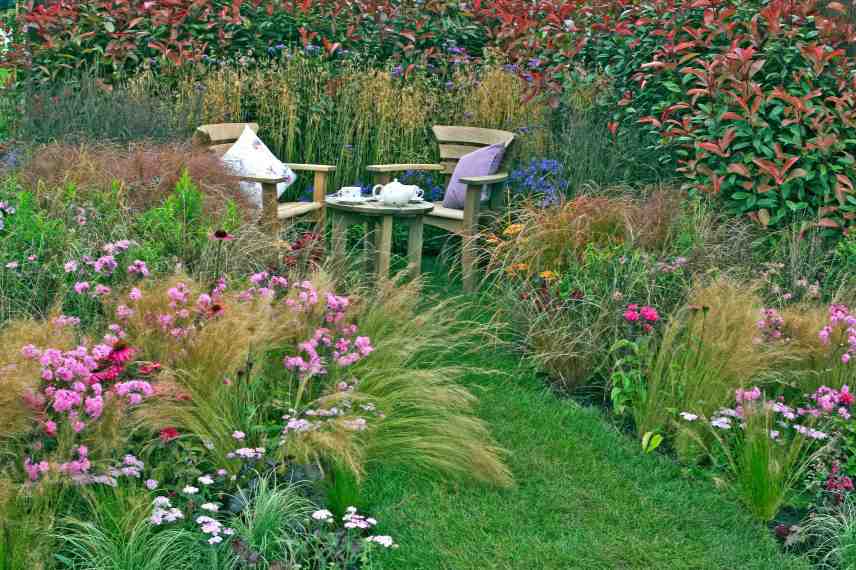
- It is possible, although less common, to transform a small space into a laissez-faire cocoon: here, in this pocket garden, the lawn remains minimal, reduced to a simple path, while perennials and grasses transform the somewhat stiff photinia hedge…
- In the Parc André Citroën in Paris, designed by Gilles Clément, the coexistence of light perennials, bushes, and a taller arboreal stratum creates a strong sense of freedom.
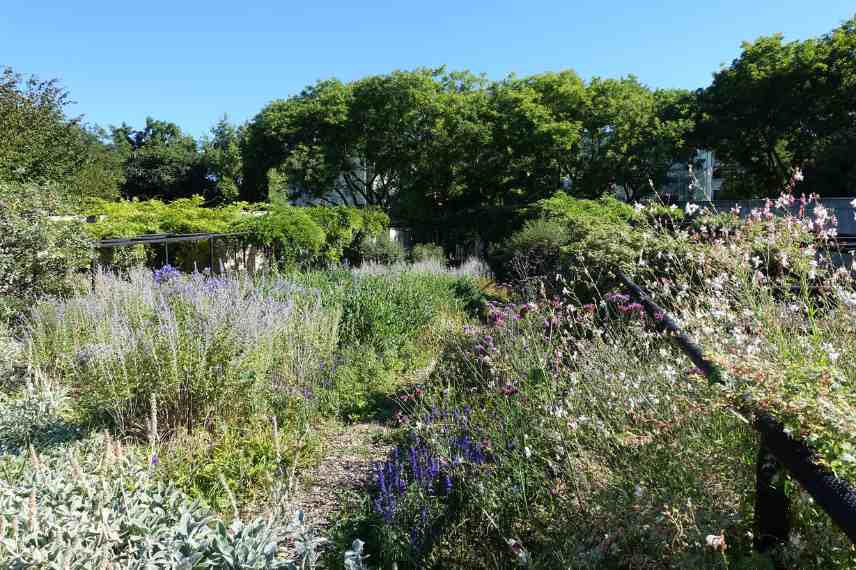
Parc André Citroën
- The profusion of plants, densely planted, creates a charming rural plant tangle below, at the Dyffryn Fernant gardens in Wales, in perfect harmony with the landscape facing it. The concentrated plants are capable of coping with drought episodes.
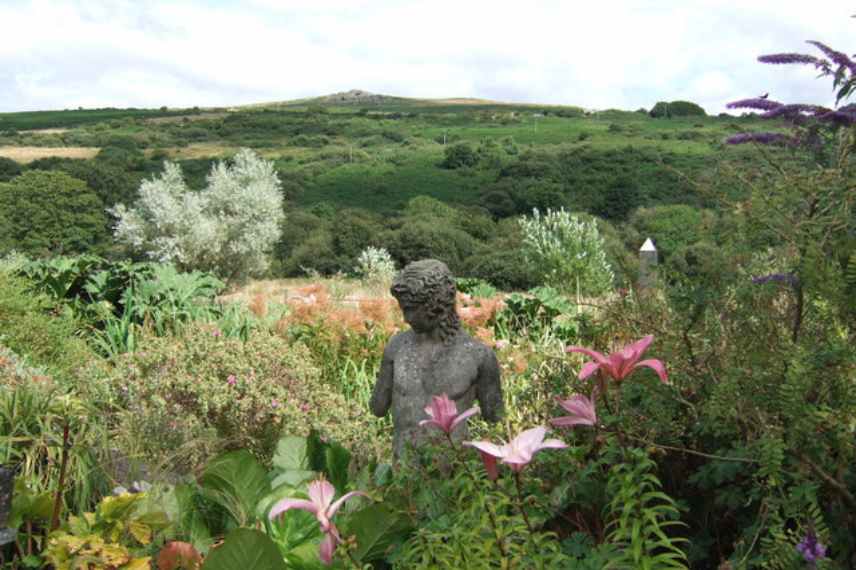
Dyffryn Fernant Gardens (© ceridwen Wikimedia Commons)
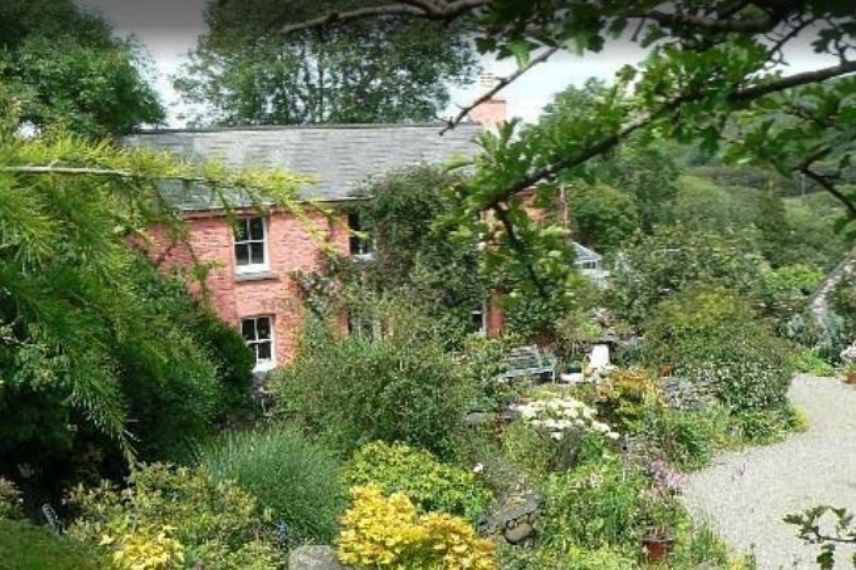
The Dyffryn Fernant garden in the UK: a generosity of plants and a natural spirit has also been chosen around the house (© ceridwen Wikimedia Commons)
- This large massif cleverly mixes perennial plants and grasses to best cover the gaps:
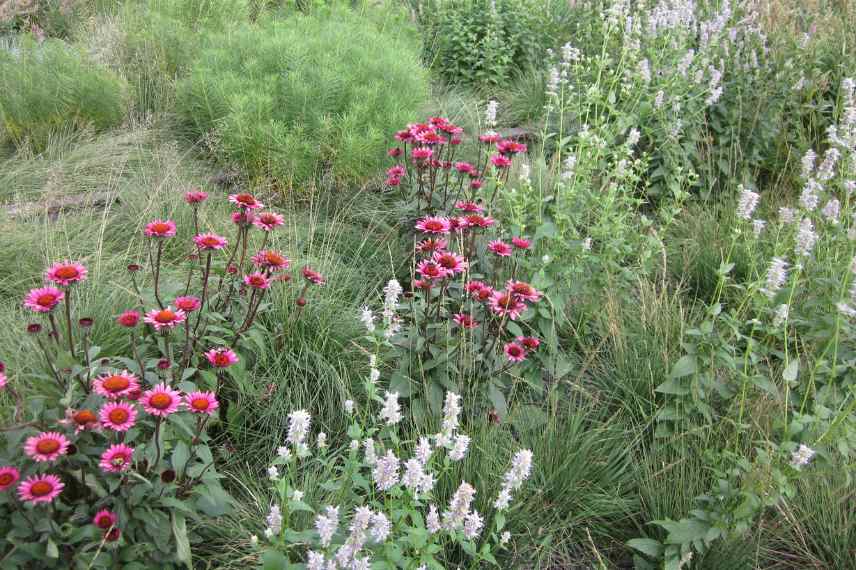
Echinacea purpurea ‘Vintage Wine’, Stachys officinalis, Amsonia hubrichtii (© sharon_k)
… and to enhance your knowledge on the subject, we recommend an excellent book published by Ulmer in 2015: Laissez faire! The art of gardening with self-seeding plants. By Jonas Rief, Christian Kress, and Jürgen Becker.
- Subscribe!
- Contents
Comments