





























7 late winter flowering bulbs
Our selection of bulbs to welcome spring
Contents
They are often classified among spring bulbs, but many bulbs actually bloom as early as the end of winter, around March. They follow the bulbs that have already bloomed early, such as crocuses or Ipheions. Erythronium, Iris reticulata, and hyacinths bring an exquisite freshness with their often blue or white colours. We reveal the late winter flowering bulbs that you must absolutely include in your garden or lovely planter! This selection will bloom earlier in sheltered, sunny gardens and in so-called mild regions.

Chionodoxa
As part of the very hardy bulbous plants, Chionodoxa, or glory of the snow, begins to flower in late winter, between February and April. The charming star-shaped flowers are small (about 2 to 3 cm in diameter), and the foliage is reminiscent of that of hyacinths.
It includes several species, the most common being Chionodoxa luciliae, with light blue flowers for the type, and white or pink in some cultivars. A much taller species worth mentioning is Chionodoxa grandiflora, which can reach up to 25 cm in height.
Like many small bulbs, Chionodoxa naturalises easily when planted in ideal conditions (cool soil, in full sun or partial shade). However, the glory of the snow does not appreciate dry soils or overly hot climates.
→ Learn more in our comprehensive guide Chionodoxa: planting, growing, and care, and Pairing ideas with Chionodoxas.
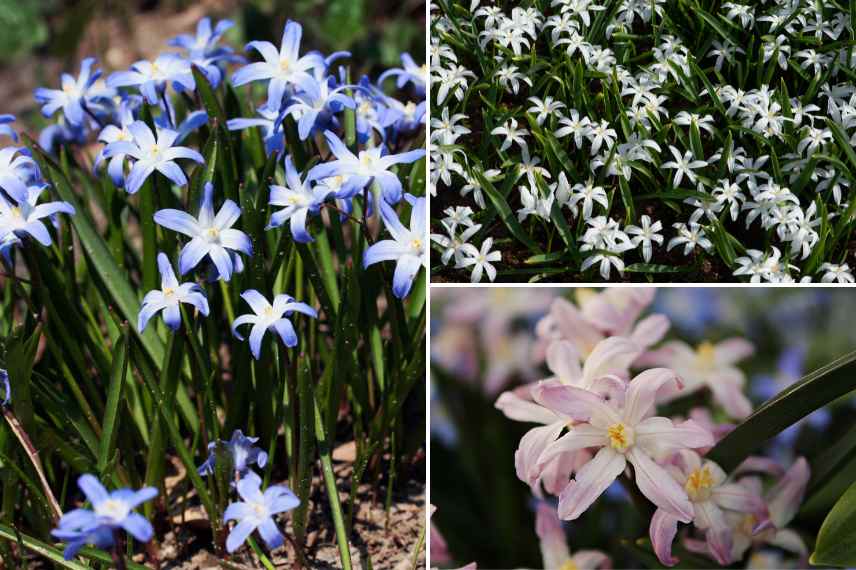
Chionodoxa luciliae, C luciliae Alba, C forbesii, and Pink Giant
Read also
5 early winter flowering bulbsErythronium
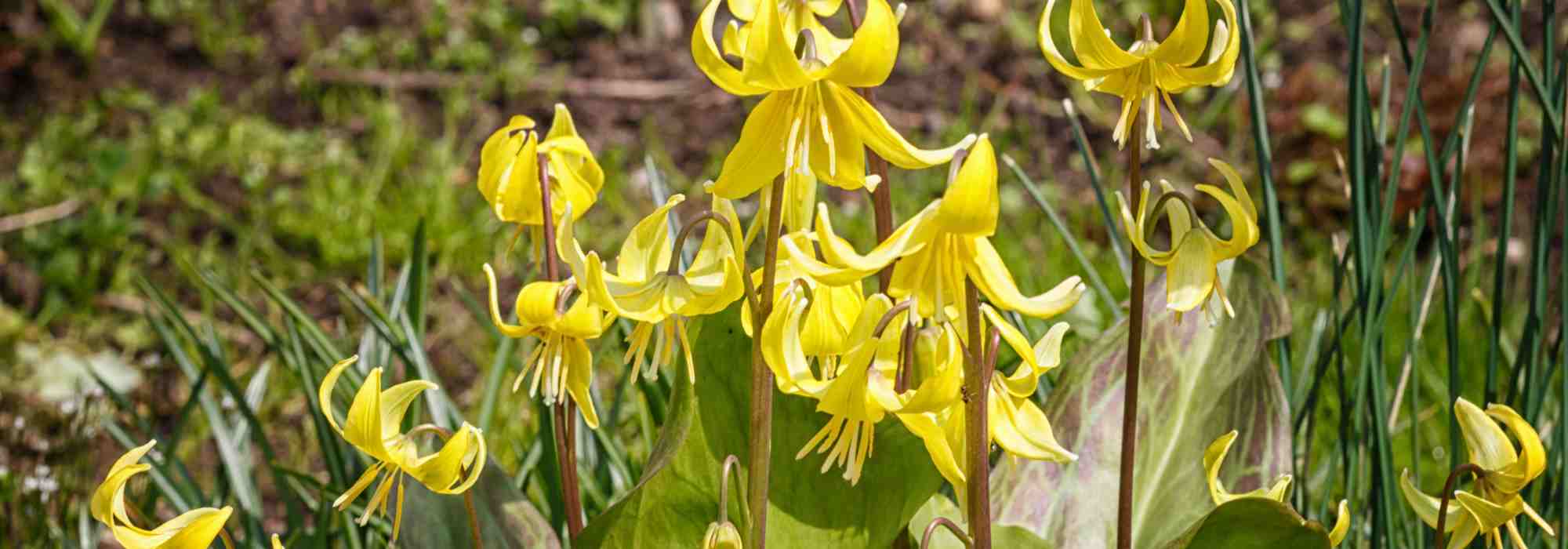
Also known as dogtooth violet, Erythronium is still relatively unknown, yet it boasts many qualities: delicate flowering, varied colours, and attractive broad sheathing foliage that is more or less veined with purple or white, exceptional hardiness, and rapid growth. The plant grows to a low height, between 12 and 30 cm at most, starting from March. The pendulous flowers resemble tiny lilies, borne on sturdy stems. This lovely bulb thrives in partial shade, in cool, humus-rich, well-drained soil. It should be kept away from overly dry soils. The Erythronium takes a little time to settle in the garden.
Among the noteworthy cultivars are: Erythronium ‘Pagoda’, which bears several golden-yellow flowers, Erythronium dens canis, with pink flowers, and Erythronium ‘Lilac Wonder’, lilac with a pale yellow centre.
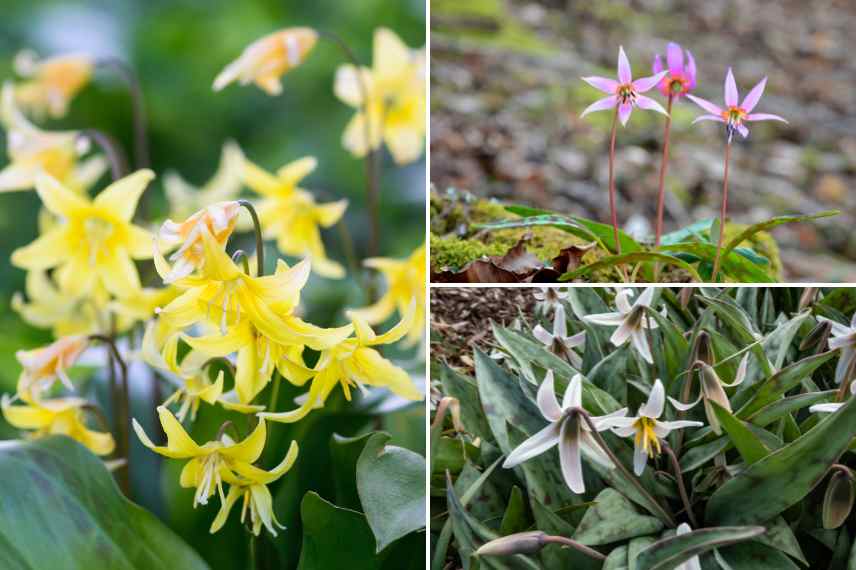
Erythronium Pagoda, dens canis and albidum
→ Learn more in our comprehensive guide Erythronium: planting and growing. I provide pairing ideas with Erythronium in this article!
Anemone blanda
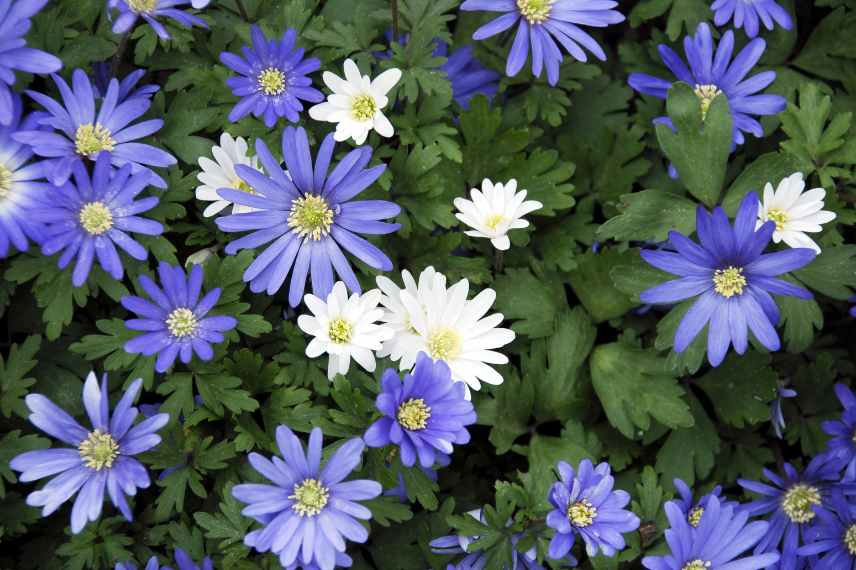
The Greek anemone or Anemone blanda has a tuberous stump, but is considered a bulbous plant. It is the first of the anemones to flower, as it radiates its white, pink, or blue flowers from early March. The flower resembles a tiny daisy, composed of around twenty petals with a diameter of 4 cm. The leaves are highly dissected.
The Greek anemone, due to its Mediterranean origins, tolerates slightly drier soils than most small spring bulbs. It will quickly form beautiful colourful carpets about fifteen centimetres high when it benefits from good light and well-drained soil. Invite it into rockeries, borders, or beds, as well as in planters on the balcony.
The varieties ‘White Splendor’, pure white, or ‘Blue Shades’, blue with a pale yellow centre, are must-haves in the garden or in pots!
→ Read also: Growing Anemone blanda in pots and Associating Anemones blanda.
Spring snowflake
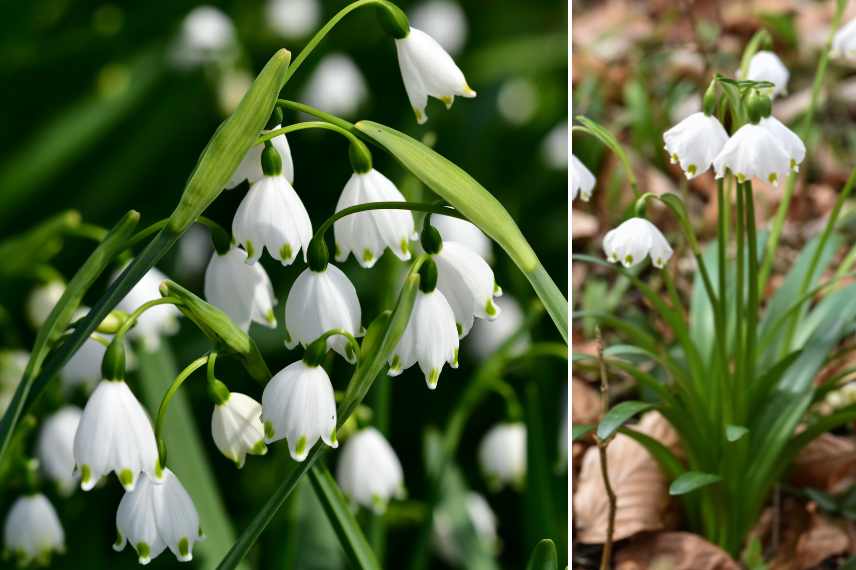
Not so common in gardens, the spring snowflake (Leucojum vernum) is another small bulbous plant heralding spring. Its whiteness, somewhat akin to that of the snowdrop, is immaculate, but the tips of the petals display small green-yellow fragrant spots. The bell-shaped flowers are pendulous and small (about 1.5 cm). Flowering can begin very early, in February, but it is often in March that it starts to reveal its charms.
Plant the bulbs in early autumn, in rich, cool to moist soil, preferably clayey, and in full sun or light partial shade. Sandy soils are not suitable for it. The spring snowflake will look magnificent in light woodland or at the edge of a water feature.
P.S.: do not confuse it with the summer snowflake or Leucojum aestivum, which resembles it but is taller and flowers in April or May.
→ Learn more in our advice sheet Snowflake, Leucojum: planting, growing and care.
Reticulated Iris
There are wonderful little irises flowering as early as February or March, well before their garden cousins or the Siberian Irises: these are the Iris reticulata. These small Irises (15 cm tall) can fit into many spaces as they are hardy, preferring light, well-drained soils, even calcareous ones. Planted in partial shade, which they favour, the typical species reveals its flowers of violet-blue with orange-yellow sepals.
The different varieties offer other colours, ranging from white to yellow, including black, but most play on the blue palette, up to deep violet, always maculate or marked with yellow and/or white. The Iris reticulata form lovely clumps, and their small size makes them particularly suited for pot or bowl cultivation.
→ Learn more in our advice sheet: Iris reticulata: planting and growing.
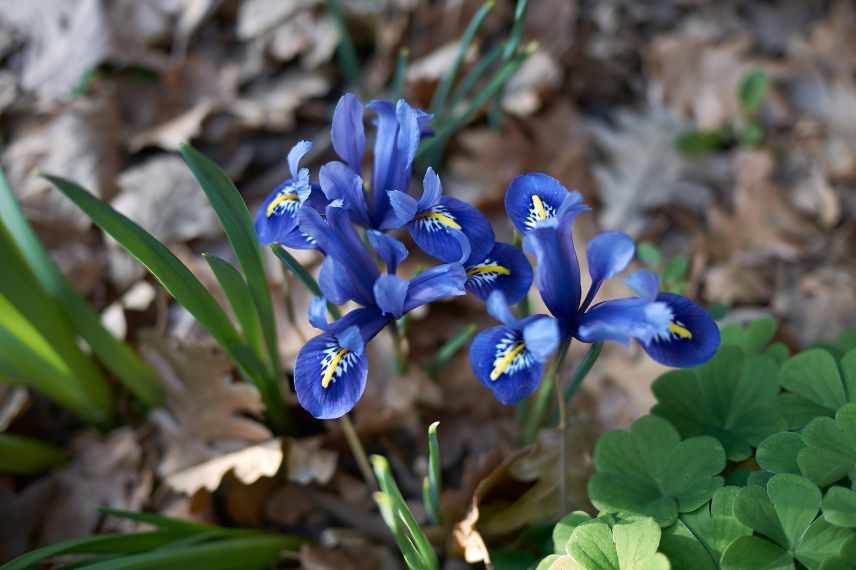
Iris reticulata ‘Harmony’
Muscari
Here are some well-known and easily recognisable small bulbs that can start to flower as early as the end of winter, in mild seasons or in temperate regions: muscari. Their flowering takes the form of tiny, tightly packed clusters at the top of the stems, which is a delight, especially when they are planted in masses. Often seen in shades of blue, you can also opt for varieties with white flowers, and even pink or bicoloured ones (‘Pink Sunrise’, or Muscari latifolium).
Muscari are bulbs that flower for quite a long time, which is undoubtedly the reason for their enduring popularity in gardens. They are often used as borders along pathways or in beds, mixed with other bulbs that will flower at the same time or a little later (anemones blanda, tulips, or daffodils). They create a small colourful carpet, 15 to 20 cm high, that will gradually naturalise. Muscari highlight blue and white flowers, and even some green tulips like the Tulip ‘Greenstar’. Plant them in ordinary, fertile, well-drained soil, in full sun or light shade.
→ Learn more with our complete guide on muscari.
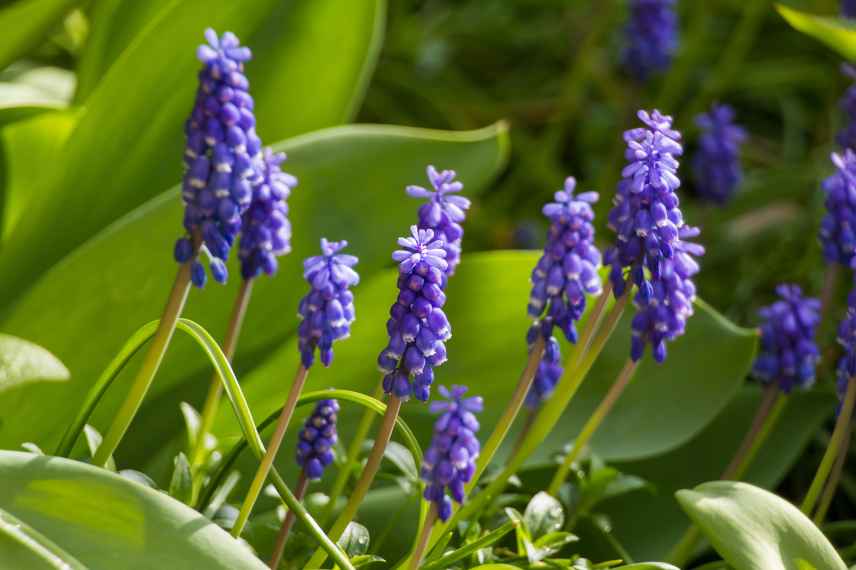
Hyacinths
Finally, like a larger version of muscaris, the hyacinths also stand out as a late winter flowering bulb, ensuring the transition to longer, warmer days. The common hyacinth that we know well (or Dutch hyacinth) comes from the species Hyacinthus orientalis, hybridised into thousands of varieties, but there are about thirty other species in this genus.
Some hyacinths bloom in the garden as early as January (and forced bulbs indoors as early as December), but most emerge from the ground in March, with their colourful, enticing, and fragrant spikes! The floral spikes measure between 10 and 20 cm long and display a palette ranging from white to yellow, light blue to very dark blues, through all shades of pink to purple, as well as single or double flowers. You will plant them spaced just a few centimetres apart if you want them grouped, always in a light, even sandy, but rich and well-drained soil, in full sun or partial shade. For flowering in February-March, you have a choice: why not the famous ‘Delft Blue‘ or the fragrant, pearly pink ‘City of Bradford’?
→ Learn more with our complete guide on hyacinths.
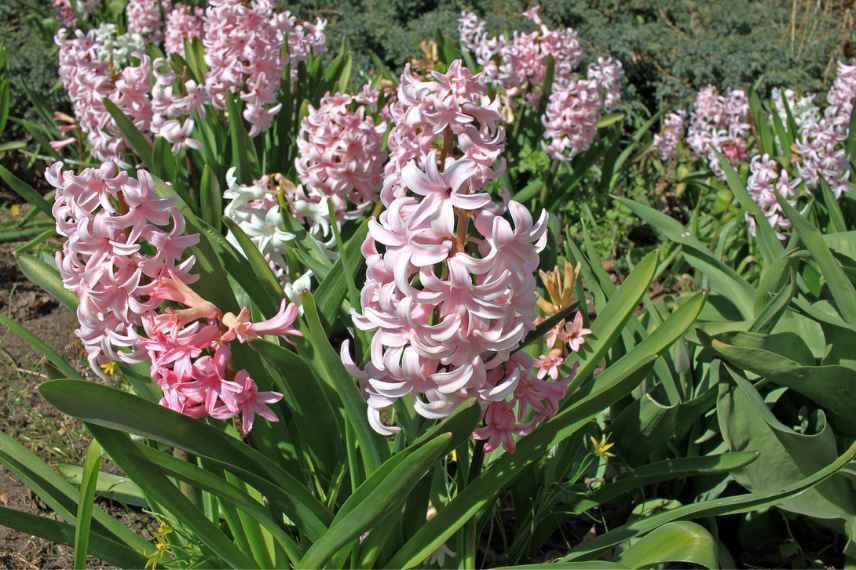
- Subscribe!
- Contents

Comments