





























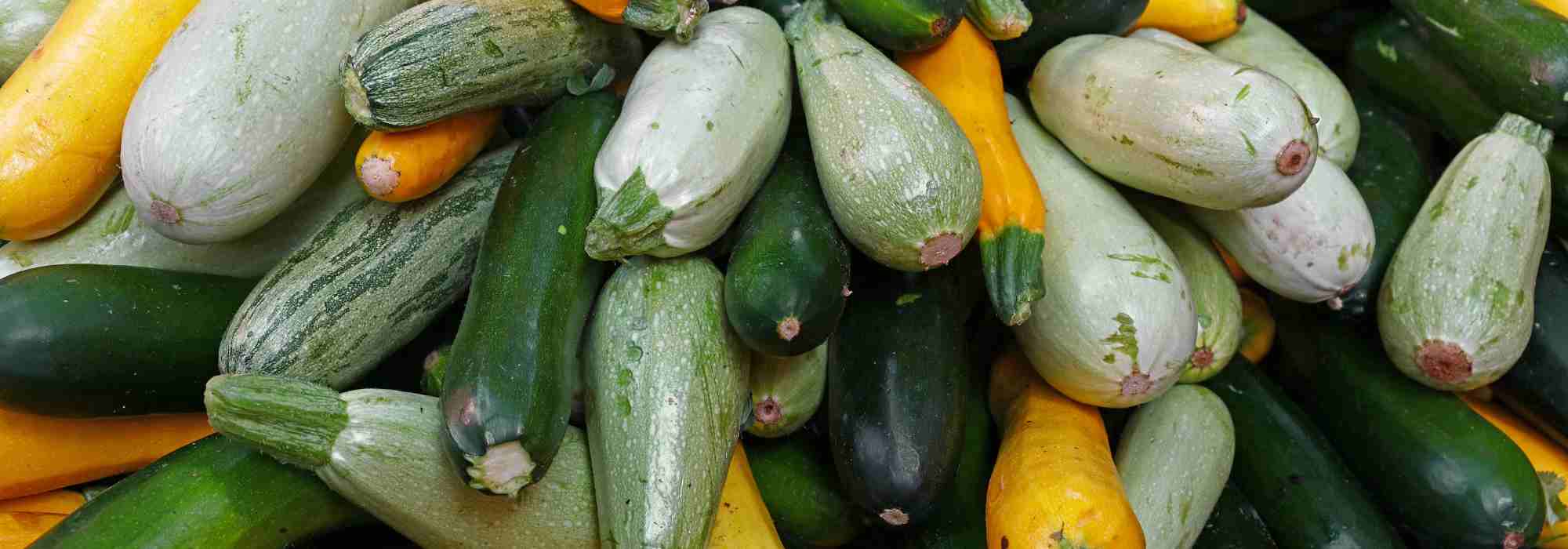
My courgettes aren't producing, why?
Various reasons why courgettes are absent and how to remedy them
Contents
Growing courgettes (Cucurbita pepo) is often synonymous with summer abundance in the vegetable garden, as this fruit-vegetable from the Cucurbitaceae family is easy to plant and maintain. Two or three plants are enough to feed a family of four. Yet, sometimes the yield isn’t as good as one might hope. And the problems you encounter are numerous: Courgettes bloom, but they do not bear fruit. Or some young courgettes, barely formed, fail to develop, turn yellow and eventually rot. It can also happen that the courgette plants produce no flowers, but a lot of foliage. Each phenomenon has its explanation… and its solution!
Let’s look together at the different reasons that can hinder fruit production from your courgettes. And above all how to remedy this lack of courgettes in your vegetable garden this summer.
For further reading: Courgette: sowing, planting and growing in the vegetable garden

Because weather conditions are not optimal
If there’s one vegetable that’s particularly sensitive to weather conditions, it’s the courgette. Indeed, the weather in your region during summer will directly determine fruit production. Especially if we’re in extremes. Thus, a scorching summer doesn’t necessarily suit courgettes, whose production is affected by excessive heat. Often, these high temperatures cause fruit drop. In fact, the courgette plants divert their energy to defending themselves against this aggression rather than producing fruit. Similarly, high temperatures can affect the quality and quantity of pollen, and thus fruiting.
That’s why, when daytime temperatures edge around 35–40°C, it’s widely advised to shade courgette plants to shave a few degrees off the temperature. For young courgette plants, placing crates weighed down with a stone on the foliage helps to considerably lower the temperature. Normally, these crates should not hinder insect visits. When the plants are too tall, you can simply create shade nets using old sheets, jute sacks or any fabric, attached to stakes and stretched above the plants. But the best approach is to anticipate by shading courgette plants with vegetable companions that have a vertical habit such as maize, sunflower, Jerusalem artichoke… which will be sown nearby to provide natural shade. And, of course, you should water very regularly and mulch.
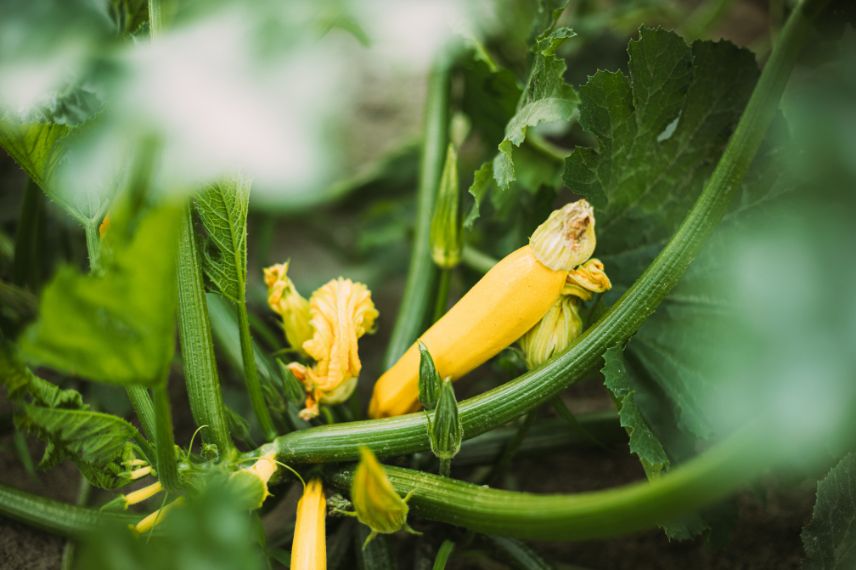
Courgettes are very sensitive to weather conditions
Conversely, summer can be wet… These damp weather conditions are not ideal either. Indeed, when rainfall is heavy in summer, light is often reduced. These wet spells and the lack of light hinder or prevent flowering. And if a few flowers do open, they are few or poorly fertilised, as insects are less active. In this case, unfortunately, there isn’t much you can do… other than wait for better days!
Our extra tips :
Read also
Courgettes: safe betsBecause soil does not provide the necessary nutrients
Courgettes are greedy feeders! They prefer soils that are rich and fertile, humus-bearing and loose, well-drained. That is why, at planting, it is essential to add generous amounts of well-rotted compost and manure.
If you haven’t supplied the soil with enough nutrients, your courgette plants may stall and therefore not bear fruit. Indeed, the soil is too poor and the courgettes cannot access nitrogen, phosphorus and potassium, the essential nutrients for healthy growth. That is why it may be wise to provide additional nutrient inputs to meet the needs of these greedy feeders! And, in this regard, several solutions are possible:
- Apply nettles manure every two weeks to young plants in order to stimulate growth. Nettles manure is indeed an excellent alternative to fertilisers, as it has the power to promote plant growth. It should not be used neat, but diluted to 10%, i.e. 1 litre of nettles manure to 9 litres of water. This manure is used for watering
- Apply comfrey manure diluted to 20% (i.e. 2 litres of manure and 8 litres of rainwater) as soon as the first flowers appear. Comfrey manure is indeed recognised for promoting flowering and thus fruiting, as it is rich in allantoin, an active constituent, but also in potash and boron. Another application of comfrey manure will be made two weeks later, watered in at the base of the courgette plants.
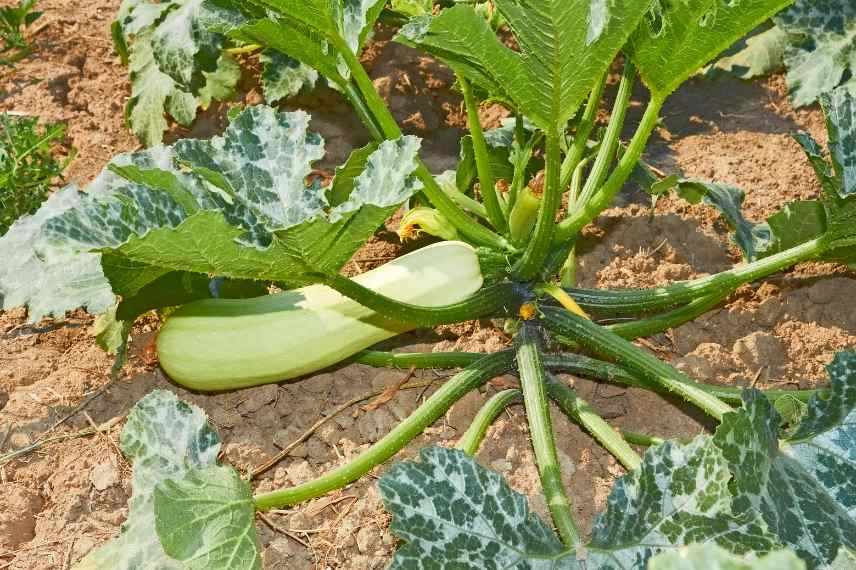 Courgettes require fertile soil enriched with compost and manure</caption]
Be careful not to overdo nettles manure which risks favouring vegetation at the expense of fruiting due to its nitrogen richness. Therefore, it should only be added at the start of the crop. Similarly, urine, dried blood or guano, natural fertilisers, should be avoided, as they risk saturating the soil with nitrogen.
In the absence of nettle manure, it is perfectly possible to add a commercial organic fertiliser, suitable for organic farming, specifically intended for fruiting vegetables. These fertilisers are more balanced, lower in nitrogen, of the type N(6) P(8) K(10) or N(4) P(8) K(12), very beneficial for fruiting. It is also possible to use beet vinasse, another fertiliser rich in potash.
Further tips :
Because your young courgette plants are suffering from drought
Courgettes are greedy for water, but they’re also thirsty! That’s why they’re very prone to hybrid stress that negatively affects fruit production.
A courgette is therefore a vegetable plant with substantial watering needs. In very hot weather, with its broad leaves, evapotranspiration is greater. This is evident in the middle of the day, as the leaves tend to wilt quickly. Therefore, water generously and regularly, with water at ambient temperature, and preferably in the morning to prevent evaporation of water.
At planting, it is also essential to water generously to promote recovery. Then, leave your young plants for about ten days without water to encourage their first flowers, in response to water deprivation. Once the flowers have formed, you can resume watering. The essential thing is regularity: lack of water is as damaging as excess.
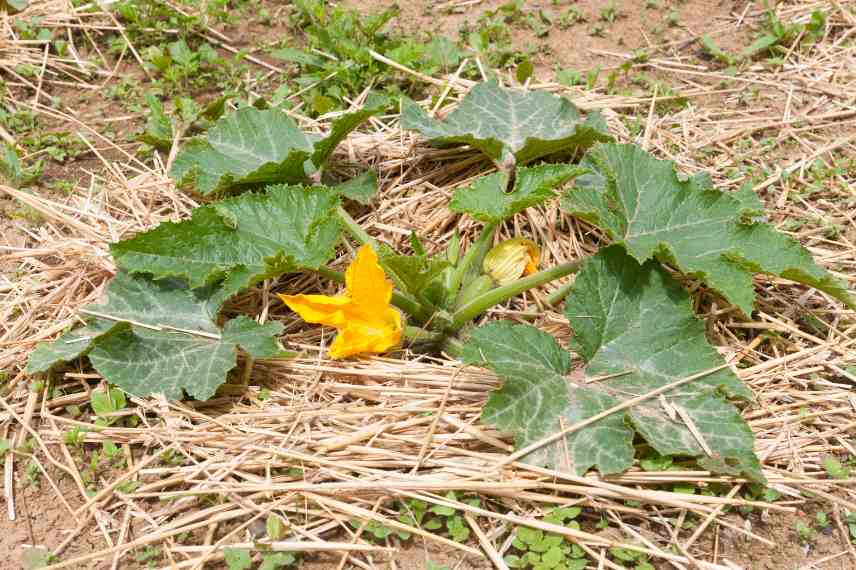
By watering regularly and mulching, courgette fruiting should be on track
Of course, I would recommend mulching heavily around your courgette plants to retain some humidity and to space out waterings. This is also a key factor for good fruiting.
Read also
How to choose your courgettesBecause pollination is not taking place correctly
No pollination, no courgettes! And to understand courgette pollination, let’s start with a short botany lesson. Courgette is a monoecious plant, meaning that on a single plant it bears female and male flowers, all yellow-hued, and lasting only a day. So how can you tell male staminate flowers from female pistillate flowers? Male flowers are attached to the peduncle by a simple stalk, whereas female flowers already have the fruit (the ovary) at their base, barely developed. At the outset, the stalk looks plumper. Likewise, female flowers have a pistil at the heart of the petals, whereas male flowers have stamens that produce pollen. For fertilisation to occur, pollen must be transported from the male flowers to the female flowers. And it’s often at this stage that things go wrong!
Indeed, this pollination is mainly carried out by insects that visit the male and female flowers in turn, thereby ensuring pollen transport. Unfortunately, many factors make this pollination ineffective. Thus, at the very start of the season, a courgette plant produces more male flowers than female flowers. Moreover, these flowers are relatively ephemeral and pollinating insects must be active during the day to ensure pollen transport. It is estimated that at least about fifteen visits by bees or bumblebees are required to ensure fertilisation. So, if weather conditions are not ideal, if it is too hot or too cold, if humidity is too high, the insects become less active. Similarly, your garden may not be visited sufficiently by these insects, as nothing attracts them there.
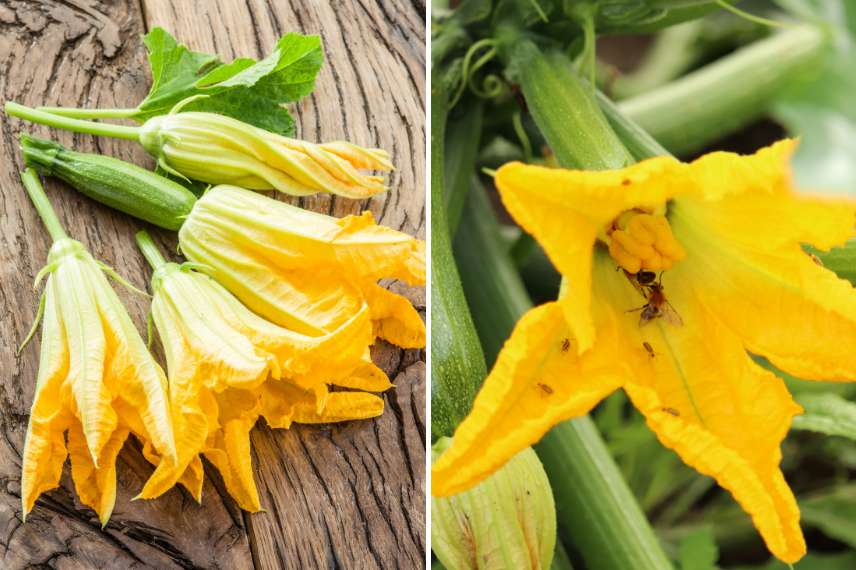 Pollination is a crucial step. In unfavourable weather conditions or in the absence of insects, it can be affected
To give pollination the best chance, you can:
- Sow or plant melliferous flowers in your vegetable garden, as close as possible to your courgettes. Thus, insects attracted by the nectar and pollen of the flowers will also visit the courgette flowers. Among melliferous flowers, one can cite phacelia, borage, rosemary, Agastache, lavender, sages, Nigella damascena …
- Install insect hotels or natural shelters all around your garden (piles of stones or branches, overturned pots…), leave part of your lawn unmown or a part of the garden to run wild in order to favour biodiversity
- Ban pesticides and other insecticidal products, even natural ones.
In the short term, I also advise planting several courgette plants to encourage cross-pollination.
Finally, as a last resort, you can play Maya the Bee (costume optional!) by pollinating your courgettes yourself. The method is simple: in the morning, simply pick the male flowers and part their petals to release the pollen-covered stamens. Then, like a brush, you can rub these stamens on the pistil of the female flower. That’s it! And there’s no need to repeat the operation fifteen times!
More tips:
Because your courgettes are being attacked by a disease or pest
A disease or pest attack is the last thing that could potentially affect your courgettes’ fruiting. Here is an article that details all the diseases and parasitic pests that attack courgettes, as well as the treatments and preventive steps: Diseases and parasitic pests of squashes and courgettes
- Subscribe!
- Contents
Comments