





























Roses: discover 6 hardy varieties
Our selection of the hardiest roses!
Contents
In the wonderful world of roses, synonymous with beauty and captivating fragrance, not all varieties are equally demanding when it comes to cultivation. Some combine the grace of their flowering with rock-solid hardiness. This article aims to lift the veil on six hardy roses, which are disease-resistant, adaptable to a range of climates and require little attention, while offering spectacular and long-lasting flowering. These champions of resilience guarantee a flower display like no other, minimising effort and maximising sensory pleasure. Note, however, that this is no excuse to mistreat them or neglect planting conditions!

Rose bush 'The Fairy'
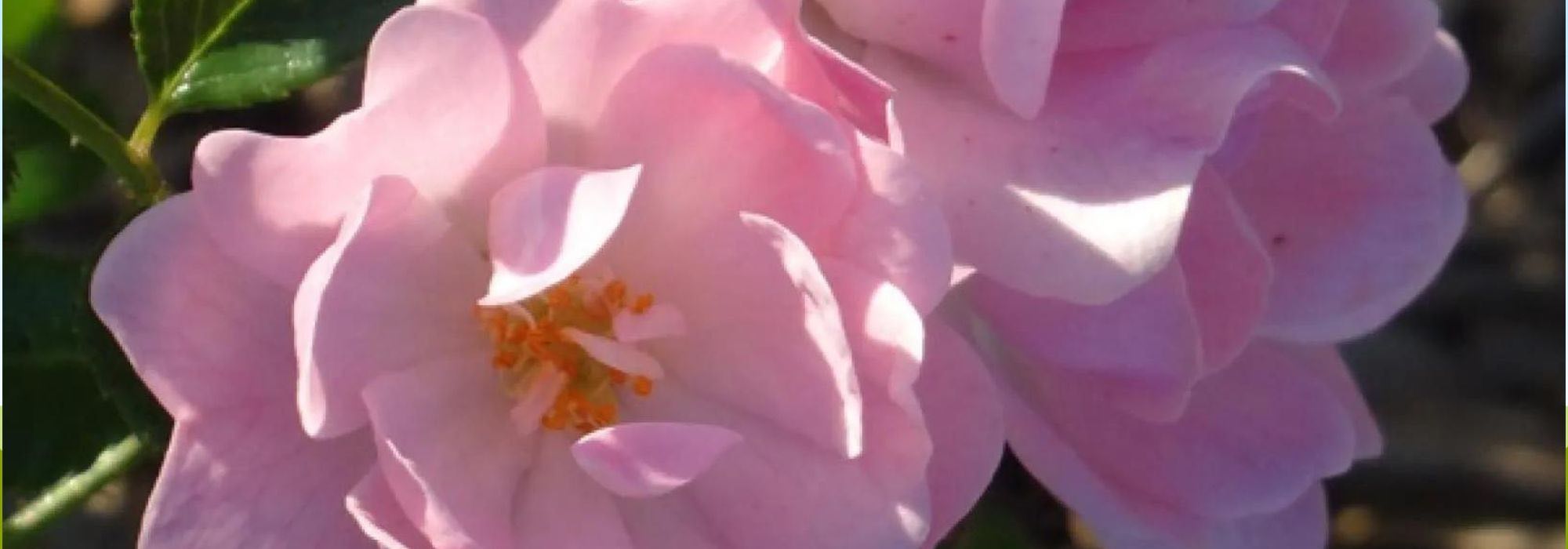
Introduced in 1932, the ‘The Fairy’ rose quickly established itself as a must-have for gardens thanks to its irresistible charm and numerous qualities. Renowned for its abundant flowering, it produces double-flowered blooms in a bright pink that softens as the season progresses. Its exceptional hardiness translates into rock-solid health, withstanding a range of conditions with remarkable vigor and ease of cultivation. Its low-maintenance nature makes it an ideal choice even for novice gardeners, lending itself to a range of uses from borders to pots on terraces or balconies.
The Rosa (x) polyantha ‘The Fairy’ stands out for its bushy habit, flexible and spreading, reaching about 80 cm in height with a spread of 90 cm to 1 m. The flowers, small and pom-pom- or rosette-shaped and slightly fragrant, bloom in abundance from July to autumn. This hardy, disease-resistant variety features delicate bronze-green semi-evergreen foliage, adding to its ornamental appeal.
The ‘The Fairy’ rose excels in a wide range of soils, except very damp ground, and adapts easily to diverse climates, from north to south. Its trailing shoots are perfect for enhancing rockeries or slopes, while mass planting or grouping makes it an elegant choice for edging avenues or borders. Paired with hardy geraniums, campanulas, nepetas or foxgloves, it creates stunning displays.
Read also
10 climbing roses for pergolaRose 'Ghislaine de Feligonde'
Created in 1916 by the French rosarian Turbat, the rose ‘Ghislaine de Feligonde’ still stands out today for its graceful habit and exceptional flowering. Climbing or shrub, it displays remarkable vigour, blooming even in partial shade with a unique charm. Its small roses, pompon-like, offer a colour progression from apricot-yellow ochre to orange, then turning to ivory, for a palette of soft and warm tones.
This hybrid is characterised by a habit that is naturally ample and unruly, reaching up to 3 metres in height. It boasts fresh, vibrant green foliage throughout the season and is resistant to diseases, though somewhat susceptible to downy mildew in certain conditions. Its abundant flowering begins in June, continuing in abundance until autumn, with nuances depending on climate.
The rose ‘Ghislaine de Feligonde’ finds its place both as a standalone specimen to reveal its somewhat bohemian habit, and climbing on an arch to create an enchanted passage near the terrace. Plant it with large blue or white clematis for perfect floral combinations. Easy to maintain as a shrub, it is also suitable for planting in a mixed hedge, alongside viburnums or lilacs, and adapts wonderfully to growing in a large pot.

Rose 'Kew Rambler'
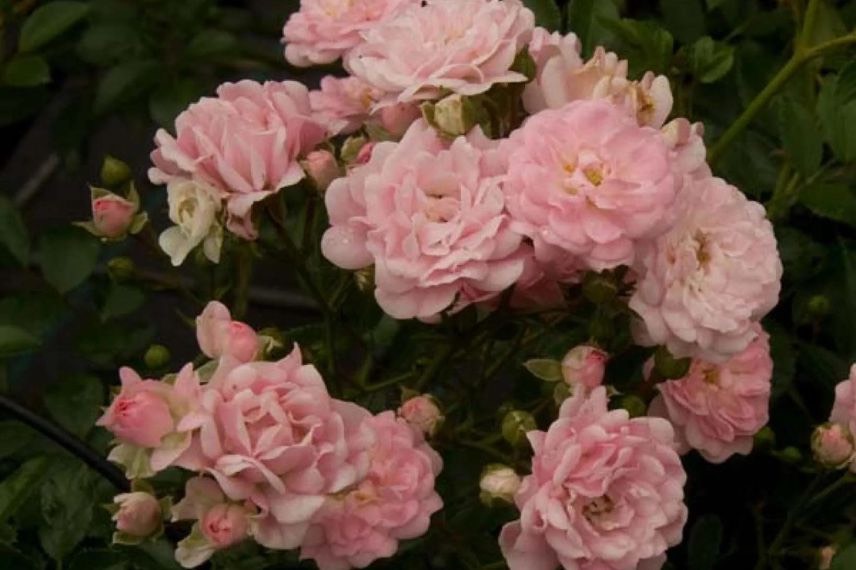
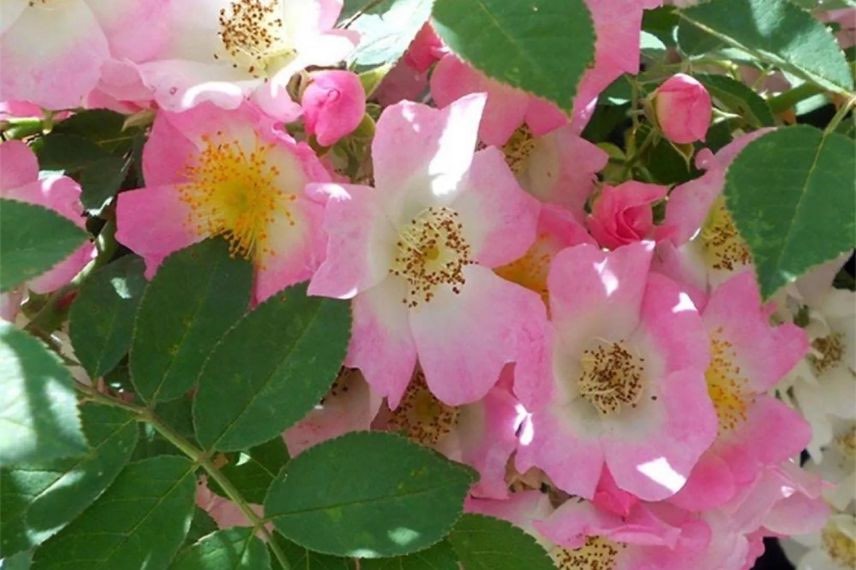
Created at the prestigious Royal Botanic Gardens, Kew in 1912, the rambling rose ‘Kew Rambler’ stands out for its robustness and spectacular appearance. Thanks to the heritage of Rosa soulieana and the ‘Hiawatha’ rose, it features very healthy deciduous foliage, with a delicate grey-green colour, as well as flexible shoots adorned with fine prickles. This rose easily reaches a height of 6 to 7 metres, covering itself in June and July with a profusion of small dog-rose flowers in pink and white hues, with golden-yellow centres, which transform into attractive orange fruits in autumn.
Its capacity to thrive in large spaces, to wind through trees, to ornament long fences or to embellish structures such as arbours and wild hedges, makes the ‘Kew Rambler’ an unparalleled choice to bring a touch of escape and freedom to the garden. Its unique flowering, although not repeat-flowering, can be advantageously complemented by planting vigorous clematis, for splashes of colour across the seasons. It is perfect for creating romantic passages near terraces or to inject life and charm into less attractive buildings.
Read also
12 thornless or nearly thornless rosesRose 'Rose de Rescht'
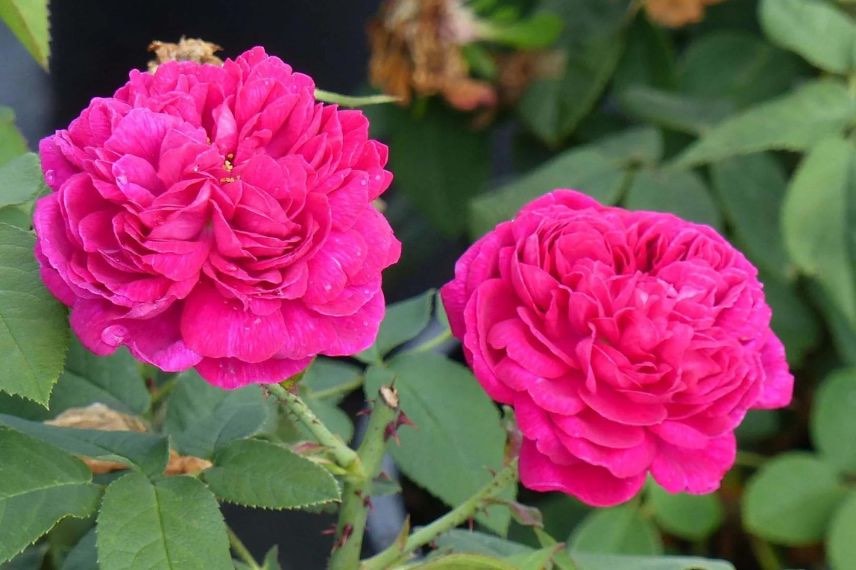
The ‘Rose de Rescht’ rose bush, a precious heritage from ancient Persia, is a Damask variety introduced in England in the 19th century. This rose is characterised by its robustness, hardiness and ease of care. With its compact habit and dark foliage, it forms a dense shrub that in spring and again in late summer is adorned with small double flowers, in a bright red tending toward fuchsia, then moving to magenta, exhaling a powerful and captivating fragrance.
Suitable for a wide variety of gardens thanks to its moderate habit, ‘Rose de Rescht’ reaches a height and spread of around 1.2 m, with abundant flowering in mid-June, and again in autumn if spent blooms are regularly deadheaded.
Its deciduous foliage, a deep green colour and disease resistance, and its sturdy stems, equipped with robust prickles, make this rose an elegant and easy-to-grow addition to any garden.
Ideal for creating a low, almost maintenance-free hedge or for enhancing borders with perennials and shrubs, the Rose de Rescht harmonises perfectly with plants such as Nepetas, Santolina, or Stachys.
Its ability to thrive even in small spaces, along with its captivating scent, makes it ideal for planting along a path edge or near outdoor seating areas, allowing you to enjoy its pleasant fragrance until the end of the season.
Rose 'Robusta'
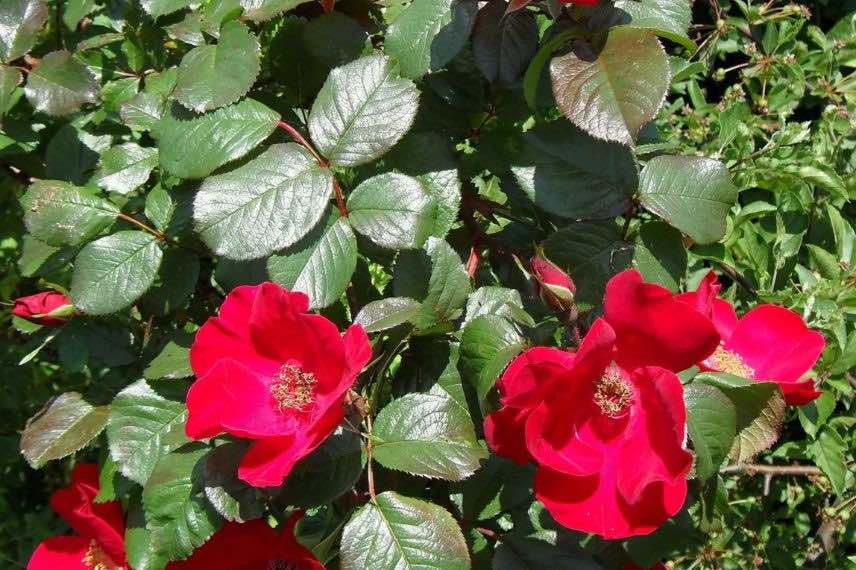
The rose ‘Robusta’®, introduced by Kordes in 1979, is a striking example of vigour and natural beauty. Direct descendant of the Rosa rugosa ‘Regeliana’, it benefits from excellent disease resistance and offers large, single red flowers, borne in generous bouquets. These blooms are a near-fluorescent red, enhanced by a pink centre with golden stamens.
This rose bush, whose ancestors naturally thrive on the coasts of Asia, is perfectly suited to challenging conditions, such as poor, saline, or even dry soils. With a bushy, flexible habit, it can reach 1.4 m in height and 1.2 m in width, although its growth may be even greater under optimal conditions. The stems, thick and thorny, bear light-green, slightly wrinkled leaves, very healthy, highlighting the plant’s robustness and ornamental appeal.
Flowering typically begins in June and continues through August. Slightly scented, this flowering gives way to red rose hips, suitable for jam.
Perfect for a low-maintenance garden, this rose fits harmoniously into a bocage hedge or defensive hedge, as well as into somewhat wild gardens, where it brings vigour and colour. Pair it with shrubs such as Cotinus for autumn colours, lilacs and the mock oranges for their fragrance.
Rose 'Opalia'
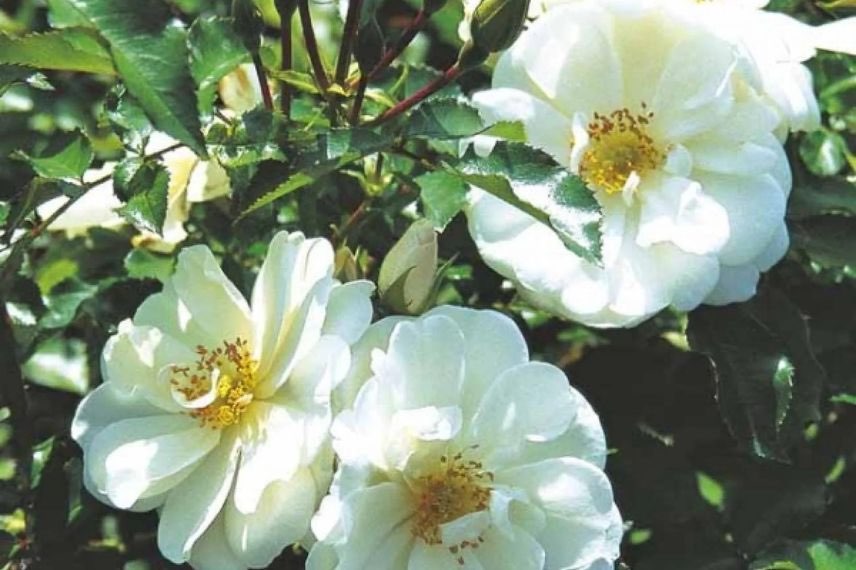
The rose ‘Opalia’®, a prominent member of the Decorosiers collection, is a variety that stands out for its early and prolonged flowering, dressing the garden in white from spring to autumn. Its semi-double corollas of remarkable purity integrate harmoniously into all floral displays and create a striking contrast with the surrounding foliage. Opalia’s dark, glossy foliage, disease-resistant, is semi-evergreen and remains decorative during mild winters.
Cultivation is easy, whether in a pot or in the ground, adapting perfectly to various climates and soil types, making ‘Opalia’ ideal for all gardens, of any size.
Listed among modern, shrub and landscape roses, ‘Opalia’ is heat-tolerant, forming a dense, slightly domed, spreading shrub, extremely floriferous from May to October. It pairs harmoniously with many perennial plants, notably geraniums or lavender.
The Decorosiers ®, renowned for their spreading habit and versatility of use, offer long and remarkable flowering on healthy, glossy foliage. With prestigious distinctions such as eight gold medals and six ADR labels, testifying to their exceptional disease resistance without the use of pesticides, they embody excellence in shrub roses. The ADR label, proof of superior quality, ensures that each variety has undergone rigorous tests in diverse environments, guaranteeing hardiness, longevity and abundant flowering. It is therefore an interesting criterion if you are looking for a particularly robust variety.
- Subscribe!
- Contents

Comments