





























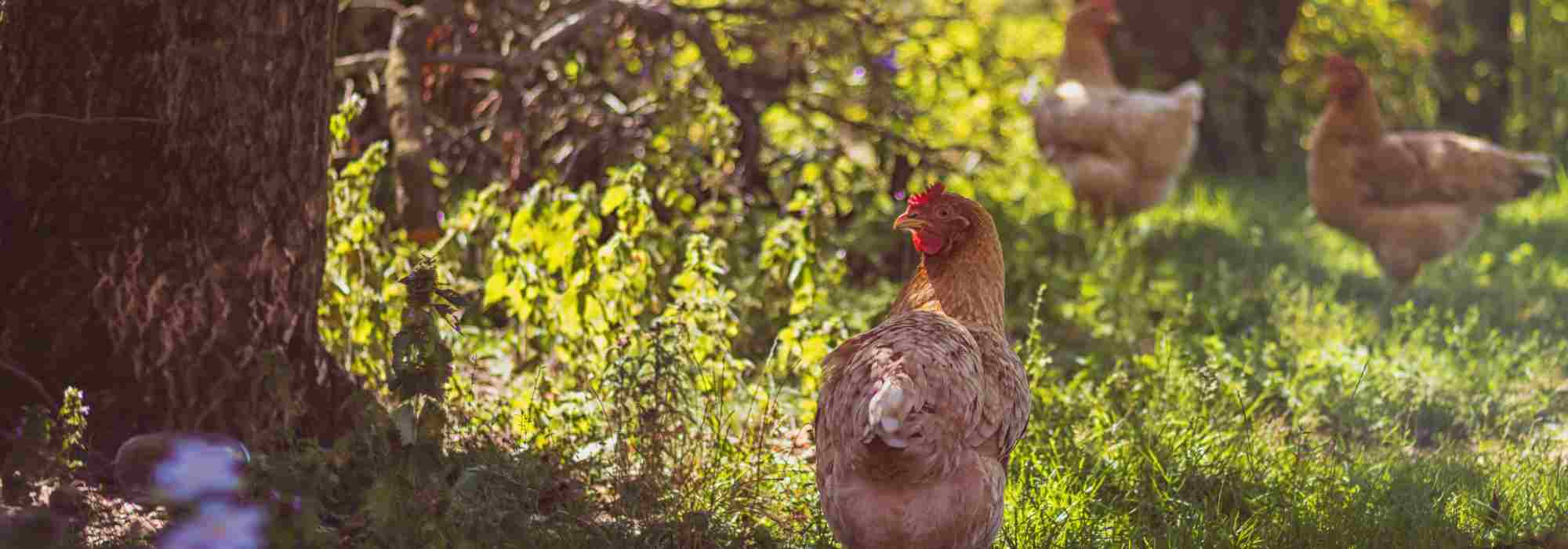
Keeping hens in the garden: a practical guide to successful cohabitation
How to reconcile hens with a vegetable garden or an ornamental garden? Our practical solutions and ideas
Contents
Whether you’re thinking of keeping a few hens or you already enjoy their charming company, one question inevitably arises: what will become of my lovely garden or my vegetable plot? And the question is perfectly valid, since hens are known to be efficient destroyers. Relentlessly, they scratch at the soil with their feet, their claws sharp, in search of a few insects to peck at. And the beak is just as effective at pecking the smallest blade of grass. Nevertheless, these birds repay you handsomely by giving you (nearly) daily delicious fresh eggs. They can also, indirectly, contribute to the fertility of your vegetable plot thanks to their droppings, particularly rich in nitrogen. Finally, they help you dispose of your kitchen scraps with a steady appetite, preventing waste.
So, how do you reconcile gardening with keeping a few pullets? How can you prevent your hens from wrecking what you sow, plant, hoe, weed and tend with passion, whether in your ornamental garden, your lawn or your vegetable plot? As the owner for several years of four especially lively and dynamic pullets, I share with you my tips and ideas (tested, approved or discarded!) to protect your garden and your vegetable plot.
Our tips for protecting your vegetable garden
To set the scene, an anecdote! Or rather a mishap that happened to me a few months after adopting my first pullets. Pressed for time, one day I forgot to close the gate marking the entrance to my vegetable garden. My four young pullets didn’t take long to stake their claim on this blessed soil. And the havoc matched their appetite. Of my beautiful lettuce heads just ready to harvest, of my spinach, nice and green, ready for picking, of radishes with tempting tops… there wasn’t much left! As for the tomatoes, already nicely red, they’d only been pecked. In short, my pullets had greatly enjoyed their stay in my vegetable garden! Which is why I now always ensure the vegetable garden is securely closed.
That is indeed the priority! To stop your chickens from invading the space set aside for the vegetable garden, the best solution is a permanent fence. If I personally opted for a wooden barrier, fairly decorative, a simple chicken wire and pickets may suffice. However, make sure the entrance gate is perfectly stable and sturdy enough to withstand opening and closing. You should aim for a height of at least 1.2 to 1.5 m, because, contrary to some common misconceptions, chickens can fly short distances. The other option is to trim the tips of a few feathers on one wing to unbalance your chickens in case of flight.
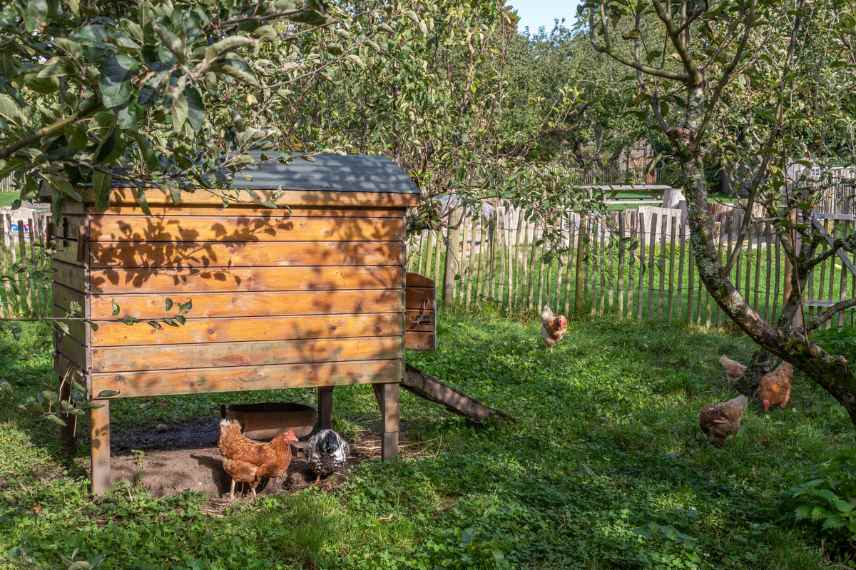
Chickens need to be channelled to prevent damage to the vegetable garden
If you have a small vegetable garden, you can also build very simple structures, quite like tunnels, with a few stakes and chicken wire. These installations will be placed over young seedlings or vegetable plantlets just transplanted into the garden. Mobile, they move with the progress of the crops.
Finally, the third option is the raised-square vegetable garden. About 1.5 m tall, these gardens are perfect for growing a few vegetables on a terrace, a balcony, or even in a yard or garden. They also spare your back! If your hens are jumpers, simply cover them with chicken wire.
However, as winter approaches and only a few vegetables such as leeks remain, my chickens are let loose in the vegetable garden. And they relish the pest insects that thrive there.
To go further, I invite you to read my article dedicated to this issue: How to protect your vegetable garden from chickens? Our tips to prevent your chickens from taking over.
Letting your chickens loose on the lawn? Good or bad idea?
Your hens have a coop to sleep in at night, safely protected from predators and to lay their daily eggs. Attached to this coop, some owners have decided to add a small enclosed run that keeps them away from predators such as foxes, martens or birds of prey during the day. Yet this small run can quickly become cramped for your hens that crave freedom. And the grass growing there soon disappears under their beaks. And even if you regularly provide chopped grass, weeds pulled from the vegetable patch, or wild plants such as dandelions that they love, your hens need to roam and peck.
So, a little foray onto the lawn can be considered. Of course, provided you have a lawn for relaxation, regularly trodden by children playing football, and not a golf-green lawn, so neatly mown that not a single blade of grass shows! Nevertheless, these outings onto the lawn should be undertaken with a few precautions. You can release your hens a few hours before sunset. Instinctively, as the light fades, they will return to sleep in their coop. Likewise, keep an eye on them as they will quickly scratch the soil in a flower bed or along a border. To avoid this nuisance, simply create a small movable enclosure that you will move daily to a new area of the lawn. Thus, the hens can gorge on grass without causing too much damage to the lawn. If some areas are damaged, simply reseed the lawn and protect the reseeded area. By letting your hens loose on the lawn, you may even spend less time mowing…
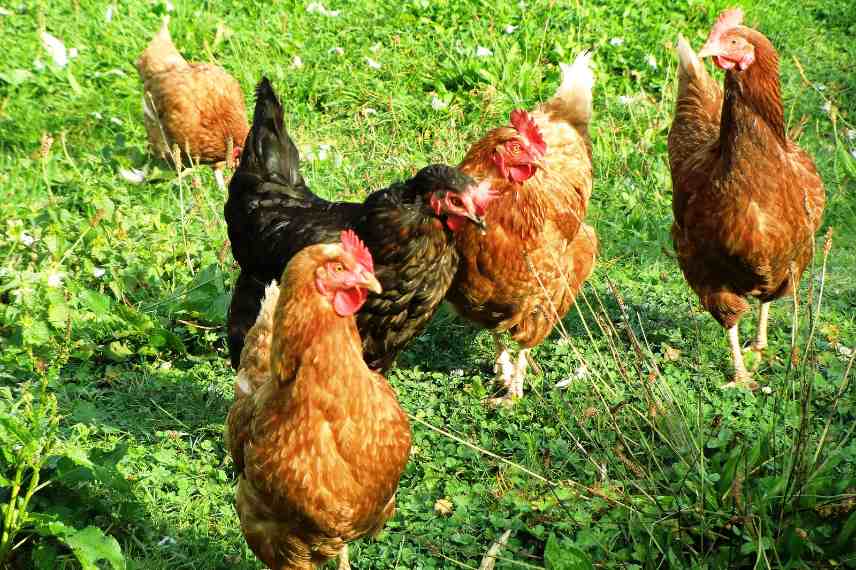
Letting chickens roam on the lawn can be beneficial
Personally, it’s the solution I chose for my hens, which have, so to speak, shifted their daily rhythm to these outing times. And I find my lawn ends up looking better. Indeed, hens pecking at lush, green grass reward it with droppings rich in nitrogen that fertilise the soil. Moreover, my hens’ feet prove very effective at scarifying shaded areas, often overrun with moss or a felted layer, and I simply use a net to delimit the zones I don’t want them to go.
Chickens in your flower beds and borders—shall we talk about it?
From experience, I know that chickens also enjoy scratching the soil in the flower beds and borders. In itself, that’s a very good thing indeed! Simply because, by scratching the soil, the chickens feed on a multitude of insects or gastropods, most of which are considered pests. Thus, chickens are particularly effective at rooting out snails and slugs, the cockchafer larvae or the wireworm, or other pest butterflies. Thus, in an orchard, they are capable of destroying more than 80 % of pest insects… Similarly, they aerate the soil, reactivate the soil’s microbial flora, and curb the proliferation of superficial weeds. And, at the same time, they rarely touch the foliage of herbaceous perennials and shrubs, which is not very appetising to them. Only the raspberry plants, the blueberry bushes, the gooseberries or the berries of elderberry (Sambucus nigra), the mountain ash (Sorbus aucuparia), the holly (Ilex), the firethorn (Pyracantha) may interest them, but without damaging the plant.
If you want to invite them into your flower borders, the laying of an organic mulch (dead leaves, RCW, conifer bark…) attracts them. And again, the droppings will be very beneficial for the plants and the soil microfauna.
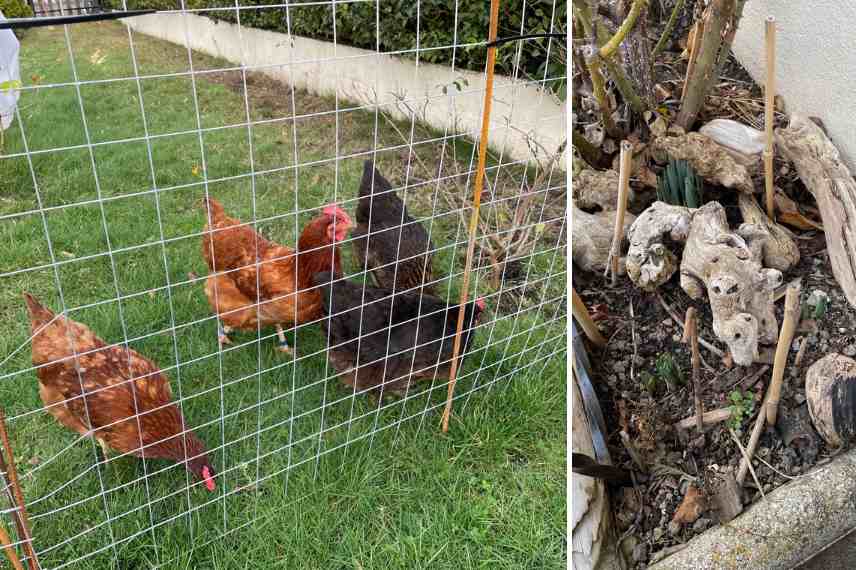
Two systems for guiding my chickens
On the other hand, if you don’t want them to venture into certain vegetated spaces, a few solutions are fairly easy to put in place:
- Plant small wooden or metal stakes or supports vertically in the soil of the flower borders.
- Cover the soil with a mineral mulch such as black pouzzolane in a 20 L bag, or washed slate chippings.
- Install borders 10 to 15 cm high around the borders to prevent soil or organic mulch from spreading onto paths or the lawn.
- Lay poultry netting over the sowings of annual flowers.
- Avoid planting relatively fragile plants such as begonias or impatiens, which will be preferred for planters.
By contrast, chickens rarely linger on patios or paved paths, simply because there is nothing for them to peck at there!
And, on their own, almost instinctively, they will not peck toxic plants. That said, I invite you to discover them in this article: Toxic plants for animals.
- Subscribe!
- Contents
Comments