





























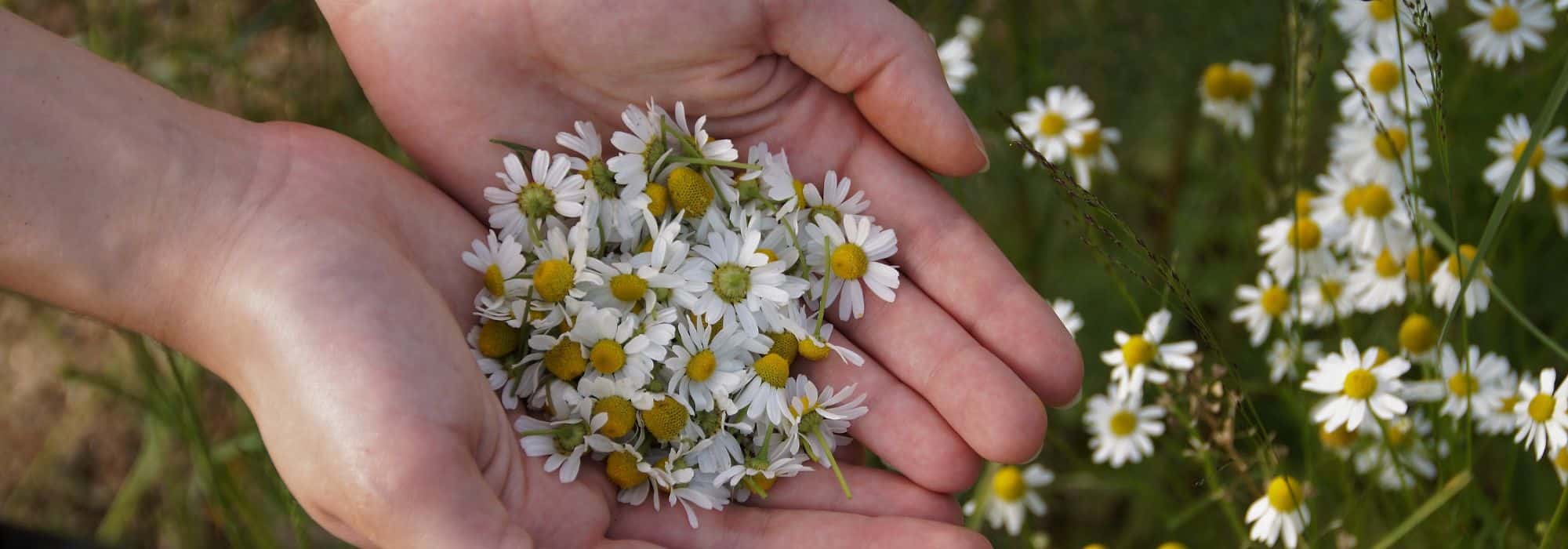
How to recognise camomile? Our guide to getting it right
Tips and advice to avoid making mistakes.
Contents
Chamomile (Matricaria chamomilla), also known as matricaria chamomile, wild chamomile, true chamomile or German chamomile, is an herbaceous annual plant, appreciated for its aromatic flowers resembling small daisies. It has been harvested and cultivated since antiquity for its medicinal properties, notably relaxing and digestive. Its growing popularity has encouraged many gardeners and walkers to pick it, to plant it and to use it in infusion or herbal tea. But how to identify chamomile with certainty? Learn, in this article, to recognise this wild plant and enjoy its benefits safely.
→ To learn more, browse our full profile on Chamomile: cultivation, harvest, benefits.
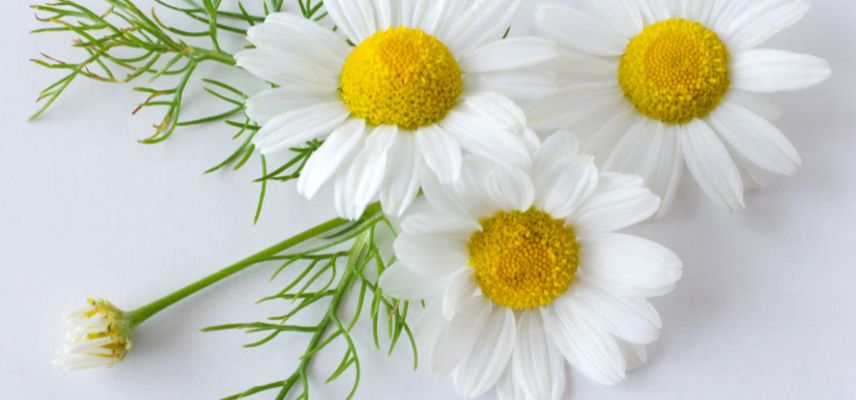
Matricaria chamomilla

Examine the flowers.
The flowers of true chamomile are recognisable by their white ray florets arranged around a conical yellow head. The white ray florets are oriented horizontally or downwards.
Botanically, each flower is, in fact, a capitulum, i.e., the yellow head is formed of numerous tiny tubular flowers and white ligulate (tongue-shaped) petals arranged in a crown around this head. They are typical of flowers in the Asteraceae family and measure between 1 and 2.5 cm in diameter. Each flower sits atop a long peduncle, emerging from the plant’s main axis.
The flowering of German chamomile extends from May (depending on the region) to October.
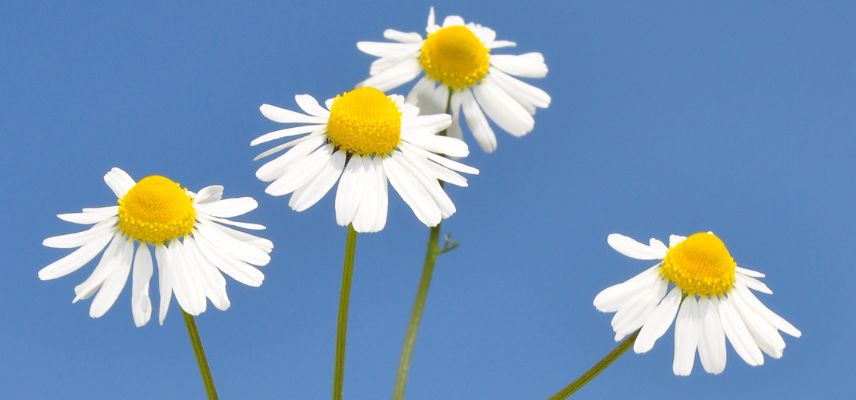
German chamomile flowers
Observe leaves and stem.
Leaves of German chamomile are fine and divided, presenting a feathery appearance. They are arranged alternately along the stem, which contributes to the plant’s light, airy appearance. The colour of the leaves varies from medium green to dark green, and they can reach up to 5 cm in length.
The stem, for its part, is generally erect, cylindrical, ramified and can reach 15–60 cm in height. It is relatively slender but robust, enabling the plant to bear several flowers.
The stem is glabrous, meaning it is smooth to the touch, without hairs. Its colour ranges from light green to dark green.
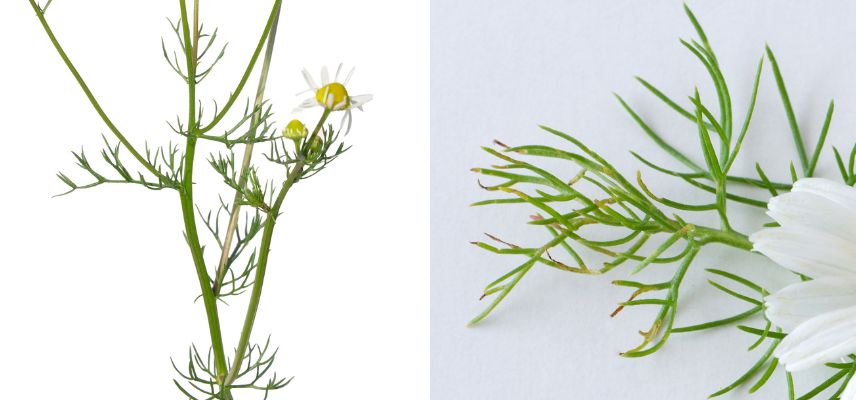
Leaves of German chamomile
Other characteristics
Its scent:
The scent is another distinctive feature. German chamomile releases a sweet, aromatic fragrance when its leaves or flowers are crushed, reminiscent of apples, which explains the etymology of its name (the Greek for ‘apple of the earth’).
Its habitat:
This plant prefers dry to moderately moist soils and sunny areas. It is often found in fields, along paths, and in disturbed areas where the soil has been recently turned.
Lifespan:
German chamomile is an annual plant.
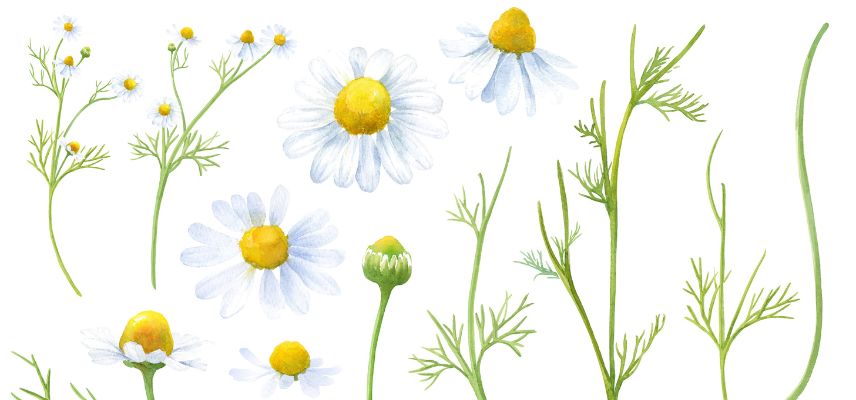
Drawing of true camomile
Read also
How to dry chamomile flowers?Other species not to be confused with
When identifying German chamomile (Matricaria chamomilla), it is essential to distinguish it from other similar species to avoid any confusion, particularly due to their distinct uses and properties. Here are a few plants commonly confused with chamomile:
Roman chamomile (Chamaemelum nobile or Anthemis nobilis):
Although sharing the name ‘camomile’ and some uses in herbalism, the Roman chamomile stands out for its flowers whose centres are less prominent and flatter.
Its leaves are dark green, glossy and have a smoother texture than those of German chamomile. They are also more rounded and less deeply cut.
Roman chamomile is a perennial, unlike German chamomile which is an annual.
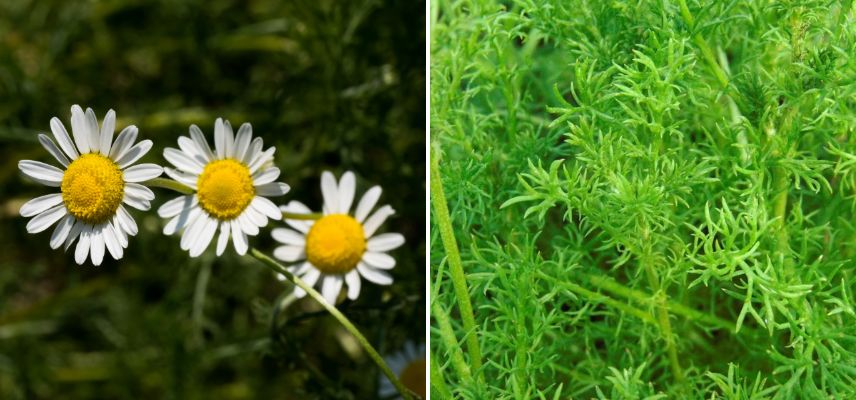
Roman chamomile
The scented Matricaria (Matricaria discoidea) :
The scented Matricaria, sometimes called false chamomile, distinguishes itself by the absence of white ray florets.
It also has a strong, characteristic scent when its leaves are crushed, often described as being similar to chamomile, but with muskier notes and compared to the aroma of pineapple.
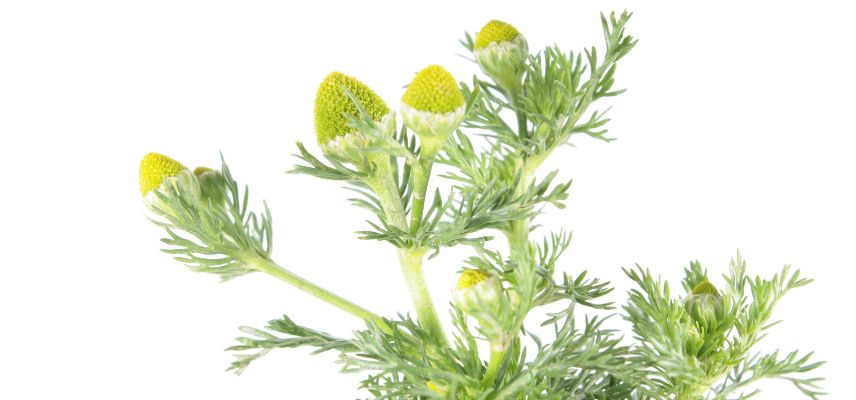
Scented Matricaria
Field chamomile (Anthemis arvensis) :
This plant emits a less pleasant, more herbaceous, slightly bitter and less strong scent compared with German chamomile. The flowers are generally larger and the centre of the flower is flatter.
The leaves of field chamomile are pale green, alternate, and deeply cut, giving an almost dentate or lacerate appearance. They are also coarser.
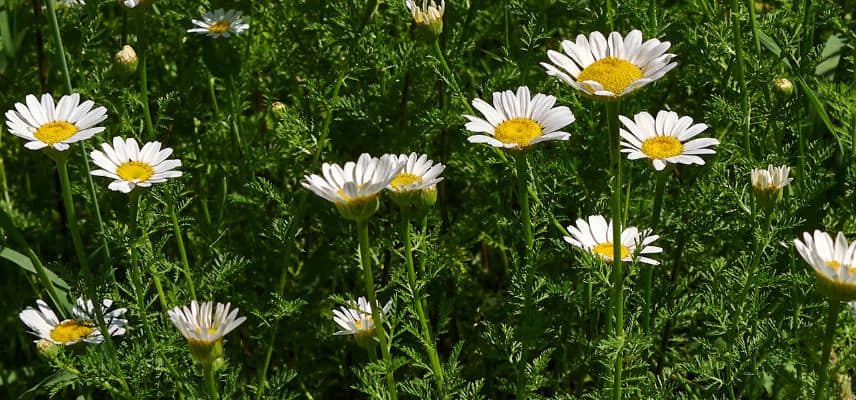
Field chamomile
Feverfew (Tanacetum parthenium) :
Feverfew has a strong and somewhat bitter aroma, distinctly different from the sweet and fruity aroma of German chamomile.
Its flowers are smaller and the centre of the flower can be less conical.
Its leaves are dark green, broad, and deeply cut, with a dentate appearance. They differ markedly from the finer, feathery leaves of German chamomile.
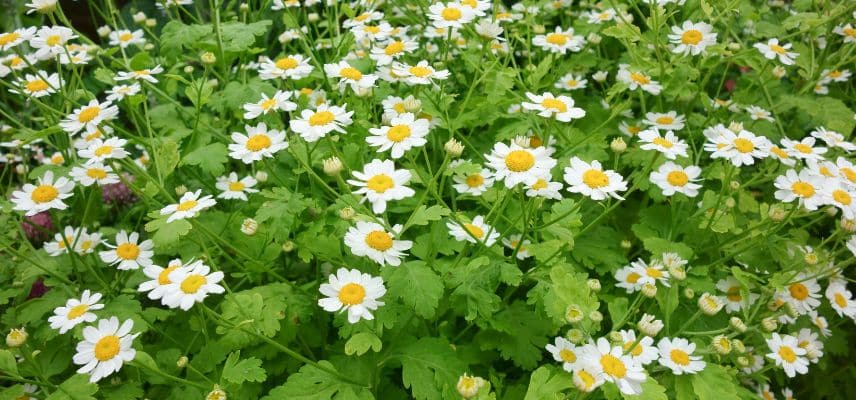
Feverfew
Latest tips
Remember that wild harvesting should always be undertaken with care:
- Never eat a wild plant unless you are certain of its identification.
- Avoid harvesting your plants near polluted areas: roads, railways, etc. Also avoid grazing areas (where liver fluke may be present) and potential animal faeces (including dog faeces!).
- Wash the plants after harvest to remove dust and other substances unsuitable for consumption.
- Only take a small quantity of plants to avoid disturbing the local ecosystem.
- Wild chamomile harvesting is regulated in certain regions. Check with local authorities before harvesting.
- Subscribe!
- Contents
Comments