





























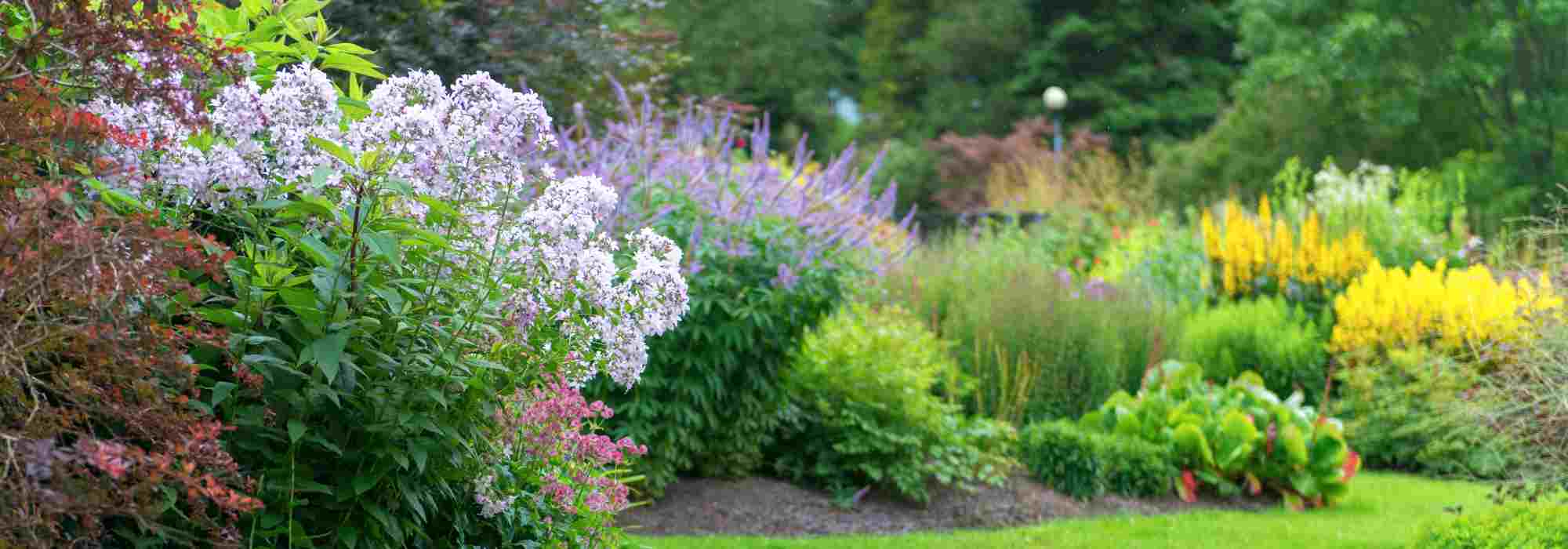
How to look after your garden in summer?
Watering, mulching, flower bed maintenance and lawn mowing: summer gardening tasks
Contents
For many, summer is synonymous with holidays, rest, the beach and fine sand. On the other hand, those who own a garden know that summer is not entirely about lounging. To make the most of your garden, you’ll need to give it at least a little attention! Indeed, the scorching heat, heatwaves, drought and total lack of rainfall put ornamental plants and the lawn to the test. A minimum of care is required to keep a flowering and fragrant garden. If this maintenance asks you for a few (small) efforts, you’ll have plenty of time to enjoy the beauty of a thriving garden, feet up on your sun lounger. And you can go on holiday with peace of mind, certain that your garden will withstand your absence.
Discover all our tips for caring for your garden during the summer period to make the most of your holidays.

Watering to compensate for the lack of rainfall
It goes without saying that you need to water in summer! Indeed, a lack of water seriously harms the health and growth of plants. Simply because water is essential for photosynthesis. Thus, the plant benefits from essential nutrients for its development, flowering, and fruiting. Without water, a plant suffers, becomes stressed, wilts, anaemic… and ends up dying. However, in summer, rainfall is scarce, especially during periods of heatwaves and recurring drought. So, you must water. But not just any old way or at any time!
First, we would strongly recommend installing rainwater harvesters all around, starting in winter. That way, when summer arrives, the tanks will be full.
Next, it is essential to use water efficiently by watering correctly. Thus, it is not advisable to water every day in small amounts, but rather generously once or twice a week, or even three times if a heatwave persists. This watering method is very beneficial, as it allows plants to establish a robust root system to reach water as deeply as possible. A plant that is watered daily becomes more susceptible to drought because the root system is shallow. Overall, it’s better to wait until a plant shows some signs of thirst rather than watering daily. For that reason, the drip irrigation system or the porous hose are also very effective for those who have plenty of rainwater at their disposal.
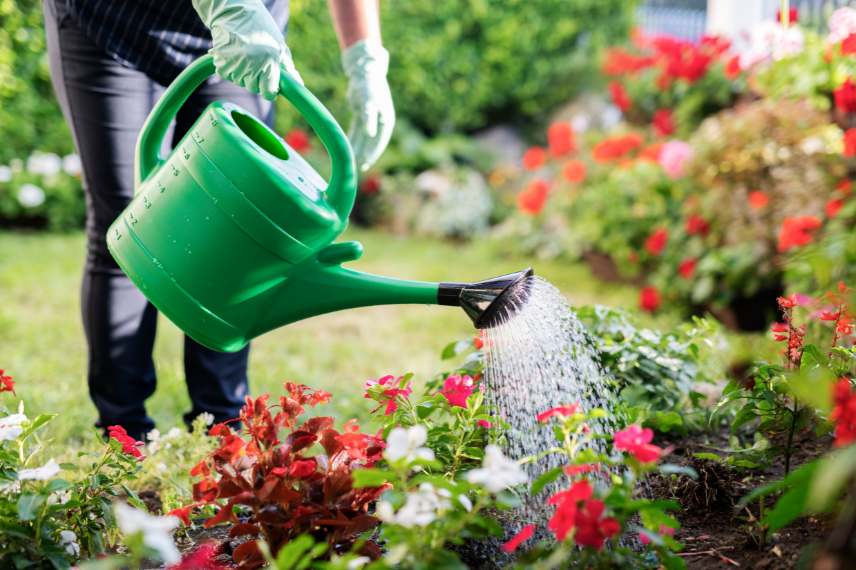
A weekly, long watering is more effective than daily, short waterings
Obviously, for young plants and bushes, newly planted in spring, watering will be heavier and more regular to encourage their recovery. Without water, they risk withering very quickly.
In summer, it is also essential to choose the best time to water. In this regard, two schools of thought clash: those who water very early in the morning and those who water very late at night. Both practices help to limit evaporation, directing water straight to the roots. If you’re an early riser, take the opportunity to water the garden. If you prefer a lie-in, opt for watering at nightfall.
Also think about watering without wetting the foliage, right at the base of the plants. It is the best way to prevent the proliferation of certain cryptogamic diseases.
To go further: Watering the garden: how to do it?
Read also
Survival guide for the garden in summerMulching generously to retain moisture
The second gardening maintenance tip is mulching to prevent the soil in your flower beds and borders from being bare. Mulching isn’t limited to the vegetable garden. For reference, mulching helps to limit evaporation of irrigation water by forming a physical barrier. Similarly, it reduces soil erosion and prevents the formation of a surface crust. Thus, watering is more effective and mulching helps retain a degree of moisture. It also has the ability to lower soil temperatures. Beyond these benefits, mulch helps suppress the growth of certain weeds and provides nutrients as it decomposes. All ornamental plants can be mulched, from perennials in beds to hedge shrubs.
There are several types of mulch, but for ornamental gardens you should favour organic, biodegradable and aesthetically pleasing mulches. Even if you can always use home-made mulches such as lawn clippings, dead leaves, compost… which may ultimately be more useful in the vegetable garden.
In beds and borders, at the foot of hedges, mulches such as shredded branches from shrub pruning offer numerous advantages. Of course, you’ll need to buy a garden shredder, but it can be a very useful and cost-effective investment. For instance, commercial mulches such as flax flakes in 120 L bags, miscanthus in 70 L bags or hemp in 70 L bags, buckwheat hulls in 60 L bags, and pine bark for ericaceous plant beds are perfectly effective, but more expensive. Cocoa hulls or coconut fibres are less eco-friendly.
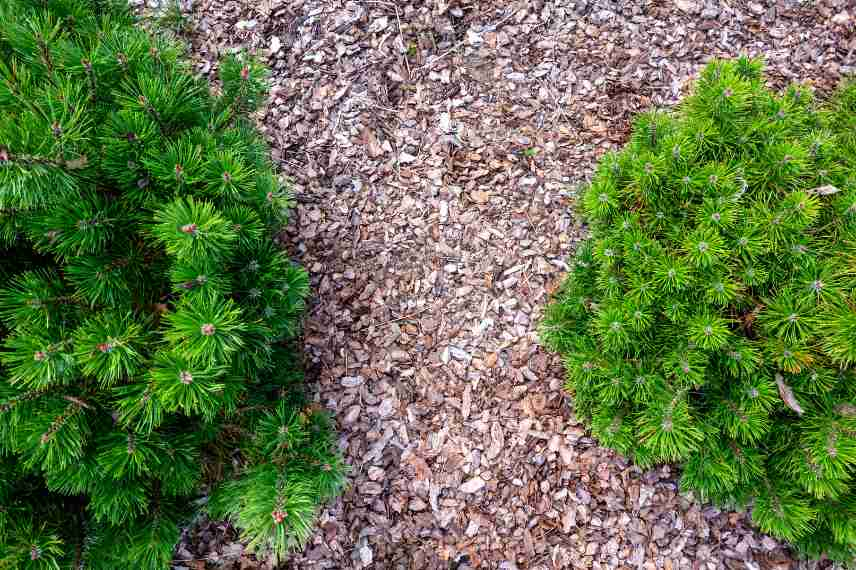
Among the different mulches, shredded branch chippings are ideal for beds and borders
Ideally, mulch should be applied in spring, but you can still do it in summer. To maximise its benefits, a few steps are required before mulching:
- Loosen and aerate the soil with a hoe to a depth of 5 cm
- Remove weeds carefully
- Water
- Spread a good layer of mulch evenly, taking care not to cover the collars of the plants. 5–10 cm is usually sufficient, depending on the mulch.
By contrast, succulents, cacti and rock-garden plants, all drought-tolerant, prefer mineral mulches. Organic mulches may cause their root system to rot.
To learn more: All our articles on mulching
Providing shade to reduce heat stress
In the height of summer, in the sweltering heat, what could be more pleasant than a little shade to bring the temperature down?
If it’s true for you, it’s true for plants too, which endure assaults from solar radiation and temperatures up to 40°C. For some, it’s a guaranteed scorcher! And the consequences don’t wait: the foliage withers, wilts, even burns… and the plant dies. This phenomenon is certainly even more pronounced for potted plants.
Obviously, regular watering and mulching help limit heat stress. But sometimes it’s not enough. That’s why we must provide shading solutions for our plants.
As temperatures rise and the heat settles in, don’t hesitate to move all your annuals, biennials or perennials grown in pots to a partly shaded to shaded spot. Nevertheless, you must not deprive them of light. So a space with morning sun is ideal.
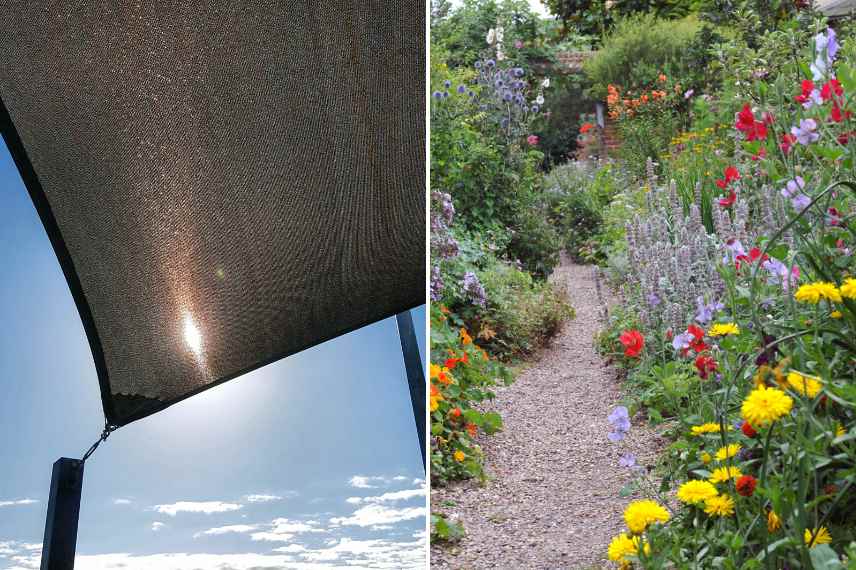
Shade solutions can significantly lower the temperature in summer
For border or bed plants, shading solutions are more difficult to implement. Upside-down crates are suitable for low-growing plants; shade sails, purchased commercially or homemade with an old sheet, a jute cloth, a scrap of fabric… are perfect for lowering the temperature.
To discover more clever solutions, transferable to ornamental gardens: Shade the vegetable garden and its vegetables in summer.
Read also
Maintaining the lawn during a heatwaveCarrying out minimal maintenance of your flower beds and borders
In summer, early in the morning or late in the evening, it is advisable to spend a little time in the garden giving your plants a quick deadheading. These few care tasks consist solely of removing spent flowers. First, for aesthetic reasons, not to be overlooked in an ornamental garden. But more importantly, to prevent your annuals, biennials or perennials, bushes or roses from wasting energy in order to ensure their survival by forming fruit and seeds. In addition, removing spent flowers daily stimulates the onset of new flowering.
This small, simple gesture that takes only a few minutes also allows you to check for the possible presence of parasites or any disease. The sooner these pests or symptoms of fungal or viral diseases are detected, the easier they will be to treat.
Leaving your shrubs and lawn alone
This final piece of garden maintenance advice is certainly the easiest to carry out!
Indeed, in the height of summer, it is now advised not to mow your lawn, or to mow only sparingly. The mowing frequency, of course, depends on the region in which you live. Thus, in regions that benefit from some summer rainfall, mowing intervals will be longer and the grass will be taller. Conversely, in very hot regions, or during heatwaves or drought, it is best not to mow. During these very hot periods, the blades of grass go into dormancy and stop growing. So the mower is unnecessary. Admittedly, the lawn will turn yellow and dry out, but at the first rainfall, the blades of grass quickly turn green again. As for watering, it is not strictly necessary, particularly from an environmental standpoint. Perhaps it is better to prioritise the vegetables in your vegetable patch than, at all costs, trying to have a lush green lawn…
On the hedge shrubs side, we also advise doing nothing (apart from mulching). The pruning of hedge shrubs is discouraged until mid-July to promote biodiversity. Garden birds nest there and shelter there, as do insects, which are very useful for pollination.
And finally, get ready for your holidays!
It’s time to pack your swimsuit or your walking boots into your suitcase. Holiday time has arrived! You need to prepare your garden for the holidays. Of course, asking a neighbour with a green thumb whom you trust for gardening is the best solution. If you don’t have the ideal neighbour on hand, there are a few precautions to take. Start by giving everything a thorough soak and mulching the soil (if you haven’t already). Next, carefully remove all faded flowers or those that are fading. Finally, in borders or in pots, install watering systems such as oyas.
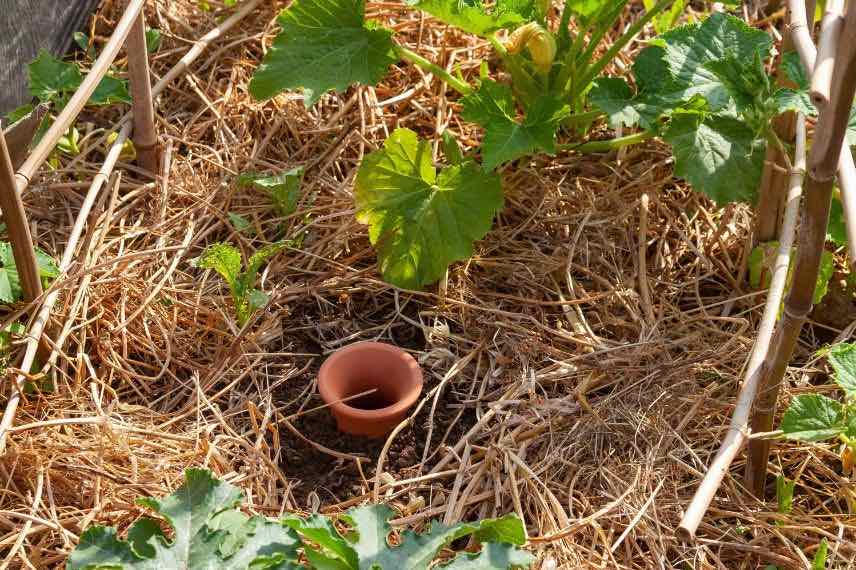
Ollas are perfect for keeping plants moist
Here are two articles to help you explore this system:
The inverted plastic bottle system is also effective, but not very attractive, both in flower beds and borders as well as for potted plants.
- Subscribe!
- Contents
Comments