





























How to design a wall garden?
Our ideas and tips for greening a walled garden
Contents
Surrounded by walls, fences or buildings, enclosed gardens can be tricky to design. Space is limited, and the walls can sometimes cast significant shade, limiting the choice of plants that can be grown there. These gardens have very specific constraints that must be taken into account when choosing suitable plants and creating a harmonious and pleasant outdoor space. Whatever style of garden you want to achieve, we share all our tips to carefully plan an enclosed garden!

What are the constraints of a fenced garden?
- The main constraint of an enclosed garden is usually the lack of light, as the walls cast shade. This shade varies, however, depending on the height of the walls: in a courtyard surrounded by buildings the walls will be particularly tall, casting substantial shade over the garden.
- Another constraint of the enclosed garden can be the lack of space. These are often small gardens, monastery gardens or urban inner courtyards. It will then be necessary to optimise the space and choose compact, low-growing plants.
- It will be important to take the surrounding context into account, notably the style of the buildings and walls, to create a harmonious space.
- The walls can create a feeling of confinement, and are sometimes a little oppressive. We will counter this feeling by dressing them with vegetation! Transforming this constraint into an advantage, the walls can serve as supports for climbing plants and provide ideal conditions for shade-loving plants by sheltering them from the sun.
In contrast, enclosed gardens are generally sheltered from the wind by walls or buildings all around the garden. This can also create a microclimate somewhat more favourable for growing less hardy plants.
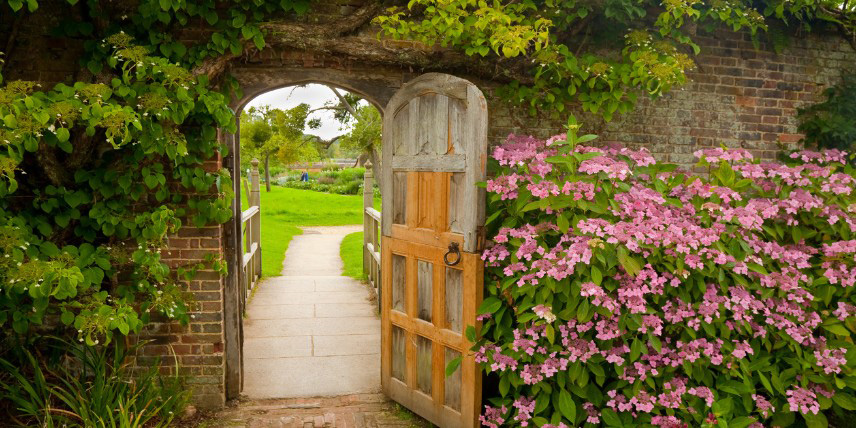
Depending on their height, the walls can feel a little oppressive; don’t hesitate to cover them with plenty of vegetation
Read also
7 trees for small gardensHow to design a walled garden?
Walled gardens are not the easiest to design, as one must take into account the various constraints we’ve just outlined. Here are, however, a few tips to help you get the most out of your garden layout:
- Install climbing plants to dress the walls.
- If light is low due to the walls, choose shade-tolerant plants.
- Also favour variegated, bright or colourful foliage, to make them stand out and to bring brightness.
- Consider the style of the garden and the buildings: we won’t landscape the garden in the same way if it is a French-style garden, a vicar’s garden, or a more contemporary urban garden…
- Play with shapes and heights, to break up the linear and oppressive feel of the walls. For example you could create rounded beds and spaces or wave-like shapes, with different levels of vegetation. A terrace or a raised bed could also break up the monotony of a rather flat enclosed garden.
- If it’s a low stone wall, it can be worthwhile to plant along the top of the wall.
- In any case, you can plant vegetation against the wall and perhaps create a green wall.
- If the garden is small, plant along the walls, outside the space, and in the centre, a terrace with a garden seating area.
- Likewise, you’ll need to optimise the space, perhaps by creating a main path leading to the garden, then several defined spaces: terrace, vegetable plot, flowering beds…
- Don’t hesitate to install outdoor lighting so you can enjoy it in the evenings.
- Avoid overly artificial, concrete or tarmacked surfaces, as they could reinforce the oppressive feel of adjacent walls or buildings. Prefer lawns, with perhaps Japanese stepping stones to delineate the paths.
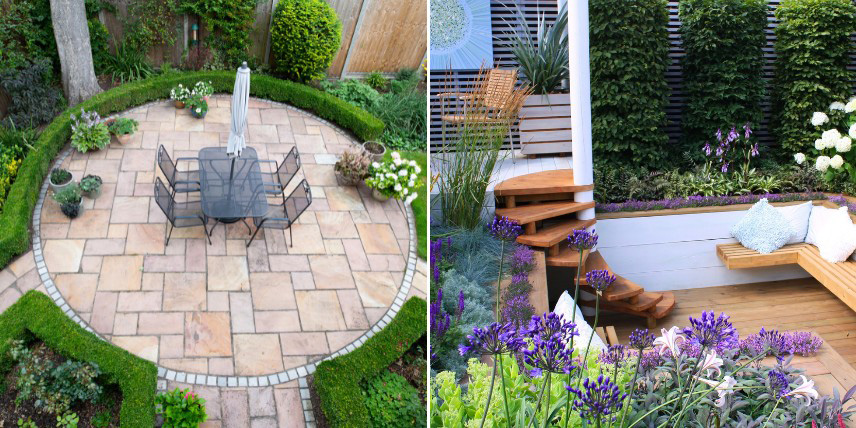
Add rhythm to your garden with rounded shapes to counteract the linear look of the walls. Don’t hesitate to create different spaces, some of which you will elevate (beds, terraces…).
Which plants should I choose?
It all depends on the style of garden you want to create! To help you decide, consider the surrounding setting: if the buildings are old, with fine architecture and stone walls (monastic garden, historic monument…), it may be wise to lean towards a vicar’s garden or a French garden. However, if the setting is more modern and urban, a contemporary and graphic garden will probably be more suitable.
In any case, if the garden is heavily shaded by the walls, we’ll of course choose shade-loving plants, which will appreciate being sheltered from the sun: ferns, hostas, hakonechloa, geranium nodosum, heucheras, periwinkles, Japanese anemones, carex, ophiopogon… The choice is wide! Do not hesitate to consult our entire range of shade-loving perennials, as well as our advice sheet: “Designing a shady border: which plants to choose?”
Here are also some ideas for climbing plants to dress the walls: variegated ivy, climbing hydrangea, Schizophragma, Akebia, honeysuckle… For more ideas and inspiration, discover our advice sheet: “Climbing plants for walls and façades: which ones to choose?” and “A wall in the garden: our ideas for dressing it up”
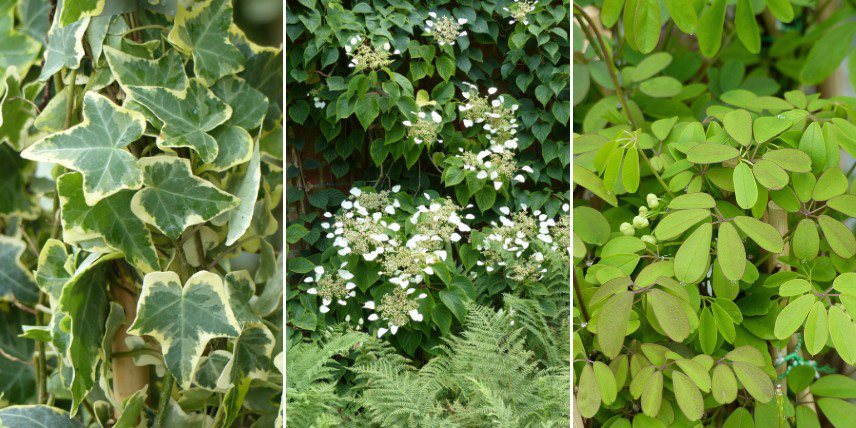
Variegated ivy Hedera helix ‘Goldchild’, Schizophragma hydrangeoides and Akebia quinata
According to your garden style:
- For a contemporary garden : choose plants with fine and graphic foliage. We particularly recommend bamboos, ferns, carex, hakonechloa, Japanese maples, Fatsia japonica, Nandina domestica, birches (notably Himalayan birch, Betula utilis ‘Jacquemontii’)… For the flowering, include Alliums, agapanthus, echinops, Gaura lindheimeri… We favour restrained colours: white, purple, black, burgundy… Discover our advice sheet “10 graphic plants, perfect for modern gardens”
- To compose a French-style garden : install straight-edged borders of pruned shrubs, and possibly a few topiaries. Traditionally box is used, but you can replace them with Lonicera nitida orIlex crenata, less prone to pests and diseases. In the centre of these defined spaces, plant shrubs and flowering annuals or perennials (marigolds, calendulas, coreopsis, yarrow, cosmos…), as well as roses. Yews and hornbeam hedges also integrate wonderfully into this garden style. Do not hesitate also to enhance your garden with sculptures, small fountains or ponds.
- In the case of a vicar’s garden : you should include aromatic and medicinal plants (sage, fennel, wormwood, bay, chamomile, rosemary, St. John’s wort…), as well as heritage vegetables and small fruit trees (gooseberries, raspberries…). Create vegetable-and-flower beds bounded by small hedges of Lonicera nitida or Ilex crenata. Explore our range of perennial plants for vicar’s gardens, as well as our advice sheet: “How to design a cottage garden?
- To design a cottage garden : typically English, cottage gardens are lush with a very natural style, often small in size and surrounded by stone walls. They are perfect for showcasing a pretty old house. The borders teem with plants and bring together flowers, vegetables, aromatic plants, and small fruit trees… Everything is mixed! In terms of colours, choose soft, pastel tones: purple, blue, pale pink, apricot, orange… Some ideas for perennials for a cottage garden: Alliums, Oriental poppies, verbascums, delphiniums, hardy geraniums… Also, against a wall or on a pergola, add a few climbing roses and clematis.
- In the case of a large enclosed garden in a relatively mild climate, such as in Brittany, for example: this type of garden allows you to create a true exotic cocoon! The walls create a microclimate that shelters the garden from wind and cold, enabling the cultivation of less hardy plants. To create a real exotic atmosphere, focus on lush foliage plants: tree ferns, palms, gunnera, Fatsia japonica, Tetrapanax, bananas and colocasia. For flowering, think of hedychiums, crocosmias, kniphofias…
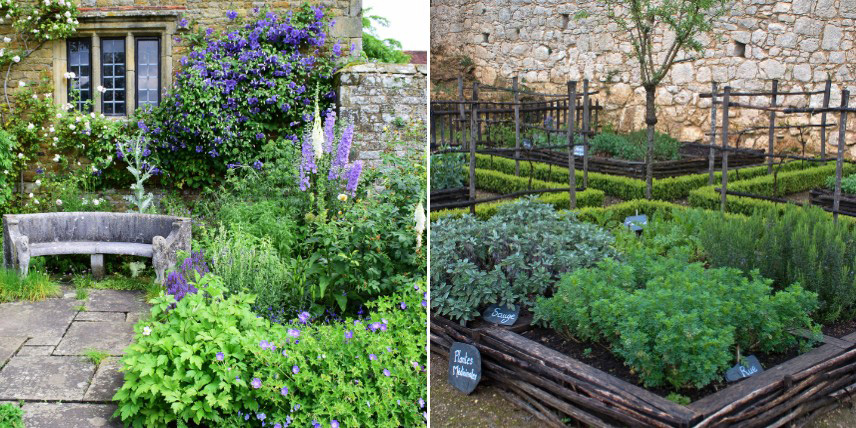 The cottage gardens are typified by stone walls surrounding them. The vicar’s gardens as well, since they were located within the precincts of abbeys and convents. Two very different styles!
- Subscribe!
- Contents
Comments