





























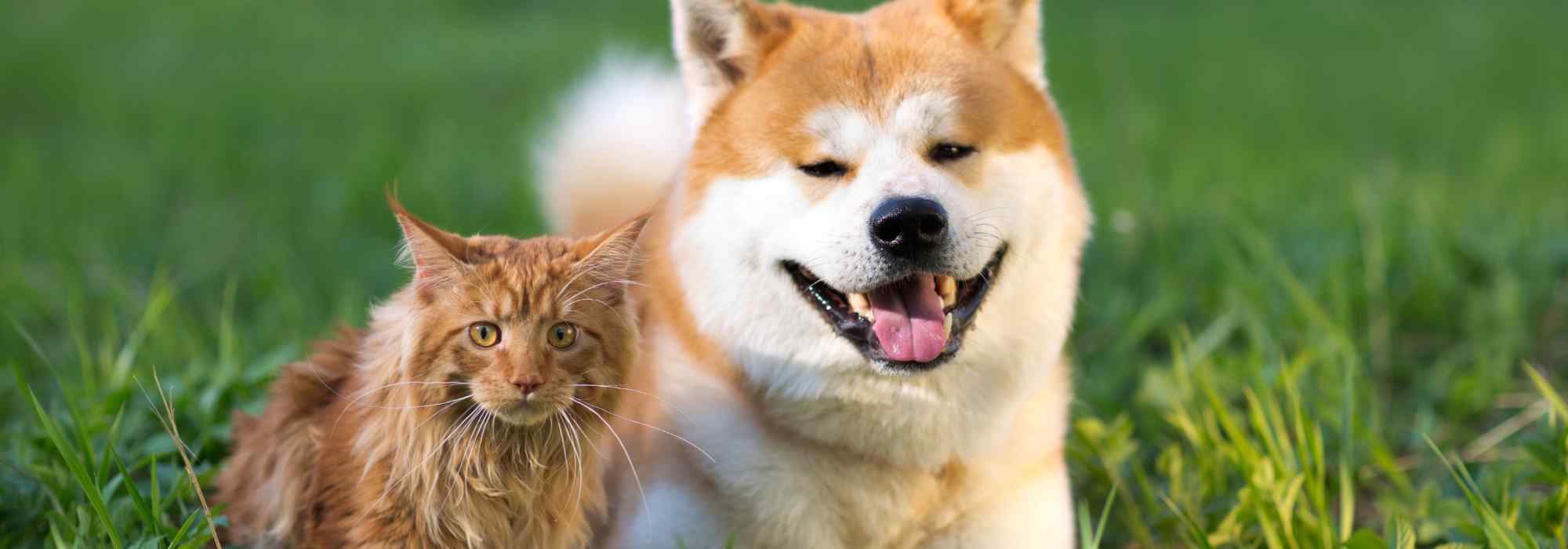
Cats and dogs: how to adapt your garden for your pets?
All our tips and tricks to make your garden pleasant and safe for your four-legged companions.
Contents
Your garden, you love to share it with friends and loved ones around a barbecue. It’s also the perfect place to rest in the shade, lying on a sun lounger, a book in your hands. But this garden, you also dream of turning it into a paradise for your domestic animal, a dog or a cat. Indeed, this garden must also be a haven of peace for your four-legged companions, which means that everything must be done to ensure their welfare, but also their safety. Especially if your dog or cat is still just a puppy. If your animal’s training is paramount, you must also ensure to remove any elements that pose a danger, to avoid escapes, or to provide them with the space they need to live their life as a dog or a cat.
Discover all our tips and ideas for creating a garden suited to your needs and desires but also to the happiness of your hair-bearing companion.

Fencing your garden with care
The fence. This is certainly the most important element in ensuring a pet is welcomed safely. At least for dogs, as cats are considerably more independent and autonomous. Indeed, a well-fenced garden is the foundation for keeping your pet safe, especially if you live near traffic, however small the road may be. Moreover, Article L211-23 of the Rural Code is very clear on this: any dog found in a public place is considered a stray and may be taken to the pound. The law defines a stray dog as an animal that is no longer under the supervision of its owner or out of earshot, or if it is more than 100 metres from its owner. For cats, it’s a little different: a microchipped cat is considered stray if found more than 1 km from home. And if your domestic pet causes an accident, it’s even more complicated…
Needless to say that the fence around your garden is essential. Whether you use mesh, trellis, a wooden palisade or any other system, it must be high enough to prevent your dog from jumping it.
For a cat, it’s more difficult because it loves (and must) to explore its environment. Their natural instincts drive them to mark out and patrol their territory, namely your garden and its surroundings, but also to venture out on the odd excursion. But cats often pay a heavy price due to road traffic. To secure its garden (without creating a blockhouse!), the ideal is to use a fencing material that cats cannot climb, such as PVC, composite or resin, made with opaque slats. It is also possible to create, at the top of the fence, a slanted inward-facing flap to make any passage impossible. Finally, if you want to plant a hedge, keep a good distance between your bushes and the fence. And if you have a tree near the fence, install a smooth cladding high enough to prevent your moggie from climbing it. Finally, as a last precaution, check every nook and cranny carefully because a cat can pass through the smallest gap (if its silhouette allows it!).
Also think about the fence around the vegetable garden, especially if you have a dog fond of digging. For square vegetable plots, always popular with digging dogs, a tunnel system of chicken wire should calm their ardour. Also consider a fence around the chicken coop if you don’t want your dog sharing its games with your hens!
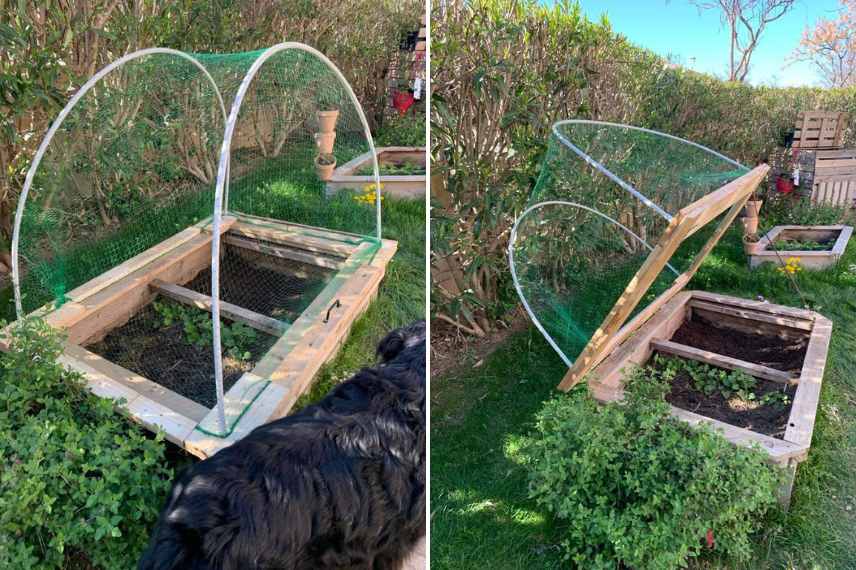
A structure to protect square vegetable plots from digging dogs
And above all, never forget that the best way for your dog to feel at ease in your garden (and incidentally not to cause too many mischiefs there) is to take it out and walk it regularly outdoors.
Read also
Which plants are toxic to animals?Creating welcoming spaces for your dog or cat
To ensure your dog or cat feels at home in your garden, you also need to tailor it for them. That is, to create spaces where they can rest, sleep, relieve themselves, but also play or seek shelter in bad weather during your absence. In short, the garden should be comfortable, welcoming, and pleasant to live in for you as well as for them.
Thus, in summer, you’ll appreciate shade to keep cool. For a dog or a cat, it’s the same! They should have shaded places to rest. If your garden has trees or hedges, your animal will quickly settle under their shade. However, if you only have young plants, plan shade sails, parasols, or even a wooden structure with a roof made of thick boards… where you can let your dog dig to find a cooler spot.
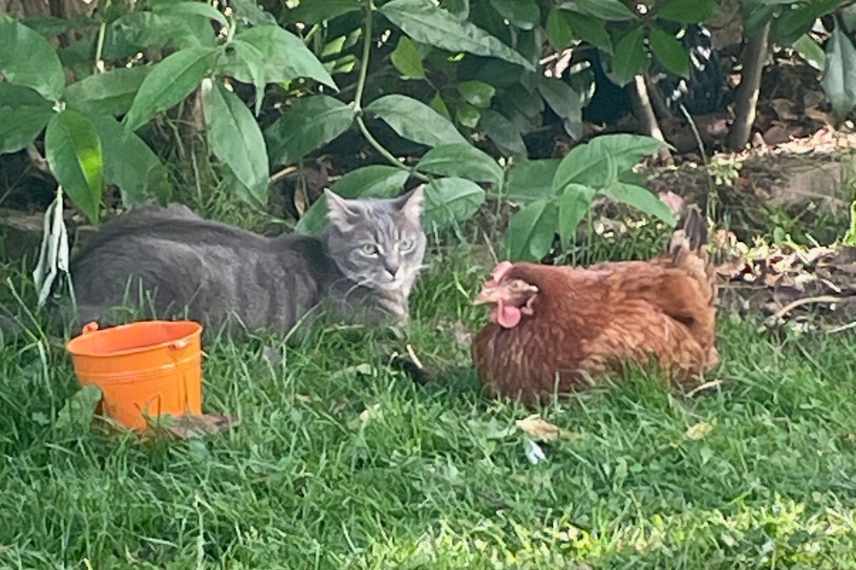
What could be better on a sweltering day than a little nap in the shade!
If your dog can stay alone in the garden while you’re out, and if you don’t have a sheltered terrace, pergola or gazebo, also provide him with a small shelter where he can take refuge in bad weather or storms. This shelter will be raised off the ground on wooden posts and fitted with a removable roof to make cleaning easier.
In terms of lawn, too, a few adjustments are recommended. Ditch the golf-green turf and instead opt for a leisure lawn that is ultra-resistant to foot traffic and to ball or frisbee games with your children. You can also choose a lawn alternative, very robust, such as the Mascarenes lawn (Zoysia tenuifolia) or Phyla nodiflora (Lippia nodiflora).
Also think about your flower borders, borders of herbaceous perennials or shrubs. If you have a puppy, try to train it not to set a paw on them! Alternatively, the installation of a low fence can help it understand that the borders are off-limits. Otherwise, for more stubborn dogs, creating a dedicated scratching area might be a solution… if you have a large garden.
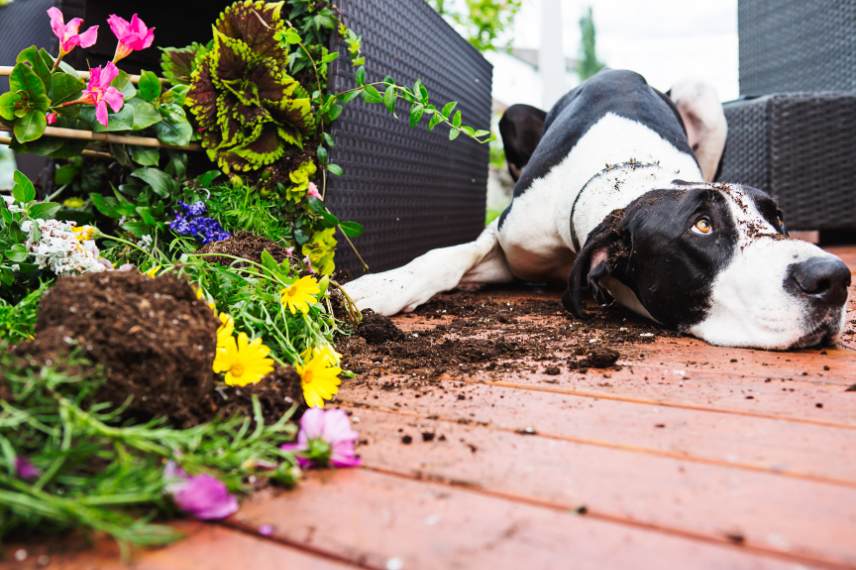 A dog doesn’t necessarily appreciate the beauty of our flower beds!
In a garden, a cat is noticeably more respectful of your borders. Nevertheless, it may tend to dig to urinate. A well-loosened soil is always very inviting for a little wee. It’s also a way of marking its territory. But despite all the love you have for your cat, seeing it scratch in your carrot or radish seedlings, or in the middle of your beautiful flowering perennials, can irritate you a little. Several solutions are possible:
- Mulch the soil of your vegetable patch or borders with RCW, wood chips, fallen leaves, lawn clippings… or any other commercial mulch
- Scatter around the vegetable patch or borders strongly scented materials, not appreciated by cats: citrus bark, coffee grounds, white vinegar, pepper, or garlic or onion peels
- Grow so-called repellent plants such as absinthe, the rue officinale, the geranium macrorrhizum…
- Install an ultrasonic deterrent device with no danger to your cat, and completely inaudible to you.
The tip from Pascale: I adopted my little cat Romy when she was only 2 months old and, very early on, I arranged an outdoor toilet behind a Photinia. Whenever I caught her urinating in my vegetable patch, I would scoop her up and take her to her outdoor litter bed lined with sand and regularly cleaned. She quickly understood and now goes there to do her business when we’re in the garden (even though I suspect she also uses my neighbour’s garden!).
Finally, cats sometimes tend to scratch the trunks of trees. Generally, it’s not harmful to the tree.
One final precaution to avoid a tragedy: use hermetically sealed water storage containers. A cat that falls into one could drown.
Plants to avoid in a garden with pets
By definition, in a garden there are plants, annuals, biennials or perennials, shrubs or trees. Yet some prove highly toxic to our four-legged friends. I’ve already devoted an article to this topic which I invite you to read, especially if you have a puppy or a kitten: Toxic plants for animals.
Also consider plants or thorny shrubs that do not mix well with children but also with domestic animals. A slightly hyperactive dog or a cat pursuing an intruder can quickly, in the heat of the moment, find itself in the middle of a thorny plant. A simple prick can quickly cause irritation or an infection. Therefore roses, the roses, the agaves, yuccas and cacti, the holly (Ilex) or the firethorn (Pyracantha), the Japanese quince (Chaenomeles), the barberry (Berberis)… are to be avoided.
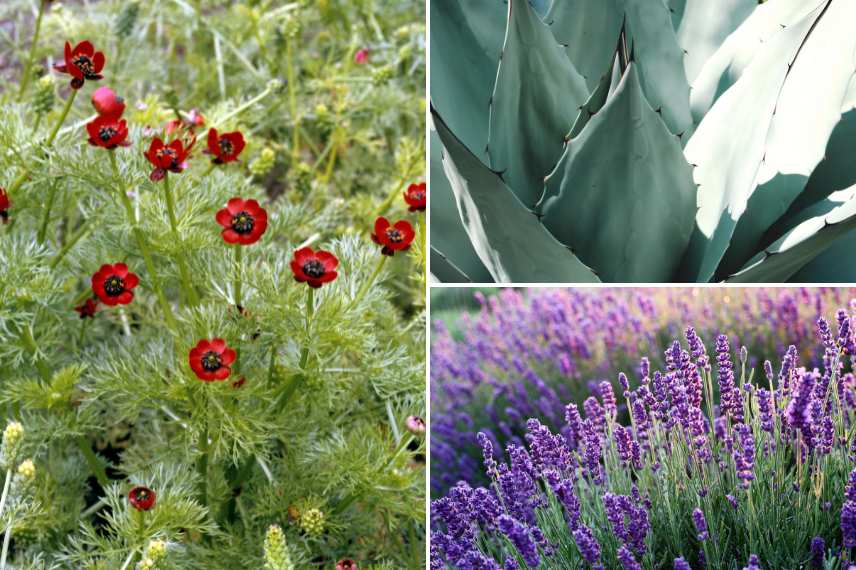
Toxic plants (here Adonis aestivalis), thorny or melliferous, pose a danger to dogs and cats in a garden
If you grow melliferous and nectariferous plants in your garden, you can only commend your efforts to maintain biodiversity. However, these plants quickly become magnets for pollinating insects. And what could be more entertaining for a playful cat or even a dog than these insects buzzing, fluttering and foraging among the flowers? Unfortunately, after the watching phase comes the chase. A dog or a cat trying to seize an insect can quickly get stung. And this simple sting can have very serious consequences for the throat or in the mouth, as it can cause suffocation. Far from me the idea of asking you to remove your melliferous plants… but keep a careful watch on your cat or dog when it roams around the flower beds.
A few final tips...
I will finish this article by reminding you thatthe use of chemical fertilisers, fungicidal products, pesticidal products and other weedkillers, however natural they may be, is never a panacea for your garden and allotment. What’s more, if you have domestic animals, there is always a risk of ingestion.
Finally, one final precaution: when using motorised equipment such as the lawn mower, keep your pets indoors to avoid any risk of accident. And if you are considering buying a robotic lawn mower, think carefully as risks still exist, despite advances in sensors and collision-avoidance systems.
- Subscribe!
- Contents
Comments