





























Designing a North-facing garden
Tips, tricks and ideas for a shady garden
Contents
North-facing gardens are by nature shady gardens. Light is either absent or only sparsely diffused there, presenting a challenge that some gardeners struggle to overcome when designing their outdoor space. Yet, while certain constraints are linked to this environment, a shaded garden also offers advantages which, when well exploited, make it possible to create a garden rich in colour and enchanting, worthy of the most beautiful woodland understoreys. Discover how to make the most of a garden lacking direct sunlight, what tips to apply to optimise its appearance and which shade plants to select to create a welcoming space with a cool, calming atmosphere.

Challenges and benefits of a shaded garden
A garden (or part of one) deprived of direct light is not synonymous with sadness and despair for a gardener. This kind of exposure of course brings constraints and imposes certain limits, particularly when it comes to the planting palette, but it also offers significant advantages and even allows landscaping solutions that are impossible to reproduce elsewhere.
Constraints and limits of a shady garden
- By definition, a garden or a bed facing north does not receive the sun’s direct light, which many plants need to thrive and flower abundantly. Depending on the type of shade, the soil moisture can vary greatly from one area to another.
- The shade cast by a wall is often associated with cool soil, even damp depending on the terrain’s topography, conditions that some plants cannot tolerate, their roots then being at risk of rotting, not to mention the hardiness that is also weakened as a result.
- The presence of trees and their roots results in drier soil, creating competition with neighbouring plants for moisture and nutrients.
- Shaded areas are generally colder than other parts of the garden where the sun manages to impose itself, at least partially, for part of the day. Temperatures take longer to rise and if the winter is severe, the soil may even remain frozen continuously, a factor that again can make the plants growing there suffer.
→ Read also: Light in the garden: exposure, sunlight, shading and brightness
Advantages and prospects
- There is an astonishing range of plants that naturally avoid the sun’s rays in nature and find refuge in areas where they are unlikely to scorch their foliage and make them sweat excessively. These are often, but not exclusively, large-leaved plants. They are adapted to this lack of light so as to still carry out photosynthesis.
- Protected, plants transpire less and benefit from soil whose evaporation is limited, ensuring a substrate that stays cooler than elsewhere. This also saves on watering chores, noting that in some regions and at certain times restrictions, even bans, prevent the gardener from intervening at this level.
- If a north-facing garden takes longer to warm up, this can also be an advantage, because this gradual rise in temperature protects against sudden frosts and thaws that can compromise, or even wipe out, certain flowerings.
- The past years have put us, and our plants, to the test. A shaded corner allows you to create a refuge where it is pleasant to sit to enjoy a few degrees less and some coolness, encouraging you to enjoy the garden even in the height of summer.
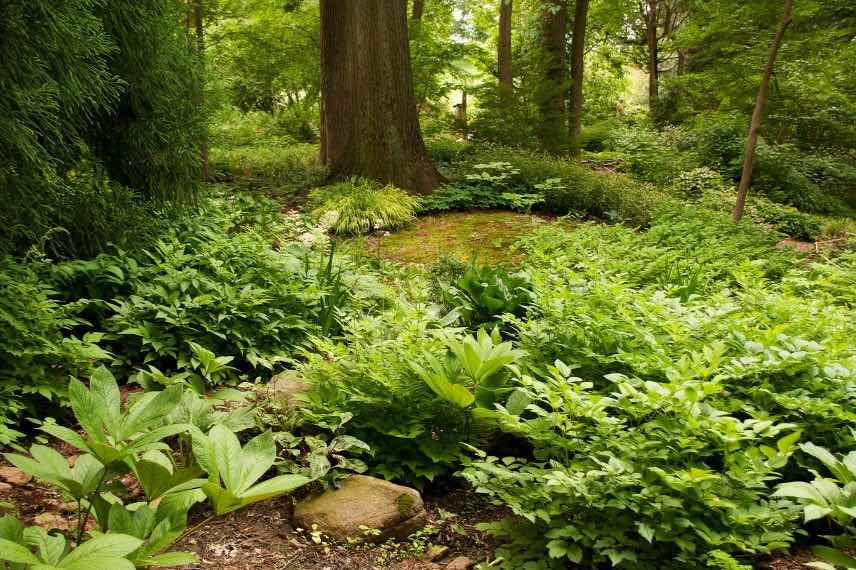
Choose from the range of woodland plants and be inspired by nature
Read also
10 plants to create a shady rockeryCreating a shaded garden
Depending on the type of shade, we have seen that conditions can vary considerably. It is of course unthinkable to demolish a wall or cut down a tree to bring in more light. However, it is always possible to improve the growing conditions you can offer your plants.
Improve the soil
- In heavy, waterlogged soil, drainage can be improved by adding soil to raise the planting bed so that water does not pool at the base of the plant or the roots. This can be a free-form raised bed or supported, for example, by a low wall or wooden sleepers. Adding draining materials (gravel, coarse sand, pumice…) mixed with the original soil also makes the soil more free-draining.
- In poor, dry soil, adding organic matter (potting compost, garden compost, manure…) will increase both water retention and nutrient levels. Just take care not to ‘smother’ the base of trees and bushes already in place with this material if applicable, and leave the base of each plant free to breathe.
Play with colour and light
- Opt for furniture in light or colourful tones to counteract the lack of brightness in the space.
- Install mirrors to reflect some light and make the area appear larger. Be careful, however, as birds may be fooled and collide with them: provide lattices or decorative elements to slow their flight.
- Lighting of all kinds is an opportunity to create magical atmospheres after dark: a spotlight to illuminate the base of a tree or bush, string lights for a lively, bistro-style atmosphere, candles that lend a mysterious and poetic mood… the choice is wide.
Create an atmosphere
- Let the moss, which thrives in these conditions, develop freely to contribute to this atmosphere reminiscent of a woodland understorey, and incorporate mineral elements (rocks, stone troughs, statues, lanterns…) that are unfazed by the lack of light and pair very well with plants.
- If space allows, do not hesitate to create winding paths whose course evokes a walk in a forest.
- Finally, and above all, turn to shade-loving perennials or bushes suited to these conditions, whose genetics have equipped them to be handsome and lush in this environment.
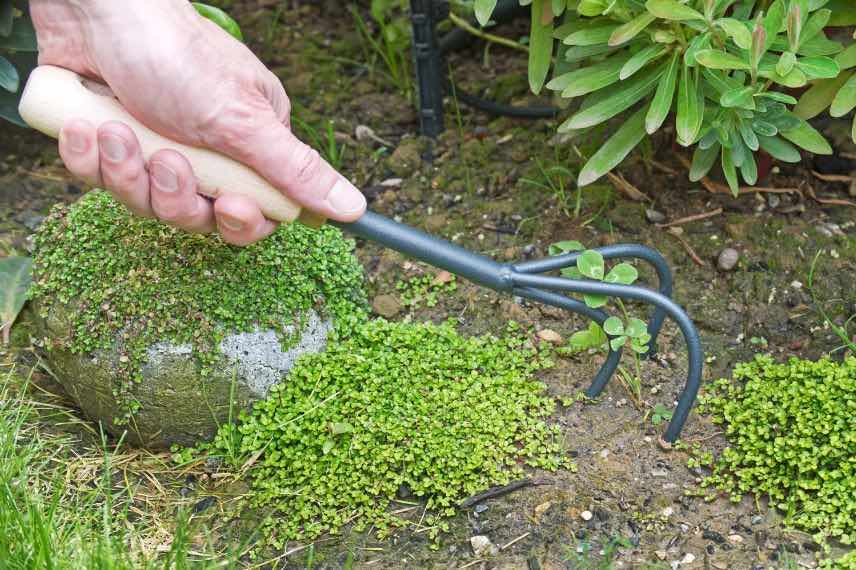
Do not remove the moss that will naturally establish itself
Which plants for a north-facing garden?
I won’t lie to you — it will be difficult, even impossible, to create a shady border with as many flowers as if it were in full sun, but that absolutely doesn’t mean you’re condemned to settle for something dull.
Focus on foliage
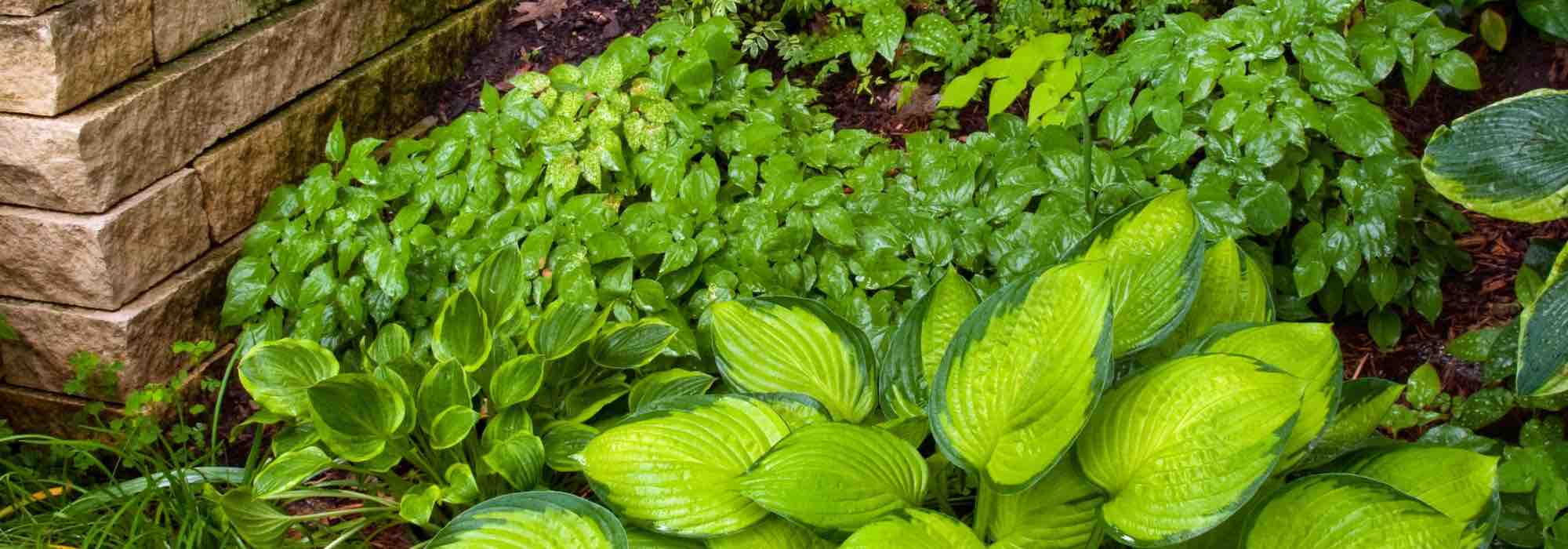
- Work primarily with foliage. Some leaves are graphic and cut like lace (ferns, for example) and provide a wonderful contrast with the broad leaves of neighbours such as Hosta, Asarum, Brunnera, lungworts or Farfugium, not to mention the elongated foliage of grasses and grass-like plants such as Hakonechloa, Luzula or Ophiopogon. This play of shapes alone would almost be enough to compose a shady border.
- To make it more interesting, more vibrant and to naturally brighten a dark area, use foliage in light tones. Some perennials offer golden foliage that are real sources of light: Carex ‘Everillo’, Dicentra ‘White Gold’, Hakonechloa ‘All Gold’, Hosta ‘Sunny Halcyon’, Vinca ‘Illumination’ are just a few examples from the wide palette available. Also rely on perennials with variegated foliage, which are another way to brighten the shade. Make them stand out against green or blue foliage and add splashes of colour thanks to the range of Heucheras, Heucherella and Tiarella, for example, which also have the good habit of flowering in the shade.
- Among bushes, some have foliage that alone creates a centrepiece in this kind of scheme, such as Japanese maples, Aucuba, Pieris or bamboos (prioritise non-spreading varieties).
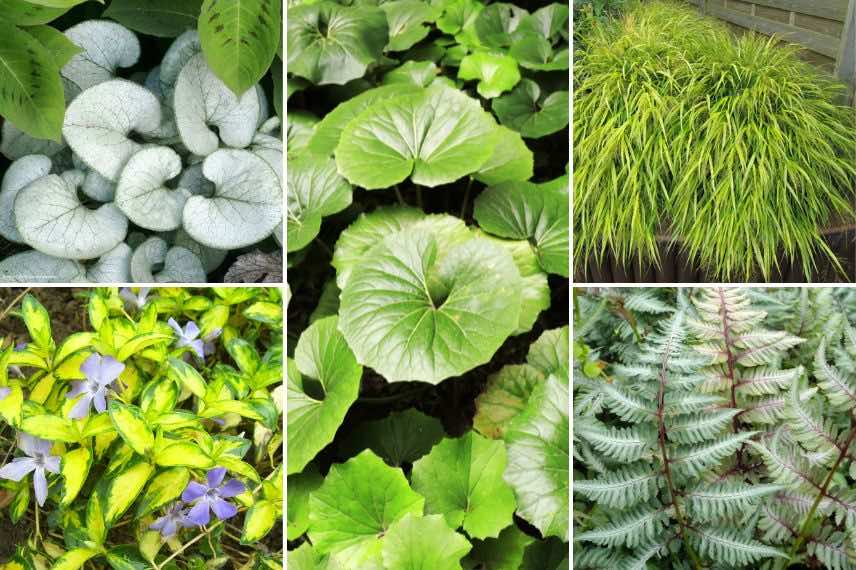
Clockwise: Brunnera ‘Looking Glass’, Farfugium japonicum, Hakonechloa ‘All Gold’, Athyrium niponiucm, Vinca ‘Illumination’
Structure the space
- Use evergreen bushes that guarantee a permanent structure to your design. Box, Leucothoe, shrubby honeysuckle, Loropetalum, Skimmia and yews are among the bushes that assert their presence all year round.
- Alternate habits and heights to create volume and relief through the silhouettes of your plants. Upright plants beside neighbours with a mound or spreading habit, combined with others with a fountain habit that emerge from low groundcover and creeping plants, dense borders that serve as a setting for taller bushes — the possibilities are wide.
Incorporate flowering
- Some shade perennials are neither short on flair nor on generosity when it comes to flowering. Examples include Acanthus, Japanese anemones, Bleeding Hearts, Cimicifuga, Epimedium, certain geraniums such as maccrorhizum, hellebores, Heucheras, Ligularias, Tricyrtis, primroses, astilbes, Asian saxifrages… the list could go on.
- For the upper layers, certain bushes are ideal in the shade. Camellias, Pieris, azaleas, rhododendrons, Hydrangea or even Mahonia are used to echo the play of shapes, textures and colours while flowering abundantly, sometimes giving off welcome fragrances.
Use verticals
- Don’t hesitate to take over structures or tree trunks using climbing plants that create attractive verticals: climbing Hydrangea, Schizophragma, ivy, honeysuckle, Virginia creeper, Berberidopsis or Holboellia perfectly complete a shady scene without taking up too much ground space.
- According to your taste, you can even create a themed atmosphere by selecting a group of plants with an exotic, natural, Japanese-style or more contemporary look.
→ Get inspiration from our advice: Pairing Epimediums, Pairing Kalmia, Pairing Aucuba, Pairing Mahonia Pairing Fatsia, Pairing Hydrangea…
In any case, at the design stage I can only advise you to draw up a list of the plants that appeal to you so that each season has something to offer visually — a principle that is all the truer if you can see the bed from a window of the house. It would indeed be a shame to have an attractive display in the main season but be partially or completely empty the rest of the time.
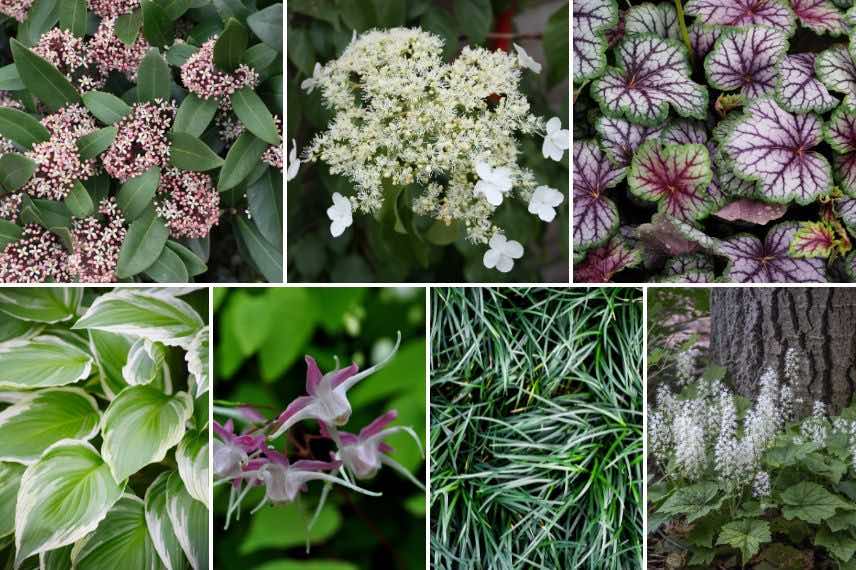
Clockwise, a very small selection of the many plants that enjoy the shade: Skimmia japonica, Hydrangea petiolaris, Heuchera, Tiarella, Ophiopogon, Epimedium, Hosta
- Subscribe!
- Contents
Comments