





























Climbing hydrangeas: our top 7
Self-clinging varieties to cover shaded walls
Contents
Climbing hydrangeas are highly valued plants in shaded gardens. Whether you’re looking to add a touch of romance to a shaded corner or brighten up a stark wall, there is a climbing hydrangea variety to suit every taste. In this top 7, we present the most remarkable and high-performing varieties, selected for their beauty, robustness and ease of cultivation. From the elegant Hydrangea petiolaris ‘Silver Lining’ with its variegated foliage to the stunning colourful flowering of Hydrangea anomala ‘Crug Coral’, discover these enchanting climbers.

Hydrangea petiolaris 'Flying Saucer' – Climbing Hydrangea
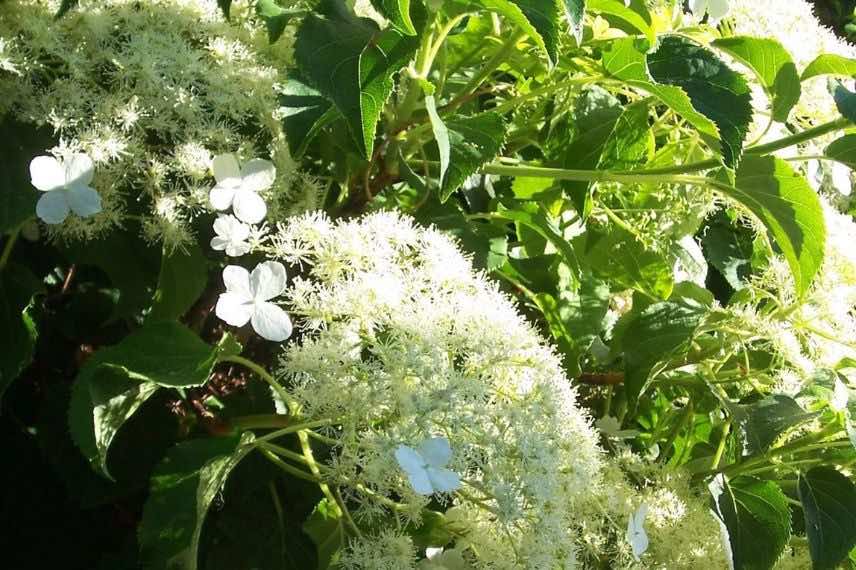
Hydrangea petiolaris ‘Flying Saucer’ is a climbing hydrangea variety that stands out for the impressive size of its fluffy inflorescences, surpassing those of the botanical species. Its long, sturdy shoots climb to a minimum height of 3–4 m and cling on their own to bare walls or bare trees thanks to effective climbing roots, quickly turning large spaces into living screens of greenery, animated by the buzzing of bees in early summer. Although its initial development may take up to three years, once established, this vigorous bush thrives with little assistance, making it an ideal choice for adorning north- or east-facing sites, often difficult to landscape.
Read also
Hydrangeas: planting, pruning and careSchizophragma hydrangeoides - climbing false hydrangea
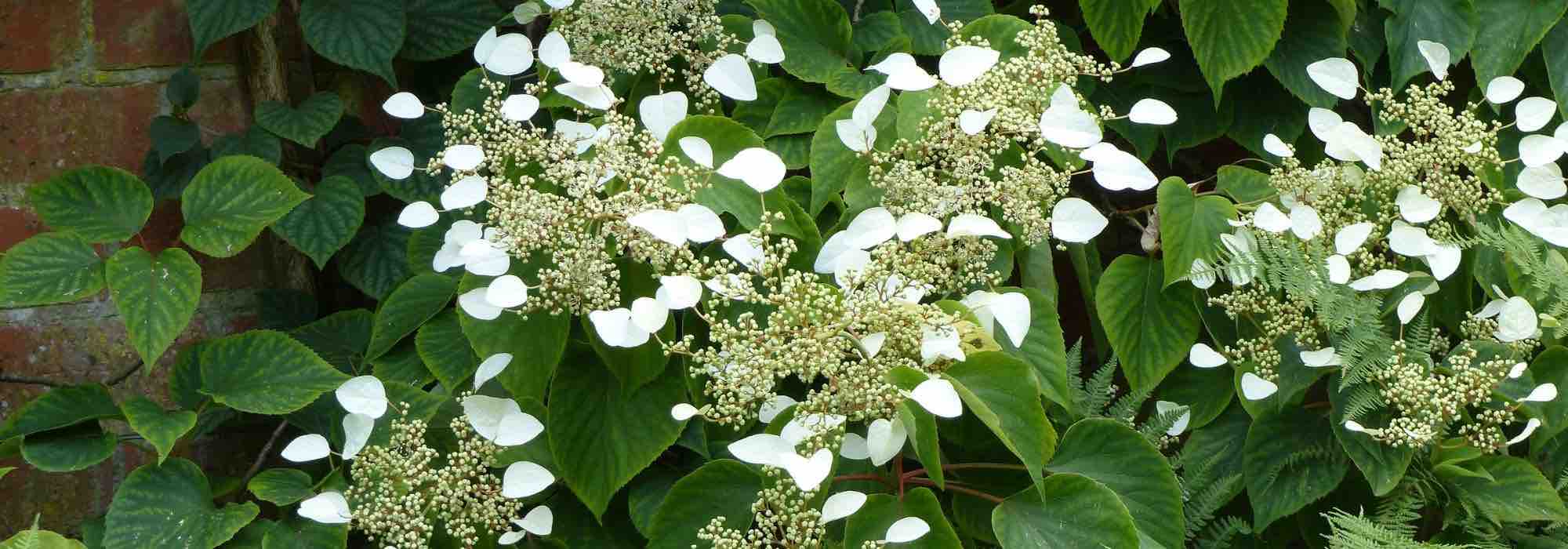
Schizophragma hydrangeoides, often called the climbing hydrangea, is a climbing bush that deserves to be better known for its generosity and striking appearance. Its large flat inflorescences are composed of small melliferous fertile flowers, surrounded by superb white bracts. This vigorous climber brightens dark, neglected corners of the garden thanks to its aerial roots that allow it to cling firmly to a support, whether a tree or a wall, and to rise up to 10 metres in height. Its summer flowering, light and airy, offers broad terminal inflorescences that evoke the delicacy of lace, reminiscent of white hydrangeas.
Schizophragma hydrangeoides spreads to 4 metres. Its deciduous foliage is dark green, with large heart-shaped leaves 10–20 cm long, bearing finely dentate margins. Very hardy, it withstands down to -20°C. It does not tolerate soils that are too dry, too poor, or chalky. To keep the soil cool and lower its pH, the addition of turf is recommended, taking care that it never dries out completely. Although it prefers shaded, sheltered exposures, it needs a little light for optimum flowering, the morning sun being ideal. This climber can also spread along the ground, brightening the dark and neglected corners of the garden.
Schyzophragma integrifolium - Hydrangea with entire leaves
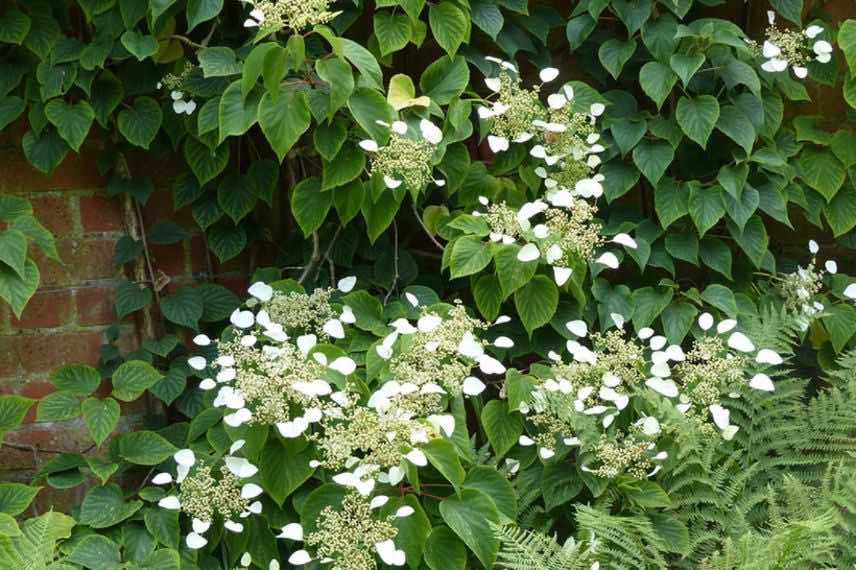
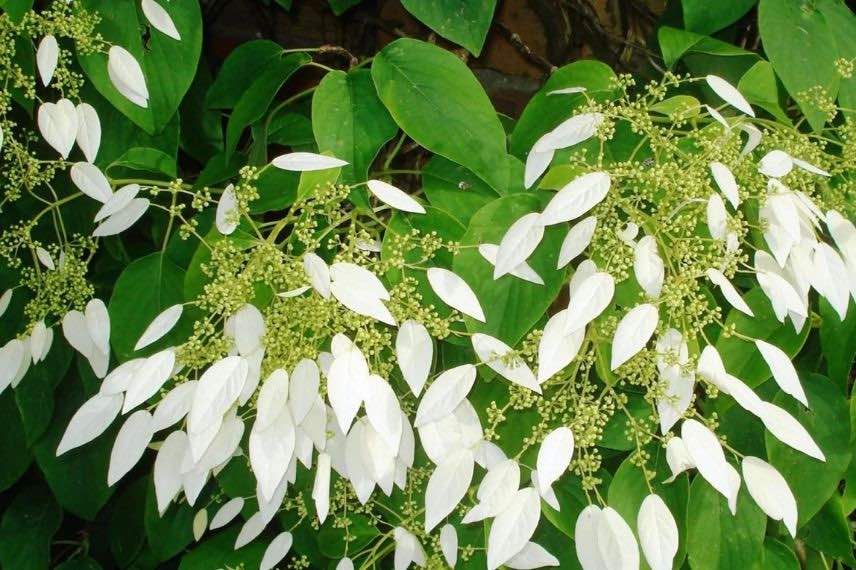
The Schizophragma integrifolium, also known as the whole-leaved hydrangea, is a climbing shrub with a woody base. This vigorous climber, with aerial roots, can reach a height of 8 to 10 metres. Its white flowering in late spring and early summer consists of cream-white terminal inflorescences that catch the eye. Despite its undeniable beauty, this climbing plant remains little grown in our gardens, which is surprising given its ornamental qualities.
Originating from China, the Schizophragma integrifolium naturally thrives in the understorey of mountain slopes and cool valleys. Its growth is fairly rapid and, apart from young plants under three years old, it clings to its support on its own thanks to its climbing roots and aerial roots. In June and July, it offers a long flowering period of at least three weeks. The inflorescences, made up of small clusters of sterile flowers surrounded by large cream-white bracts that droop, are borne on flat corymbs about 25 cm in diameter.
Its spectacular flowering can take three to four years to appear. Its deciduous foliage is a rich green, with large leaves 10–20 cm long, opposite, heart-shaped and sometimes dentate at the margins.
The Schizophragma integrifolium displays moderate hardiness and may struggle to survive below -15°C. It does not tolerate dry soils or calcareous soil.
Read also
Hydrangeas: how to choose them?Hydrangea anomala 'Crug Coral'
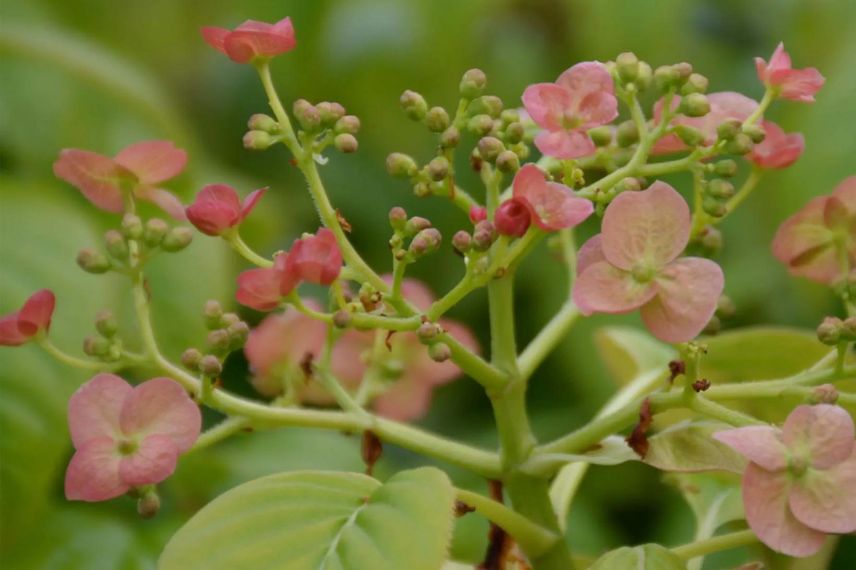
Hydrangea anomala ‘Crug Coral’ is a climbing hydrangea variety that stands out for the unusually pink colour of its inflorescences. The nearly red flower buds open in early summer to reveal panicles of delicate flowers, with large pale pink florets surrounding numerous small cream flowers. This charming flowering is further enhanced by glossy leaves in a vivid green.
Originating from Japan and tropical Asia, more precisely collected in the mountains of Taiwan in 2016, Hydrangea anomala subsp. glabra is a deciduous climbing bush in winter. Very hardy, this plant tolerates temperatures down to -20°C and prefers deep, fertile, well-drained soil, without excessive lime and not too dry.
The ‘Crug Coral’ variety is characterised by inflorescences larger than those of the type species, sometimes reaching 20 cm in diameter. They consist of numerous small cream fertile flowers with protruding stamens, surrounded by pale pink florets. The stems of this vigorous, robust and well-branched climber can reach a minimum height of 3–4 metres, offering aesthetic interest even in winter thanks to their bark that peels in strips.
Pileostegia viburnoides - False Viburnum
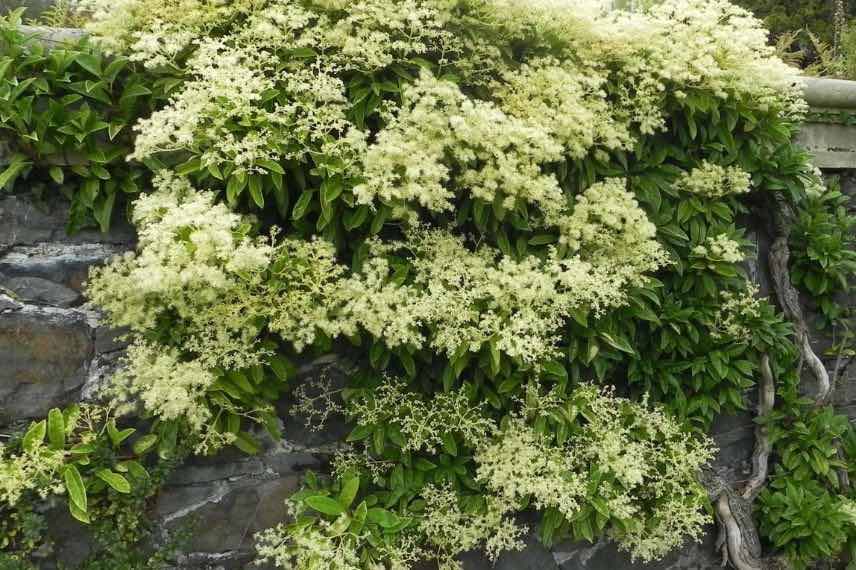
Pileostegia viburnoides, unlike other climbers selected, is evergreen. Close to climbing hydrangeas, it develops a late flowering in large cream-white panicles, airy and fluffy. It is an ideal plant for covering a wall in shade or partial shade, adapting well to any well-drained soil rich in humus, and preferably slightly acidic.
Originating from India and East Asia regions such as China, Taiwan and Japan, Pileostegia viburnoides remains relatively uncommon in cultivation despite its good hardiness, tolerating temperatures down to -18°C. This bush is slow to establish, but its growth later speeds up somewhat, covering an area of 5–6 m² at maturity. The young pink-tinged shoots and foliage reminiscent of palm laurel add to its decorative appeal. Leaves, narrowly oval to elliptical, leathery and glossy, are dark green and evergreen.
Flowering takes place from late August to late September, appearing as elongated panicles up to 15 cm long, composed of small cream-white flowers that are highly melliferous. For best flowering, Pileostegia viburnoides prefers a site sheltered from cold winds, with the crown facing the sun and the base in shade, in soil that is slightly moist and rich in humus.
This plant is perfect for covering a north- or east-facing wall, providing dense vegetation all year and attracting bees late in the season. Over time, it can also clothe an old tree or mask an unsightly building.
Variegated foliage: Hydrangea petiolaris 'Miranda' and 'Silver Lining'
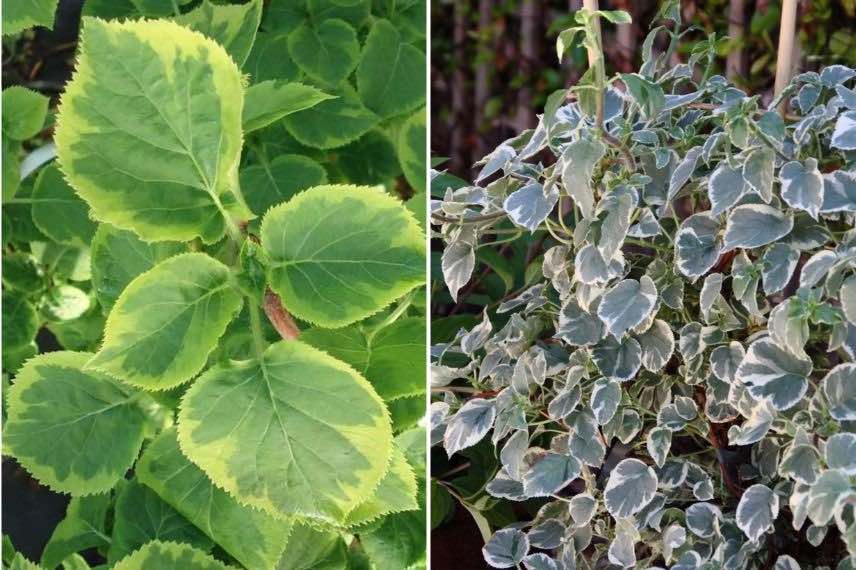
Two varieties with variegated foliage to finish: the Hydrangea petiolaris ‘Miranda’ and the Hydrangea petiolaris‘Silver Lining’.
The first has been awarded the Royal Horticultural Society’s Award of Garden Merit. It features variegated foliage, ranging from dark green to light green, and even yellow. ‘Miranda’ flowers in May and June, the flowers form flat, umbrella-shaped umbels, white, with a delicate fragrance. It has two growth habits: against a wall, it can reach up to 6–8 m in height, but without support it forms a dense shrub of about 1.5 m in all directions.
‘Silver Lining’ develops variegated grey and white foliage, remarkably bright. This variety is particularly suited to northern or western exposures, as it dislikes sun scorch and prefers fertile, deep, well-drained and not very calcareous soil. ‘Silver Lining’ offers oval leaves with crenate margins, which in autumn take on a pretty golden hue, enhancing its seasonal interest. Flowering takes place in May-June, even in shaded areas. The nectariferous flowers form large umbels up to 20 cm in diameter, reminiscent of flat, white, scented parasols. These inflorescences, not fading but drying gradually, take on subtle greenish tints before browning, contributing to the plant’s rustic and ethereal appearance.
- Subscribe!
- Contents

Comments