





























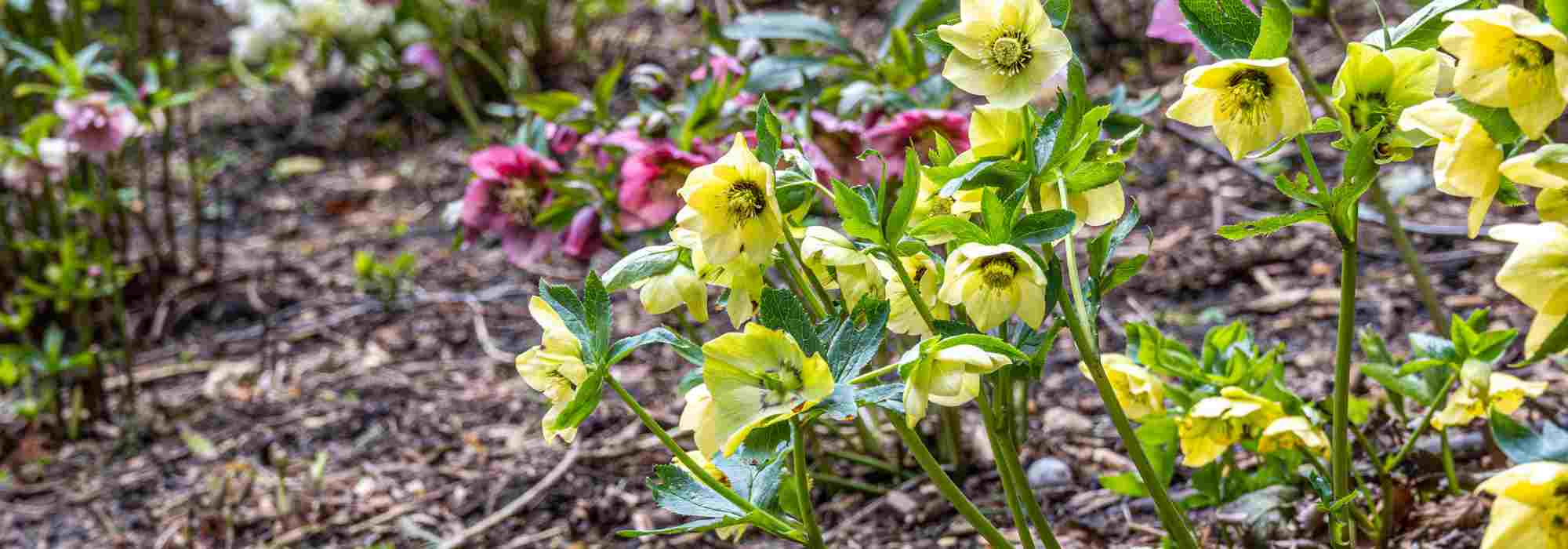
Awake your garden at the end of winter with late-flowering hellebores
Choosing them, pairing them, and growing them
Contents
At the end of winter, as the garden gradually awakens from its slumber, late hellebores provide an explosion of colour and life. These very robust and refined perennials are among the few plants that bloom at this time. They bring a lot of grace and act as one of the best precursors to spring flowering. Discover why to plant late hellebores, which varieties to choose, as well as our pairing ideas for all gardens. We will also explain how to grow them well to keep them for many years.

Why choosing late varieties?
There are around twenty species of hellebores, some early and others later, with either evergreen or deciduous foliage. Hellebores are often confused with Christmas roses. Although they belong to the same family, the Ranunculaceae, the Christmas rose or Helleborus niger is much earlier: it is generally the first to offer its white flowers in December, as its name suggests, sometimes even as early as November. It is also more delicate to cultivate.
Later hellebores begin their flowering from February. These are mainly Oriental hellebores, hybridised, with hundreds of stunning varieties, as well as some very graceful hellebores native to the Mediterranean region. It is truly interesting to use the varied range of hellebores to extend their flowering period: by judiciously combining them, one can see a bed or pot in bloom for 4 to 5 months. Hellebores are also among the longest-flowering plants in the garden, bringing soft colours against the still bare bark and branches, playing an undeniable role in winter garden scenes.
N.B.: The indications on flowering periods should always be taken with a pinch of salt: flowers appear earlier or later depending on the growing region, seasonal weather, and climate change.
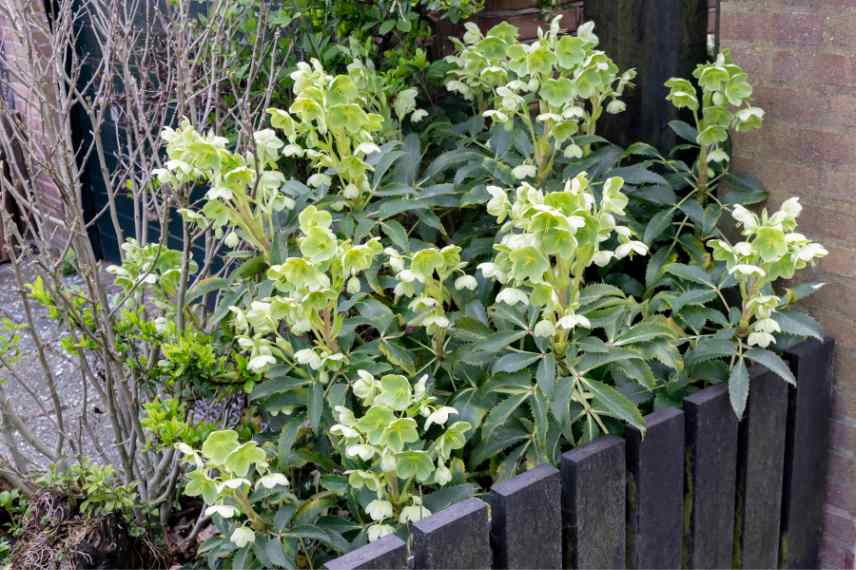
The Corsican Hellebore, or Helleborus argutifolius
They also accompany the first bulbs to emerge from the ground, and one should not hesitate to plant them alongside to welcome the approaching spring.
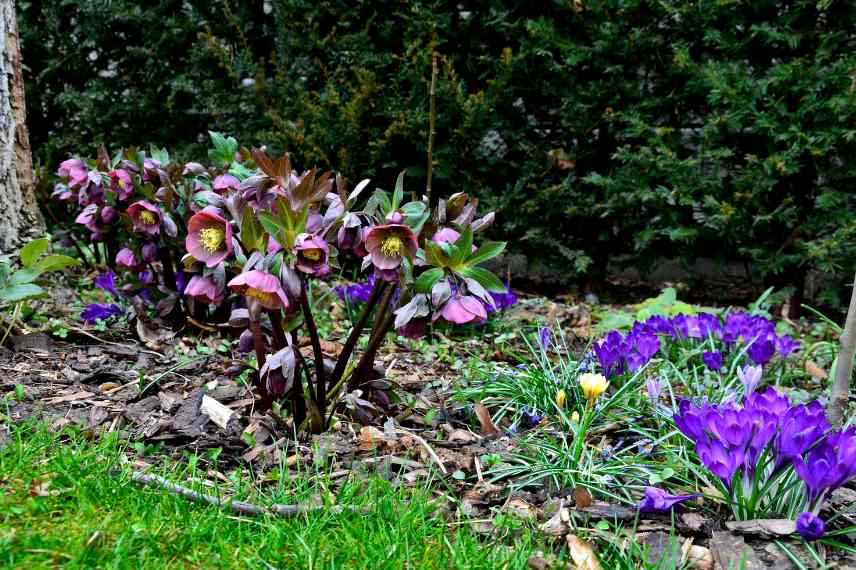
Late hellebores alongside the first garden bulbs
These late hellebores provide a valuable source of food for pollinators in late winter and early spring, when few other plants are in bloom. Highly pollen- and nectariferous, they help to further support biodiversity in your garden!
Read also
3 ideas for beautiful winter flower bedsThe most beautiful late-flowering hellebore varieties
Here are some of the most beautiful late hellebores: the orientals that typically flower from January to May, the hybrids (Lenten roses) resulting from cross-breeding between hellebores of different species, and the native and botanical species, often in bloom until the end of May or even June.
Oriental Hellebores and hybrids: From white to pink to black!
- White Hellebores: Hybrid Hellebore ‘Paradenia’, Oriental Hellebore ‘Anemone Pure White’, and Oriental Hellebore ‘Double White’;
- Yellow Hellebores: Hybrid Hellebore ‘Yellow Strain’, Hybrid Hellebore ‘Yellow Lady’, Oriental Hellebore ‘Yellow Guttatus’, Oriental Hellebore ‘Double Primrose Yellow’;
- Pink to Red Hellebores: Oriental Hellebore ‘Peach with Pink Centre’, Oriental Hellebore ‘ViV Alessandra’, and Hybrid Hellebore ‘Picotee’;
- Purple to Black Hellebores: Oriental Hellebore ‘Slaty Blue’, Black Oriental Hellebore, Hellebore ‘Early Purple’.
Mediterranean and Eastern European Hellebores
These are native to the Mediterranean region and often bloom in green tones. They are less sophisticated botanical species than hybrid creations, perfect for English or natural garden borders. Their origins make them perennials more sensitive to frost.
- The Corsican Hellebore, or Helleborus argutifolius, gradually forming a persistent clump with magnificent leathery, dentate foliage;
- Helleborus lividus, from the Balearics, slow to establish but offering a lovely bicoloured green and pink flowering in February-March, on bluish foliage;
- Helleborus x sternii, a cross between the two previous species, valued for its greenish-pink flowering and often marbled grey-green foliage;
- Helleborus foetidus: a European species appreciated for its finely cut, quite dark leaves, contrasting with its pale green bell-shaped flowers edged in purple. It usually flowers in February but displays its buds from December. Also discover the beautiful varieties ‘Wester Flisk’ and ‘Sopron’;
- Helleborus viridis, a species from Central Europe, found naturally in the Pyrenees, takes its time as it flowers from February-March. It is one of those hellebores with entirely green flowers, far from the sophistication of some hybrids. It resembles Helleborus purpurascens, a wildflower perfect for a woodland setting (although the flowers of the latter are washed with purple) and like it has semi-evergreen or deciduous leaves;
- Helleborus multifidus ssp. bocconei, with flowers that start green, gradually fading to white, and beautiful deeply lobed palmate leaves.
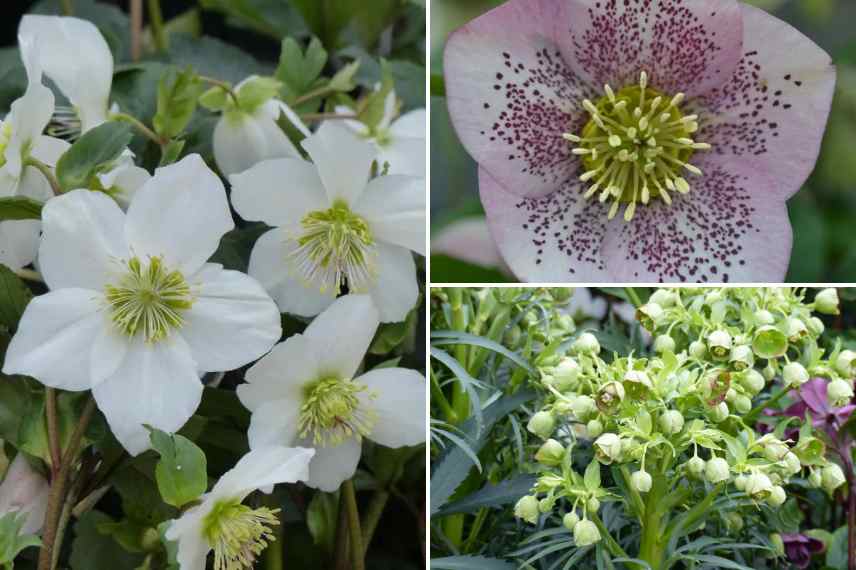
Hybrid Hellebore ‘Paradenia’ on the left, and on the right, Oriental Hellebore ‘Pink Guttatus’ and Helleborus foetidus ‘Sopron’
Pair late hellebores with other winter plants
To create attractive beds with late hellebores, the possibilities are truly numerous. As mentioned earlier, it is essential to combine perennials or bushes that bloom around the same time, and especially to play with bulbs, which are the most abundant to emerge at the end of winter. Consider planting hellebores in groups: they are never more beautiful than when installed en masse, with at least three lovely clumps. Also integrate some evergreen foliage for texture effects.
Since some hellebores prefer more sun than others, while this perennial generally thrives in partial shade or shade, you have several options for combinations, exposures, and colour effects:
- A bed based on colour harmonies: the simplest approach is to mix colours ranging from pink to purple. This creates a varied yet harmonious palette, a sort of monochrome, and you can mix double-flowered hellebores with single-flowered ones and anemone-flowered varieties.
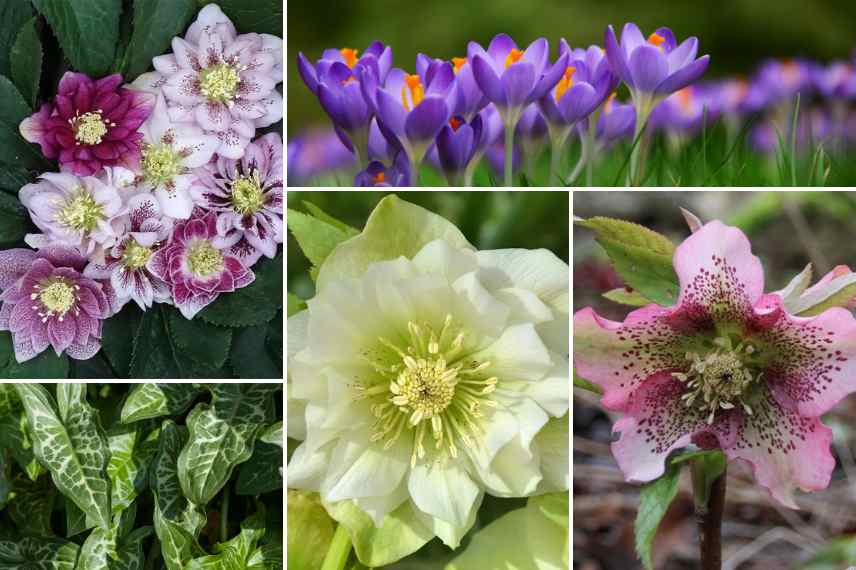
Helleborus orientale ‘Magic Double Rose’, Crocus ‘Mammouth’, Arum italicum, Helleborus orientale ‘Double Blanc’ and Helleborus orientale ‘Rose Guttatus’
- A bed based on contrasts: for a more striking scene, yet magical under the sun that warms the atmosphere, consider hellebores ‘Slaty Blue’, some daffodils, yellow and purple erythroniums, and fritillaries, complemented by Veratrum nigrum with its beautiful foliage, which will bloom in purple much later.
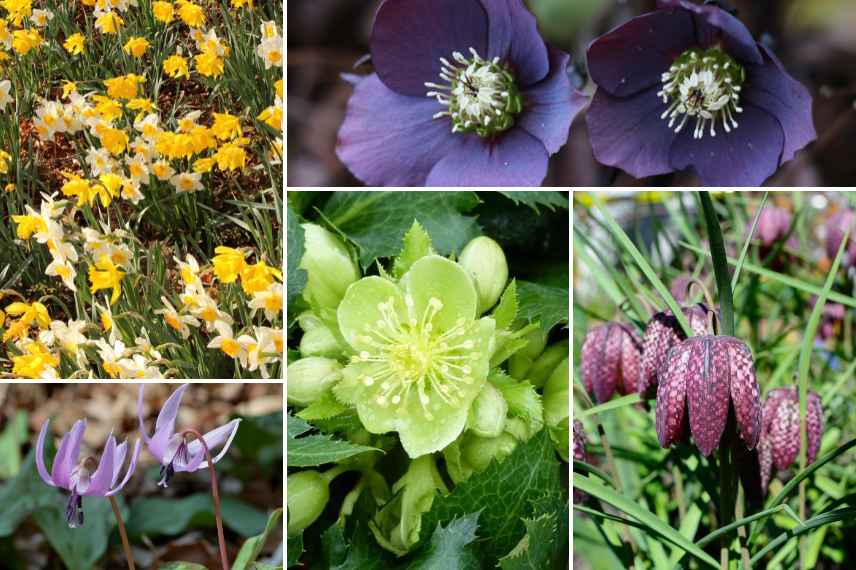 Narcissus pseudonarcissus, hellebore ‘Slaty Blue’, erythroniums, Helleborus sternii ‘Boughton Beauty’ and fritillary[/caption>
- A sunny bed: the perfect combination will be winter heathers (Erica darleyensis), which should be carefully combined with later heathers like Erica carnea. The contrast between the myriad of bells from the former and the large flowers of hellebores sternii, lividus, and orientalis makes this bed particularly interesting. A low-growing euonymus ties the whole together.
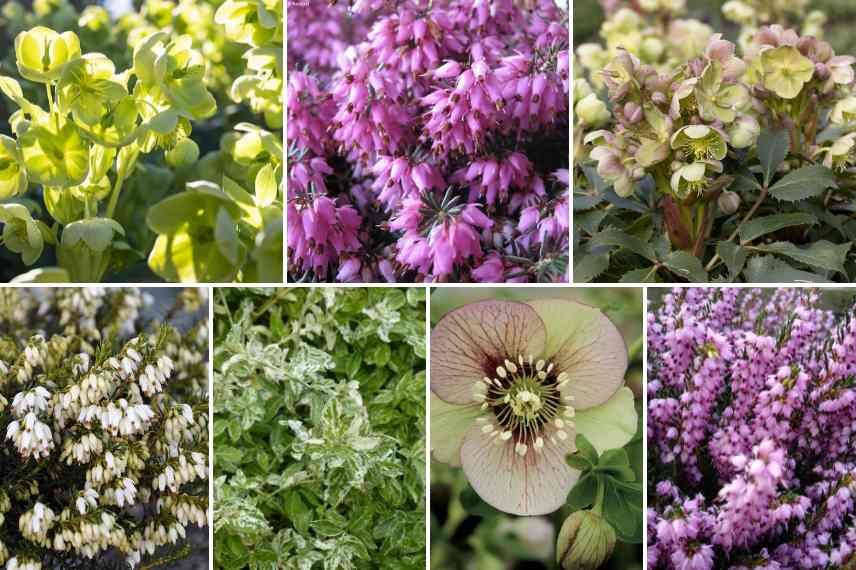
Helleborus lividus, Erica carnea ‘Rosalie’, Helleborus x sternii, Erica carnea ‘Isabell’ (©Kerisnel), euonymus ‘Harlequin’, Helleborus hybridus ‘Picotee’ and Erica darleyensis ‘Darley Dale'[/caption>
- A 100% hellebore bed, as their colours truly blend well together, without any taste issues! You can add some evergreen foliage here. The aim is to highlight the diversity of colours, foliage, and forms of hellebores.
[caption id="attachment_285504" align="aligncenter" width="856"]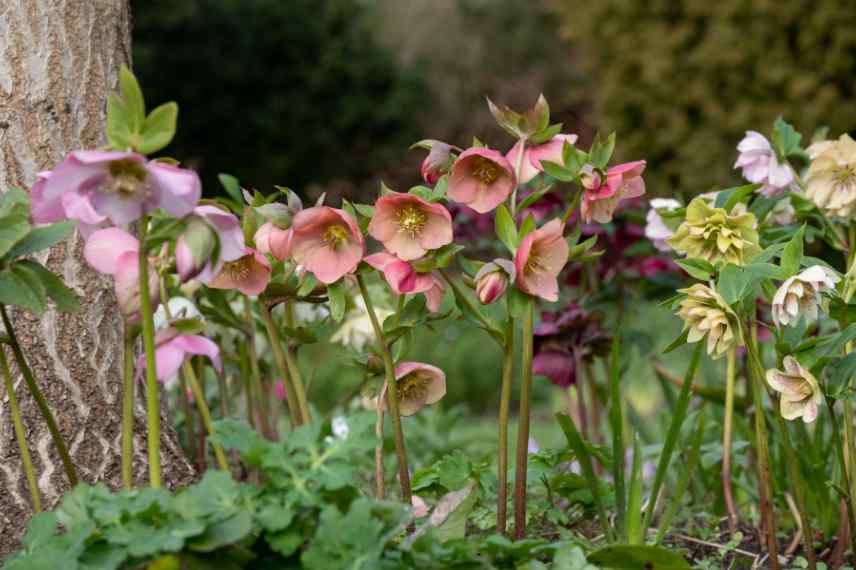 Just among themselves, late hellebores take centre stage in the garden as winter ends…
- A soft and tangy monochrome bed, by choosing a colour palette from white to chartreuse green, integrating tulips, bushes, and perennials as shown here:
[caption id="attachment_285721" align="aligncenter" width="856"]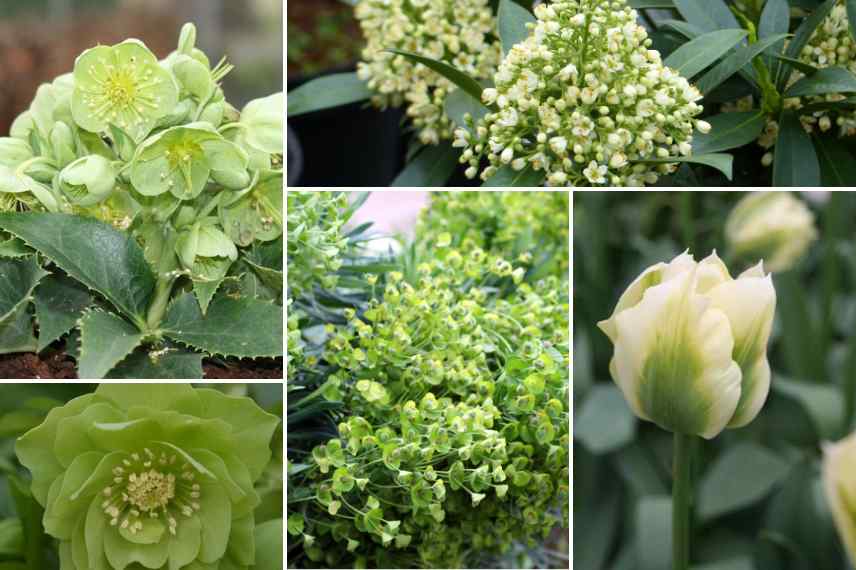 Helleborus argutifolius, Skimmia japonica ‘Kew Green’, oriental hellebore ‘Double Vert Pistache’, Euphorbia characias and tulip viridiflora ‘Spring Green’
- In a winter garden with multiple options, as many colourful plants are available in this season if chosen wisely. Combine bark, flowers, and grasses or groundcover:
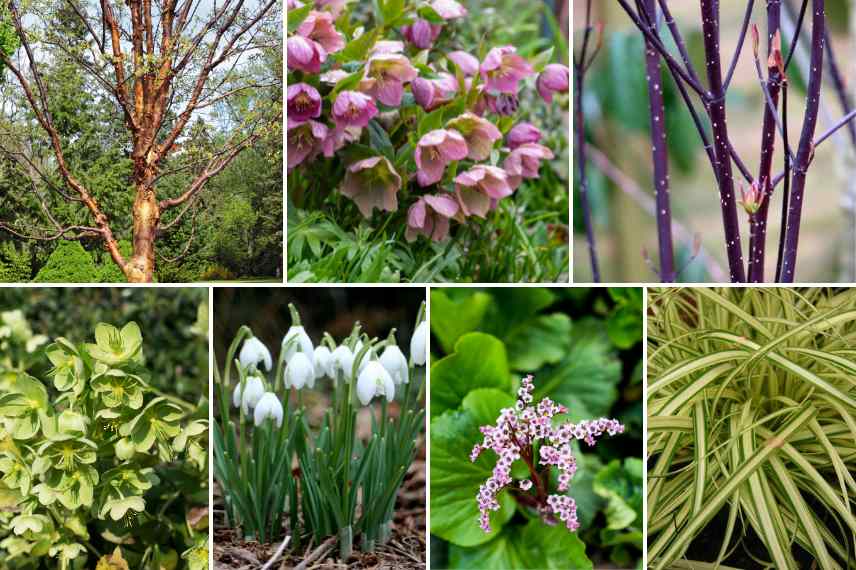
Acer griseum, Helleborus purpurascens, Cornus alba ‘Kesselringii’, Helleborus lividus, Galanthus nivalis (snowdrop), Bergenia cordifolia and Carex oshimensis ‘Everillo’
Of course, most of these combinations can be replicated in miniature format, in lovely pots on the balcony, terrace, or even a windowsill.
P.S.: I suggest more combination ideas in these articles: 10 single-flowered hellebores, 6 oriental hellebores: the darkest; 6 double-flowered hellebores and 7 anemone-flowered hellebores.
Read also
7 Anemone centred HelleboresOur tips for successfully growing your late hellebores
You will find everything you need to know about hellebores in our comprehensive guide Hellebores: how to plant and cultivate them. Here are five essential tips to remember about these among the easiest plants to grow:
- Choose the location carefully: hellebores generally prefer well-drained, deep soils and shaded to partially shaded locations. Avoid overly sunny spots (except for Corsican hellebore) or excessively damp areas, and for Mediterranean species, steer clear of unprotected windy locations and regions that are too cold.
- Do not overwater in summer, as they enter a period of dormancy, and their fleshy roots tolerate a bit of drought quite well;
- Water at the soil level while avoiding wetting the foliage, to reduce recurring issues with foliar diseases in hellebores.
- Regarding pruning, cut back the foliage of hybrid hellebores in December, and in spring after flowering for all others. As for flowering, it will change from green to pink, extending its interest in the garden: cut back to the ground after complete wilting to prevent self-seeding (learn more in When and how to prune hellebores?).
- Late hellebores, just like the genus Helleborus, are among the plants that dislike being moved! You should divide them when the clumps are well established, not before four years.
- Subscribe!
- Contents
Comments