





























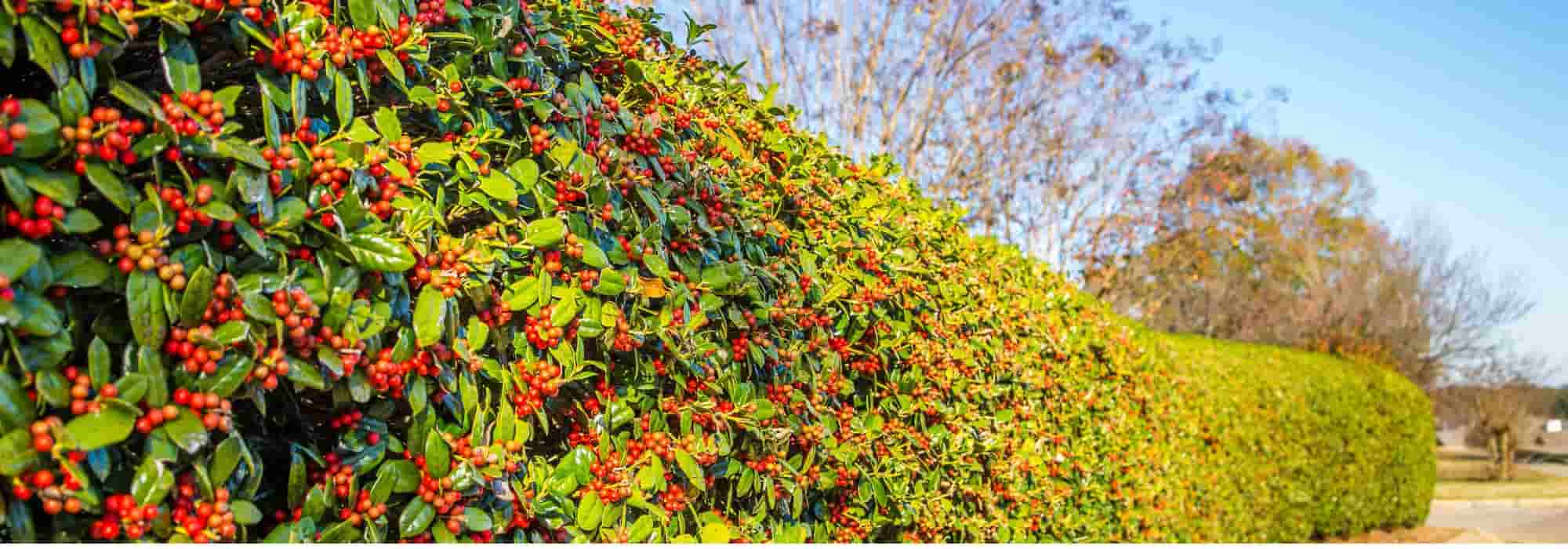
9 ornamental fruit-bearing hedge bushes
Selection of ornamental bushes based on their berries
Contents
Whether defensive, screening or wind-breaking, a hedge bush is primarily ornamental since, beyond hiding you or protecting you, it will be a structural element of your garden. In other words, the choice of ornamental bushes that will make up this informal or country hedge (we immediately exclude strict, uniform hedges, time-consuming in terms of pruning, and not conducive to biodiversity) deserves careful consideration. Of course, you can choose your bushes based on their flowering (flower colours, duration and timing of flowering, fragrance of the flowers…) or their foliage. Again, the foliage, deciduous or evergreen, can take on a range of hues or shapes. Growth is also a key consideration when planting a hedge.
But a hedge bush can also be attractive due to its fruiting, most often in autumn or winter. These berries or small fruits, sometimes edible or simply enjoyed by birds, offer an undeniable appeal at times when the flowers, or even the foliage, are fading.
Discover our selection of 9 bushes chosen for their decorative fruiting, perfect for incorporating into a hedge.

serviceberry
The Amelanchier Amelanchier is among the most appreciated bushes, as it combines a host of advantages. It is hardy, very vigorous, not fussy about soil or exposure, and above all very hardy, which makes it suitable to plant anywhere in France. In addition to these horticultural advantages, The Amelanchier is above all a bush endowed with exceptional, abundant and melliferous spring flowering, pure white, sometimes slightly tinged with pink. The autumn foliage is just as exceptional with coppery, purplish or orange tones.
Ideal for a loose, country-style hedge, Amelanchier is also valued for its fruiting. Indeed, in early summer, Amelanchier bears sweet berries, which progress from red to dark purple, almost black. If these berries are delicious raw or cooked, in jams, compotes, desserts or juice, they are also very decorative amid medium-green foliage. Birds are not fooled either and are likely to savour them before you have time to harvest them.
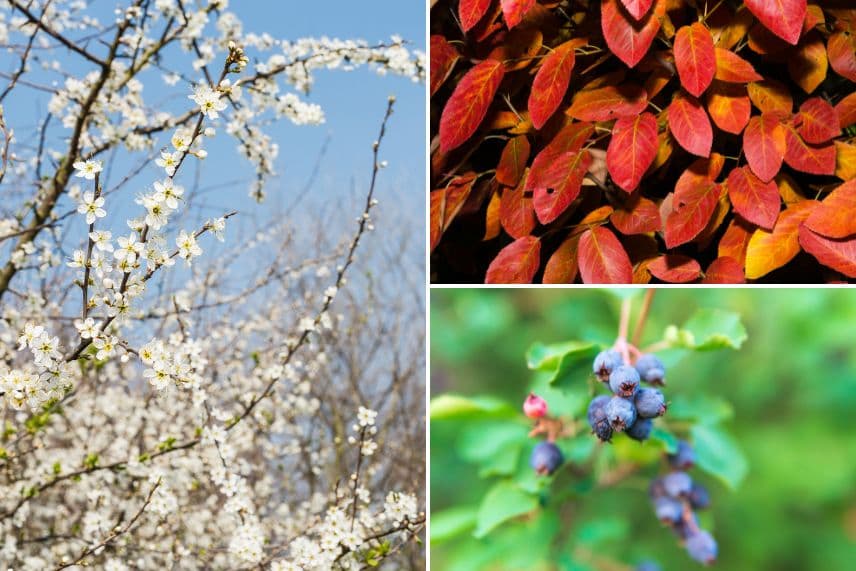
Pour une plantation en haie, nous vous recommandons plus spécialement l’‘Amelanchier spicata’ au port ouvert, arrondi et compact, qui atteint 3 m de hauteur pour une envergure de 2 m.
How to grow it? Amelanchier thrives in any good garden soil, not limey, but it can be acidic, provided that it is perfectly drained and moist. It adapts to sunny or partially shaded conditions. It requires no special care, but it does not tolerate overly severe pruning.
Read also
8 decorative fruiting viburnumsPheasant berry (Leycesteria formosa)
leycesteria formosa, commonly known by its vernacular name, the pheasant tree, is a bush native to the Himalayas, which hardly exceeds 2 m in height, with an erect habit and highly ramified.
Its semi-evergreen to deciduous foliage, borne on hollow, glabrous shoots and often pruinose with blue, typically displays a dark green colour with a bluish tinge on the underside. The leaves are ovate or oblong, pointed or acuminate. From July to September, flowers, arranged in pendant spikes, arise from the leaf axils. These flowers, consisting of a white-to-purple corolla, are surrounded by dark purple bracts for a striking effect.
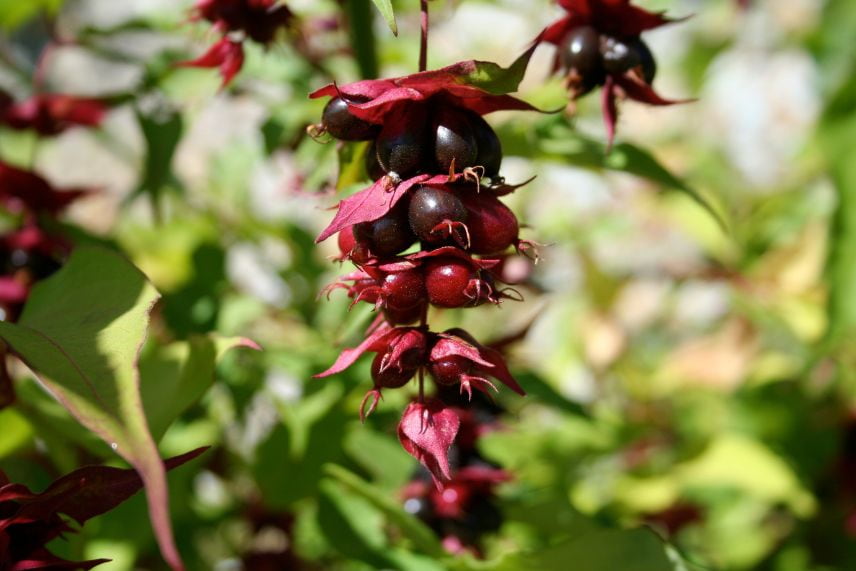
After flowering, glossy, globular berries appear in a wine-red colour. These berries persist for much of the winter. With a caramel flavour, these berries please birds, particularly pheasants. This explains their vernacular name!
How to grow it? The pheasant tree has few planting requirements: a well-drained, fairly cool soil suits it perfectly. It prefers a sunny, not scorching or semi-shaded site. In cold climates, the stems may freeze. Hence, severe pruning is required, and in spring the shrub flowers again more vigorously.
Snowberry (Symphoricarpos)
The symphorine (Symphoricarpos) is a bushy, very dense shrub, more or less stoloniferous, giving it a suckering habit. With slender, arching shoots, it quickly grows, reaching around 2–3 m in height with a spread of 1.2–1.5 m. Its small flowers, pink-red or white, arranged in terminal or axillary inflorescences, are inconspicuous but melliferous. They are also interesting, as they give rise to spherical berries, most often white, pink or even red for certain varieties. These small berries cluster on the stems and persist throughout the winter. Thanks to the shape and colour of its berries, Symphorine is often nicknamed the pearl tree. This delicately fruiting display adds a touch of softness to winter gardens.
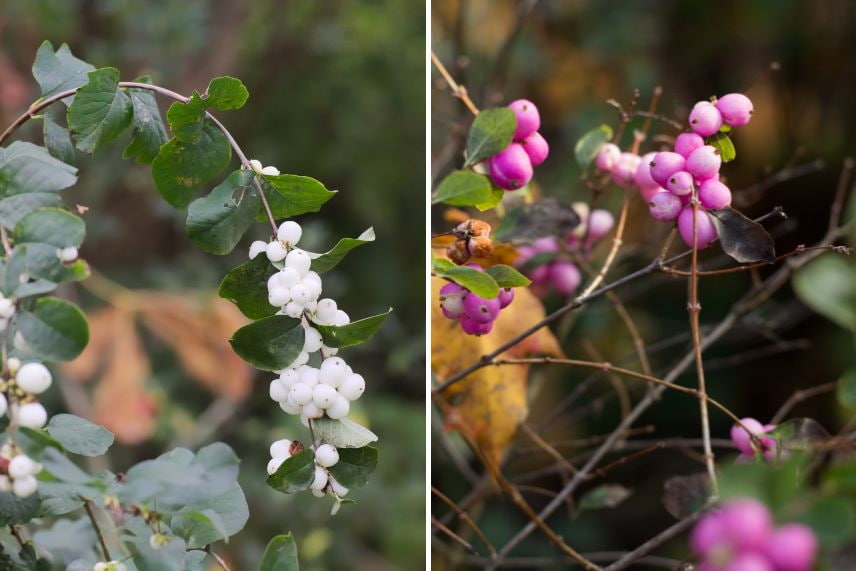
Berries of Symphorine
To form a free-standing hedge, we particularly recommend the variety ‘Mother of Pearl’ with large berries in a delicious pearly pink, produced by white flowering. The Symphorine ‘Magical Candy’, on the other hand, offers berries in a deeper pink, almost fuchsia.
How to grow it? Symphorine is a hardy shrub that tolerates all soil types. It enjoys both full sun and partial shade. It only needs an autumn application of compost and a light pruning in March.
Read also
6 climbing plants with decorative fruitsChokeberry (Aronia)
Aronia aronie is a deciduous bush with particularly hardy foliage (down to -28°C). The tallest varieties (Aronia arbutifolia) can easily be used in a free-standing hedge, as they reach 1.5 to 3 m in height. Fast-growing, Aronia has a bushy, compact habit and finely dentate foliage that takes on beautiful fiery colours in autumn. The white or slightly pink flowers bloom in spring, in May–June, and attract many insects with their melliferous properties.
But it is mainly the berries that give all the appeal of this hardy shrub that requires very little cultivation. Edible, these berries, which resemble blueberries, can be eaten cooked or dried. They are rich in nutrients, even regarded as superfoods. The berries are harvested from September to December.
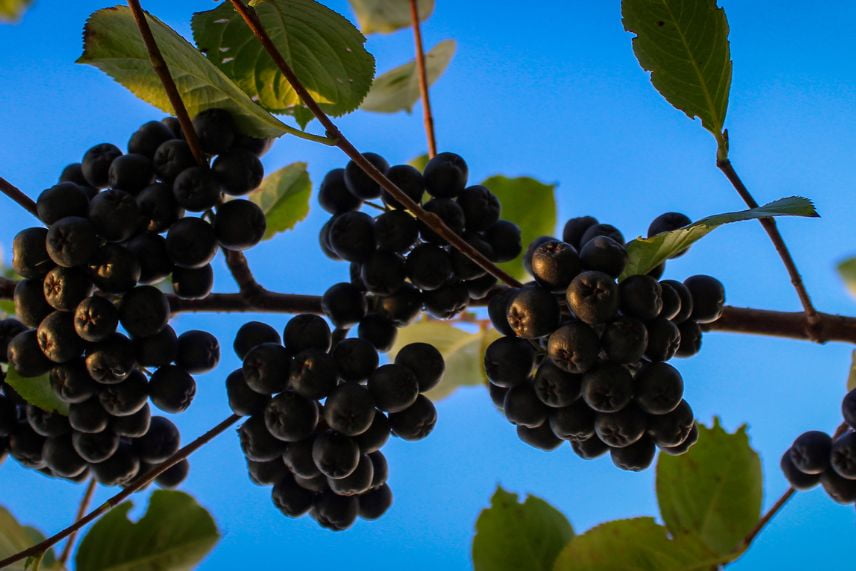
Aronia berries aronie
To integrate a free-standing hedge, we recommend Aronia arbutifolia ‘Brilliant’, which combines all the advantages: a height of 3 m, bright red autumn foliage, large white flowers and bright red berries.
How to grow it? Aronia thrives in light, cool, humus-bearing and well-drained soils and in partially shaded positions, at least tolerating sunny spots, but not scorching. Pruning is required in late winter.
Buttonbush (Cephalanthus)
The Cephalanthus occidentalis is a medium-sized shrub (2 m × 3 m), very ramified from the base, with rapid growth, very suitable for hedge planting. With deciduous foliage, very colourful in autumn, still relatively little known, this shrub is especially appreciated for its distinctive flowering in large cream-coloured pom-pom heads. These flowers, very fragrant, nectariferous and melliferous, bloom in late summer. They are followed by fruiting that is equally distinctive and ornamental. At the tips of the current year’s shoots appear hairy-looking fruits in a fairly bright red that persist throughout the winter. This shrub has hardiness well beyond -20°C.
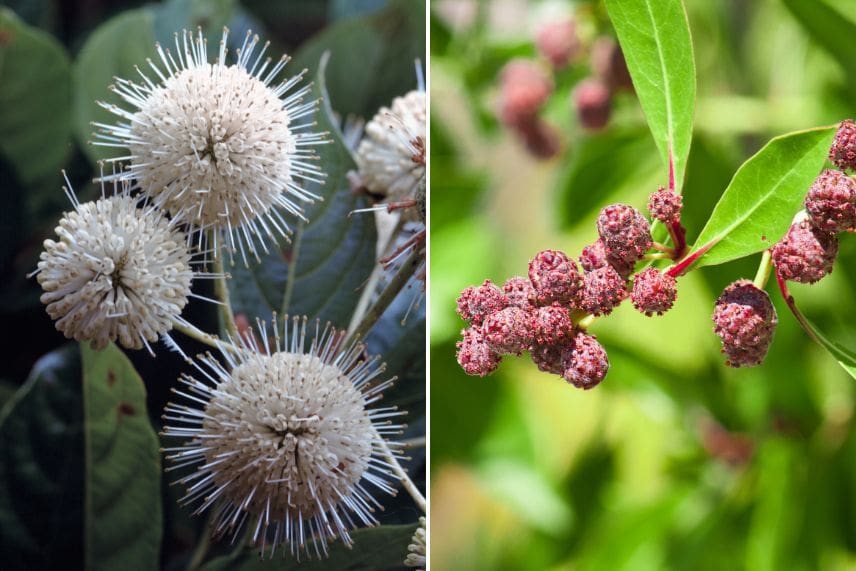
Flowers and berries of Cephalanthus occidentalis
How to grow it ? Cephalanthus should be planted in moist soil, ideally near a water source. It can adapt to all soil types, except calcareous soils. It grows in partial shade or in sun that is not scorching.
Barbary goji berry (Lycium barbarum)
The goji bush (Lycium barbarum) is a bush best known for its goji berries with numerous nutritional virtues when dried. Nevertheless, it is a deciduous bush with a bushy habit that can feature in a cottage-style hedge. In late summer and autumn, the shoots, arched and flexible, of the goji bush bear small star-shaped flowers, ranging from pink-purple to purple. Very melliferous, they attract swarms of nectar-foraging insects. These flowers then give rise to oval berries, which transition from green to orange. These berries are only edible when ripe, as they contain solanine. Nevertheless, they are recognised for their protein, calcium, vitamins, potassium and iron content. This bush is also easy to train. This bush is hardy down to -23 °C. Some cultivars such as ‘Amber Sweet’ produce yellow berries.
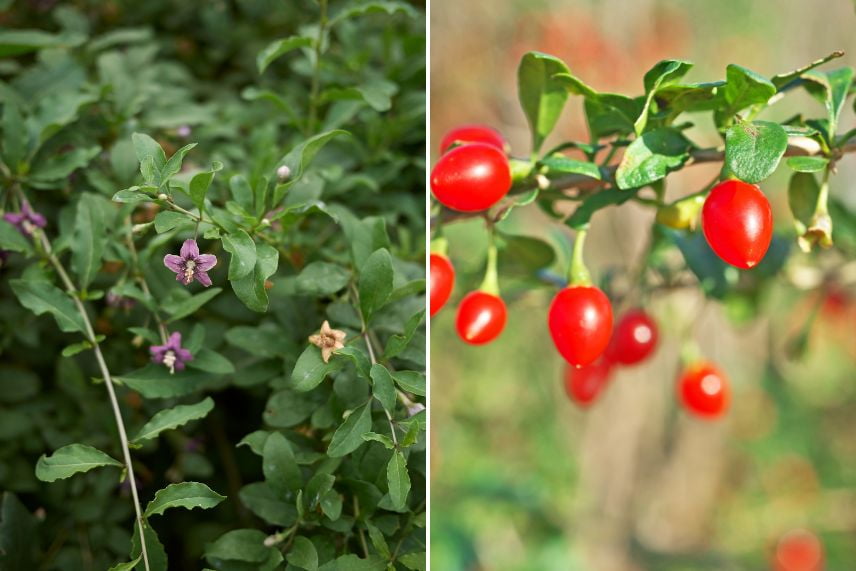
For hedge planting, we recommend the variety Lifeberry which reaches 2 m in all directions. It is also a very productive variety.
How to grow it? The goji bush prefers slightly cool soils, rather calcareous and well-drained. It requires a sunny position. Fruiting occurs after two years of planting.
Chinese privet (Ligustrum lucidum)
The Chinese privet or glossy privet (Ligustrum lucidum) is a large bush that can reach 7 m tall and 5 m wide. With its evergreen foliage and conical habit, it is perfect for forming a hedge, especially in regions with mild climates since it is hardy down to -12°C, but only for short periods.
This bush is notable for its late-summer flowering: long panicles of pinkish-white to cream-white flowers open late in September–October, among dense, leathery, oval and pointed foliage. These flowers are highly fragrant and melliferous, attracting a host of pollinating insects.
These flowers are followed by small berries of a very dark blue, almost black, gathered in compact clusters. Naturally, to achieve this fruiting, the bush should not be pruned.
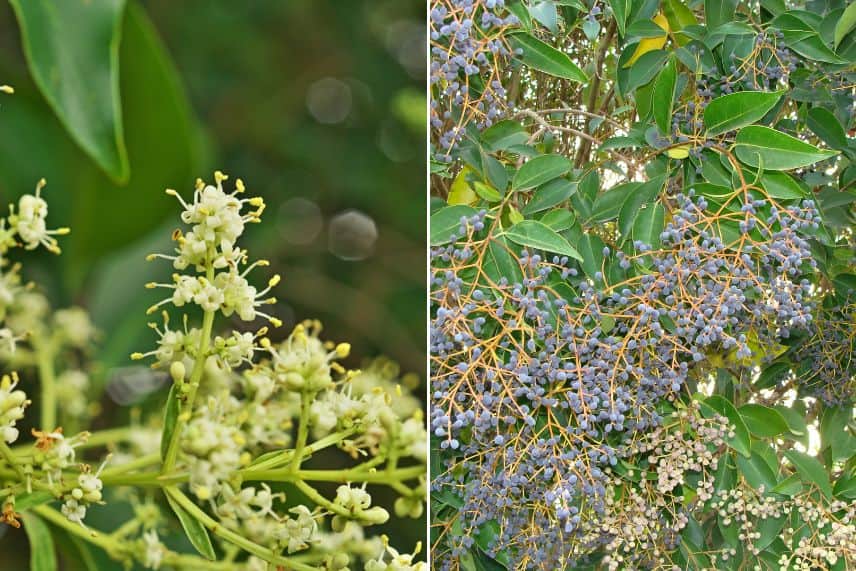
Flowers and berries of the Chinese privet
How to grow it? This privet variety can be planted in full sun or partial shade in all soil types, provided they are deep enough and well-drained.
Harlequin glorybower (Clerodendron trichotomum)
Native to China, the Clerodendron trichotomum does not exceed 3 m in our latitudes. It is truly remarkable for its autumn flowering in corymbs of white flowers measuring up to 20 cm in diameter. The calyx of the flowers, greenish at flowering, becomes fleshy and pink at fruit maturity. This shrub indeed bears turquoise-blue fruits, enclosed within this pink calyx. As for the foliage, opposite, ovate-elliptic, and slightly velvety, it is deciduous. Fast-growing, this shrub benefits from hardiness down to -15°C.
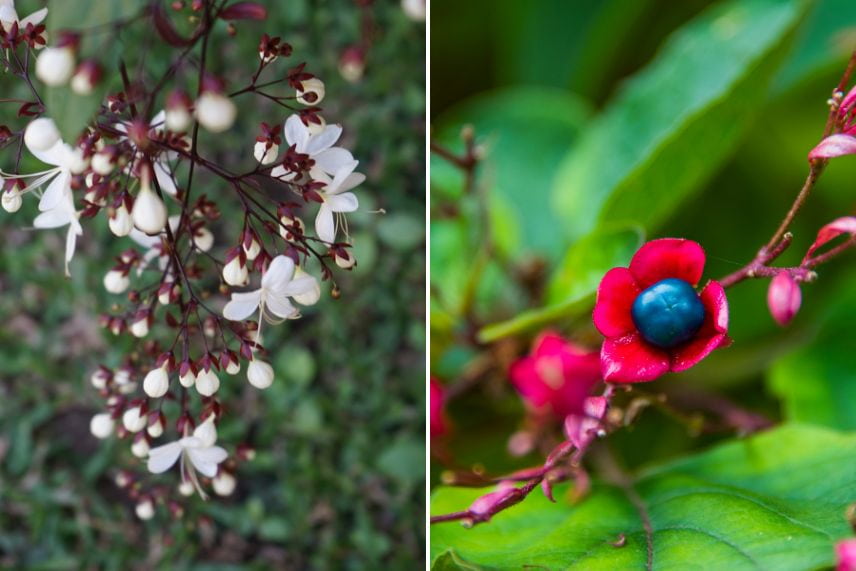
Flowers and berries of Clerodendron trichotomum
How to grow it? This shrub, very floriferous and fruit-bearing, thrives in deep, rich, moist and well-drained soil, in full sun or partial shade, but in a location sheltered from cold winds.
Aucuba
Even though some may regard it as commonplace, with many plants in parks and public gardens (where it is not always shown to its best advantage), aucuba remains a fine bush with evergreen foliage that offers a multitude of advantages.
Indeed, throughout the year, aucuba offers its thick evergreen foliage variegated with yellow, very glossy and highly ornamental, and pale green shoots that bring a note of freshness to any garden.
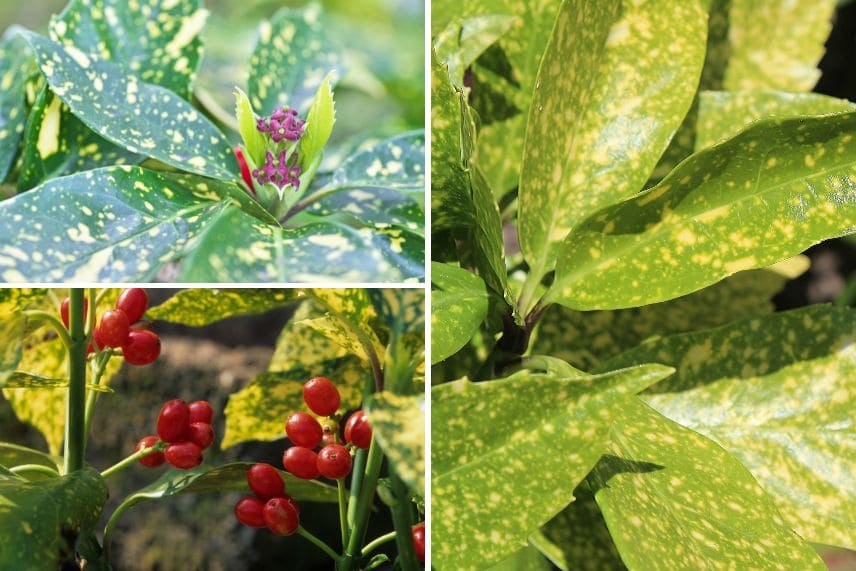
Foliage, flowers and berries of aucuba
In May–June, small, unobtrusive flowers appear, which, in winter, bear pretty red berries that are very decorative and provide colour. Note, however, that aucuba is a dioecious bush, so only female plants fruit, provided there is a male plant nearby. They make excellent hedge shrubs, especially as they can reach 3 to 4 m in our climate. Aucuba is also a very hardy shrub, resistant to urban pollution and to sea spray, low-maintenance and little prone to disease.
How to grow it? Aucuba should be planted in moist, well-drained, fertile soil, neutral or slightly acidic, in a site that is shaded to lightly sunny.
- Subscribe!
- Contents
Comments