





























7 trees with striking foliage and form
Choose a tree for the beauty of its foliage and silhouette
Contents
A tree leaf can be a reason in itself to choose the tree that bears it as a companion in your garden. Foliage offers significant ornamental interest, especially since it is present for at least 7 months out of 12 for deciduous species and all year round for evergreen trees. The shape of the leaf, its colour, the way it is arranged, as well as the tree’s habit—whether umbrella-shaped, tabular, weeping, or very vertical—are all assets that contribute to the garden’s graphic appeal. Let’s explore some species and varieties of trees with remarkable foliage and decorative habits that truly enhance the garden.

Albizia
Albizia trees are small trees that generally reach heights of between 6 and 10 m with a spread of 5 to 6 m. Featuring exotic, intense pink to red pompom flowers in summer, they also have very decorative foliage, similar to that of mimosas and acacias. The leaves of the Albizia are divided into large leaflets, which are further subdivided into smaller leaflets. This results in very small segments that give the foliage a light, feathery, and graphic appearance, reminiscent of ferns. The leaves, a deep yet light green, are very large, measuring 15 to 40 cm, and are flexible, gracefully cascading from the arched branches. The tree’s habit is also graceful, resembling a parasol, with the first branches high on the clear trunk. The overall effect is a tree that catches the eye with its strong yet gentle graphic form, exuding an exotic charm.
The albizia is also notable for the quality of its shade, which is filtered and dappled, allowing plenty of light to pass through due to its finely divided foliage. Combined with its parasol-like habit, it is the most delightful tree for a peaceful nap or lunch beneath its branches. Plant this decorative tree in isolation, carefully choosing its location to enjoy its beautiful silhouette.
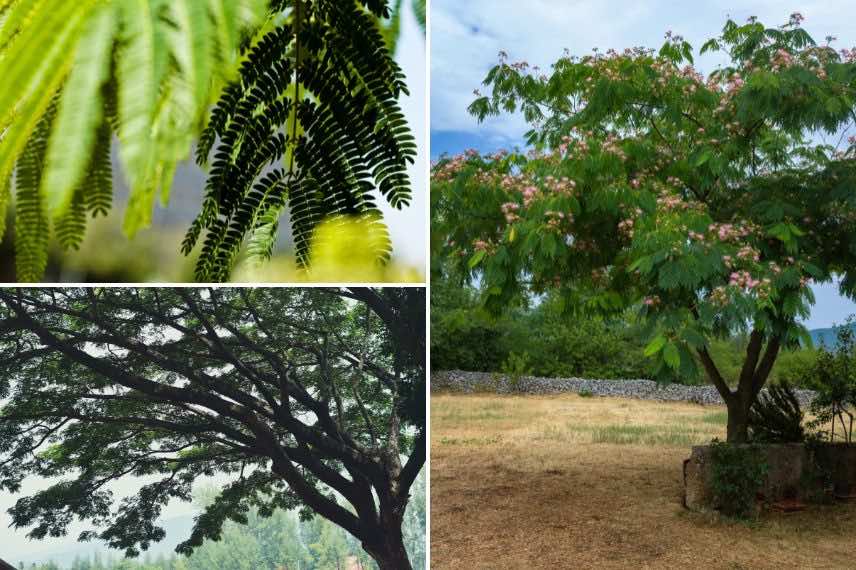
Foliage and branches of the Albizia
Read also
10 Columnar TreesAraucaria araucana
The famous Araucaria araucana, or Monkey Puzzle, is a large conifer with an astonishing appearance, featuring branches arranged in a geometric pattern, covered in very hard scale-like leaves. Its growth can be somewhat slow, but don’t be deceived; it has an impressive longevity and can reach 15 m in height and 8 m in spread. It develops a very vertical trunk with branches arranged in helices of 3 to 7 more or less horizontal shoots. Its evergreen leaves are small, flattened, pointed, and sharp at the tip, densely imbricate with one another. The geometry of its ramure and leaves makes it a highly graphic tree.
It is the national tree of Chile. Only plant it if you have the space to allow it to reach its full potential; otherwise, go admire it in a botanical garden. Its picturesque structure attracts all eyes.
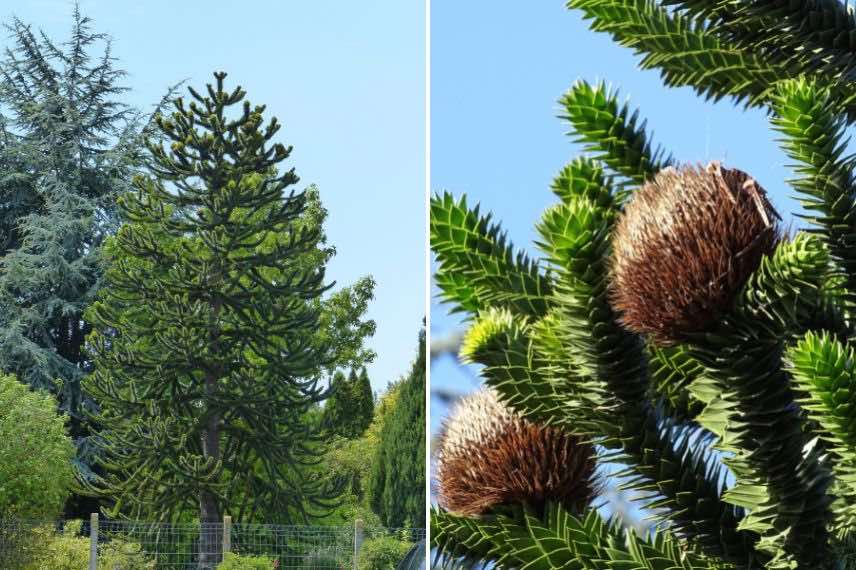
The astonishing Araucaria araucana
Discover other Decoratively-shaped trees and shrubs
View all →
Available in 1 sizes
Available in 1 sizes

Available in 1 sizes
Available in 1 sizes
Available in 1 sizes
Available in 1 sizes
Available in 1 sizes
Available in 2 sizes
Available in 1 sizes
Available in 1 sizes
Gleditsia or Honey locust
Plants from the legume family often feature finely cut foliage with a graphic appearance. This is the case with the Honey Locust, otherwise known as Gleditsia triacanthos. A tree with a light and airy habit, it reaches 15 m in height and 10 m in spread, offering an elegant and spreading silhouette. It bears flexible, trailing branches that zigzag. Its green foliage consists of long, large leaves measuring 15 to 25 cm in length, arranged alternately. They are fine and elegant, reminiscent of fern fronds. There is something of the Albizia or other legumes like wisteria here. It also provides a beautifully filtered and light shade beneath a graceful, airy canopy. Its deciduous foliage appears late in spring and adorns itself with sumptuous changing hues that do not go unnoticed and vary according to the varieties.
Hardier than the Albizia, it can be more interesting to grow in certain regions. It also shows its full potential when planted as a specimen.
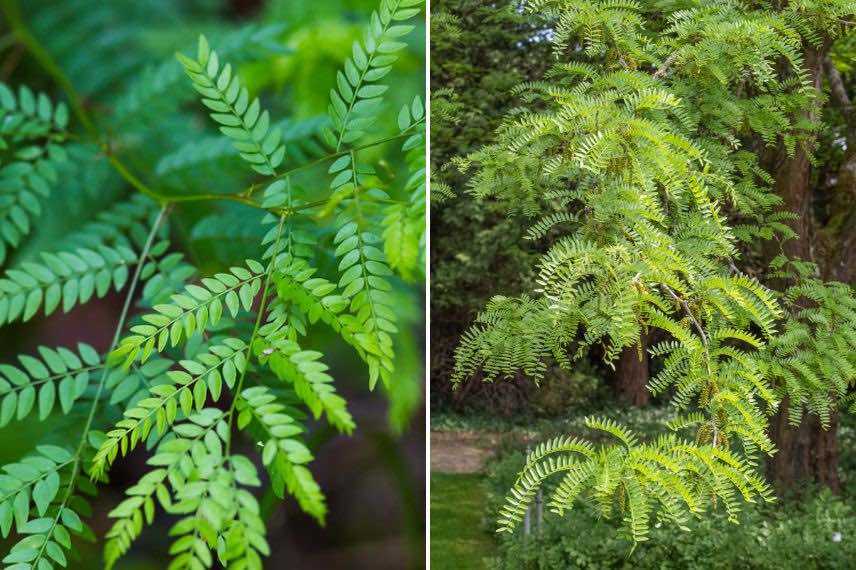
The fine foliage of the Gleditsia
Eucalyptus
The beautiful evergreen foliage of the Eucalyptus is quite distinctive: matte blue, glossy green, or silver-grey, adorned with subtle reflections in the sunlight. Its juvenile leaves, round and small like pearls strung on a fine stem, later evolve into elongated, narrow, and pendulous leaves. An elegant tree, its bark, coloured in shades of grey or brown, exfoliates in strips. The graphic quality of a leaf can be defined by its colour as much as by its shape; this is often the case with blue and metallic grey foliage that gives the plant a modern appearance. The habit of eucalyptus is generally spreading.
Depending on the species and varieties, the height and spread of eucalyptus can vary greatly. Plant it with consideration for its expected mature size, as its growth can be remarkably rapid. Also, check the hardiness of the chosen variety, as it is a specimen native to exotic regions, specifically Australia. Play with the colour of its foliage by pairing it with other strong foliage, such as black, gold, purple, or blue tones found in certain conifers.
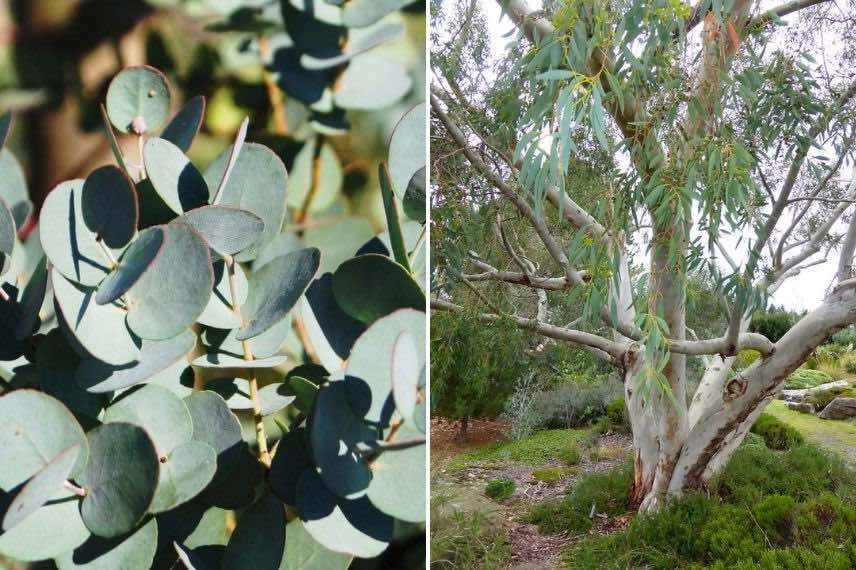
The exotic beauty of eucalyptus
The Tulip tree
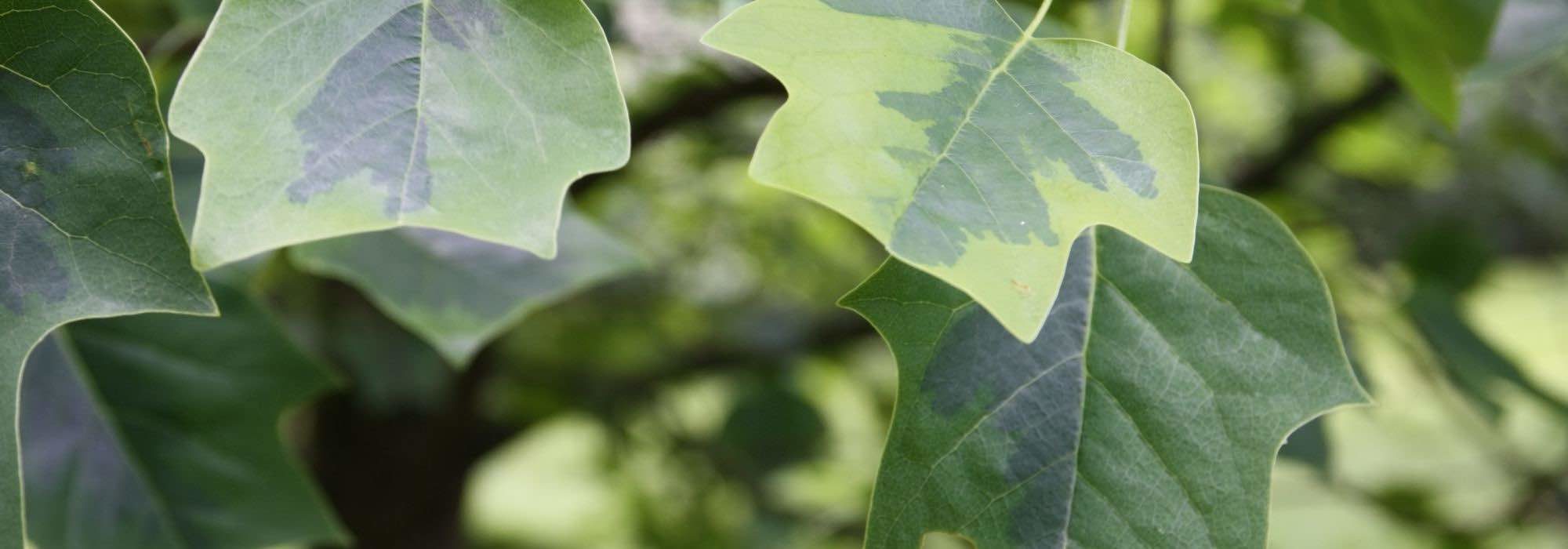
It’s not just the flower of the Tulip Tree that resembles a tulip. Its foliage has a very distinctive shape, cut and truncated into a stylised tulip form. The graphic quality of its leaf is further enhanced in the variegated version of Liriodendron tulipifera: the Liriodendron tulipifera ‘Aureomarginatum’. With bright green leaves strongly marginate with yellow in spring, it is particularly ornamental. It becomes greener in summer and yellow in autumn. Its leaves, measuring 10 to 12 cm, are divided into 4 lobes separated by clear notches. As for its silhouette, take a look at the fastigiate form: Liriodendron tulipifera ‘Fastigiata’ for a tall and narrower habit than the typical species.
This ornamental tree, given its size, is also suitable for planting in isolation, except perhaps for its fastigiate and variegated forms. At maturity, it reaches 25 m in height and 15 m in spread, while the other two measure 15 m in height and 7 m in spread.
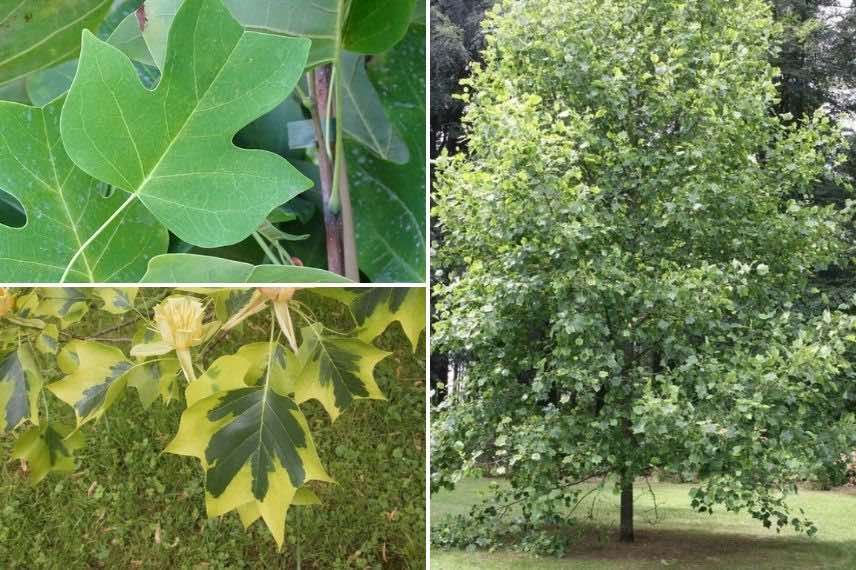
The astonishing leaf of the Tulip Tree
Birches
Among the various species and varieties of birch, you can find weeping or fastigiate forms, with finely dissected, purple or variegated foliage, and of course, remarkable bark. This offers plenty of opportunities for striking graphic elements in the garden. Firstly, the verticality of birch trunks, devoid of branches, makes for a visually strong tree. Their light and slender silhouette, sometimes reaching heights of 20 to 30 m, with fine branches bending under the weight of the foliage, and triangular leaves, are all interesting features that further highlight their white, pearlescent, or orange bark in mature specimens. Take a look at the Betula pendula ‘Crispa’ with its almost laciniate dissected leaves and weeping habit, the Betula pendula ‘Royal Frost’ with its satin chocolate-purple foliage contrasting strongly with the white bark. Admire the finely dentate, white-variegated foliage against the green background of the Betula nigra ‘Shilo Splash’ on a tall tree. The Himalayan white birches, with their tall and open branching habit, allow for a full appreciation of their very white bark.
Plant birch in cool climates and create winter scenes alongside it, or plant it in groups.
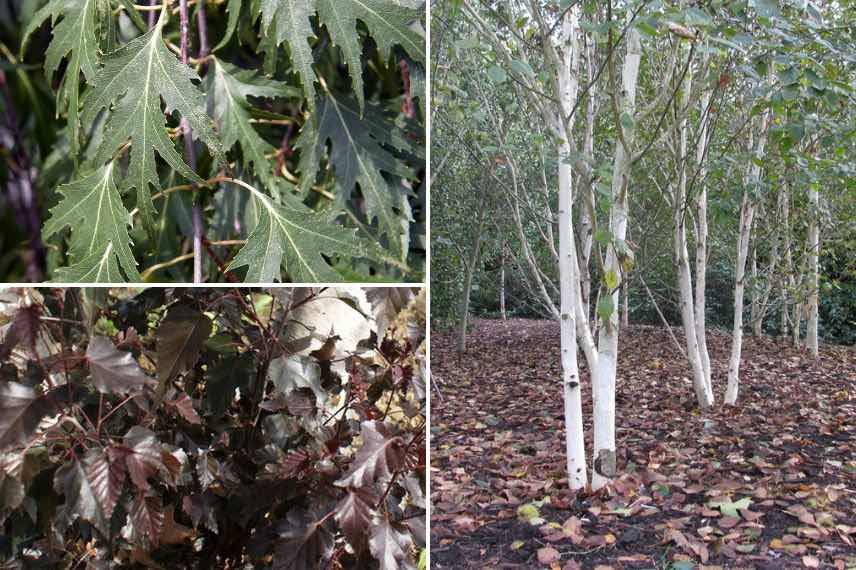
The dissected foliage of Betula pendula ‘Crispa’, the purple of Betula pendula ‘Royal Frost’, and the white trunks of Himalayan birches
Cornus controversa 'Variegata'
Cornus controversa ‘Variegata’ is undoubtedly a very graphic small deciduous tree. Everything about it is striking: from its table-like habit to its silver foliage, variegated with green and white. In winter, when the leaves have fallen, its light grey branches still make a strong impression with their beautiful architecture, always graphic. Its presence in the garden is significant : its lovely structure of tiered branches and its light attract the eye. Its beautiful pointed leaves, arranged solely on the upper side of the branches, turn red and purple in autumn and return in mid-spring. This dogwood slowly reaches 7 to 8 m in height, and its long horizontal branches give it an almost equivalent span. Its alternate, elliptical leaves are veined and measure 10 cm in length.
In the garden, it is essential to admire its branches; the ideal situation is really to plant it in isolation to showcase its beauty against a simple, dark background.
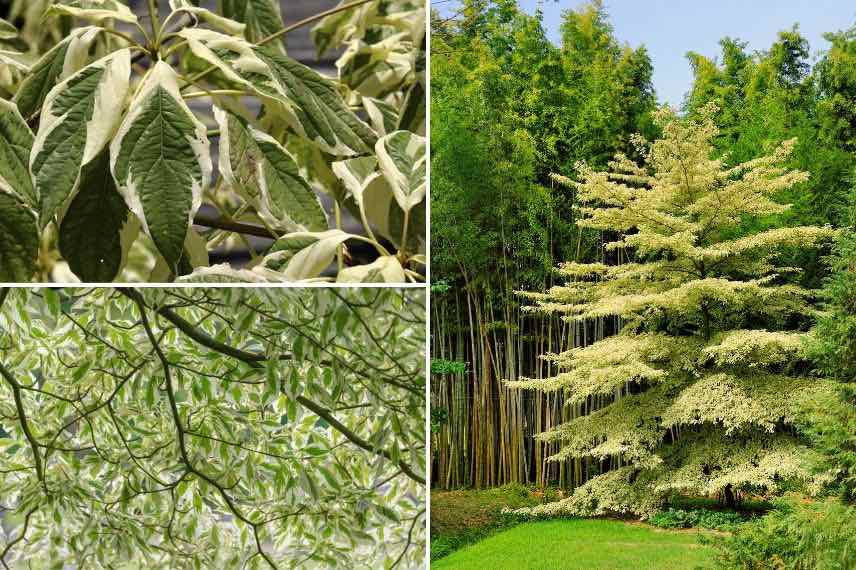
Foliage and table-like habit of Cornus controversa ‘Variegata’
- Subscribe!
- Contents
Comments