Nicotiana tabacum 'Gold Leaf Orinoco'
Nicotiana tabacum 'Gold Leaf Orinoco'
Nicotiana tabacum Gold Leaf Orinoco
Tobacco, Cultivated Tobacco, Common Tobacco
Back-to-school special offer!
Get €10 off for every €50 you spend! And get up to €40 off on a single order.
How does it work?
1. Shop your favourites
Add your favourite plants to your basket. For every €50 you spend (excluding delivery charges, store credit and the plastic-free option), you’ll receive a €10 voucher.
€50 spent = €10 voucher
€100 spent = €20 voucher
€150 spent = €30 voucher
€200 spent = €40 voucher
2. Place your order
Once your basket reaches one of the spending thresholds, place your order. You can even choose your delivery date!
3. Receive your voucher
As soon as your order has been shipped, you’ll receive an email containing your personal voucher code and its value.
4. Use it on your next order
Your voucher is valid for 90 days from the date you receive it. It can be used once only, on a new order worth at least the value of the voucher, excluding delivery charges.
Please note: Vouchers can be combined with other offers, but cannot be split or refunded.
Home or relay delivery (depending on size and destination)
Important: You may be charged customs duties by your country’s customs authorities upon delivery.
Schedule delivery date,
and select date in basket
This plant carries a 6 months recovery warranty
More information
We guarantee the quality of our plants for a full growing cycle, and will replace at our expense any plant that fails to recover under normal climatic and planting conditions.
Does this plant fit my garden?
Set up your Plantfit profile →
Description
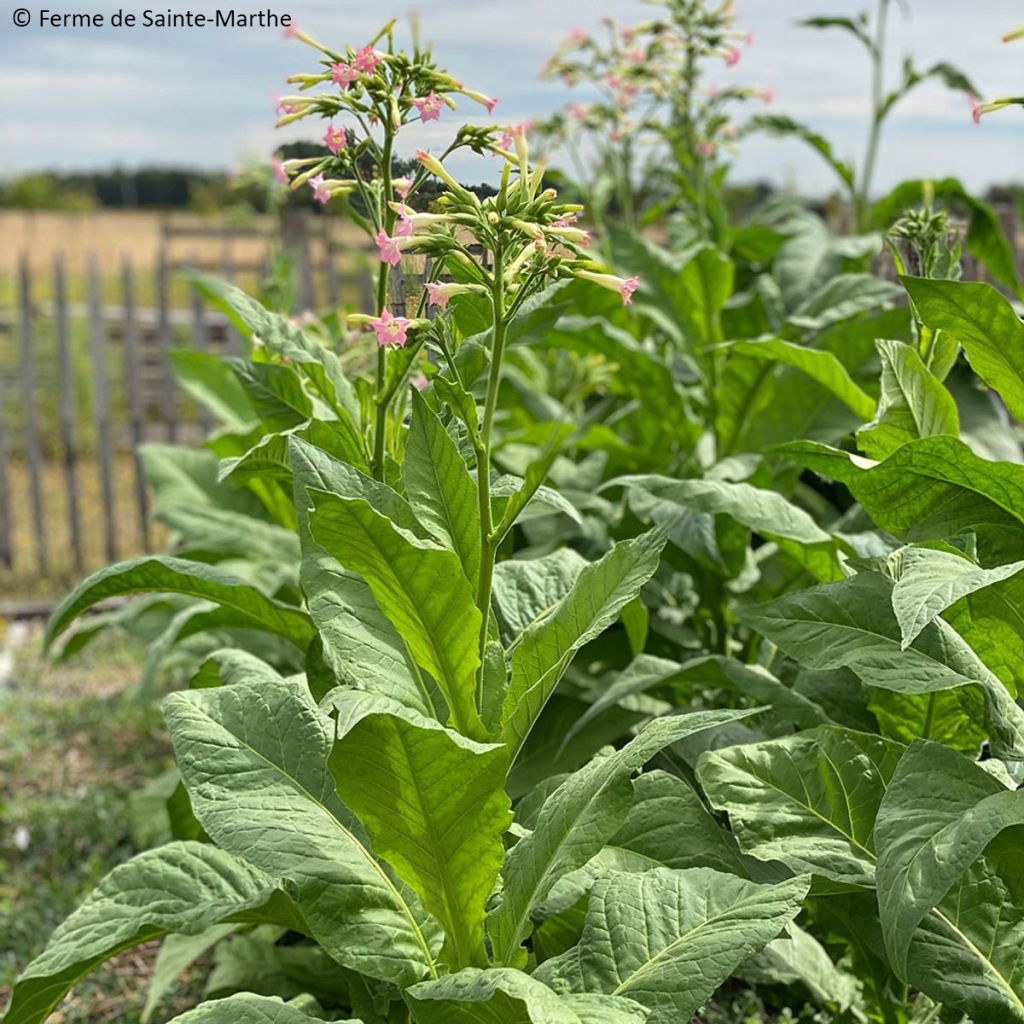
The 'Gold Leaf Orinoco' Tobacco is an ancient variety of cultivated tobacco (in Latin Nicotiana tabacum) that is particularly vigorous, forming a magnificent plant exceeding the size of a man in the space of a year. Its large decorative leaves, of a light green colour, have a pronounced aroma that evokes brown Virginia tobaccos, and the leaves located in the upper part of the plant can contain up to 4% nicotine. The tobacco is sown in March or April, under heated shelter, for planting after the frost. This plant appreciates the sun, rich, fresh, but well-drained soils. The leaves will be harvested from June to September and dried away from the sun.
Originally from the plains located in the humid tropical zones of Central America, extensively cultivated in many warm regions, Nicotiana tabacum is a plant of the Solanaceae family cultivated as an annual for the tobacco industry. The 'Gold Leaf Orinoco' variety (Gold Leaf Orinoco) has been cultivated for generations in Peru and has given rise to all modern varieties of Virginia tobacco. It is a herbaceous plant with a pyramidal shape reaching 2m (7ft) in height when flowering, spreading over 70-80cm (28-32in) in width. It develops a robust, slightly sticky stem, which branches out mainly in the upper part. The leaves, embracing at the base and cordate in shape, can measure up to 60cm (24in) in length by 40cm (16in) in width. They are shiny, of a bright green colour and covered with glandular hairs that make them slightly sticky and fragrant. The flowering, not very decorative, begins in midsummer and continues until early autumn. The inflorescence is a racemose cyme bearing small tubular flowers, with trumpet-shaped and rounded 5-lobed corollas. The flowers are greenish-yellow tinged with pink. This nectariferous flowering attracts butterflies, especially certain sphinx moths. The fruit is a capsule containing numerous small seeds.
Usage: 'Gold Leaf Orinoco' tobacco produces magnificent and highly aromatic plants. Generally, dried tobacco leaves are used for smoking or as an insect repellent. Drying is a process that takes 3 to 8 weeks in the open air and in the shade. It is advisable to take advantage of the end of summer or the beginning of autumn with still warm and dry days and relatively humid cool nights for drying. First, select the leaves located at the base of the plant, which yellow first. They will be bound at the petioles in small bundles of 3 to 5 with a rubber band, each bundle will be hung on a cord. Choose a location that is both shaded (no direct sunlight) and well-ventilated, such as a shed, barn, or well-ventilated garage. Make sure the air is not too dry, possibly close your location during the day and open it at night. The leaves gradually change colour from yellow to orange to brown. Their edge is slightly curved, but they should not be brittle.
Attention, seeds reserved for very experienced gardeners who are used to sowing very fine seeds. These seeds are as fine as dust, barely visible to the naked eye.

Flowering
Foliage
Plant habit
Botanical data
Nicotiana
tabacum
Gold Leaf Orinoco
Solanaceae
Tobacco, Cultivated Tobacco, Common Tobacco
Cultivar or hybrid
Planting and care
Sowing:
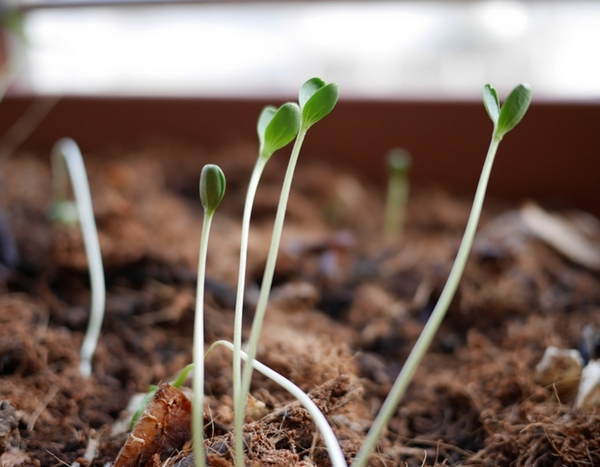
Sow tobacco seeds in March-April in pots or trays filled with moist compost and cover with a light sprinkle of vermiculite. Place in a propagator or enclose them in a polythene bag and put it in a warm place. Maintain a temperature of 18 to 20 °C. Keep in the light, as this promotes germination. Keep the surface of the compost moist, but not waterlogged; germination usually takes 7 to 21 days.
When the plants are sufficiently developed (4 to 5 leaves), transplant them into 7.5cm (3in) pots or trays. Acclimatize the plants to cooler conditions for a few weeks before placing them outside after all risk of frost, at a distance of 80cm (32in) apart.
Cultivation:
Tobacco plants thrive in rich, deep, and slightly moist soils. They enjoy the sun, but excessive exposure can damage their foliage. They also grow well in partial shade. In mild climates, these plants often become perennials. They readily self-seed in the garden, appearing in various locations.
Sowing period
Intended location
Planting & care advice
-

-
-

-

-

-

-

-

This item has not been reviewed yet - be the first to leave a review about it.
Recently viewed products
Haven't found what you were looking for?
Hardiness is the lowest winter temperature a plant can endure without suffering serious damage or even dying. However, hardiness is affected by location (a sheltered area, such as a patio), protection (winter cover) and soil type (hardiness is improved by well-drained soil).
In temperate climates, pruning of spring-flowering shrubs (forsythia, spireas, etc.) should be done just after flowering.
Pruning of summer-flowering shrubs (Indian Lilac, Perovskia, etc.) can be done in winter or spring.
In cold regions as well as with frost-sensitive plants, avoid pruning too early when severe frosts may still occur.
The harvesting period indicated on our website applies to countries and regions in USDA zone 8 (France, England, Ireland, the Netherlands).
In colder areas (Scandinavia, Poland, Austria...) fruit and vegetable harvests are likely to be delayed by 3-4 weeks.
In warmer areas (Italy, Spain, Greece, etc.), harvesting will probably take place earlier, depending on weather conditions.
The sowing periods indicated on our website apply to countries and regions within USDA Zone 8 (France, UK, Ireland, Netherlands).
In colder areas (Scandinavia, Poland, Austria...), delay any outdoor sowing by 3-4 weeks, or sow under glass.
In warmer climes (Italy, Spain, Greece, etc.), bring outdoor sowing forward by a few weeks.
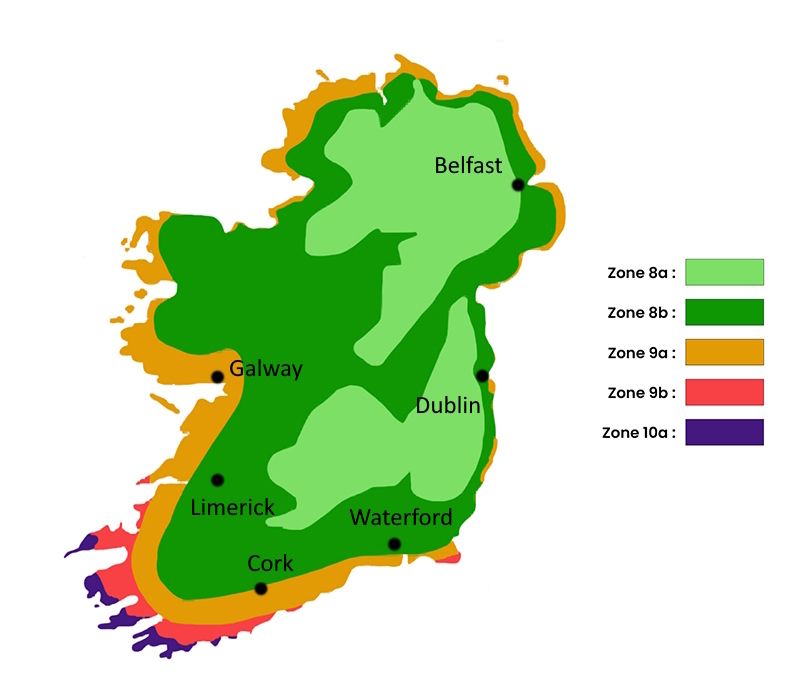
The planting period indicated on our website applies to regions in USDA Zone 9a (East Coast and Midlands: Dublin, Wexford, Waterford, Kilkenny, Portlaoise). It will vary depending on where you live:
- On the west coast and in the north-west (Galway, Limerick, Sligo, Donegal, Westport), delay planting by 1 to 2 weeks in spring and bring it forward by 1 to 2 weeks in autumn compared to the dates given, preferably choosing periods without strong winds.
- In the inland hills and plateaus (Wicklow Mountains, Macgillycuddy’s Reeks, Connemara, Killarney), it is best to plant in spring (April–May) or autumn (September–October), avoiding periods of waterlogged soil in winter and strong winds, which pose the main risk to newly planted trees in these areas.
The flowering period indicated on our website applies to regions in USDA Zone 9a, such as the East Coast and Midlands, including Dublin, Wexford, Waterford, Kilkenny and Portlaoise.
This will vary depending on where you live:
- On the west coast and in the northwest (Galway, Limerick, Sligo, Donegal and Westport), it will be delayed by one to two weeks compared to the given dates, due to stronger Atlantic winds and less spring sunshine.
- In the inland hills and plateaus (the Wicklow Mountains, the Macgillycuddy's Reeks, Connemara and Killarney), flowering will be delayed by two to three weeks. Flowering mainly occurs between May and July, with the limiting factors being less frost and more of the excessive humidity, strong winds and lack of sunshine that are characteristic of these areas.
Shipping country and language
Your country of residence may be:
Your country of residence is:
For a better user experience on our website, you can select:
Your shipping country:
-
 Austria
-
 Belgium
-
 Bosnia & Herzegovina
-
 Bulgaria
-
 Croatia
-
 Cyprus
-
 Czechia
-
 Denmark
-
 Estonia
-
 Finland
-
 France
-
 Germany
-
 Greece
-
 Hungary
-
 Iceland
-
 Ireland
-
 Italy
Italy
-
 Latvia
-
 Liechtenstein
-
 Lithuania
-
 Luxembourg
-
 Malta
Malta
-
 Netherlands
-
 Poland
-
 Portugal
-
 Romania
-
 Serbia
-
 Slovakia
-
 Slovenia
-
 Spain
Spain
-
 Sweden
-
 Switzerland
Language:
-
French
-
 English
-
Spanish
-
Italian
-
German
-
Portuguese
-
Dutch
-
Finnish
My Account
Hello
My wish lists
My cart
Log in / Register
Existing customer?
This form is protected by reCAPTCHA - the Google Privacy Policy and Terms of Service apply.
New customer?
Create an account to track your orders, access our customer service and, if you wish, make the most of our upcoming offers.