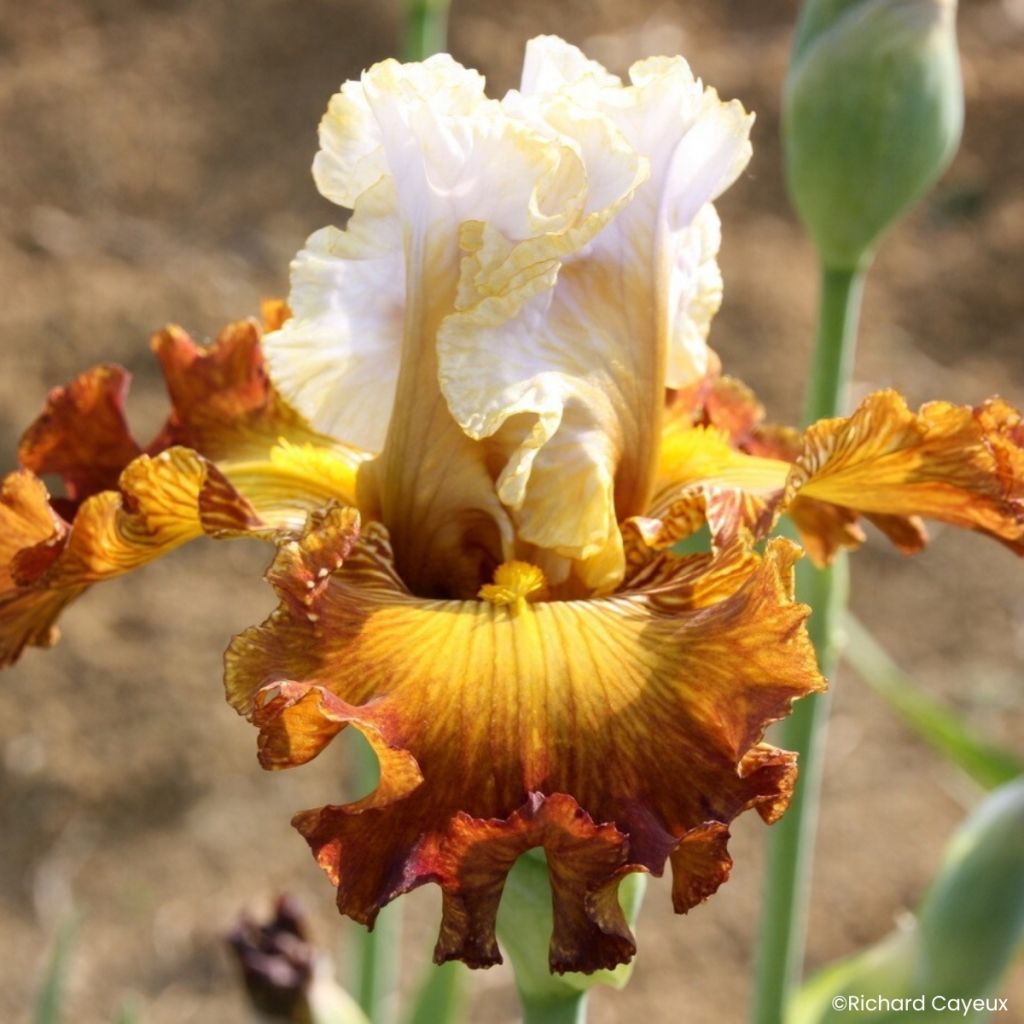
Iris germanica Daniel Collin - Tall Bearded Iris
Iris germanica Daniel Collin - Tall Bearded Iris
Iris germanica Daniel Collin
Bearded Iris
Back-to-school special offer!
Get €10 off for every €50 you spend! And get up to €40 off on a single order.
How does it work?
1. Shop your favourites
Add your favourite plants to your basket. For every €50 you spend (excluding delivery charges, store credit and the plastic-free option), you’ll receive a €10 voucher.
€50 spent = €10 voucher
€100 spent = €20 voucher
€150 spent = €30 voucher
€200 spent = €40 voucher
2. Place your order
Once your basket reaches one of the spending thresholds, place your order. You can even choose your delivery date!
3. Receive your voucher
As soon as your order has been shipped, you’ll receive an email containing your personal voucher code and its value.
4. Use it on your next order
Your voucher is valid for 90 days from the date you receive it. It can be used once only, on a new order worth at least the value of the voucher, excluding delivery charges.
Please note: Vouchers can be combined with other offers, but cannot be split or refunded.
Home or relay delivery (depending on size and destination)
Important: You may be charged customs duties by your country’s customs authorities upon delivery.
Schedule delivery date,
and select date in basket
This plant carries a 12 months recovery warranty
More information
We guarantee the quality of our plants for a full growing cycle, and will replace at our expense any plant that fails to recover under normal climatic and planting conditions.
Does this plant fit my garden?
Set up your Plantfit profile →
Description
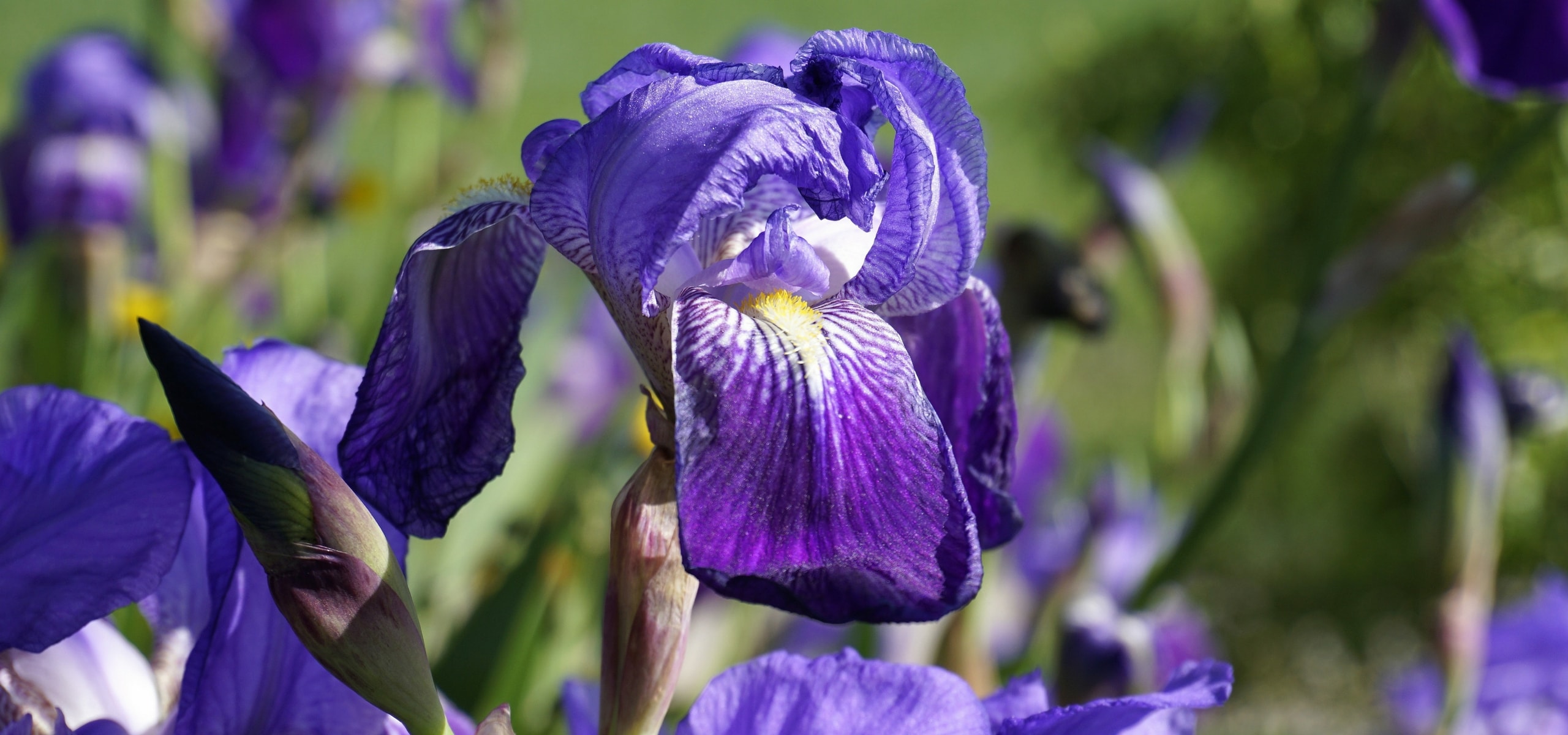
L’Iris ‘Daniel Collin’ est un iris des jardins de haute stature, dont les fleurs se démarquent autant par leur forme que par leur palette de couleurs. C'est une variété bicolore, aux pétales blanc crème veinés de jaune orangé vers la base, et aux sépales, larges et très ondulés à centre jaune d’or bordé de cuivre orangé et de brun pourpré. La barbe jaune, pointée d’orange, éclaire le cœur de la fleur. Les fleurs sont légèrement parfumées.
'Daniel Collin’ est une plante vivace rhizomateuse. Il fait partie des grands iris barbus cultivés dans les jardins depuis fort longtemps. Ces plantes de la famille des Iridacées ont pour ancêtre l’Iris × germanica, un hybride européen très ancien issu d’Iris pallida et d’Iris variegata. Elles sont bien rustiques en sol drainé et supportent la sécheresse estivale. Leurs feuilles en forme de glaive, d’un vert grisé à glauque, sont plus ou moins persistantes en hiver selon le climat.
‘Daniel Collin’ est un iris élancé, ses hampes florales atteignent 1 m de hauteur. Après 3 ou 4 ans de culture, la touffe occupe 40 à 50 cm au sol. Les rhizomes se multiplient lentement à la périphérie de la souche, tandis que ceux du centre fleurissent moins au fil du temps. Les fleurs éclosent en mai-juin, vers la fin de la saison des iris des jardins. Elles présentent des pétales dressés blanc crème, veinés de jaune orangé vers la base. Les sépales retombants sont larges, horizontaux, bien ondulés, jaune d’or au centre, largement bordés de cuivre orangé, de brun chaud et de pourpre. La fleur possède une silhouette mouvementée, mais bien dessinée. Les barbes jaunes, pointées d’orange, relient le cœur doré aux tons plus brûlés des sépales. Le parfum est léger, doux et sucré.
Obtenu en France par Roland Dejoux et enregistré en 2019, cet iris porte le numéro de semis RD13-54A. Il est issu du croisement entre deux semis de Barry Blyth, V208-1 et W97-2. Il appartient à la même fratrie que l’iris ‘Paul Henri’. Son nom rend hommage à Daniel Collin, un ingénieur horticole et architecte paysagiste, créateur du Parc Floral de Paris.
Plantez cet iris ‘Daniel Collin’ par groupes de trois rhizomes, espacés de 35 à 40 cm, pour obtenir une touffe bien fleurie en l’espace de 2-3 ans. Dans un massif, associez-le à des iris unis blancs, jaunes ou orangés. L’Iris ‘Ré la Blanche’, blanc pur à petites barbes jaune pâle, illumine ses tons chauds. L’Iris ‘Baie des Anges’, bleu moyen à barbes orange vif, offre une couleur très complémentaire. À distance, vous pouvez planter un gros coussin argenté de Ballota pseudodictamnus, ou de Teucrium marum, fleuri de rose pourpré en été. Laissez les rhizomes au soleil, sans plante couvrante par-dessus.
Flowering
Foliage
Plant habit
Botanical data
Iris
germanica
Daniel Collin
Iridaceae
Bearded Iris
Cultivar or hybrid
Planting and care
Plant the iris ‘Daniel Collin’ from July to October, when the rootstocks can root before winter, or in spring in heavy soils that remain damp in autumn. Choose a very sunny position, with at least six hours of direct sun per day. The soil should be fairly rich but without excess nitrogen, neutral to calcareous, and especially well-drained. In clay soil, plant on a small mound and mix gravel or coarse sand into the planting soil. Place the rootstock almost at the surface, with the back visible to the sun. Water after planting, then only during prolonged droughts in the first year. Apply some well-rotted compost in spring, around the clump, without covering the rootstocks. Divide the clumps every three or four years, in summer, when the centre flowers less.
Planting period
Intended location
Care
Planting & care advice
-
-
-
-
-
-
-
-
This item has not been reviewed yet - be the first to leave a review about it.
Recently viewed products
Haven't found what you were looking for?
Hardiness is the lowest winter temperature a plant can endure without suffering serious damage or even dying. However, hardiness is affected by location (a sheltered area, such as a patio), protection (winter cover) and soil type (hardiness is improved by well-drained soil).
In temperate climates, pruning of spring-flowering shrubs (forsythia, spireas, etc.) should be done just after flowering.
Pruning of summer-flowering shrubs (Indian Lilac, Perovskia, etc.) can be done in winter or spring.
In cold regions as well as with frost-sensitive plants, avoid pruning too early when severe frosts may still occur.
The harvesting period indicated on our website applies to countries and regions in USDA zone 8 (France, England, Ireland, the Netherlands).
In colder areas (Scandinavia, Poland, Austria...) fruit and vegetable harvests are likely to be delayed by 3-4 weeks.
In warmer areas (Italy, Spain, Greece, etc.), harvesting will probably take place earlier, depending on weather conditions.
The sowing periods indicated on our website apply to countries and regions within USDA Zone 8 (France, UK, Ireland, Netherlands).
In colder areas (Scandinavia, Poland, Austria...), delay any outdoor sowing by 3-4 weeks, or sow under glass.
In warmer climes (Italy, Spain, Greece, etc.), bring outdoor sowing forward by a few weeks.
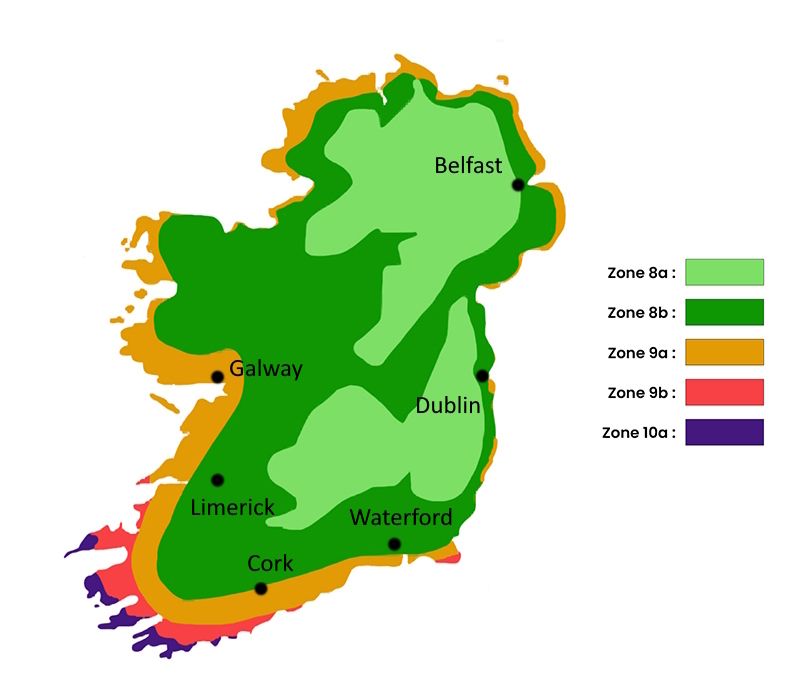
The planting period indicated on our website applies to regions in USDA Zone 9a (East Coast and Midlands: Dublin, Wexford, Waterford, Kilkenny, Portlaoise). It will vary depending on where you live:
- On the west coast and in the north-west (Galway, Limerick, Sligo, Donegal, Westport), delay planting by 1 to 2 weeks in spring and bring it forward by 1 to 2 weeks in autumn compared to the dates given, preferably choosing periods without strong winds.
- In the inland hills and plateaus (Wicklow Mountains, Macgillycuddy’s Reeks, Connemara, Killarney), it is best to plant in spring (April–May) or autumn (September–October), avoiding periods of waterlogged soil in winter and strong winds, which pose the main risk to newly planted trees in these areas.
The flowering period indicated on our website applies to regions in USDA Zone 9a, such as the East Coast and Midlands, including Dublin, Wexford, Waterford, Kilkenny and Portlaoise.
This will vary depending on where you live:
- On the west coast and in the northwest (Galway, Limerick, Sligo, Donegal and Westport), it will be delayed by one to two weeks compared to the given dates, due to stronger Atlantic winds and less spring sunshine.
- In the inland hills and plateaus (the Wicklow Mountains, the Macgillycuddy's Reeks, Connemara and Killarney), flowering will be delayed by two to three weeks. Flowering mainly occurs between May and July, with the limiting factors being less frost and more of the excessive humidity, strong winds and lack of sunshine that are characteristic of these areas.
Shipping country and language
Your country of residence may be:
Your country of residence is:
For a better user experience on our website, you can select:
Your shipping country:
-
 Austria
-
 Belgium
-
 Bosnia & Herzegovina
-
 Bulgaria
-
 Croatia
-
 Cyprus
-
 Czechia
-
 Denmark
-
 Estonia
-
 Finland
-
 France
-
 Germany
-
 Greece
-
 Hungary
-
 Iceland
-
 Ireland
-
 Italy
Italy
-
 Latvia
-
 Liechtenstein
-
 Lithuania
-
 Luxembourg
-
 Malta
Malta
-
 Netherlands
-
 Poland
-
 Portugal
-
 Romania
-
 Serbia
-
 Slovakia
-
 Slovenia
-
 Spain
Spain
-
 Sweden
-
 Switzerland
Language:
-
French
-
 English
-
Spanish
-
Italian
-
German
-
Portuguese
-
Dutch
-
Finnish
My Account
Hello
My wish lists
My cart
Log in / Register
Existing customer?
This form is protected by reCAPTCHA - the Google Privacy Policy and Terms of Service apply.
New customer?
Create an account to track your orders, access our customer service and, if you wish, make the most of our upcoming offers.