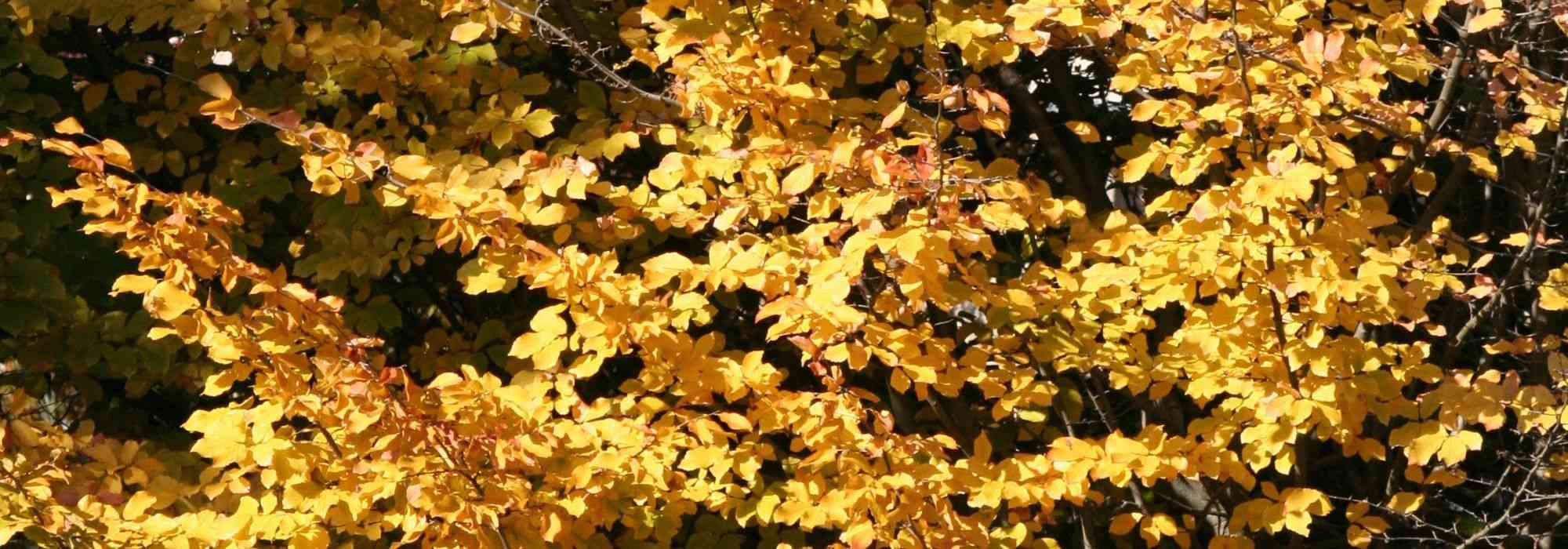
Parrotia persica, Persian ironwood: planting, pruning and care
Contents
Parrotia in a nutshell
- Persian ironwood is a handsome ornamental tree with splendid, varied autumn colours
- Its extremely hard wood has earned it the nickname “ironwood“
- This small tree grows in any good humus-rich soil, even clayey, provided it remains moist
- Very hardy, Persian ironwood does not, however, tolerate severe heat and drought
- Can be planted as a solitary specimen, in an informal hedge or in a small grove among other shrubs with beautiful autumn colours and even in a pot for some varieties
A word from our expert
“Iron tree”, “Persian beech”, “Parrot tree”… Nicknames for this little-known small tree are plentiful! Resplendent in multiple colours in autumn, its foliage then turning green, yellow, red and orange, it also provides presence in the garden throughout other seasons, notably thanks to its particular habit, wider than tall. Branches, as they age, seem to bow under weight of years and bark exfoliates gradually to reveal yellowish patches, which gives it extra interest during the winter.
Flowering, though inconspicuous to the gardener, is far less so for early bees and bumblebees venturing out in early spring. Indeed, flowers are melliferous and highly nourishing at a time when food for insects is desperately scarce.
With unfailing hardiness, free from disease, almost no maintenance and tolerating any good fresh, well-drained soil, Persian ironwood rightly deserves to be planted more often in our gardens. It fears only two things: extreme heat and lack of water! So avoid planting it in southern regions.
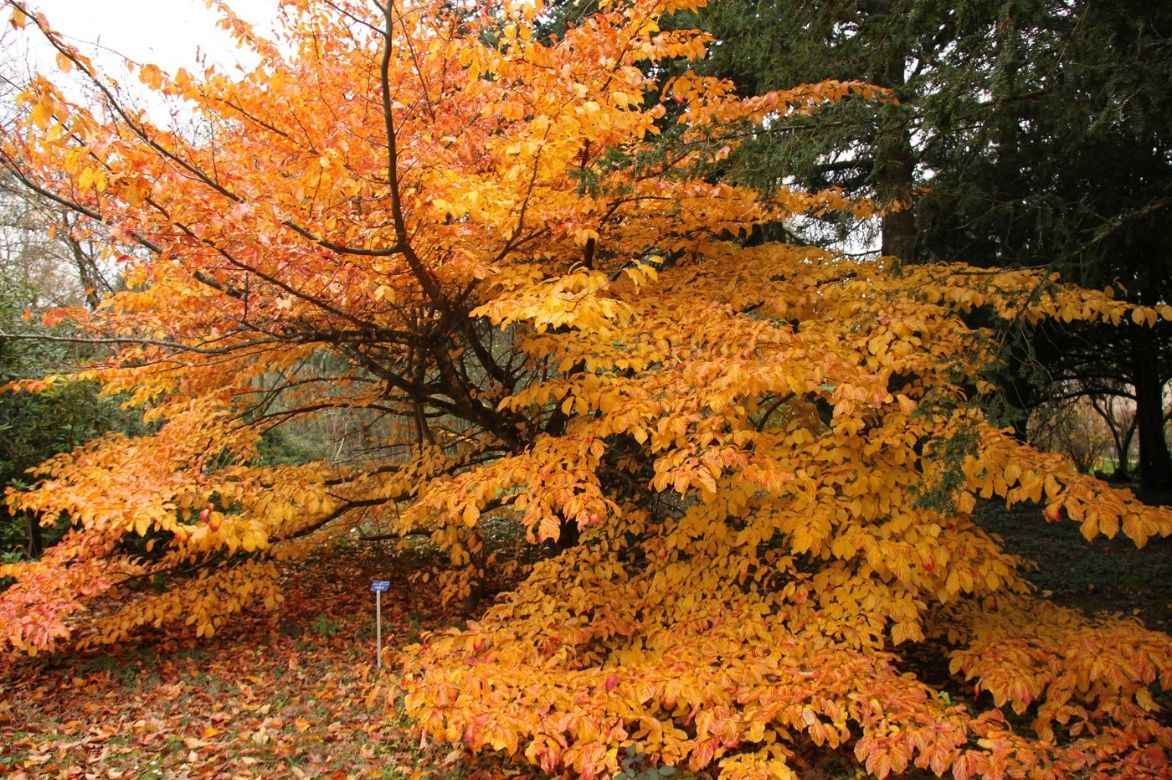
With fairly slow growth, the Parrotia persica can be planted within an informal hedge or in a small copse among other shrubs with beautiful autumnal colours. But as a solitary specimen, in the middle of a well-open space, it will offer the most spectacular display in all its autumnal splendour, becoming without doubt one of the focal points of your garden. Note that varieties now exist that adapt very well to growing in containers.
Description and botany
Botanical data
- Latin name Parrotia persica
- Family Hamamelidaceae
- Common name Persian parrotia or Persian beech; ironwood or Persian ironwood; parrot tree
- Flowering February–March
- Height 8 metres
- Sun exposure full sun to partial shade
- Soil type deep, fertile and moist
- Hardiness -25°C
Persian parrotia (Parrotia persica) belongs to family Hamamelidaceae and is now the sole species of genus Parrotia though several cultivars exist. This small tree or large shrub originates from mixed forests of northern Iran and eastern Caucasus, hence species epithet “persica“, but is becoming rare in its native habitat. Known as “ironwood” or “Persian ironwood” because of hardness of its wood, it is also nicknamed “parrot tree” for flamboyant autumn leaf colours. This shrub can also be found in older works under name Hamamelis persica.
Ironwood is a large shrub or small tree reaching 5 to 10 m tall in cultivation, though it can grow to 20 m in native range. It has a stout trunk and very spreading habit, often wider than tall (commonly nearly 10 metres across). Branches of older specimens arch to the ground. Root system is extensive and tree tends to sucker.
Bark is grey in colour but peels with age to reveal yellowish patches, somewhat like plane bark. Young shoots are green-brown with fine hairs and buds are very dark purplish, themselves slightly puberulous.
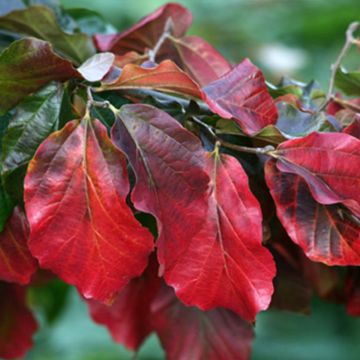
Deciduous foliage comprises oval leaves about 8 cm long, glossy green in spring and summer (reddish at bud burst) and becoming intensely colourful in autumn with colours appearing simultaneously: green, yellow, orange and crimson to purple. Upper half of leaf margin bears rounded teeth and veins are prominent, somewhat reminiscent of beech leaf. Hence common name “Persian beech”.
Flowers are hermaphrodite, small and apetalous, formed of scarlet stamens surrounded by brown bracts. They appear directly on branches at end of winter (late February–early March) just before leaf emergence. Although inconspicuous, flowers are very melliferous and provide an excellent early-season food source for first pollinators after winter. Fruit formed after fertilisation is somewhat nut-like, a softly hairy capsule with four chambers. Seeds are light brown.
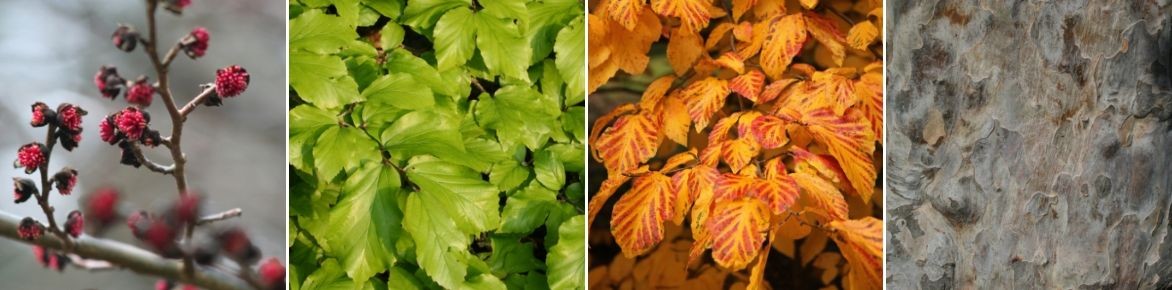
Parrotia persica : flowering, spring foliage then autumn foliage, attractive bark
Parrotia reaches sexual maturity from around ten years old. It is a relatively slow-growing tree, gaining only about 30 cm per year, but can easily live two hundred years.
Please note : only one species remains in genus Parrotia. Formerly it included others such as Parrotia jacquemontiana now Parrotiopsis jacquemontiana and Parrotia subaequalis now Shaniodendron subaequalis.
Read also
The flowering of Parrotia persicaOur preferential varieties
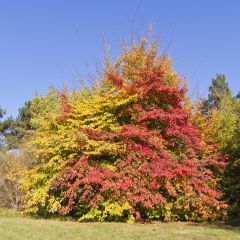
Parrotia persica - Persian Ironwood
- Flowering time March to May
- Height at maturity 8 m
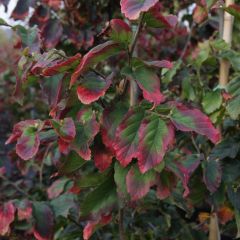
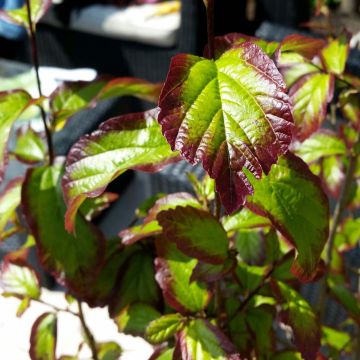
Parrotia persica Vanessa - Persian Ironwood
- Flowering time March to May
- Height at maturity 6,50 m
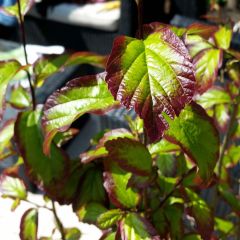
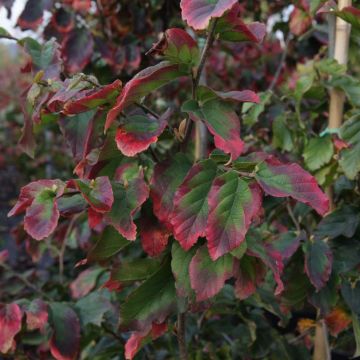
Parrotia persica Persian Spire - Persian Ironwood
- Flowering time March to May
- Height at maturity 7 m
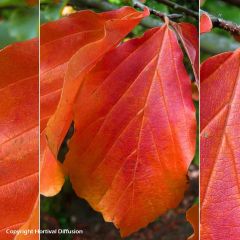
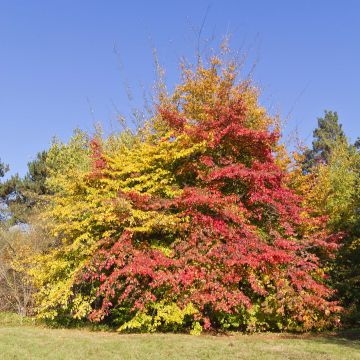
Parrotia persica Bella - Persian Ironwood
- Flowering time March to May
- Height at maturity 10 m
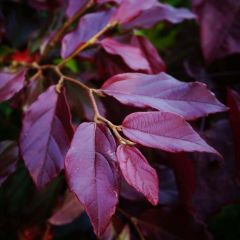
Sycoparrotia semidecidua Purple Haze
- Flowering time March to May
- Height at maturity 4 m
Discover other Parrotia - Persian Ironwood
View all →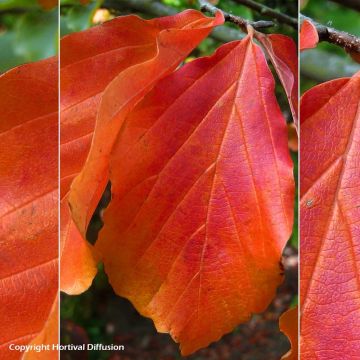
Available in 2 sizes
Available in 2 sizes
Available in 2 sizes
Available in 2 sizes
Available in 1 sizes
Available in 2 sizes
Planting Parrotia
Where to plant Parrotia?
Persian ironwood is a very hardy tree, as it tolerates frosts down to -25 °C. However, it dislikes heat and is susceptible to drought, although it becomes fairly resilient once established. Avoid planting it south of the Loire, as the climate is generally unsuitable.
This tree prefers rich, deep, acidic soils (autumn colours are then much more attractive) but will tolerate calcareous soil. It also needs soil to remain cool but well drained. It adapts easily to heavy clay soils.
The ideal situation is a sunny but not scorching position, or partial shade, protected from drying winds.
Allow plenty of space for this tree, which tends to spread widely: at least 10 metres wide at maturity. Unless you choose a narrower-growing variety such as ‘Vanessa’ or ‘Persian Spire’.
When to plant?
The best time to plant is autumn (November–December). You can also plant in early spring if soil is not frozen.
How to plant?
- Dip the pot of your new Parrotia into a bucket of water for a few minutes to thoroughly re-wet the root ball
- Dig a hole twice as deep and twice as wide as the root ball
- Add a few handfuls of well-rotted compost to the bottom of the hole
- If your soil is heavy, add some sand or a little gravel to improve drainage
- Begin gently teasing out the roots
- Place the root ball into the bottom of the hole, spreading the roots out well
- Refill the hole with the loosened excavated soil
- Firm the soil gently around the tree with your hands (not with your feet!)
- Give the base a 10-litre watering to reduce the risk of air pockets between roots and soil
- Apply a mulch to protect the young tree from drought or plant a few small groundcover plants at its base (creeping bugle, sweet woodruff, Glechoma, Geranium macrorrhizum, …).
Maintenance, pruning and care
Care
Very little care is required for Persian ironwoods. Mulching is highly recommended, especially during the first years, to maintain coolness and moisture in summer.
During periods of drought, check whether your Persian ironwood is suffering from lack of water.
Pruning
No pruning is really necessary. If needed, you can remove, just before growth resumes (February), fragile, dead or crossing branches to preserve a harmonious and healthy habit.
Possible diseases
This shrub or small tree suffers from no disease and is not attacked by pests.
Multiplication
Sowing
Sowing is difficult and slow; seeds take 18 months to germinate with a very low germination rate.
Layering
In fact, the tree layers naturally. Layering by couching is an easy operation to carry out in March–April. Bend a few healthy flexible shoots down to the soil. Split the bark of these shoots beforehand for a few centimetres to a depth of about 2 mm. Bury your layers at the split and secure them with a stainless-steel “U” pin. Keep moist and wait at least two years before separating the layer from the parent plant. Remove it carefully once it has rooted, then pot it up.
Propagation by cuttings
In June, you can try taking semi-ripe cuttings of shoots under cover. Take young shoots and make a slanting heel cut. Remove the leaves, keeping only one to reduce evapotranspiration. The substrate should be light; a mix of 50% sowing compost and 50% sand will be perfect. Keep moist but not waterlogged. Unrooted cuttings do not take up water, so excessive moisture will cause rot. First roots will appear by autumn, but it is better to wait until spring to repot. Wait at least until the following autumn, or better still the year after, before planting out.
Grafting
Parrotie is grafted onto Hammamelis: this is normal, as they belong to the same botanical family. This technique should be reserved for specialists (especially given the price of Hammamelis…). If you do decide to try, the ‘cleft’ grafting method is used and is carried out in February.
Pairing Parrotia with other plants in the garden
Within a small grove of colourful autumn foliage
If you ask gardeners their favourite season, some will say spring, but many will also answer autumn. Autumn in the garden and in nature is truly a magical season. If you love the warm foliage colours of this period, why not create a shrub group made up of species renowned for their autumnal colour? Parrotia persica ‘Persian Spire’ takes little lateral space, making it perfect to insert into a shrub group alongside Liquidambar styraciflua ‘Gum Ball’, a compact variety with multicoloured autumn foliage. A Fothergilla major will complete the picture while also brightening spring with its charming flowers. If you are looking for another member of the Hamamelidaceae to accompany Parrotia and Fothergilla, opt for a witch hazel such as this friendly Hamamelis vernalis ‘Amethyst’ with scarlet autumn foliage followed by purplish-pink winter flowers.
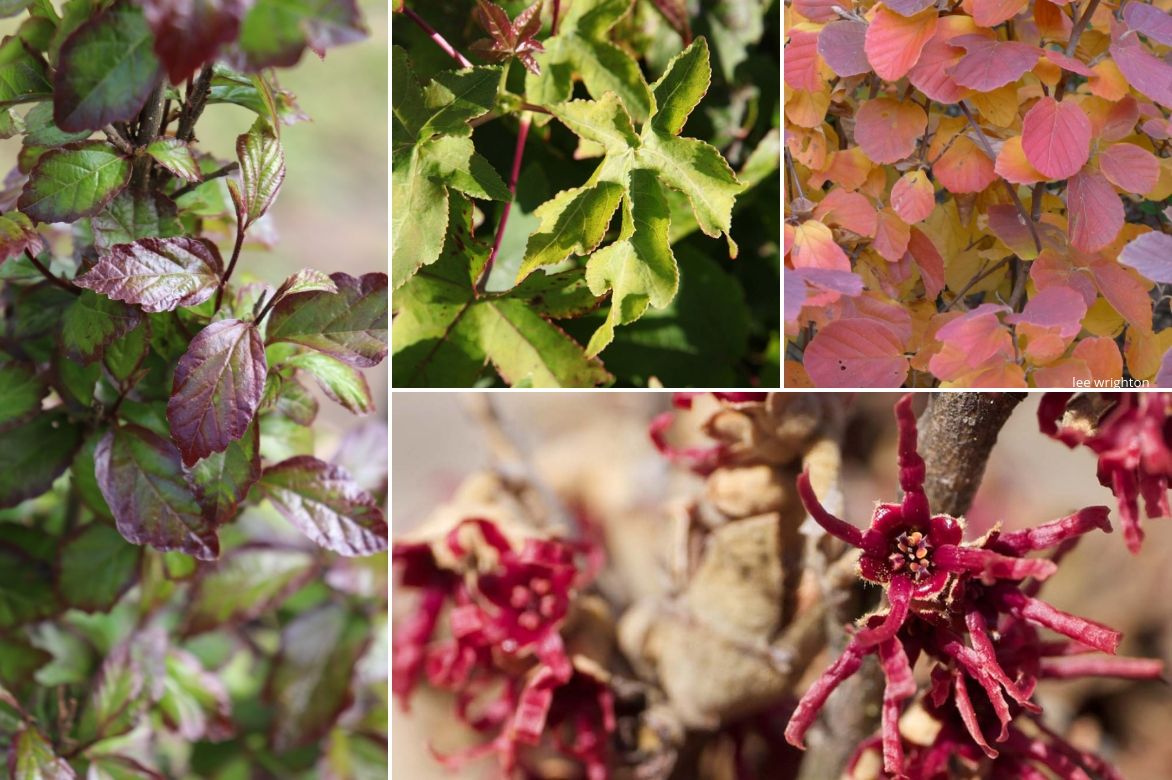
An example of a shrub-group combination: Parrotia persica ‘Persian Spire’, Liquidambar styraciflua ‘Gum Ball’ with incredible autumn foliage and Fothergilla major, to which you can add a Hamamelis with superb winter flowering such as ‘Amethyst’
Within an informal four-season hedge
Parrotia persica ‘Vanessa’ does not take much lateral space, so it is ideal for an informal hedge of shrubs that provide colour through foliage and flowers. To maintain year-round interest, play on spring and summer flowering, autumn foliage colours and winter presence with coloured bark or striking habits, so Parrotia does not steal the show too often. Amelanchier spicata is perfect in an informal hedge: attractive at flowering and at bud burst in spring, its foliage also turns lovely colours in autumn. For summer interest, a simple but effective Buddleia davidii ‘Empire Blue’, a superb variety that flowers from July to September with long blue panicles, is ideal. To complete the scheme, plant plenty of decorative dogwoods with colourful stems and foliage. For example: Cornus alba ‘Aurea’ with golden foliage all season and bright red stems in winter, and Cornus sericea ‘Cardinal’ whose fresh green leaves develop reddish tones in autumn before giving way to red stems in winter.
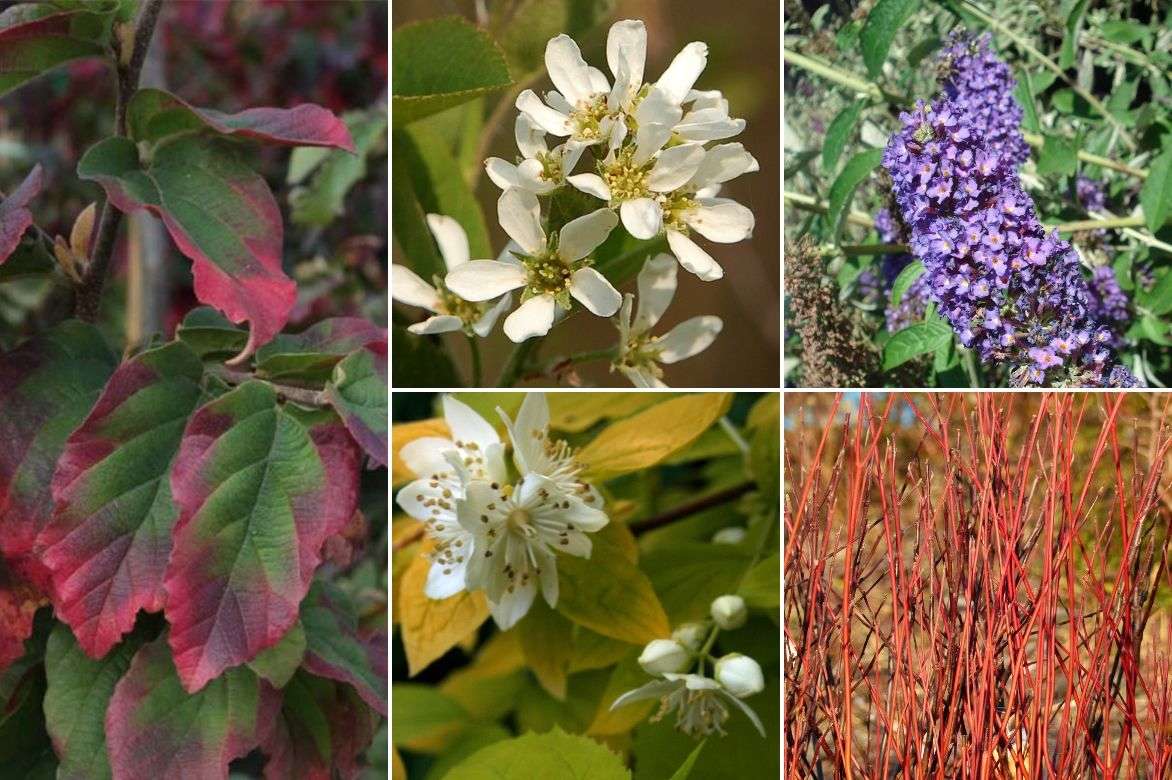
An example of a four-season hedge: Parrotia persica ‘Vanessa’ with beautiful autumn colours, Amelanchier spicata which flowers in spring and also offers attractive autumn foliage, Buddleia davidii ‘Empire Blue’, Cornus alba ‘Aurea’ with golden foliage all season and Cornus sericea ‘Cardinal’ valued for its autumn colours and red stems in winter
As a solitary specimen in the centre of a lawn
The species Parrotia persica eventually takes a little lateral space (10 m!), but it is also a very handsome small tree to grow on its own so it can fully develop. Standing proudly in the centre of an open part of your garden, it will quickly become a focal point that lifts the heart in autumn when it turns gold and flame. It will also provide welcome shade for many attractive plants. If soil is sufficiently acidic, why not try planting heathers, azaleas or Pieris at its feet, which will thrive in its shade.
→ Discover other ideas for pairing with Parrotia in our advice sheet !
Did you know?
- Genus name Parrotia derives from its discoverer, the German naturalist F.W. Parrot.
- It is a melliferous plant that will attract pollinators at a crucial time of year, the end of winter and the very beginning of spring.
- Parrotia persica was not introduced to Europe until 1841.
- Its vernacular name, iron tree, refers to its exceptionally hard wood.
- Parrotia wood has been used to make tools for more than 2,000 years.
Useful resources
- Discover our full range of Persian ironwoods in our online nursery.
- Discover our selection of Parrotia, Persian ironwood: 5 most beautiful varieties
- Flowering of Parrotia persica is discreet but very beautiful if you take time to admire it.
- Persian ironwood is a delight for small gardens but not the only option, discover our selection of 7 trees for small gardens.
- Find out more about Parrotia in Olivier’s video
Frequently asked questions
-
I do not have any space left at home. Can I still grow a Parrotia?
Indeed, there are many varieties of Parrotia persica with a narrow habit or very compact growth. For example, varieties 'Vanessa' and 'Persian Spire' can even be grown in pots.
-
I live in southern France. Is it possible to acclimatise a Parrotia persica?
Parrotia persica does not tolerate heat or drought and is therefore not recommended for this type of climate. If you are looking for a small tree with autumn interest for this area, consider Cotinus for its foliage or Arbutus for its flowering.
- Subscribe!
- Contents
This form is protected by reCAPTCHA - the Google Privacy Policy and Terms of Service apply.

































Comments