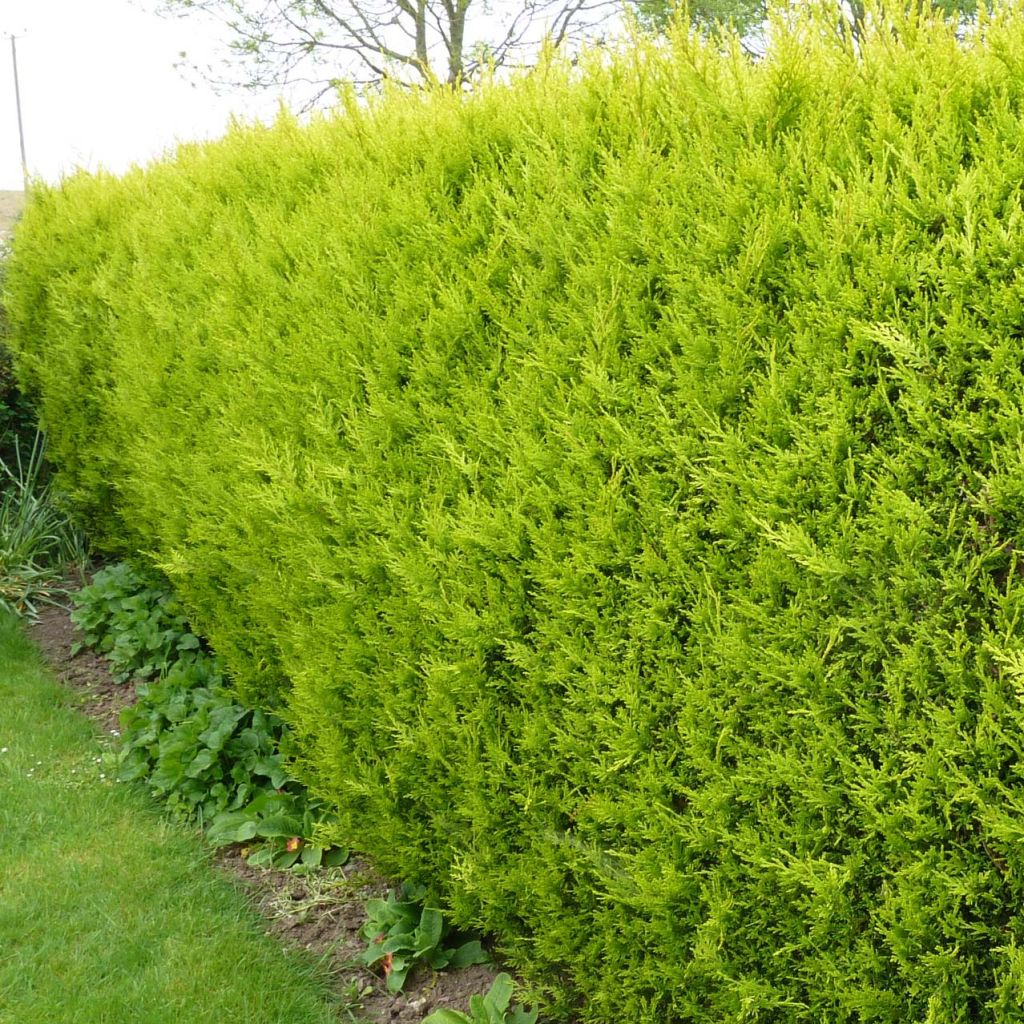
Cupressocyparis Castlewellan Gold - Leyland Cypress
Cupressocyparis Castlewellan Gold - Leyland Cypress
(x) Cupressocyparis leylandii Castlewellan Gold
Leyland cypress
beautiful plant
Jean-Claude L., 05/10/2019
Back-to-school special offer!
Get €10 off for every €50 you spend! And get up to €40 off on a single order.
How does it work?
1. Shop your favourites
Add your favourite plants to your basket. For every €50 you spend (excluding delivery charges, store credit and the plastic-free option), you’ll receive a €10 voucher.
€50 spent = €10 voucher
€100 spent = €20 voucher
€150 spent = €30 voucher
€200 spent = €40 voucher
2. Place your order
Once your basket reaches one of the spending thresholds, place your order. You can even choose your delivery date!
3. Receive your voucher
As soon as your order has been shipped, you’ll receive an email containing your personal voucher code and its value.
4. Use it on your next order
Your voucher is valid for 90 days from the date you receive it. It can be used once only, on a new order worth at least the value of the voucher, excluding delivery charges.
Please note: Vouchers can be combined with other offers, but cannot be split or refunded.
Home or relay delivery (depending on size and destination)
Important: You may be charged customs duties by your country’s customs authorities upon delivery.
Schedule delivery date
and select date in basket
This plant carries a 24 months recovery warranty
More information
We guarantee the quality of our plants for a full growing cycle, and will replace at our expense any plant that fails to recover under normal climatic and planting conditions.

Does this plant fit my garden?
Set up your Plantfit profile →
Description
The Cupressocyparis leylandii 'Castlewellan Gold' is a variant of this large hedge conifer with slightly golden foliage that is better known as the Leyland Cypress. Its growth can be controlled by pruning, which is well tolerated, making it easy to use in an evergreen hedge. Undemanding and hardy, it adapts to fairly poor, chalk, clayey soils, pollution, salt spray, and misty conditions. However, rocky soils and the very dry climate of the Mediterranean should be avoided. Depending on your budget, the length of your hedge, your patience, and the time you can dedicate to gardening, different types of products are available to you.
- For an economical Leyland Cypress hedge, opt for 9cm pots that you can plant all year round. Soil preparation should be meticulous (thorough weeding, removal of all roots, planting trench), and it is advisable to lay a weed suppressant at the base of the shrubs to limit the germination of weeds while they establish themselves. Once established, they grow quickly and will soon catch up with their counterparts grown in bigger pots. This is the most economical solution for creating a hedge of at least 10m (32.8ft) in length.
- For a fast-growing Leyland Cypress hedge or to fill in an existing hedge, your choice will be shrubs in 3-litre pots. Shrubs in pots can be planted all year round, except during freezing or hot periods. They are planted in individual planting holes, like all other shrubs in the garden. While they have an immediate impact, they take a little longer to establish and will require more frequent and regular watering, especially when the summer is dry.
Respect the proper planting distance depending on the size of your plant! Generally, it is advisable to allow a space of 60cm (23.6in) between each plant for shrubs in pots, 70 to 80cm (27.6 to 31.5in) for plants in 2 or 3-litre pots, 80 cm (31.5in) to 1m (3.3ft) for pots from 4 to 10 litres, and 1m (3.3ft) to 1.2m (3.9ft) for pots larger than 10 litres. For Leyland Cypress, given its rapid growth and size at maturity, it is preferable to allow a spacing of 1m (3.3ft) between each plant in pots, up to 2m (6.6ft) for shrubs grown in large pots.
The (x) Cupressocyparis leylandii is a spontaneous hybrid between the Cupressus macrocarpa, the Lambert or Monterey Cypress, native to the forests bordering the central California coast, and the Chamaecyparis nootkatensis, the Nootka False Cypress, native to the northern part of the western coast of North America. These two hardy conifers, with their large growth and accommodating nature, appreciate rather humid climates. Both belong to the Cupressaceae family.
The 'Castlewellan Gold' cultivar (also known as Castlewellan or Galway Gold), introduced in 1962 in Northern Ireland, differs from the classic Leyland Cypress mainly in the colouration of its foliage. It is the result of a cross with the Monterey Cypress 'Lutea', which has golden foliage.
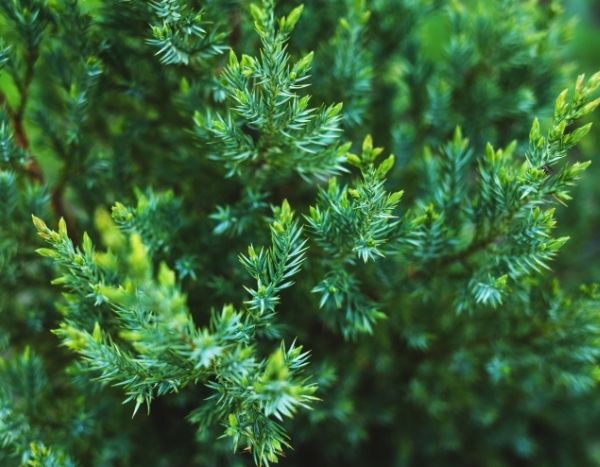
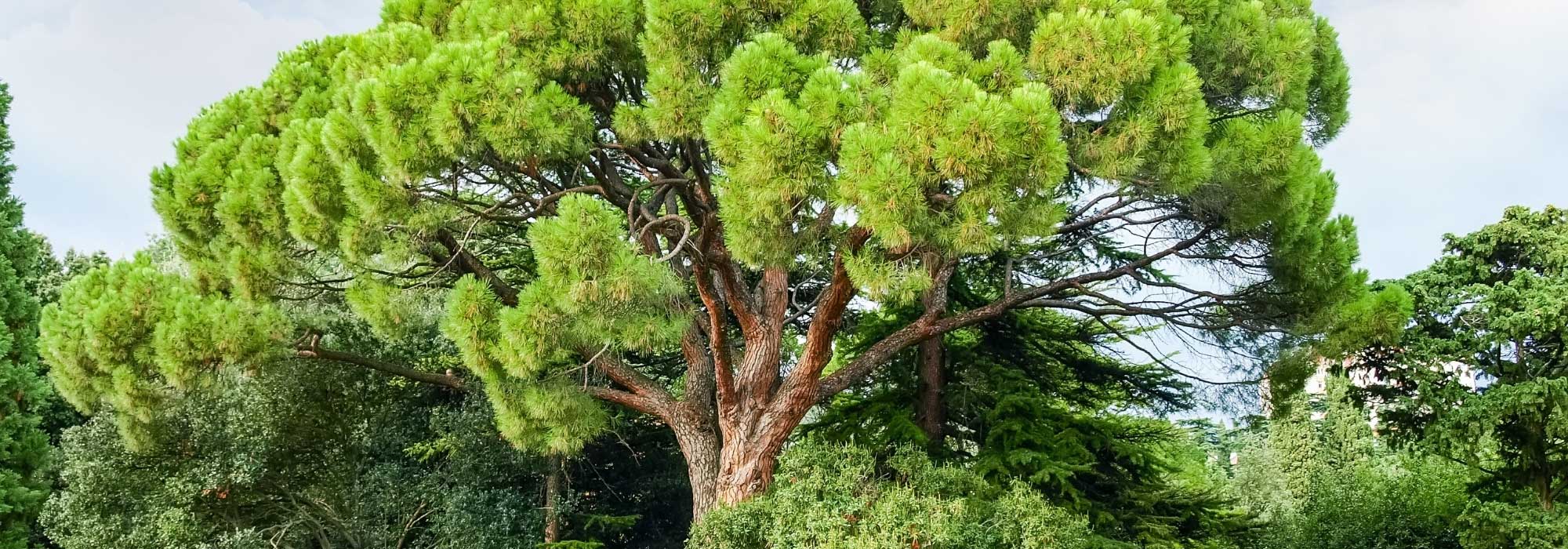
Its growth is very fast after an establishment period. The 'Castlewellan Gold' cypress grows about 80cm (31.5in) to 1m (3.3ft) per year, reaching an average height of 20m (65.6ft) with a width of 6 to 7m (19.7 to 23ft) if not pruned. Regular pruning (twice a year) will be necessary if you want to maintain it at a height of 2 to 3m (6.6 to 9.8ft) in a conventional hedge. This conifer has a naturally regular, pyramidal, and dense habit. Its flexible and slightly upright branches are adorned with fairly coarse foliage when observed up close, with an aromatic scent when crushed. Its smell is slightly acidic. Its small, blunt, triangular leaves are imbricate on short cylindrical branchlets, which are themselves located on branches. The young shoots are variegated with yellow and gold in spring, then turn green in summer. The autumn foliage is a mixture of gold and green, while it turns to a golden bronze colour in winter due to the cold.
This conifer produces pollen that can cause allergies in some people in early spring. The female cones are rounded and green, turning brown when mature. The reddish-brown bark becomes greyish with age. This tree develops a taproot, allowing it to anchor very deeply in the soil to draw water and nutrients and resist even strong winds. Its hardiness is excellent, around -20°C (-4°F).
The Castlewellan Leyland Cypress, with its brighter colour, breaks the monotony of an unvaried, green landscape throughout the year. It is perfect in a boundary hedge that will protect the garden, at the edge of the countryside or by the sea. A boon for urban gardens or very windy seaside gardens, often planted in housing estates, this cypress provides a permanent landscape all year round while working well as a privacy screen. If left to grow freely, it will become a majestic pyramid within a few years. While it forms beautiful evergreen screens, this Leyland Cypress can also be placed as a specimen tree or mixed with other large shrubs in a hedge that will promote biodiversity in the garden. Placed as a specimen in a large garden, it is a magnificent tree. Like many conifers, it fits into gardens of all styles, whether contemporary, wild, countryside, or English.

Cupressocyparis Castlewellan Gold - Leyland Cypress in pictures

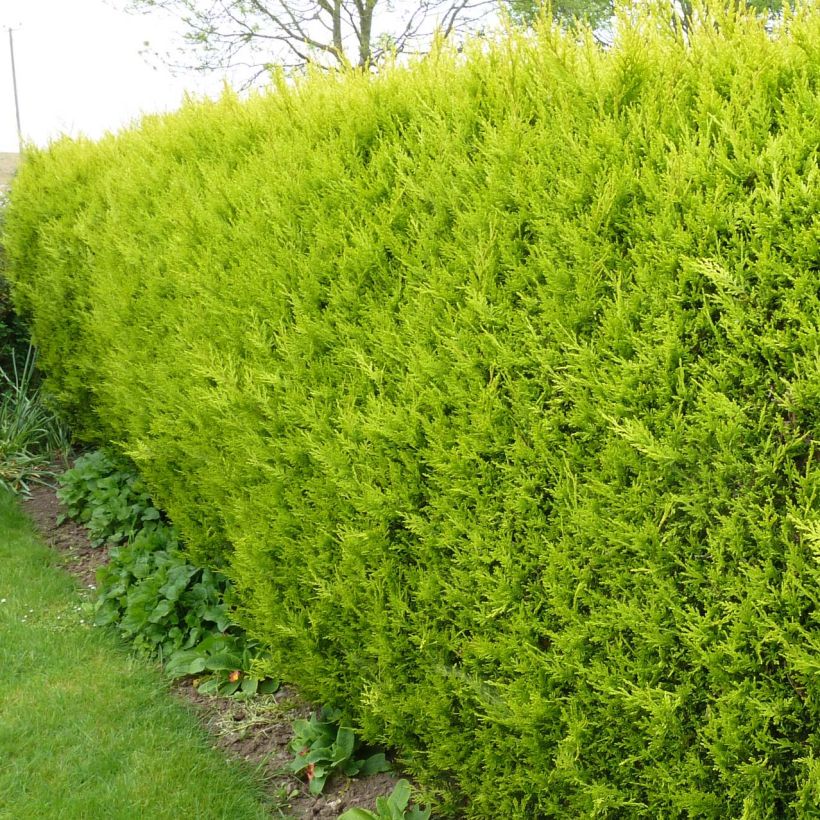
Plant habit
Flowering
Foliage
Botanical data
(x) Cupressocyparis
leylandii
Castlewellan Gold
Cupressaceae
Leyland cypress
Cupressocyparis 'Castlewellan', C.'Galway Gold'
Cultivar or hybrid
Planting and care
Plant Leyland Cypress in a sunny location in ordinary but well-prepared, deep soil, as its taproot will need to go down to find water and ensure a strong anchoring for its tall stature. Choose its location carefully, as this large pivot-like main root does not appreciate being disturbed or broken at all. This conifer does not need to be staked at planting. If it is very exposed to the wind, brace it until it is established. This conifer tolerates all soils that remain moist in summer, it dislikes long dry and hot periods. Space the plants 2m (6.6ft) apart for hedge planting.
Trees planted in isolation naturally develop a beautiful shape, which should not be spoiled by pruning. On the other hand, those used in hedges can be regularly and judiciously pruned.
This conifer can be subject to canker (a pathogenic fungus), especially if it is subjected to repeated pruning or injuries. Its most common pests are red spiders, aphids, scale insects, bark beetles, and jewel beetles, which are aggressive in hot and dry weather; it is advisable to spray the foliage with water during hot and dry weather to prevent mite proliferation.
Planting period
Intended location
Care
Planting & care advice
-
-
-

-
-
-

-

-

-
, onOrder confirmed
Reply from on Promesse de fleurs
Recently viewed products
Haven't found what you were looking for?
Hardiness is the lowest winter temperature a plant can endure without suffering serious damage or even dying. However, hardiness is affected by location (a sheltered area, such as a patio), protection (winter cover) and soil type (hardiness is improved by well-drained soil).
In temperate climates, pruning of spring-flowering shrubs (forsythia, spireas, etc.) should be done just after flowering.
Pruning of summer-flowering shrubs (Indian Lilac, Perovskia, etc.) can be done in winter or spring.
In cold regions as well as with frost-sensitive plants, avoid pruning too early when severe frosts may still occur.
The harvesting period indicated on our website applies to countries and regions in USDA zone 8 (France, England, Ireland, the Netherlands).
In colder areas (Scandinavia, Poland, Austria...) fruit and vegetable harvests are likely to be delayed by 3-4 weeks.
In warmer areas (Italy, Spain, Greece, etc.), harvesting will probably take place earlier, depending on weather conditions.
The sowing periods indicated on our website apply to countries and regions within USDA Zone 8 (France, UK, Ireland, Netherlands).
In colder areas (Scandinavia, Poland, Austria...), delay any outdoor sowing by 3-4 weeks, or sow under glass.
In warmer climes (Italy, Spain, Greece, etc.), bring outdoor sowing forward by a few weeks.
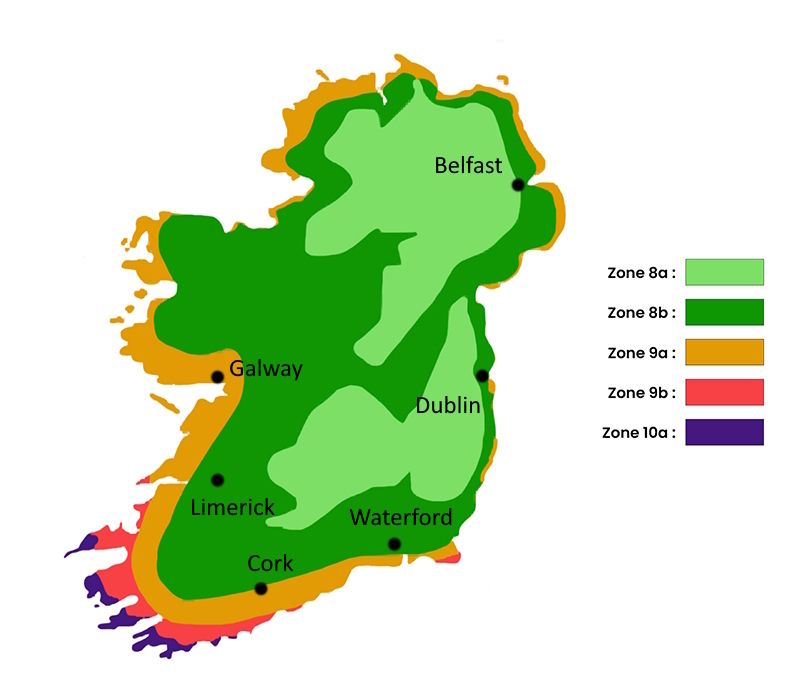
The planting period indicated on our website applies to regions in USDA Zone 9a (East Coast and Midlands: Dublin, Wexford, Waterford, Kilkenny, Portlaoise). It will vary depending on where you live:
- On the west coast and in the north-west (Galway, Limerick, Sligo, Donegal, Westport), delay planting by 1 to 2 weeks in spring and bring it forward by 1 to 2 weeks in autumn compared to the dates given, preferably choosing periods without strong winds.
- In the inland hills and plateaus (Wicklow Mountains, Macgillycuddy’s Reeks, Connemara, Killarney), it is best to plant in spring (April–May) or autumn (September–October), avoiding periods of waterlogged soil in winter and strong winds, which pose the main risk to newly planted trees in these areas.
The flowering period indicated on our website applies to regions in USDA Zone 9a, such as the East Coast and Midlands, including Dublin, Wexford, Waterford, Kilkenny and Portlaoise.
This will vary depending on where you live:
- On the west coast and in the northwest (Galway, Limerick, Sligo, Donegal and Westport), it will be delayed by one to two weeks compared to the given dates, due to stronger Atlantic winds and less spring sunshine.
- In the inland hills and plateaus (the Wicklow Mountains, the Macgillycuddy's Reeks, Connemara and Killarney), flowering will be delayed by two to three weeks. Flowering mainly occurs between May and July, with the limiting factors being less frost and more of the excessive humidity, strong winds and lack of sunshine that are characteristic of these areas.
Shipping country and language
Your country of residence may be:
Your country of residence is:
For a better user experience on our website, you can select:
Your shipping country:
-
 Austria
-
 Belgium
-
 Bosnia & Herzegovina
-
 Bulgaria
-
 Croatia
-
 Cyprus
-
 Czechia
-
 Denmark
-
 Estonia
-
 Finland
-
 France
-
 Germany
-
 Greece
-
 Hungary
-
 Iceland
-
 Ireland
-
 Italy
Italy
-
 Latvia
-
 Liechtenstein
-
 Lithuania
-
 Luxembourg
-
 Malta
Malta
-
 Netherlands
-
 Poland
-
 Portugal
-
 Romania
-
 Serbia
-
 Slovakia
-
 Slovenia
-
 Spain
Spain
-
 Sweden
-
 Switzerland
Language:
-
French
-
 English
-
Spanish
-
Italian
-
German
-
Portuguese
-
Dutch
-
Finnish
My Account
Hello
My wish lists
My cart
Log in / Register
Existing customer?
This form is protected by reCAPTCHA - the Google Privacy Policy and Terms of Service apply.
New customer?
Create an account to track your orders, access our customer service and, if you wish, make the most of our upcoming offers.