Paeonia suffruticosa Zhu Guang Mo Run - Tree peony
Paeonia suffruticosa Zhu Guang Mo Run - Tree peony
Paeonia suffruticosa Zhu Guang Mo Run
Tree Peony
Back-to-school special offer!
Get €10 off for every €50 you spend! And get up to €40 off on a single order.
How does it work?
1. Shop your favourites
Add your favourite plants to your basket. For every €50 you spend (excluding delivery charges, store credit and the plastic-free option), you’ll receive a €10 voucher.
€50 spent = €10 voucher
€100 spent = €20 voucher
€150 spent = €30 voucher
€200 spent = €40 voucher
2. Place your order
Once your basket reaches one of the spending thresholds, place your order. You can even choose your delivery date!
3. Receive your voucher
As soon as your order has been shipped, you’ll receive an email containing your personal voucher code and its value.
4. Use it on your next order
Your voucher is valid for 90 days from the date you receive it. It can be used once only, on a new order worth at least the value of the voucher, excluding delivery charges.
Please note: Vouchers can be combined with other offers, but cannot be split or refunded.
Home or relay delivery (depending on size and destination)
Important: You may be charged customs duties by your country’s customs authorities upon delivery.
Schedule delivery date
and select date in basket
This plant carries a 12 months recovery warranty
More information
We guarantee the quality of our plants for a full growing cycle, and will replace at our expense any plant that fails to recover under normal climatic and planting conditions.
Does this plant fit my garden?
Set up your Plantfit profile →
Description
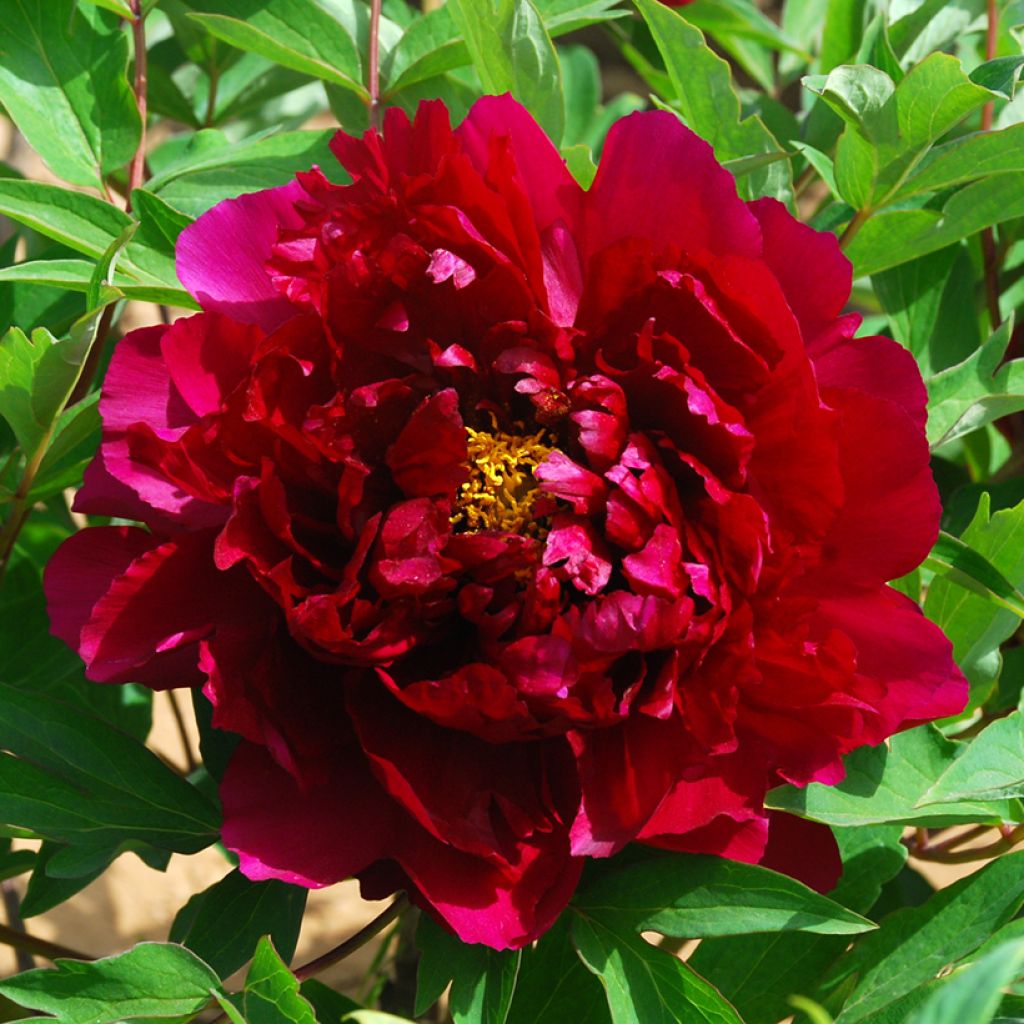
Paeonia × suffruticosa 'Zhu Guang Mo Run', sold under the name Deep Fire, is a Chinese moutan peony, i.e. a tree peony. In spring, it bears large, double carmine-red flowers that are slightly crumpled. In winter, the plant retains short brown stems, then in spring it is clothed with large, divided leaves. Plant it near a path, in front of a light-coloured wall, or at the front of a large shrub border.
This peony belongs to the Paeoniaceae family. It is part of the group of Chinese tree peonies, cultivated for centuries under the name mudan, which we have translated as moutan peony, tree peony or shrub peony. Paeonia × suffruticosa refers to a woody hybrid whose botanical origin is linked to Paeonia jishanensis × Paeonia rockii. Its native range is in temperate China, particularly in Henan. There, the plant grows in regions with cold winters and distinct springs.
'Zhu Guang Mo Run' belongs to the Chinese central plains cultivars, also known as the Zhongyuan group. It is a woody, deciduous perennial: the branches persist in winter, while the leaves fall in autumn and regrow in spring. The plant forms an upright, branched bush from a short base, reaching 1.20 to 1.50m in height when planted in open ground. Its spread eventually reaches 1 to 1.30m. Growth starts slowly, as the thick roots establish themselves deeply before the top growth takes off. Flowering occurs in April-May in gardens with a medium climate and more towards May-June in colder regions. The flowers are large, double, 15cm or more across on a well-established mature specimen. The outer petals are broad, flat, glossy and carmine-red. The inner petals are shorter, tighter, crumpled, and purplish-red to dark red. The flower shape resembles a very double rose, with a more crumpled centre reminiscent of some chrysanthemum flowers. They are lightly fragrant.
Its Chinese name evokes a luminous pearl and a deep ink, two images that well describe the dark satin of the petals. The foliage consists of large green leaves, divided into oval to lobed leaflets, decorative even outside the flowering period. The short, brown-grey branches are not cut back like a herbaceous peony. The large, round, black seeds, when they form, take several years to germinate and do not faithfully reproduce the cultivar.
Plant this moutan peony in the garden and do not disturb it. Give it morning sun and some afternoon shade in warm regions. Very robust once established, its roots need space. Behind it, you can place a white 'Grefsheim' spiraea, a Cotinus coggygria 'Young Lady' and a Mexican orange blossom, for example. To surround it, plant at a good distance white Chinese peonies such as 'Immaculée' or 'Boule de Neige', which flower a little later.

Flowering
Foliage
Plant habit
Botanical data
Paeonia
suffruticosa
Zhu Guang Mo Run
Paeoniaceae
Tree Peony
Paeonia suffruticosa 'Deep Fire'
Cultivar or hybrid, China
Planting and care
Plant tree peony Zhu Guang Mo Run in partial shade, or in full sun in northern regions. It needs six hours of sunlight per day to achieve beautiful flowering. Continental climates with marked winters and springs and hot summers favour particularly abundant flowering. Morning sun is especially appreciated in Mediterranean areas, and scorching situations should be avoided. From September to May, except during frost periods, plant it in fertile, deep soil, slightly acidic, neutral or even slightly chalky, moist but well-drained. Once well established in deep soil, the tree peony requires no watering in summer, particularly the varieties that flower early in spring. Its cold resistance is excellent, but the flower buds can be damaged by strong, dry, or cold winds.
Easy-going, tree peonies require little care but deserve careful planting. When planting, dig a large hole 40 to 50cm deep and at least as wide. Fill it with a mixture of garden soil, leaf mould, and river sand or gravel if your soil is very heavy and compact. Add crushed horn, bone meal, and dried blood to the bottom of the planting hole. Do not overcrowd the plants to ensure good air circulation. Tree peonies dislike competition from the roots of other plants; allow a spacing of 1m from their neighbours. The graft must be buried about twenty centimetres deep so that the plant gradually becomes independent from its rootstock. Watering should be abundant but spaced 8 to 15 days apart for the first two years, from March to September. Peonies have a reputation for being not liking to be transplanted, so they should not be moved after planting. Avoid pruning unless the plant becomes bare at the base. If this happens, prune at the level of the basal shoots. Provide a stake to support the flower stems and cut off faded flowers during the season.
Planting period
Intended location
Care
Planting & care advice







This item has not been reviewed yet - be the first to leave a review about it.
Recently viewed products
Haven't found what you were looking for?
Hardiness is the lowest winter temperature a plant can endure without suffering serious damage or even dying. However, hardiness is affected by location (a sheltered area, such as a patio), protection (winter cover) and soil type (hardiness is improved by well-drained soil).
In temperate climates, pruning of spring-flowering shrubs (forsythia, spireas, etc.) should be done just after flowering.
Pruning of summer-flowering shrubs (Indian Lilac, Perovskia, etc.) can be done in winter or spring.
In cold regions as well as with frost-sensitive plants, avoid pruning too early when severe frosts may still occur.
The harvesting period indicated on our website applies to countries and regions in USDA zone 8 (France, England, Ireland, the Netherlands).
In colder areas (Scandinavia, Poland, Austria...) fruit and vegetable harvests are likely to be delayed by 3-4 weeks.
In warmer areas (Italy, Spain, Greece, etc.), harvesting will probably take place earlier, depending on weather conditions.
The sowing periods indicated on our website apply to countries and regions within USDA Zone 8 (France, UK, Ireland, Netherlands).
In colder areas (Scandinavia, Poland, Austria...), delay any outdoor sowing by 3-4 weeks, or sow under glass.
In warmer climes (Italy, Spain, Greece, etc.), bring outdoor sowing forward by a few weeks.
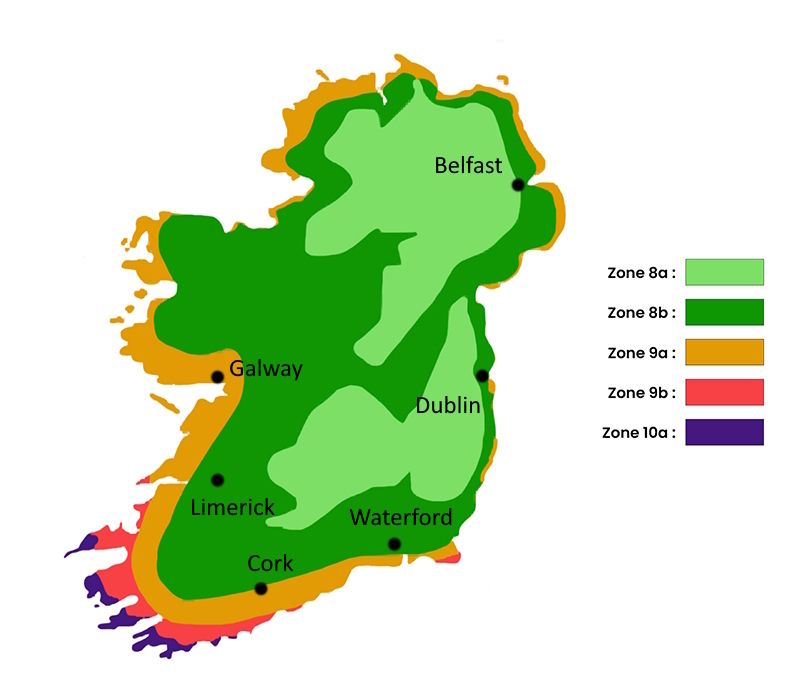
The planting period indicated on our website applies to regions in USDA Zone 9a (East Coast and Midlands: Dublin, Wexford, Waterford, Kilkenny, Portlaoise). It will vary depending on where you live:
- On the west coast and in the north-west (Galway, Limerick, Sligo, Donegal, Westport), delay planting by 1 to 2 weeks in spring and bring it forward by 1 to 2 weeks in autumn compared to the dates given, preferably choosing periods without strong winds.
- In the inland hills and plateaus (Wicklow Mountains, Macgillycuddy’s Reeks, Connemara, Killarney), it is best to plant in spring (April–May) or autumn (September–October), avoiding periods of waterlogged soil in winter and strong winds, which pose the main risk to newly planted trees in these areas.
The flowering period indicated on our website applies to regions in USDA Zone 9a, such as the East Coast and Midlands, including Dublin, Wexford, Waterford, Kilkenny and Portlaoise.
This will vary depending on where you live:
- On the west coast and in the northwest (Galway, Limerick, Sligo, Donegal and Westport), it will be delayed by one to two weeks compared to the given dates, due to stronger Atlantic winds and less spring sunshine.
- In the inland hills and plateaus (the Wicklow Mountains, the Macgillycuddy's Reeks, Connemara and Killarney), flowering will be delayed by two to three weeks. Flowering mainly occurs between May and July, with the limiting factors being less frost and more of the excessive humidity, strong winds and lack of sunshine that are characteristic of these areas.
Shipping country and language
Your country of residence may be:
Your country of residence is:
For a better user experience on our website, you can select:
Your shipping country:
-
 Austria
-
 Belgium
-
 Bosnia & Herzegovina
-
 Bulgaria
-
 Croatia
-
 Cyprus
-
 Czechia
-
 Denmark
-
 Estonia
-
 Finland
-
 France
-
 Germany
-
 Greece
-
 Hungary
-
 Iceland
-
 Ireland
-
 Italy
Italy
-
 Latvia
-
 Liechtenstein
-
 Lithuania
-
 Luxembourg
-
 Malta
Malta
-
 Netherlands
-
 Poland
-
 Portugal
-
 Romania
-
 Serbia
-
 Slovakia
-
 Slovenia
-
 Spain
Spain
-
 Sweden
-
 Switzerland
Language:
-
French
-
 English
-
Spanish
-
Italian
-
German
-
Portuguese
-
Dutch
-
Finnish
My Account
Hello
My wish lists
My cart
Log in / Register
Existing customer?
This form is protected by reCAPTCHA - the Google Privacy Policy and Terms of Service apply.
New customer?
Create an account to track your orders, access our customer service and, if you wish, make the most of our upcoming offers.