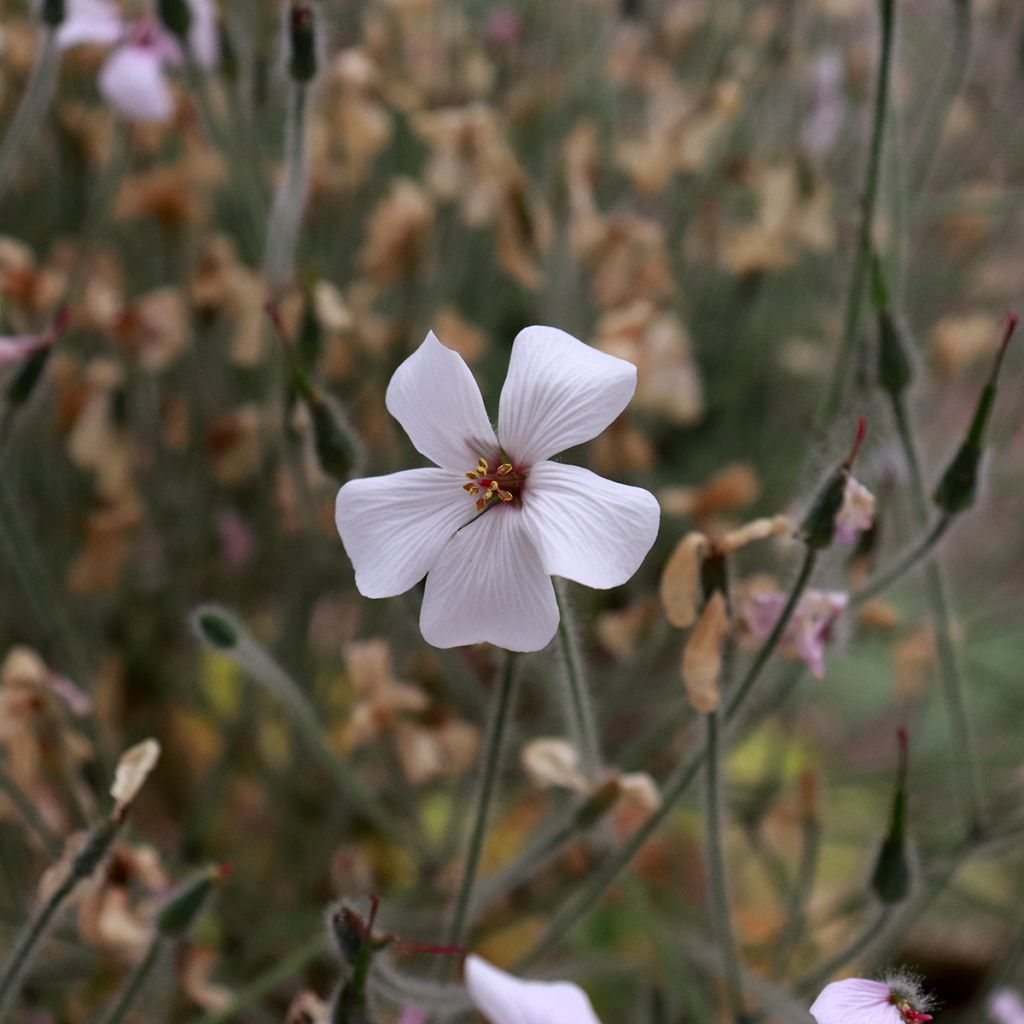
Geranium maderense Album
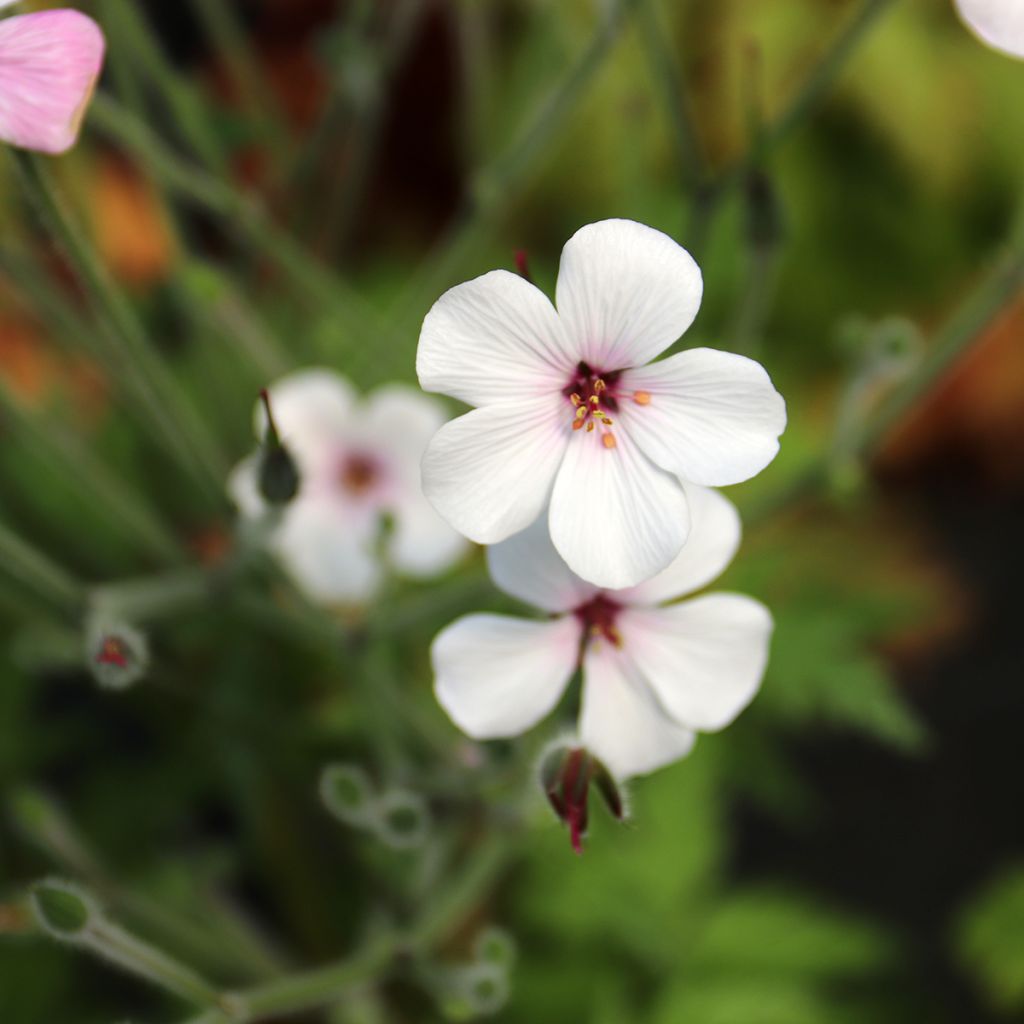
Geranium maderense Album
Geranium maderense Album
Geranium maderense Album
Madeira Cranesbill
Back-to-school special offer!
Get €10 off for every €50 you spend! And get up to €40 off on a single order.
How does it work?
1. Shop your favourites
Add your favourite plants to your basket. For every €50 you spend (excluding delivery charges, store credit and the plastic-free option), you’ll receive a €10 voucher.
€50 spent = €10 voucher
€100 spent = €20 voucher
€150 spent = €30 voucher
€200 spent = €40 voucher
2. Place your order
Once your basket reaches one of the spending thresholds, place your order. You can even choose your delivery date!
3. Receive your voucher
As soon as your order has been shipped, you’ll receive an email containing your personal voucher code and its value.
4. Use it on your next order
Your voucher is valid for 90 days from the date you receive it. It can be used once only, on a new order worth at least the value of the voucher, excluding delivery charges.
Please note: Vouchers can be combined with other offers, but cannot be split or refunded.
Home or relay delivery (depending on size and destination)
Important: You may be charged customs duties by your country’s customs authorities upon delivery.
Schedule delivery date,
and select date in basket
This plant carries a 12 months recovery warranty
More information
We guarantee the quality of our plants for a full growing cycle, and will replace at our expense any plant that fails to recover under normal climatic and planting conditions.
Does this plant fit my garden?
Set up your Plantfit profile →
Description
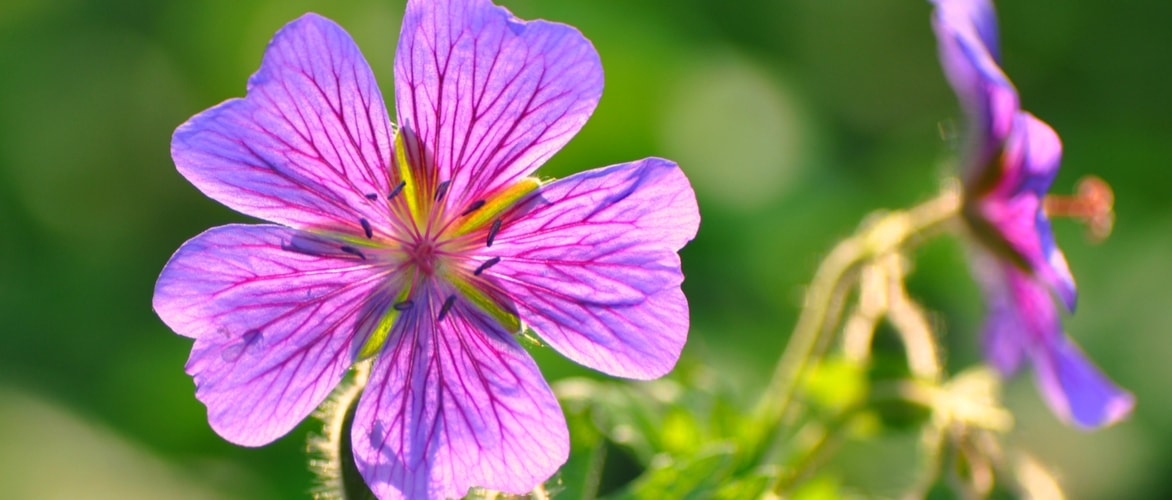
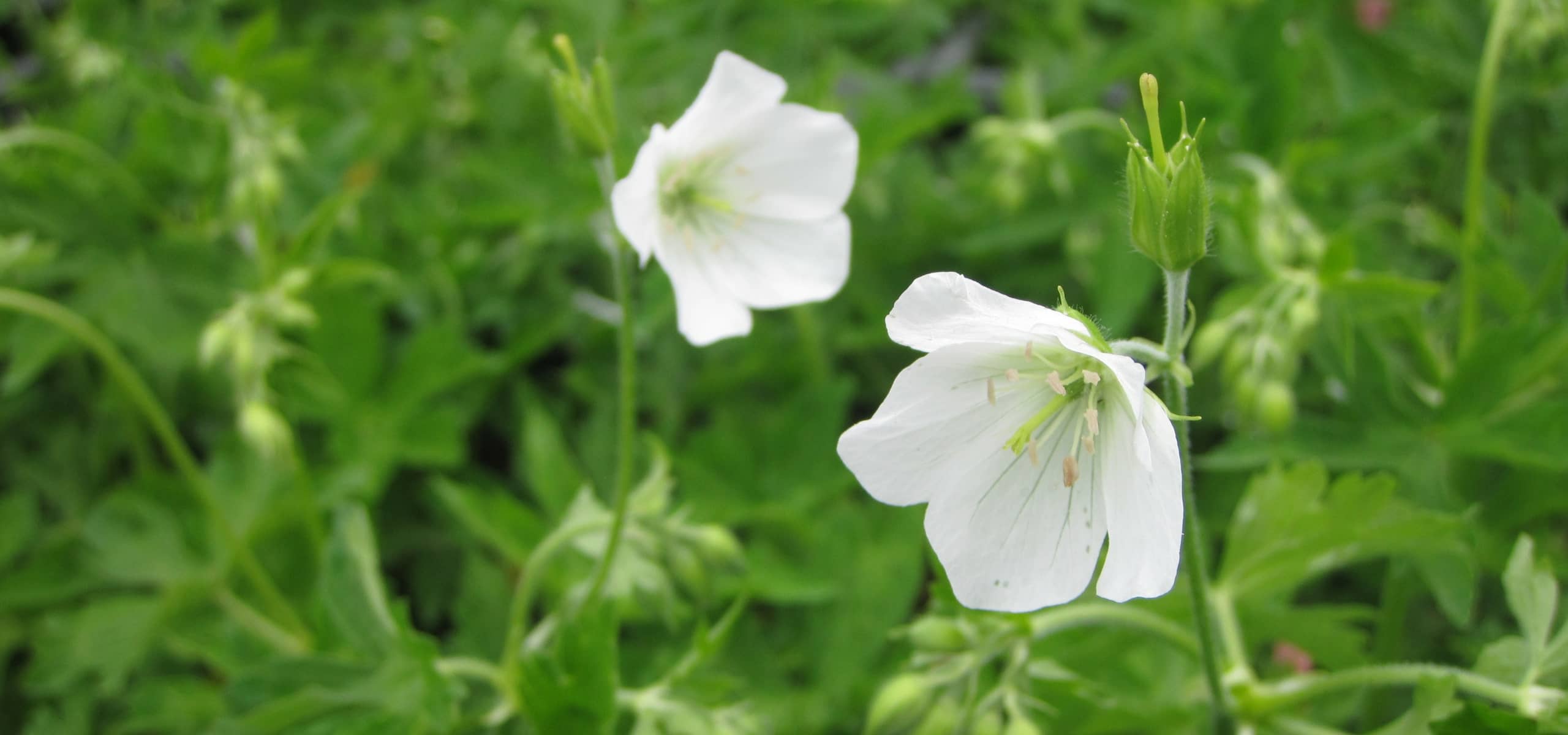
The Geranium maderense Album is the white-flowered form of a botanical species (with pink flowers) native to the island of Madeira. It is a perennial evergreen plant full of variegation but with a short lifespan. It forms a majestic clump composed of an axis bearing large, highly dissected, dark green leaves with magnificent patterns. Curiously, the leaf petioles help it rise to 1m or more in height. In spring, a flowering occurs, consisting of a profusion of small white flowers whose impressive volume rivals that of the foliage and evokes wonder. Sensitive to frost, except in mild climates, it is best cultivated in a pot to protect it during winter.
The Madeira Geranium is a member of the Geraniaceae family, just like the Pelargonium on our balconies (incorrectly called "Geranium") or the Erodium found in our countryside, which readily invades fruit orchards and other plots. The Geranium maderense is one of the beautiful surprises that the Macaronesian flora offers, a region that includes the Azores, Madeira, the Canary Islands, and Cape Verde. Cousin to our Geranium species, most of which form low cushions or medium-sized plants, the G. maderense is a perennial in XXL format, similar to the G. canariense (or G. reuteri) of the Canary Islands, which is also affected by gigantism. This uncommon Geranium is native to the laurel forest of Madeira, a humid subtropical forest that hosts laurels, hence its name, and is also found on the island of Tenerife. It has been awarded the Royal Horticultural Society's prestigious Award of Garden Merit for its ornamental qualities.
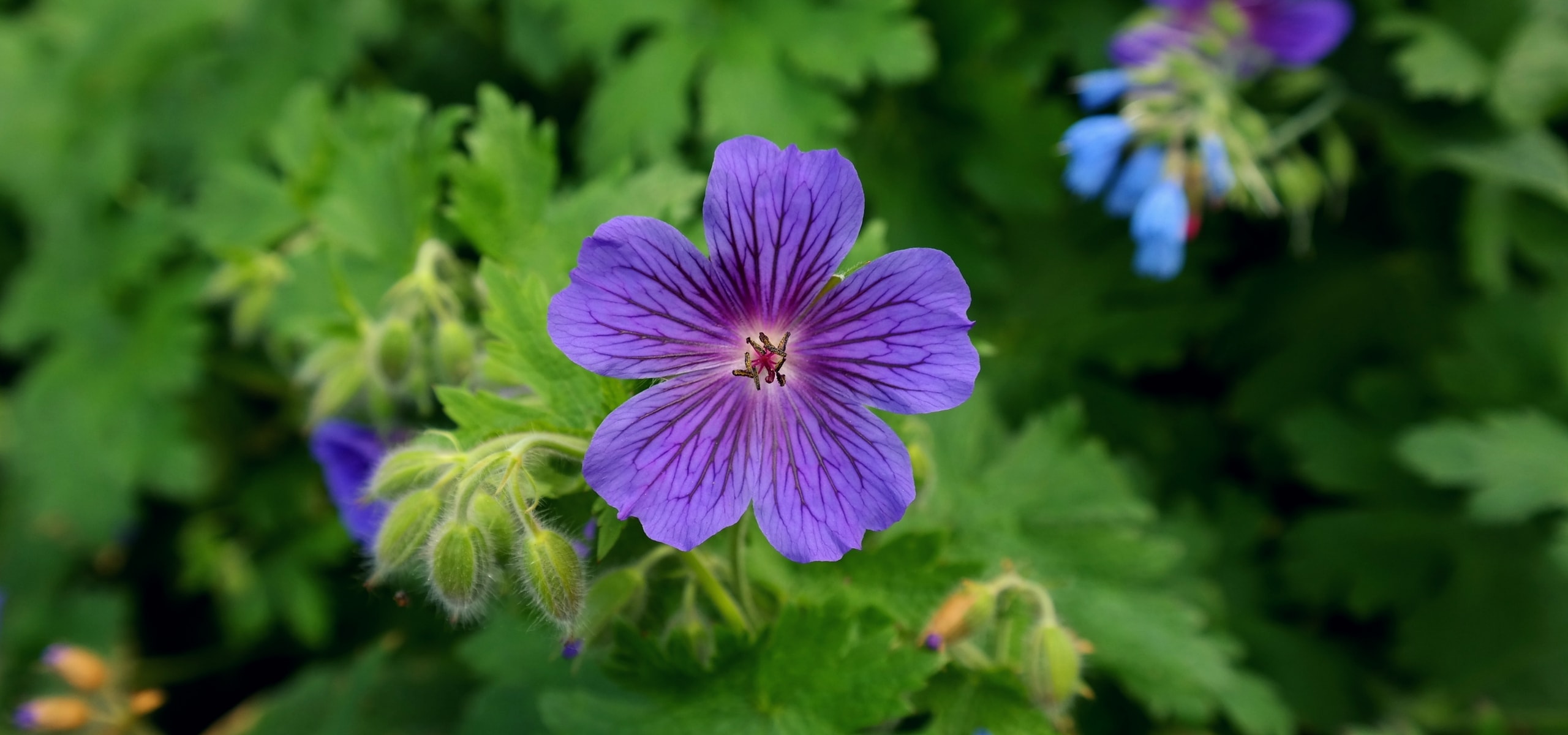
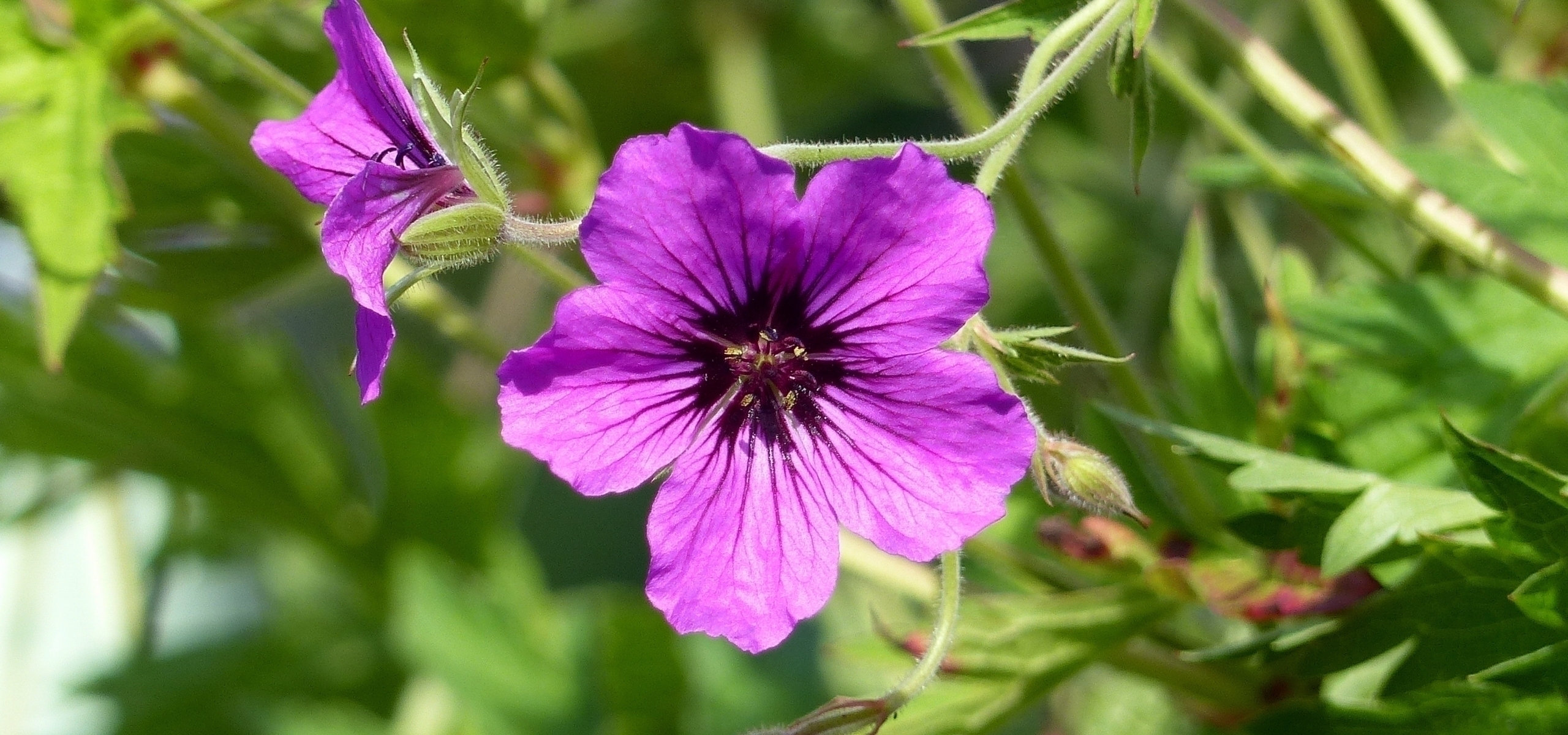
'Album' (white in Latin) is the white-flowered form, while the species-type flowers are mauve-pink. Considered a short-lived perennial, often treated as a biennial, it is a semelparous plant, meaning it only flowers once in its lifetime and then dies after producing seeds. This Geranium can take 3 to 4 years from the original sowing before flowering. It forms a central axis, which rises as new leaves appear. These leaves are highly decorative, palmate in shape, measuring about twenty centimetres in diameter, and deeply dissected, reminiscent of the cut and elegance of certain tropical ferns. Their glossy surface enhances their dark green colour, especially since the long petioles are dark red. They spread 360° around the central stem, with the oldest trailing down to the ground. The petioles then serve as stilts for the plant, so when the older leaves turn yellow, only the leaf blades should be cut, while the petioles should be kept. They dry out, harden, and form a scaffold to support the entire plant! At maturity, the Geranium exceeds 1m in height and is ready to bear its impressive flowering, reaching up to 1.20m in diameter. In spring, usually in April, many small flowers (up to 300) carried by long flower stalks form a huge dome above the foliage. With five rounded petals, the flowers are white with a pinkish-purple centre. The sepals and flower stalks are covered in tiny hairs that capture light and further enhance the aesthetics of this extraordinary flowering. The enormous inflorescence captivates throughout spring, extending into summer, before fading and forming seeds that will spontaneously reseed in the garden. The flowers, pollinated by insects, give way to long green fruits that "explode" when ripe, releasing a large quantity of very fine seeds.
This exceptional plant should be cultivated in pots in most regions to be protected from frost during winter. The leaves are destroyed at -2°C and the entire plant dies at -4°C, which limits its planting in open ground to mild areas. It will allow you to create a subtropical-inspired bed by associating it with other spectacular plants, such as the Beschorneria yuccoides, which forms a rosette of large blue-green leaves from which emerges a flower spike that reaches the size of a person. The Syagrus romanzoffiana, a fast-growing palm tree, will further accentuate the exoticism of your decor with its coconut tree-like appearance, as will a few clumps of Hedychium, an ornamental ginger with a fiercely tropical look, featuring large tender green leaves and especially splendid flowers in long spikes.
Flowering
Foliage
Plant habit
Botanical data
Geranium
maderense
Album
Geraniaceae
Madeira Cranesbill
Geranium maderense 'Album'
Macaronesia
Planting and care
The Geranium maderense Album should be planted in spring, directly in the ground in mild regions, or in a large pot to overwinter in a frost-free, bright location elsewhere. Choose a sunny or partially shaded (in hot regions), sheltered from strong winds that could cause this tall plant to fall over. Prepare the soil well by incorporating plenty of leaf compost, coarse sand or gravel to ensure good drainage, which will prevent the roots from rotting due to excess moisture. In heavy soil, you can plant it on a slightly raised mound (20 cm is sufficient) that is 80 cm wide. Watering should be regular but not excessive throughout the entire growth and flowering period. This plant sometimes takes 3 or 4 years to establish and bloom, only to die after its incredible flowering. However, it produces numerous seeds that can be harvested and sown in spring. In mild climates, spontaneous seedlings in light soils are not uncommon.
Pot cultivation: choose a pot with a good capacity (at least 30 litres) with a drainage hole at the bottom. Create a 4-5 cm drainage layer composed of clay pebbles, pottery shards, or non-limestone gravel if possible. Fill it with a mixture of topsoil, leaf compost, and coarse sand. Regularly apply special geranium fertiliser and monitor watering. Overwinter your Madeira geranium in a cool, bright, frost-free location. Reduce watering significantly in winter, but do not completely stop! The plant may sometimes lose its foliage in winter and regrow in spring.
Planting period
Intended location
Care
Planting & care advice
-
-
-
-
-
-
-
-
This item has not been reviewed yet - be the first to leave a review about it.
Recently viewed products
Haven't found what you were looking for?
Hardiness is the lowest winter temperature a plant can endure without suffering serious damage or even dying. However, hardiness is affected by location (a sheltered area, such as a patio), protection (winter cover) and soil type (hardiness is improved by well-drained soil).
In temperate climates, pruning of spring-flowering shrubs (forsythia, spireas, etc.) should be done just after flowering.
Pruning of summer-flowering shrubs (Indian Lilac, Perovskia, etc.) can be done in winter or spring.
In cold regions as well as with frost-sensitive plants, avoid pruning too early when severe frosts may still occur.
The harvesting period indicated on our website applies to countries and regions in USDA zone 8 (France, England, Ireland, the Netherlands).
In colder areas (Scandinavia, Poland, Austria...) fruit and vegetable harvests are likely to be delayed by 3-4 weeks.
In warmer areas (Italy, Spain, Greece, etc.), harvesting will probably take place earlier, depending on weather conditions.
The sowing periods indicated on our website apply to countries and regions within USDA Zone 8 (France, UK, Ireland, Netherlands).
In colder areas (Scandinavia, Poland, Austria...), delay any outdoor sowing by 3-4 weeks, or sow under glass.
In warmer climes (Italy, Spain, Greece, etc.), bring outdoor sowing forward by a few weeks.
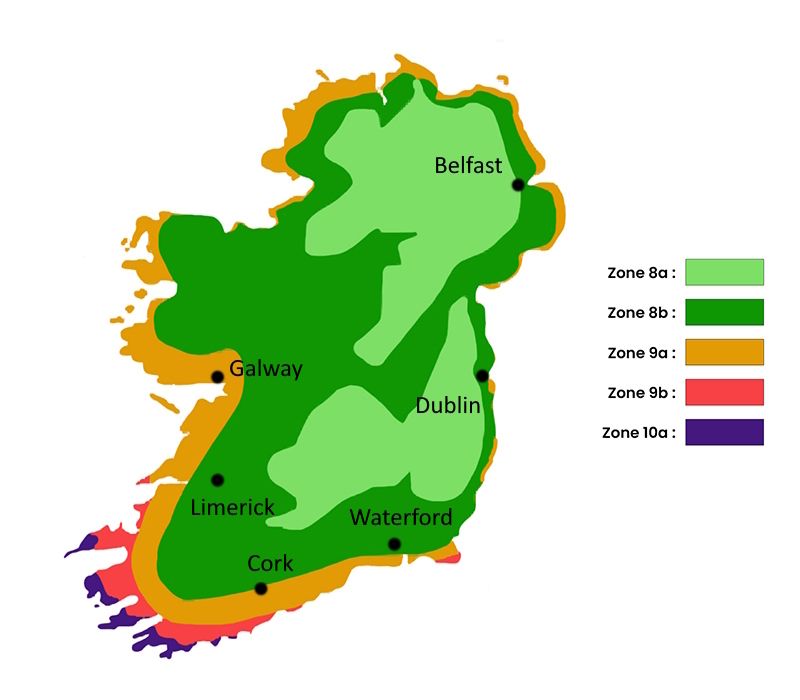
The planting period indicated on our website applies to regions in USDA Zone 9a (East Coast and Midlands: Dublin, Wexford, Waterford, Kilkenny, Portlaoise). It will vary depending on where you live:
- On the west coast and in the north-west (Galway, Limerick, Sligo, Donegal, Westport), delay planting by 1 to 2 weeks in spring and bring it forward by 1 to 2 weeks in autumn compared to the dates given, preferably choosing periods without strong winds.
- In the inland hills and plateaus (Wicklow Mountains, Macgillycuddy’s Reeks, Connemara, Killarney), it is best to plant in spring (April–May) or autumn (September–October), avoiding periods of waterlogged soil in winter and strong winds, which pose the main risk to newly planted trees in these areas.
The flowering period indicated on our website applies to regions in USDA Zone 9a, such as the East Coast and Midlands, including Dublin, Wexford, Waterford, Kilkenny and Portlaoise.
This will vary depending on where you live:
- On the west coast and in the northwest (Galway, Limerick, Sligo, Donegal and Westport), it will be delayed by one to two weeks compared to the given dates, due to stronger Atlantic winds and less spring sunshine.
- In the inland hills and plateaus (the Wicklow Mountains, the Macgillycuddy's Reeks, Connemara and Killarney), flowering will be delayed by two to three weeks. Flowering mainly occurs between May and July, with the limiting factors being less frost and more of the excessive humidity, strong winds and lack of sunshine that are characteristic of these areas.
Shipping country and language
Your country of residence may be:
Your country of residence is:
For a better user experience on our website, you can select:
Your shipping country:
-
 Austria
-
 Belgium
-
 Bosnia & Herzegovina
-
 Bulgaria
-
 Croatia
-
 Cyprus
-
 Czechia
-
 Denmark
-
 Estonia
-
 Finland
-
 France
-
 Germany
-
 Greece
-
 Hungary
-
 Iceland
-
 Ireland
-
 Italy
Italy
-
 Latvia
-
 Liechtenstein
-
 Lithuania
-
 Luxembourg
-
 Malta
Malta
-
 Netherlands
-
 Poland
-
 Portugal
-
 Romania
-
 Serbia
-
 Slovakia
-
 Slovenia
-
 Spain
Spain
-
 Sweden
-
 Switzerland
Language:
-
French
-
 English
-
Spanish
-
Italian
-
German
-
Portuguese
-
Dutch
-
Finnish
My Account
Hello
My wish lists
My cart
Log in / Register
Existing customer?
This form is protected by reCAPTCHA - the Google Privacy Policy and Terms of Service apply.
New customer?
Create an account to track your orders, access our customer service and, if you wish, make the most of our upcoming offers.