
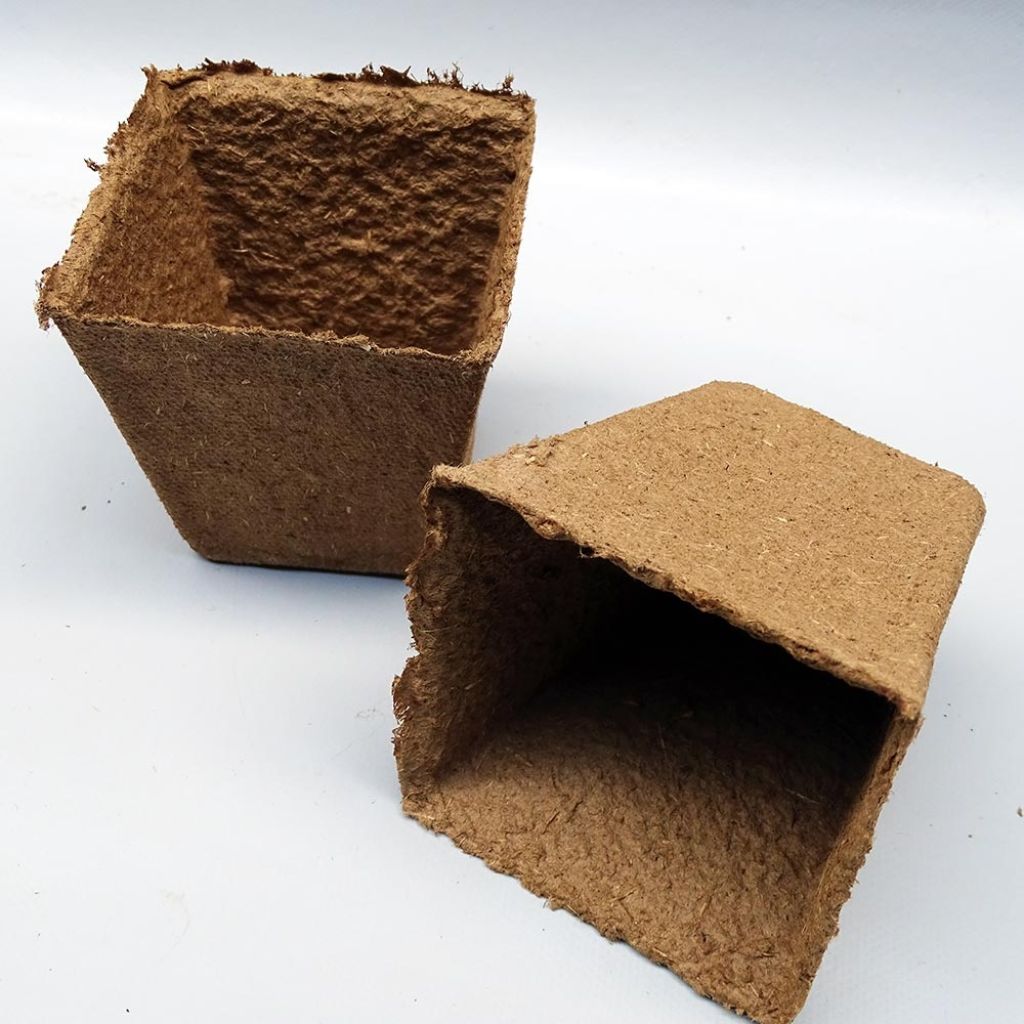
Organic biodegradable square pots FERTILPOT - 8 x 8 x 8 cm (3in) - sold in packs of 24.

Organic biodegradable square pots FERTILPOT - 8 x 8 x 8 cm (3in) - sold in packs of 24.
Organic biodegradable square pots FERTILPOT - 8 x 8 x 8 cm (3in) - sold in packs of 24.
Organic biodegradable square pots FERTILPOT - 8 x 8 x 8 cm (3in) - sold in packs of 24.
No text to translate.
josé, 01/09/2024
Back-to-school special offer!
Get €10 off for every €50 you spend! And get up to €40 off on a single order.
How does it work?
1. Shop your favourites
Add your favourite plants to your basket. For every €50 you spend (excluding delivery charges, store credit and the plastic-free option), you’ll receive a €10 voucher.
€50 spent = €10 voucher
€100 spent = €20 voucher
€150 spent = €30 voucher
€200 spent = €40 voucher
2. Place your order
Once your basket reaches one of the spending thresholds, place your order. You can even choose your delivery date!
3. Receive your voucher
As soon as your order has been shipped, you’ll receive an email containing your personal voucher code and its value.
4. Use it on your next order
Your voucher is valid for 90 days from the date you receive it. It can be used once only, on a new order worth at least the value of the voucher, excluding delivery charges.
Please note: Vouchers can be combined with other offers, but cannot be split or refunded.
Home or relay delivery (depending on size and destination)
Important: You may be charged customs duties by your country’s customs authorities upon delivery.
Schedule delivery date,
and select date in basket
We guarantee the quality of our plants for a full growing cycle, and will replace at our expense any plant that fails to recover under normal climatic and planting conditions.


These 8 cm (3in) square FERTILPOT buckets are highly recommended by horticulture and market gardening professionals. Made exclusively from plant fibres, they are an excellent ecological alternative to regular plastic buckets as they are 100% biodegradable and free from any additives or chemical residues. Permeable to water, air, and plant roots, they are strong enough to withstand handling. You can sow or transplant your flowers, vegetables, trees, and bushes in them, then transfer them to a larger pot or directly into the garden soil without disturbing the delicate young roots of your plants. A clever and environmentally friendly product.
These small FERTILPOT buckets are manufactured in the Vosges region using branch fibres from forest maintenance (thinning) with well-defined characteristics, and peat that does not come from sensitive ecological areas. They offer numerous advantages: their walls have a dense and porous mesh that allows roots to penetrate easily and ensures good water retention and excellent substrate aeration. These factors are essential for seed germination and the healthy growth of young seedlings. The roots stop growing in length once they reach the pot walls, then they start branching out, eventually creating a significant and uniform root hair system that colonizes the entire substrate and provides better nourishment to the plant. The roots remain intact during transplanting and are immediately functional, avoiding any post-transplantation shock for the plants. The wood fibres will gradually decompose naturally, along with the substrate, disappearing completely once in the soil.
Another advantage compared to plastic buckets and pots, and not the least, is that the phenomenon of root circling is impossible in FERTILPOT wood fibre pots: while roots tend to grow in a spiral and tangle in a too-small plastic pot with an impassable wall, they will easily pass through the wood fibre walls of FERTILPOTS. This will be a sign that it's time to transplant the young plants into a larger pot or plant them directly in the ground. It should be noted that while this phenomenon of root circling is almost nonexistent or has little impact on herbaceous plants (perennials, vegetables, annuals, and biennials), it can be detrimental to the growth of many bushes and trees, especially in challenging soil and climate conditions.
Finally, gardeners concerned about preserving nature will find in these wood fibre pots an ecological solution to replace often non-recyclable plastic pots, which will eventually pose an environmental problem. FERTILPOTS comply with environmental standards and can be added to compost without any risk.
FERTILPOTS are available in various sizes and shapes and are sold in sets.
Technical features
Tips
Detailed features
-
, onOrder confirmed
Reply from on Promesse de fleurs
Recently viewed products
Haven't found what you were looking for?
Hardiness is the lowest winter temperature a plant can endure without suffering serious damage or even dying. However, hardiness is affected by location (a sheltered area, such as a patio), protection (winter cover) and soil type (hardiness is improved by well-drained soil).
In temperate climates, pruning of spring-flowering shrubs (forsythia, spireas, etc.) should be done just after flowering.
Pruning of summer-flowering shrubs (Indian Lilac, Perovskia, etc.) can be done in winter or spring.
In cold regions as well as with frost-sensitive plants, avoid pruning too early when severe frosts may still occur.
The harvesting period indicated on our website applies to countries and regions in USDA zone 8 (France, England, Ireland, the Netherlands).
In colder areas (Scandinavia, Poland, Austria...) fruit and vegetable harvests are likely to be delayed by 3-4 weeks.
In warmer areas (Italy, Spain, Greece, etc.), harvesting will probably take place earlier, depending on weather conditions.
The sowing periods indicated on our website apply to countries and regions within USDA Zone 8 (France, UK, Ireland, Netherlands).
In colder areas (Scandinavia, Poland, Austria...), delay any outdoor sowing by 3-4 weeks, or sow under glass.
In warmer climes (Italy, Spain, Greece, etc.), bring outdoor sowing forward by a few weeks.
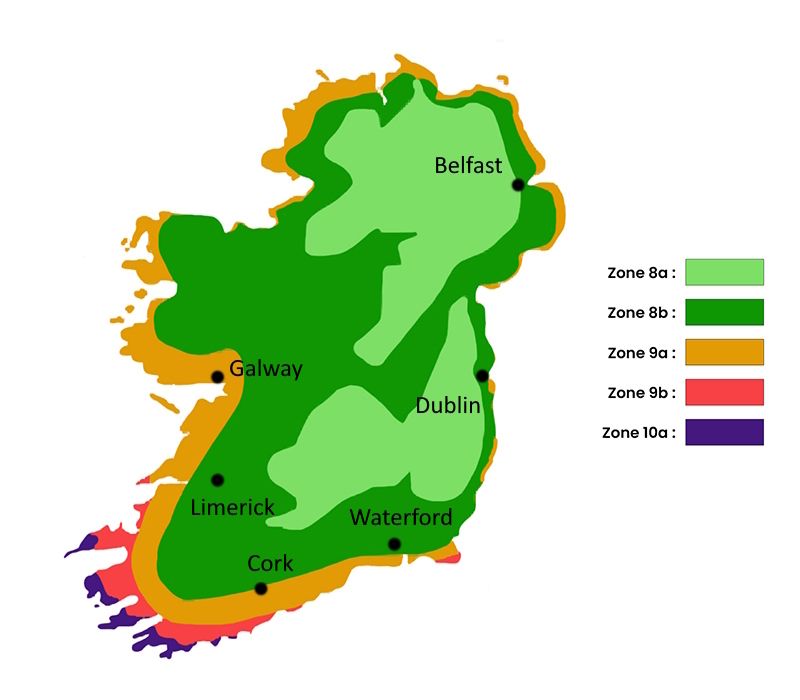
The planting period indicated on our website applies to regions in USDA Zone 9a (East Coast and Midlands: Dublin, Wexford, Waterford, Kilkenny, Portlaoise). It will vary depending on where you live:
- On the west coast and in the north-west (Galway, Limerick, Sligo, Donegal, Westport), delay planting by 1 to 2 weeks in spring and bring it forward by 1 to 2 weeks in autumn compared to the dates given, preferably choosing periods without strong winds.
- In the inland hills and plateaus (Wicklow Mountains, Macgillycuddy’s Reeks, Connemara, Killarney), it is best to plant in spring (April–May) or autumn (September–October), avoiding periods of waterlogged soil in winter and strong winds, which pose the main risk to newly planted trees in these areas.
The flowering period indicated on our website applies to regions in USDA Zone 9a, such as the East Coast and Midlands, including Dublin, Wexford, Waterford, Kilkenny and Portlaoise.
This will vary depending on where you live:
- On the west coast and in the northwest (Galway, Limerick, Sligo, Donegal and Westport), it will be delayed by one to two weeks compared to the given dates, due to stronger Atlantic winds and less spring sunshine.
- In the inland hills and plateaus (the Wicklow Mountains, the Macgillycuddy's Reeks, Connemara and Killarney), flowering will be delayed by two to three weeks. Flowering mainly occurs between May and July, with the limiting factors being less frost and more of the excessive humidity, strong winds and lack of sunshine that are characteristic of these areas.
Shipping country and language
Your country of residence may be:
Your country of residence is:
For a better user experience on our website, you can select:
Your shipping country:
-
 Austria
-
 Belgium
-
 Bosnia & Herzegovina
-
 Bulgaria
-
 Croatia
-
 Cyprus
-
 Czechia
-
 Denmark
-
 Estonia
-
 Finland
-
 France
-
 Germany
-
 Greece
-
 Hungary
-
 Iceland
-
 Ireland
-
 Italy
Italy
-
 Latvia
-
 Liechtenstein
-
 Lithuania
-
 Luxembourg
-
 Malta
Malta
-
 Netherlands
-
 Poland
-
 Portugal
-
 Romania
-
 Serbia
-
 Slovakia
-
 Slovenia
-
 Spain
Spain
-
 Sweden
-
 Switzerland
Language:
-
French
-
 English
-
Spanish
-
Italian
-
German
-
Portuguese
-
Dutch
-
Finnish
My Account
Hello
My wish lists
My cart
Log in / Register
Existing customer?
This form is protected by reCAPTCHA - the Google Privacy Policy and Terms of Service apply.
New customer?
Create an account to track your orders, access our customer service and, if you wish, make the most of our upcoming offers.