Salix caprea Ogon - Goat Willow
Salix caprea Ogon - Goat Willow
Salix caprea Ogon
Goat Willow, Pussy Willow
Back-to-school special offer!
Get €10 off for every €50 you spend! And get up to €40 off on a single order.
How does it work?
1. Shop your favourites
Add your favourite plants to your basket. For every €50 you spend (excluding delivery charges, store credit and the plastic-free option), you’ll receive a €10 voucher.
€50 spent = €10 voucher
€100 spent = €20 voucher
€150 spent = €30 voucher
€200 spent = €40 voucher
2. Place your order
Once your basket reaches one of the spending thresholds, place your order. You can even choose your delivery date!
3. Receive your voucher
As soon as your order has been shipped, you’ll receive an email containing your personal voucher code and its value.
4. Use it on your next order
Your voucher is valid for 90 days from the date you receive it. It can be used once only, on a new order worth at least the value of the voucher, excluding delivery charges.
Please note: Vouchers can be combined with other offers, but cannot be split or refunded.
Home or relay delivery (depending on size and destination)
Important: You may be charged customs duties by your country’s customs authorities upon delivery.
Schedule delivery date,
and select date in basket
This plant carries a 24 months recovery warranty
More information
We guarantee the quality of our plants for a full growing cycle, and will replace at our expense any plant that fails to recover under normal climatic and planting conditions.
Does this plant fit my garden?
Set up your Plantfit profile →
Description
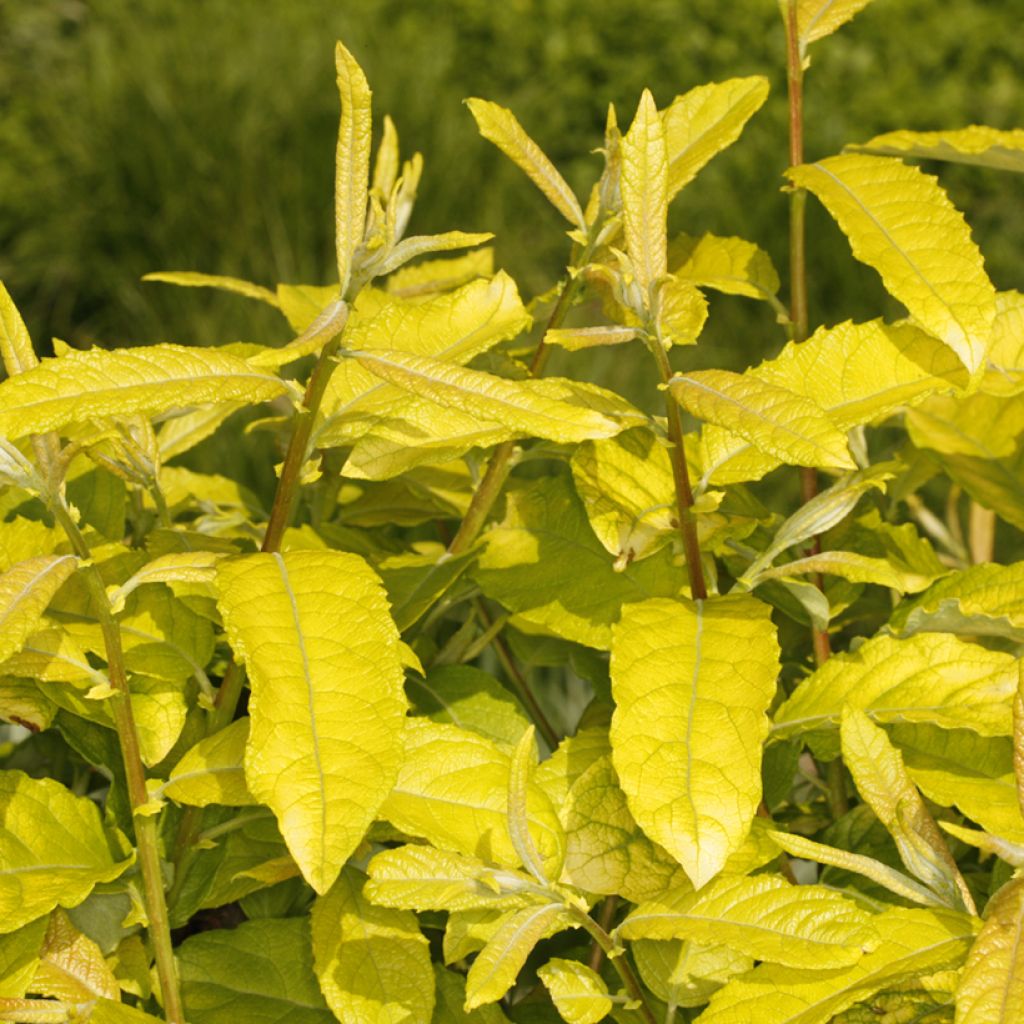
Salix caprea 'Ogon' is a variety of goat willow selected for its very beautiful spring foliage in yellow tones. A beautifully changing foliage, which attracts attention from spring to autumn. Its small development, beauty, and accommodating character regarding the soil also suit a beginner gardener with a modest-sized garden.
Salix caprea 'Ogon' is a horticultural selection. The species is commonly referred to as goat willow, willow of the goats, marsault, or grey osier. It belongs to the Salicaceae family. This is a deciduous tree native to Europe, especially central Europe, and to central and northern Asia. The goat willow is a pioneering and ubiquitous species, an essential plant less exclusively linked to wet places than most other species of the genus Salix.
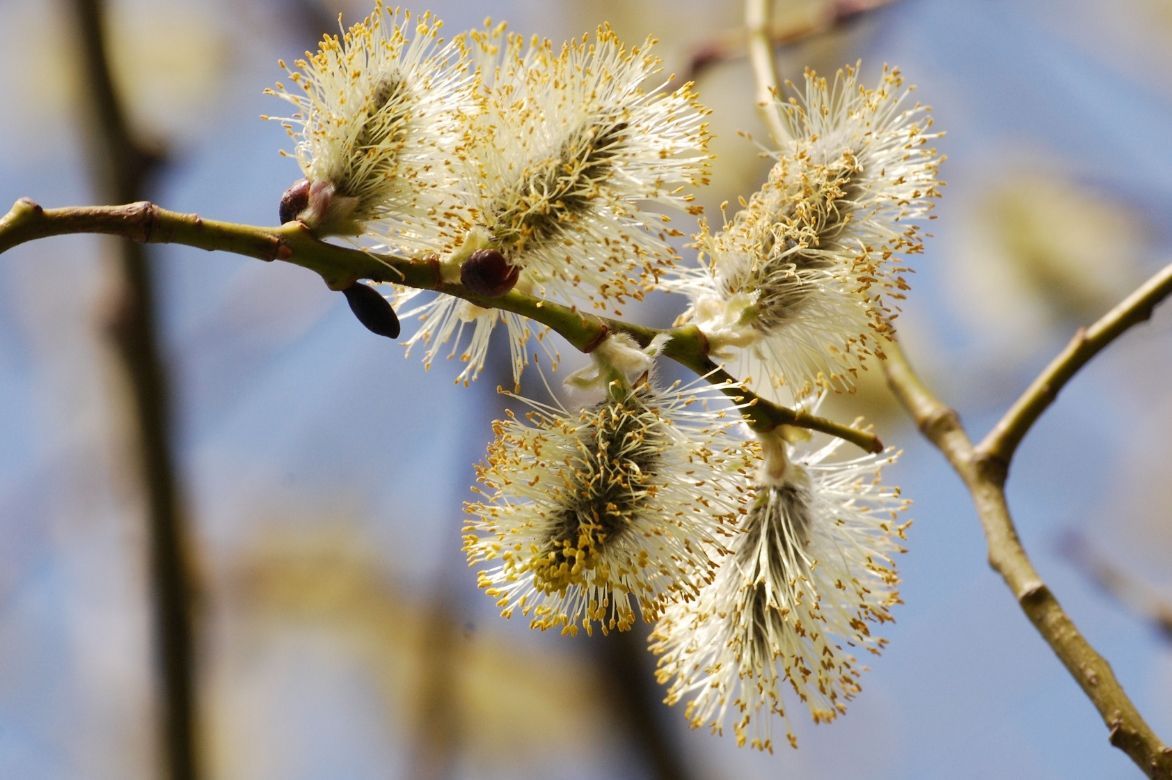
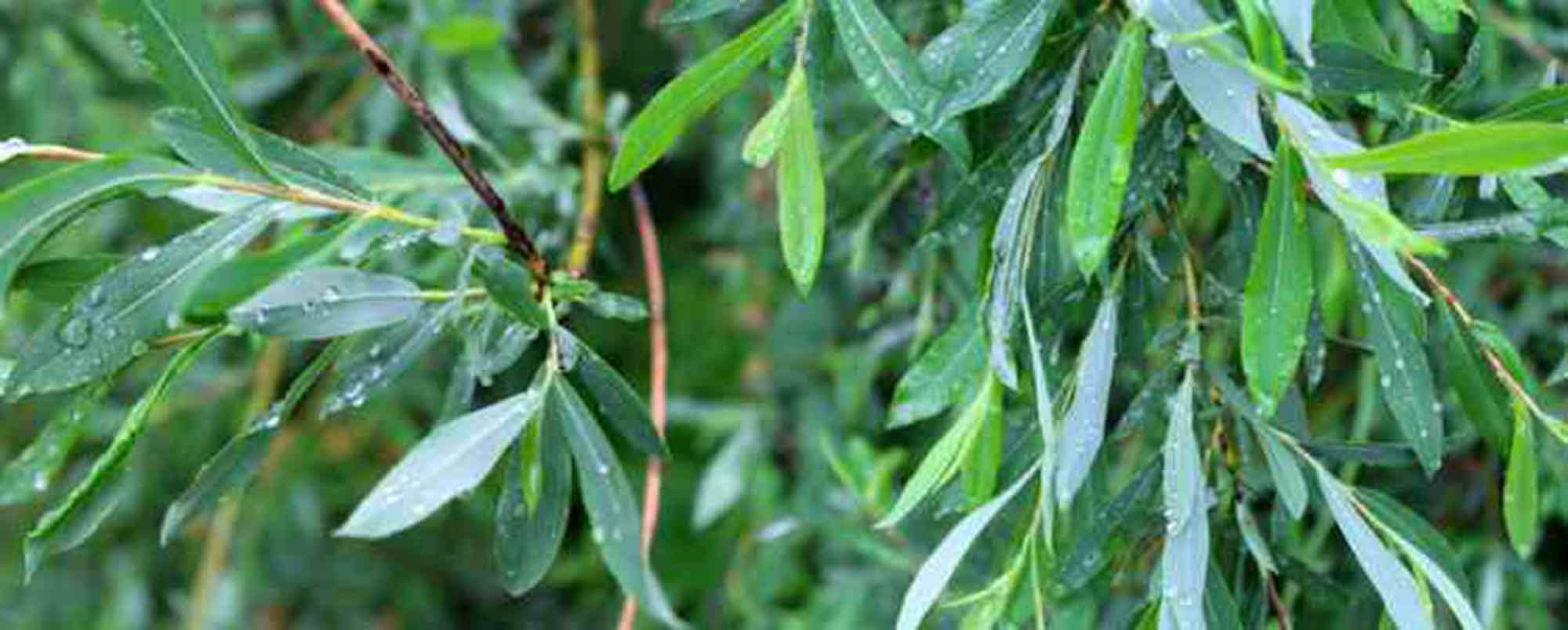
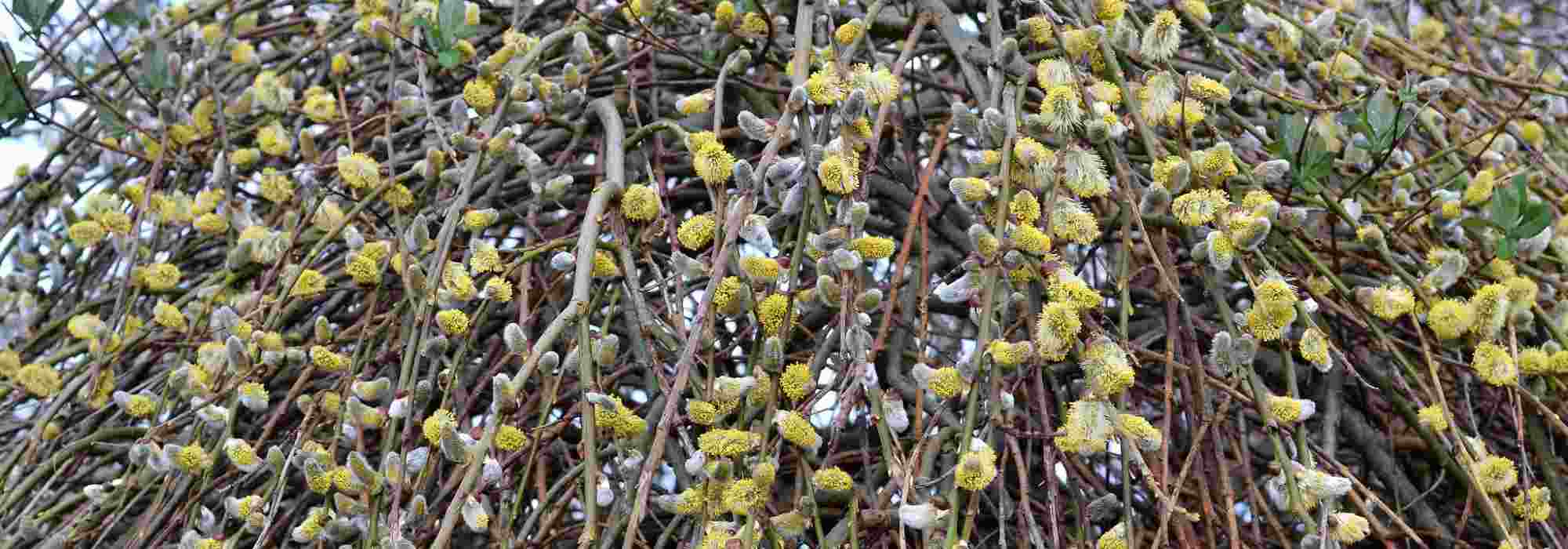
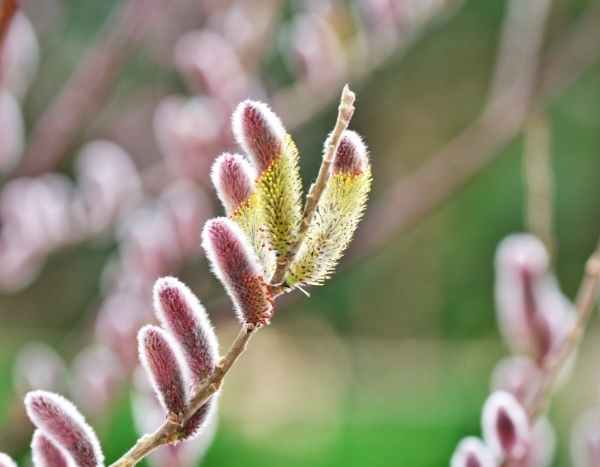
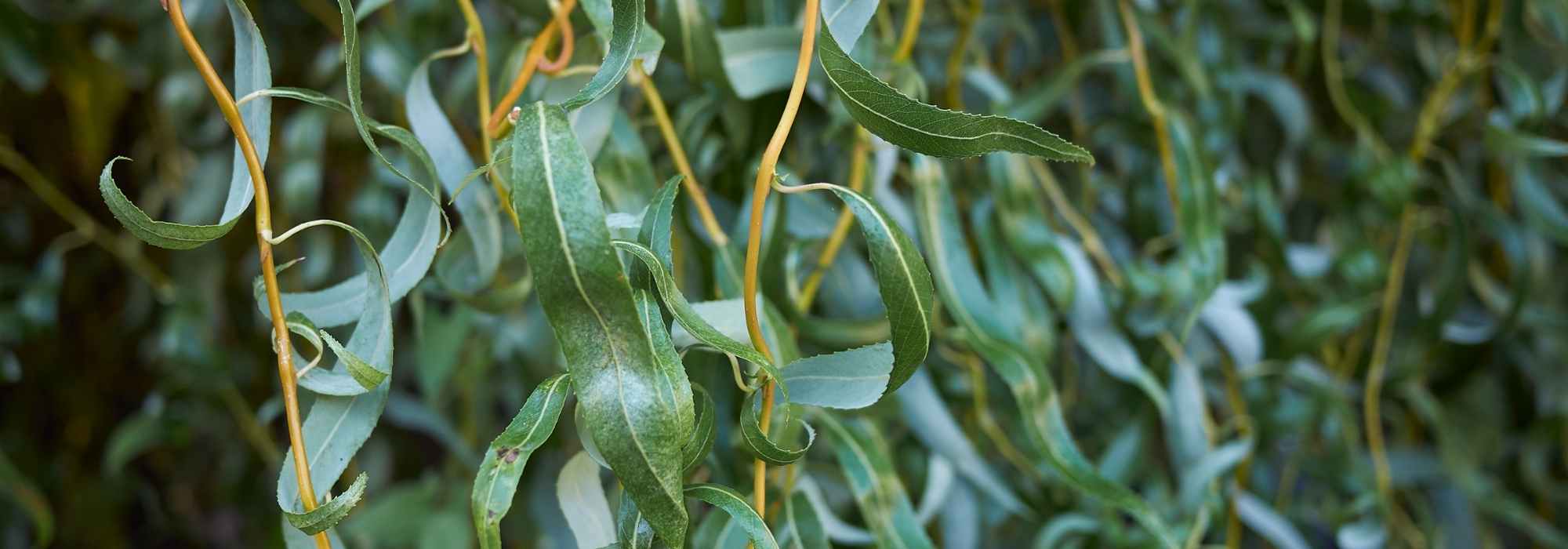
The 'Ogon' willow generally forms a bush with a neat habit, but it can also be trained as a miniature tree with multiple trunks. Young subjects show rapid growth. Subsequently, growth slows down and the plant does not exceed 5 m in height. The older branches are olive green, quite thin and long, forming an airy, slightly irregular dome-shaped crown, with a spread of approximately 3 m. The young branches are reddish-brown and slightly hairy. Flowering occurs in late winter (March) or very early spring (early April), on the bare branches. The flowers are grouped in catkins, providing pollen and nectar to the first foraging insects. Just after flowering, young leaves that also decorative develop. They emerge pink, then take on a bright lemon-yellow hue. This yellow colouration lasts for 2 months. In summer, the foliage displays a bright light green colour. The leaves are smooth and soft to the touch. They are broadly elliptical, measuring 5 to 10 cm long, slightly wavy and somewhat wrinkled at the edge. In autumn, the foliage turns yellow again before falling.
Salix caprea 'Ogon' withstands very cold winters perfectly and is very easy to cultivate in most regions. Unlike most willows, it does not require moist or waterlogged soil throughout the year and is capable of withstanding moderate drought periods with good episodic watering. Prune it every year after flowering to encourage it to thicken and produce numerous floriferous branches. It should be placed as a specimen, surrounded by early flowering bulbs (snowdrops, spring crocus, fritillaries, hyacinths), in a free-standing hedge or at the back of a flowerbed with coppice shoots. It will be perfect in a naturally inspired garden with white dogwoods, for example. Consider composing bouquets with its branches adorned with silver catkins. In a vase, they beautifully accompany those of Prunus triloba, flowering cherries, and plums that the warmth of the house will open.
Properties:
Like all willows, this species contains a substance in its bark similar to aspirin. It is highly nectar-rich and honey-producing: the bees that forage on it produce honey of golden yellow colour, iridescent green, which takes on amber to beige reflections as it ages. Its flavour is sweet, floral and slightly woody. Its foliage was once used as fodder for goats.
Plant habit
Flowering
Foliage
Planting and care
Plant the Goat Willow 'Ogon' in non-scorching sunlight, sheltered from strong winds that could uproot this young plant with its poorly developed root system. Place a sturdy stake that you can remove after 2 or 3 years of cultivation. It is not very demanding regarding soil as long as it has some depth to allow the bush to find a bit of moisture in case of drought. In warm regions, once the young plant is established, a generous watering every 15 days or 3 weeks will be more than sufficient. It will adapt well to light, stony, and sandy soil as well as heavy, clayey, very wet soil. A small amount of lime is not a problem. Ideally, at planting, use a mixture composed of half potting compost and half garden soil. It is perfectly resistant to cold and severe frosts. To encourage a bushy habit and the formation of branches bearing catkins, prune fairly short (5 cm) after flowering, every year. Protect all cut wounds with a healing paste.
Planting period
Intended location
Care
Planting & care advice
-
-
-

-

-
-

-
-
This item has not been reviewed yet - be the first to leave a review about it.
Recently viewed products
Haven't found what you were looking for?
Hardiness is the lowest winter temperature a plant can endure without suffering serious damage or even dying. However, hardiness is affected by location (a sheltered area, such as a patio), protection (winter cover) and soil type (hardiness is improved by well-drained soil).
In temperate climates, pruning of spring-flowering shrubs (forsythia, spireas, etc.) should be done just after flowering.
Pruning of summer-flowering shrubs (Indian Lilac, Perovskia, etc.) can be done in winter or spring.
In cold regions as well as with frost-sensitive plants, avoid pruning too early when severe frosts may still occur.
The harvesting period indicated on our website applies to countries and regions in USDA zone 8 (France, England, Ireland, the Netherlands).
In colder areas (Scandinavia, Poland, Austria...) fruit and vegetable harvests are likely to be delayed by 3-4 weeks.
In warmer areas (Italy, Spain, Greece, etc.), harvesting will probably take place earlier, depending on weather conditions.
The sowing periods indicated on our website apply to countries and regions within USDA Zone 8 (France, UK, Ireland, Netherlands).
In colder areas (Scandinavia, Poland, Austria...), delay any outdoor sowing by 3-4 weeks, or sow under glass.
In warmer climes (Italy, Spain, Greece, etc.), bring outdoor sowing forward by a few weeks.
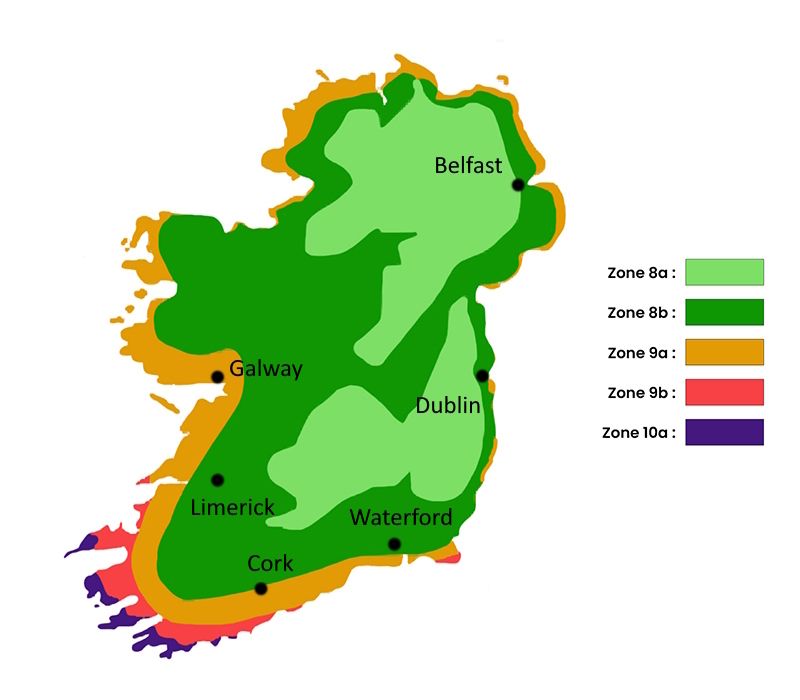
The planting period indicated on our website applies to regions in USDA Zone 9a (East Coast and Midlands: Dublin, Wexford, Waterford, Kilkenny, Portlaoise). It will vary depending on where you live:
- On the west coast and in the north-west (Galway, Limerick, Sligo, Donegal, Westport), delay planting by 1 to 2 weeks in spring and bring it forward by 1 to 2 weeks in autumn compared to the dates given, preferably choosing periods without strong winds.
- In the inland hills and plateaus (Wicklow Mountains, Macgillycuddy’s Reeks, Connemara, Killarney), it is best to plant in spring (April–May) or autumn (September–October), avoiding periods of waterlogged soil in winter and strong winds, which pose the main risk to newly planted trees in these areas.
The flowering period indicated on our website applies to regions in USDA Zone 9a, such as the East Coast and Midlands, including Dublin, Wexford, Waterford, Kilkenny and Portlaoise.
This will vary depending on where you live:
- On the west coast and in the northwest (Galway, Limerick, Sligo, Donegal and Westport), it will be delayed by one to two weeks compared to the given dates, due to stronger Atlantic winds and less spring sunshine.
- In the inland hills and plateaus (the Wicklow Mountains, the Macgillycuddy's Reeks, Connemara and Killarney), flowering will be delayed by two to three weeks. Flowering mainly occurs between May and July, with the limiting factors being less frost and more of the excessive humidity, strong winds and lack of sunshine that are characteristic of these areas.
Shipping country and language
Your country of residence may be:
Your country of residence is:
For a better user experience on our website, you can select:
Your shipping country:
-
 Austria
-
 Belgium
-
 Bosnia & Herzegovina
-
 Bulgaria
-
 Croatia
-
 Cyprus
-
 Czechia
-
 Denmark
-
 Estonia
-
 Finland
-
 France
-
 Germany
-
 Greece
-
 Hungary
-
 Iceland
-
 Ireland
-
 Italy
Italy
-
 Latvia
-
 Liechtenstein
-
 Lithuania
-
 Luxembourg
-
 Malta
Malta
-
 Netherlands
-
 Poland
-
 Portugal
-
 Romania
-
 Serbia
-
 Slovakia
-
 Slovenia
-
 Spain
Spain
-
 Sweden
-
 Switzerland
Language:
-
French
-
 English
-
Spanish
-
Italian
-
German
-
Portuguese
-
Dutch
-
Finnish
My Account
Hello
My wish lists
My cart
Log in / Register
Existing customer?
This form is protected by reCAPTCHA - the Google Privacy Policy and Terms of Service apply.
New customer?
Create an account to track your orders, access our customer service and, if you wish, make the most of our upcoming offers.