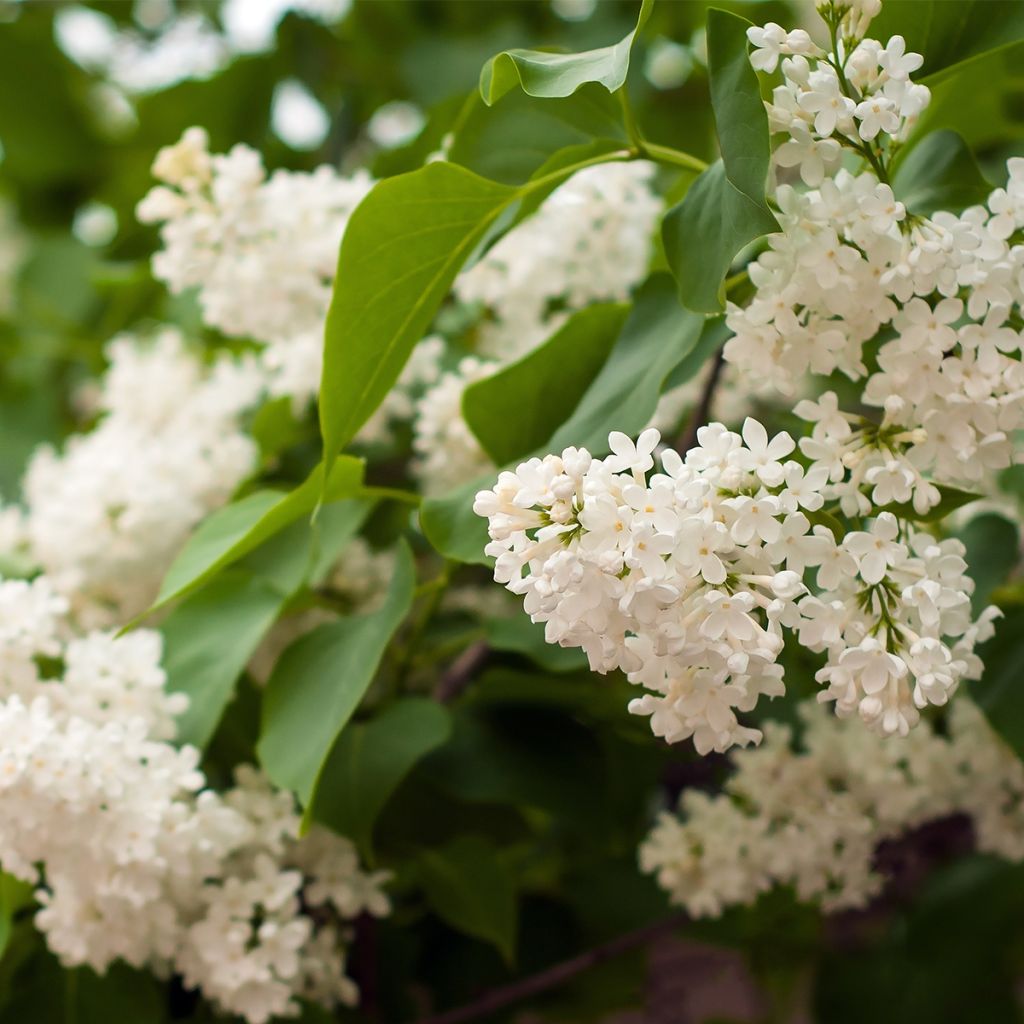
Syringa vulgaris Comtesse Dharcourt - Common Lilac
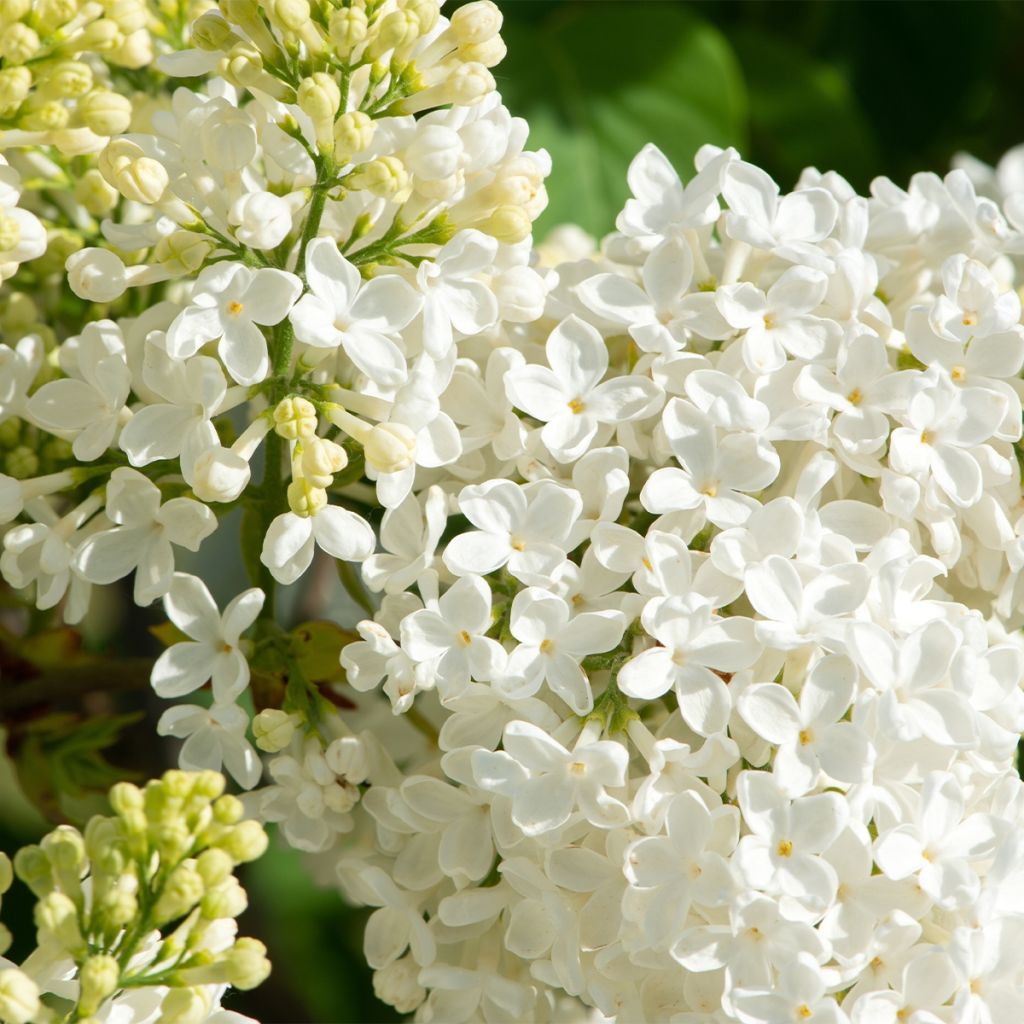
Syringa vulgaris Comtesse Dharcourt - Common Lilac
Syringa vulgaris Comtesse Dharcourt - Common Lilac
Syringa vulgaris Comtesse D'harcourt
Common Lilac, Lilac
Back-to-school special offer!
Get €10 off for every €50 you spend! And get up to €40 off on a single order.
How does it work?
1. Shop your favourites
Add your favourite plants to your basket. For every €50 you spend (excluding delivery charges, store credit and the plastic-free option), you’ll receive a €10 voucher.
€50 spent = €10 voucher
€100 spent = €20 voucher
€150 spent = €30 voucher
€200 spent = €40 voucher
2. Place your order
Once your basket reaches one of the spending thresholds, place your order. You can even choose your delivery date!
3. Receive your voucher
As soon as your order has been shipped, you’ll receive an email containing your personal voucher code and its value.
4. Use it on your next order
Your voucher is valid for 90 days from the date you receive it. It can be used once only, on a new order worth at least the value of the voucher, excluding delivery charges.
Please note: Vouchers can be combined with other offers, but cannot be split or refunded.
Home or relay delivery (depending on size and destination)
Important: You may be charged customs duties by your country’s customs authorities upon delivery.
Schedule delivery date
and select date in basket
This plant carries a 24 months recovery warranty
More information
We guarantee the quality of our plants for a full growing cycle, and will replace at our expense any plant that fails to recover under normal climatic and planting conditions.
Does this plant fit my garden?
Set up your Plantfit profile →
Description
The lilac 'Comtesse d'Harcourt' is a variety selected by a French nurseryman at the end of the 20th century. It produces beautiful clusters of white flowers in the spring, which exude a light, very pleasant fragrance and radiate an undeniable romantic charm. The Syringa vulgaris 'Comtesse d'Harcourt' is a French variety obtained in 1995 by Claude Bellion, then director of the research and development department of the Minier Nurseries in Angers. Claude Bellion, who was also head of cultivation, notably won the Xavier-Bernard Foundation award in 1993 for his work on ecological hedges. Of fairly large size, this bush is as comfortable in a free hedge as in a mass of country bushes. Very hardy, this easy-to-grow variety thrives in sunny exposure, in any neutral to limestone, not too dry soil.
Lilacs are part of the Oleaceae family, which includes many ornamental genus, Forsythia, Osmanthus, Phyllirea, Chionanthus, the sweetly scented Jasmines, the Privets, the majestic Common Ash, as well as the venerable Olive tree with its legendary longevity. Fallen into disuse in the 1960s-1970s, which saw the arrival of American or Asian lilacs, with their model-like size and often perpetual flowering, the lilac of Europe and its hybrids, larger, are making a strong comeback in our gardens, following the trend of old roses, which were criticised for their single flowering, and were therefore neglected in favour of modern hybrids. It is often forgotten that the Common Lilac, or Lilac of Europe, is actually native to South-east Europe and the west of Asia, more precisely the Balkan peninsula, and it did not arrive in Western Europe until the end of the renaissance. In nature, this untamed plant with its very fragrant purplish blue flowers colonises the rocky hills and braves cold winters
This lilac is a large bush, as it reaches a mature height of 4 m (13 ft 1 in) and 3 m (9 ft 10 in) in width. It should also be taken into account that it suckers, meaning that it gradually widens by emitting new shoots on the periphery of the original plant. It is therefore better to plant it in a sufficiently spacious location. Its pretty green foliage, composed of heart-shaped leaves at the base, 5 to 8 cm (2 to 3.1 in) long, provides a beautiful background to the wonderful white flowering in April-May. At the end of one-year-old branches, long ramified clusters grouped in pairs, or even more, appear. These compound clusters, called thyrsus, sometimes reach 20 cm (7.9 in) in length. Their shape, overall pyramidal, is rather slender. The flowers that make them up are single, of a pure white. They diffuse a light, very pleasant fragrance and allow for the creation of beautiful bouquets for the home.
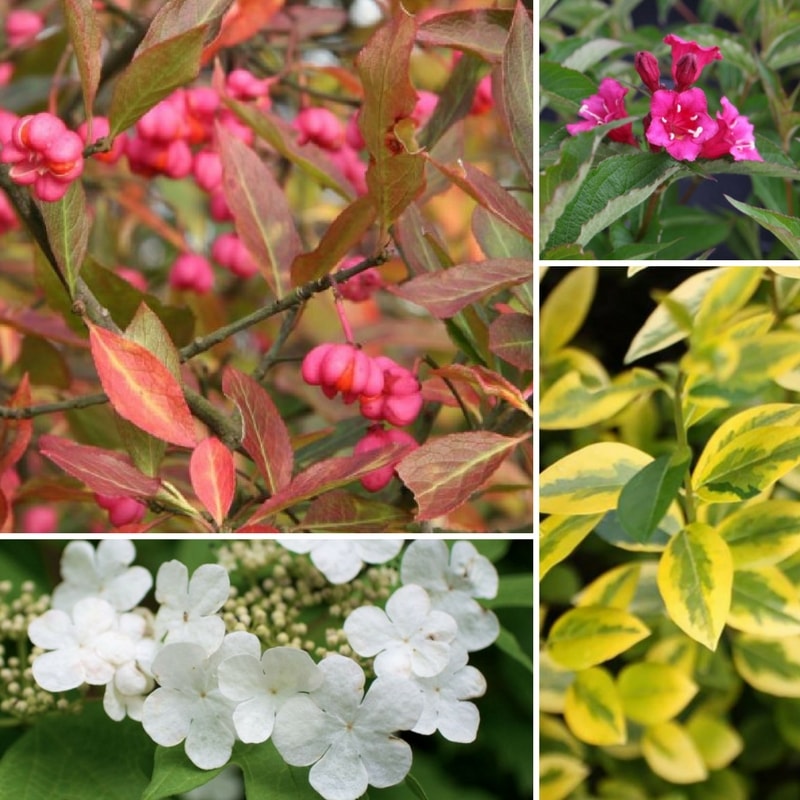
The common lilac ‘Comtesse d'Harcourt’, with its name hinting at old nobility, is an indispensable bush in a romantic garden. Use it, mixed with other varieties, mauves, pinks or reds, in abundance, in large flowering hedges, or in the company of other wild-looking bushes like the Amelanchier lamarckii, whose countless spring white flowers are equalled in beauty only by its autumnal colours and its decorative red fruits at the end of the year. To vary the colours, opt for the Chinese Spindle, or Euonymus phellomanus, with its superb decorative pink fruits. Another companion of choice for our lilacs is the Cornelian Cherry, which, like it, perfectly tolerates limestone and is full of assets, from its early yellow flowering, in February-March, to its decorative and edible red berries, not to mention its beautiful autumn colours. And to top off your free hedge on a joyful note, nothing better than the Crataegus laevigata Paul's Scarlet, a superb hawthorn with bright pink flowers that gives decorative red fruits and offers, like the dogwood, an autumnal spectacle, with its foliage turning red.

Syringa vulgaris Comtesse Dharcourt - Common Lilac in pictures
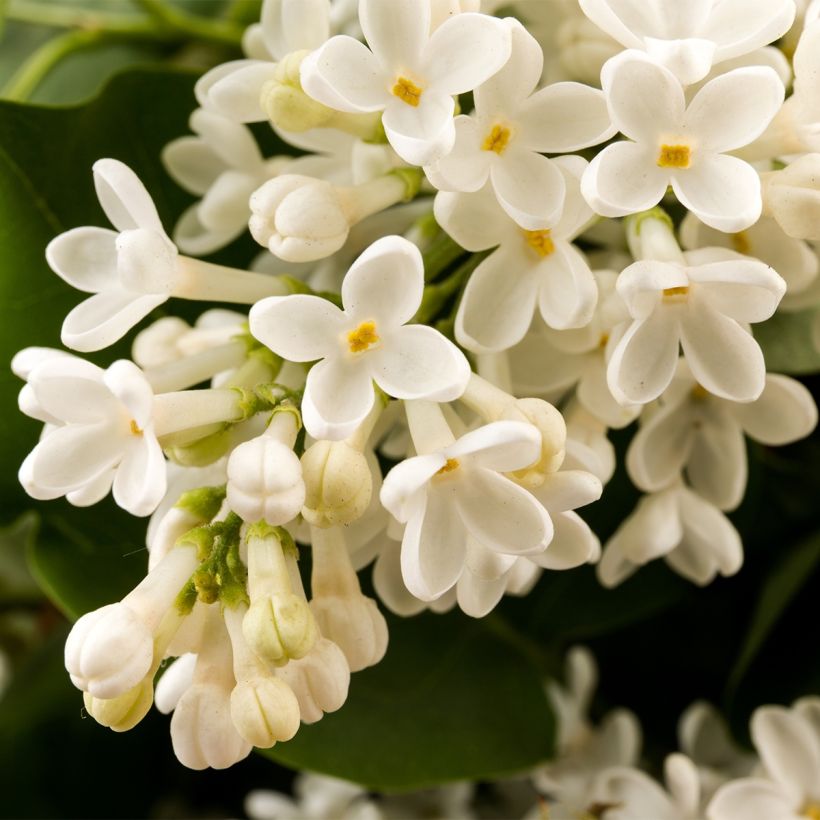
Plant habit
Flowering
Foliage
Botanical data
Syringa
vulgaris
Comtesse D'harcourt
Oleaceae
Common Lilac, Lilac
Cultivar or hybrid
Planting and care
The Common Lilac 'Comtesse D'harcourt' appreciates being planted in full sun, in a soil that's not too dry, but deep, even clay-limestone. It tolerates all types of soil, but prefers slightly calcareous soils and fears highly acidic soils. It will grow in a semi-shaded exposure, but the flowering will be reduced. Its hardiness is excellent, beyond -25 °C. Easy to grow, it requires only mulching and regular watering in dry climate, to maintain a certain humidity.
While the common lilac grows in the mediterranean, its large-flowered hybrids suffer from a lack of water that disfigures their thirsty vegetation. In all cases, water it in the first years in case of marked drought. You can prune the flowering shoots to make beautiful bouquets, or at the end of flowering to promote the appearance of new flowers and avoid exhausting the bush. Avoid severe pruning that limits the flowering of the following spring, unless your Lilac becomes too large.
Planting period
Intended location
Care
Planting & care advice
-
-

-

-

-

-

-

-
This item has not been reviewed yet - be the first to leave a review about it.
Recently viewed products
Haven't found what you were looking for?
Hardiness is the lowest winter temperature a plant can endure without suffering serious damage or even dying. However, hardiness is affected by location (a sheltered area, such as a patio), protection (winter cover) and soil type (hardiness is improved by well-drained soil).
In temperate climates, pruning of spring-flowering shrubs (forsythia, spireas, etc.) should be done just after flowering.
Pruning of summer-flowering shrubs (Indian Lilac, Perovskia, etc.) can be done in winter or spring.
In cold regions as well as with frost-sensitive plants, avoid pruning too early when severe frosts may still occur.
The harvesting period indicated on our website applies to countries and regions in USDA zone 8 (France, England, Ireland, the Netherlands).
In colder areas (Scandinavia, Poland, Austria...) fruit and vegetable harvests are likely to be delayed by 3-4 weeks.
In warmer areas (Italy, Spain, Greece, etc.), harvesting will probably take place earlier, depending on weather conditions.
The sowing periods indicated on our website apply to countries and regions within USDA Zone 8 (France, UK, Ireland, Netherlands).
In colder areas (Scandinavia, Poland, Austria...), delay any outdoor sowing by 3-4 weeks, or sow under glass.
In warmer climes (Italy, Spain, Greece, etc.), bring outdoor sowing forward by a few weeks.
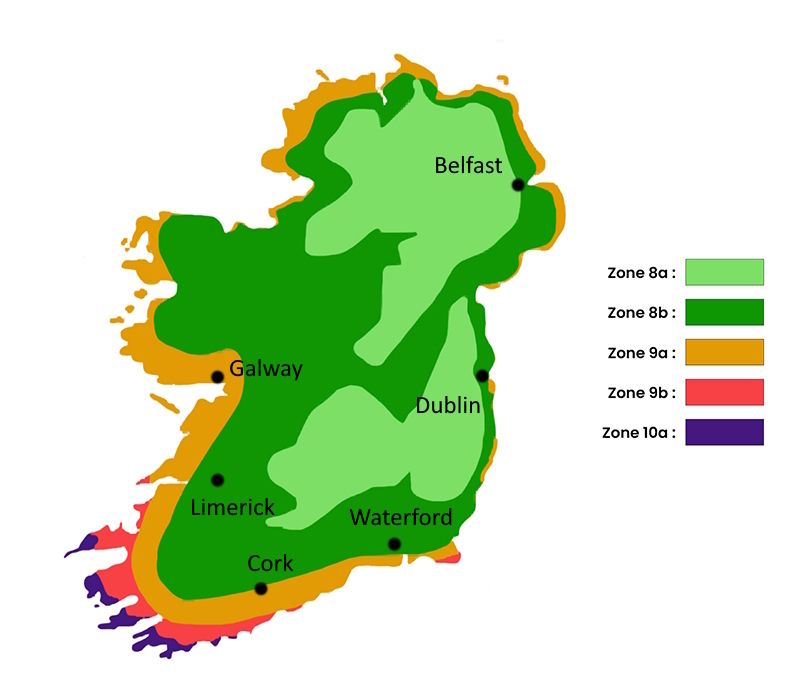
The planting period indicated on our website applies to regions in USDA Zone 9a (East Coast and Midlands: Dublin, Wexford, Waterford, Kilkenny, Portlaoise). It will vary depending on where you live:
- On the west coast and in the north-west (Galway, Limerick, Sligo, Donegal, Westport), delay planting by 1 to 2 weeks in spring and bring it forward by 1 to 2 weeks in autumn compared to the dates given, preferably choosing periods without strong winds.
- In the inland hills and plateaus (Wicklow Mountains, Macgillycuddy’s Reeks, Connemara, Killarney), it is best to plant in spring (April–May) or autumn (September–October), avoiding periods of waterlogged soil in winter and strong winds, which pose the main risk to newly planted trees in these areas.
The flowering period indicated on our website applies to regions in USDA Zone 9a, such as the East Coast and Midlands, including Dublin, Wexford, Waterford, Kilkenny and Portlaoise.
This will vary depending on where you live:
- On the west coast and in the northwest (Galway, Limerick, Sligo, Donegal and Westport), it will be delayed by one to two weeks compared to the given dates, due to stronger Atlantic winds and less spring sunshine.
- In the inland hills and plateaus (the Wicklow Mountains, the Macgillycuddy's Reeks, Connemara and Killarney), flowering will be delayed by two to three weeks. Flowering mainly occurs between May and July, with the limiting factors being less frost and more of the excessive humidity, strong winds and lack of sunshine that are characteristic of these areas.
Shipping country and language
Your country of residence may be:
Your country of residence is:
For a better user experience on our website, you can select:
Your shipping country:
-
 Austria
-
 Belgium
-
 Bosnia & Herzegovina
-
 Bulgaria
-
 Croatia
-
 Cyprus
-
 Czechia
-
 Denmark
-
 Estonia
-
 Finland
-
 France
-
 Germany
-
 Greece
-
 Hungary
-
 Iceland
-
 Ireland
-
 Italy
Italy
-
 Latvia
-
 Liechtenstein
-
 Lithuania
-
 Luxembourg
-
 Malta
Malta
-
 Netherlands
-
 Poland
-
 Portugal
-
 Romania
-
 Serbia
-
 Slovakia
-
 Slovenia
-
 Spain
Spain
-
 Sweden
-
 Switzerland
Language:
-
French
-
 English
-
Spanish
-
Italian
-
German
-
Portuguese
-
Dutch
-
Finnish
My Account
Hello
My wish lists
My cart
Log in / Register
Existing customer?
This form is protected by reCAPTCHA - the Google Privacy Policy and Terms of Service apply.
New customer?
Create an account to track your orders, access our customer service and, if you wish, make the most of our upcoming offers.