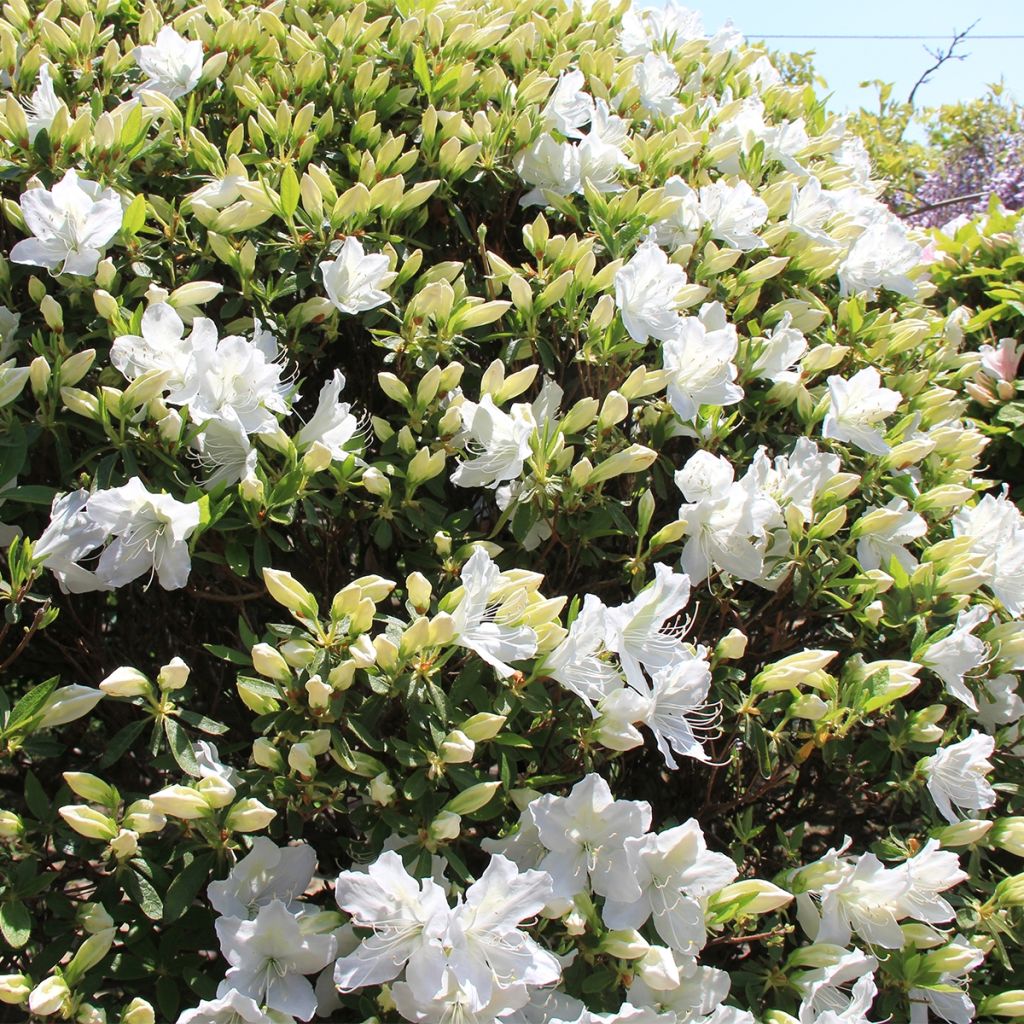
Azalea japonica Luzi
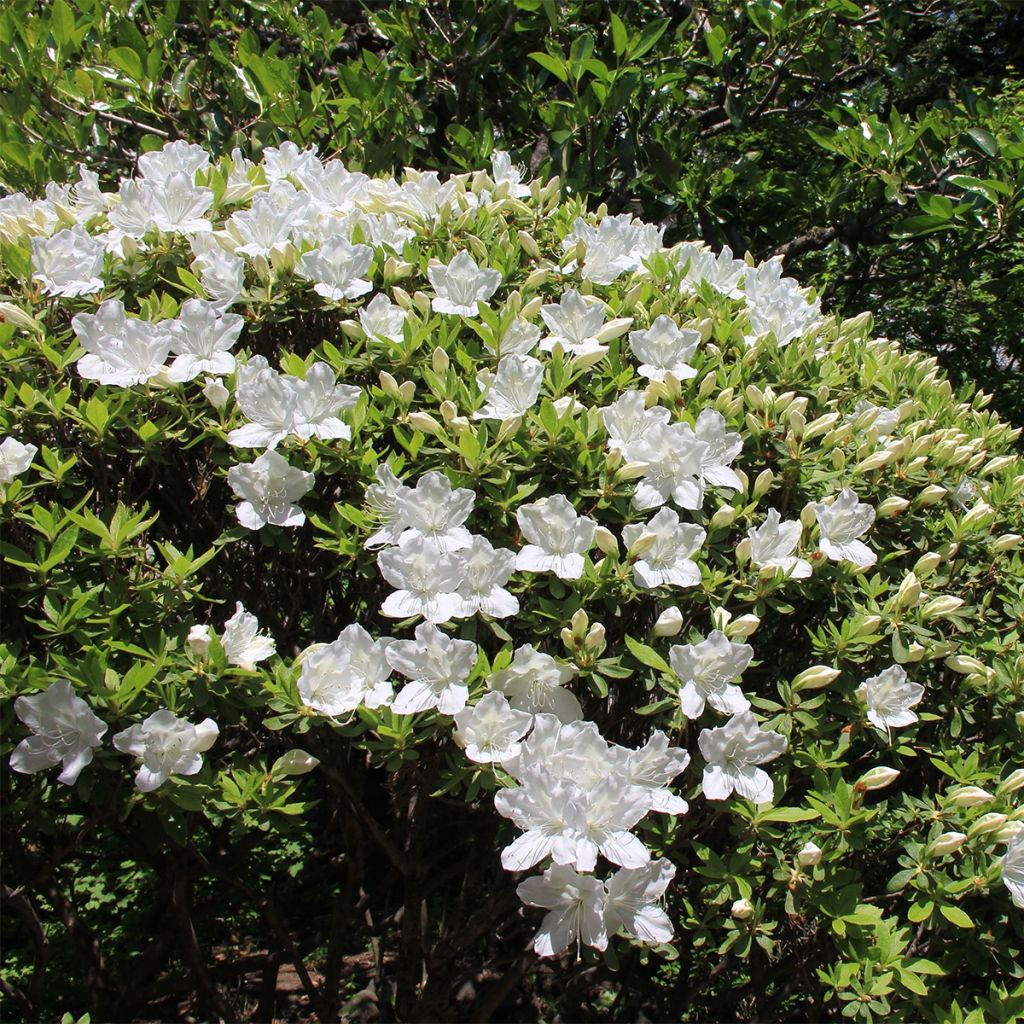
Azalea japonica Luzi
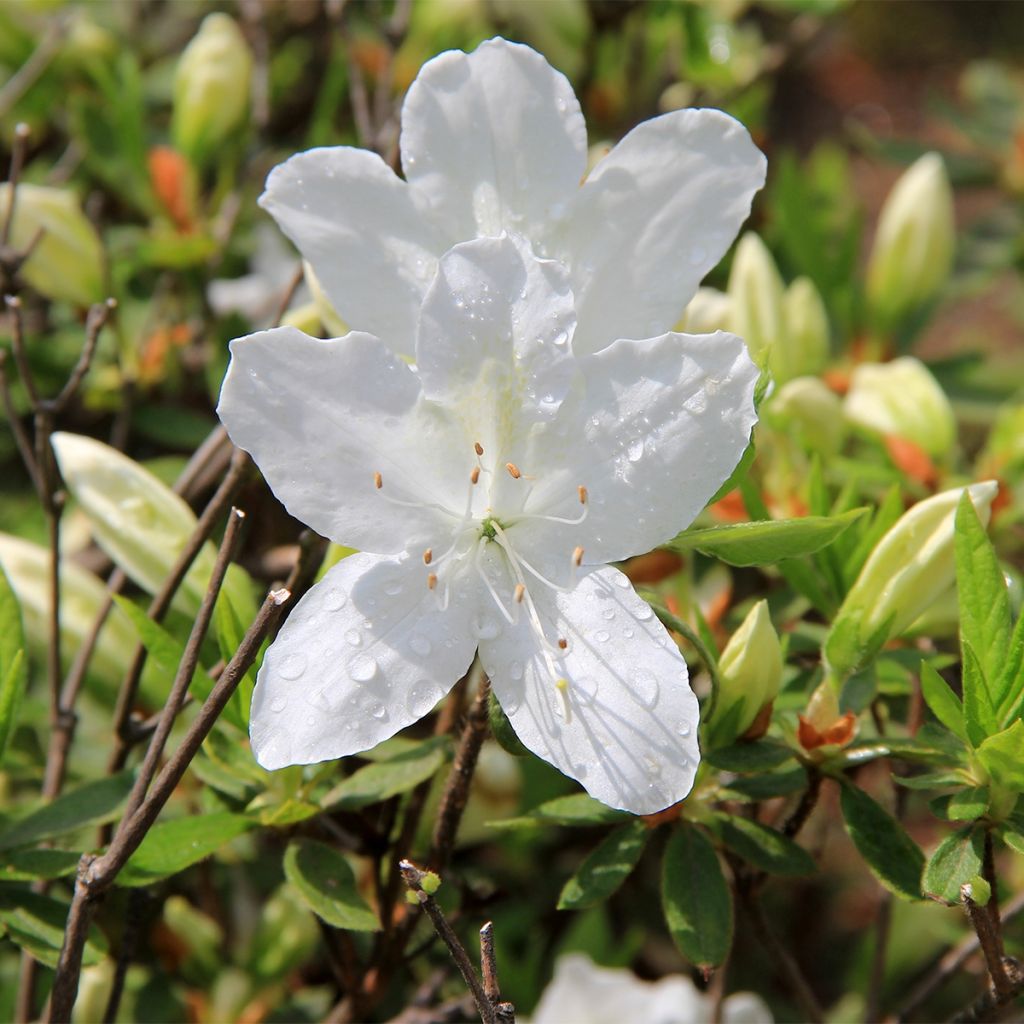
Azalea japonica Luzi
Azalea japonica Luzi
Rhododendron (Azalea) Luzi
Japanese Azalea
Back-to-school special offer!
Get €10 off for every €50 you spend! And get up to €40 off on a single order.
How does it work?
1. Shop your favourites
Add your favourite plants to your basket. For every €50 you spend (excluding delivery charges, store credit and the plastic-free option), you’ll receive a €10 voucher.
€50 spent = €10 voucher
€100 spent = €20 voucher
€150 spent = €30 voucher
€200 spent = €40 voucher
2. Place your order
Once your basket reaches one of the spending thresholds, place your order. You can even choose your delivery date!
3. Receive your voucher
As soon as your order has been shipped, you’ll receive an email containing your personal voucher code and its value.
4. Use it on your next order
Your voucher is valid for 90 days from the date you receive it. It can be used once only, on a new order worth at least the value of the voucher, excluding delivery charges.
Please note: Vouchers can be combined with other offers, but cannot be split or refunded.
Home or relay delivery (depending on size and destination)
Important: You may be charged customs duties by your country’s customs authorities upon delivery.
Schedule delivery date,
and select date in basket
This plant carries a 24 months recovery warranty
More information
We guarantee the quality of our plants for a full growing cycle, and will replace at our expense any plant that fails to recover under normal climatic and planting conditions.
Does this plant fit my garden?
Set up your Plantfit profile →
Description
The Japanese Azalea 'Luzi' (now classified as Rhododendron) is a charming little, compact shrub, forming an evergreen ball with small, dark green, pointed leaves. The blossom in spring is magical, completely covering the shrub in clusters of white flowers. This ericaceous plant does not tolerate alkaline soils or drought. It will do best in a mildly sunny or semi-shaded position, in acid soil that remains slightly moist. Very hardy, this small Rhododendron is an excellent choice for a small garden, which it brightens up with its luminous blooms.
Rhododendrons are members of the Ericaceae family, which includes many ornamental genera (Kalmia, Leucothoe, Erica, Calluna, Oxydendrum, Gaultheria, Pieris...) as well as a few small fruits (Vaccinium: blueberry, Arbutus: strawberry tree, Arctostaphyllos uva-ursi: bearberry). The Rhododendron genus has numerous species (about a thousand). It includes evergreen and deciduous varieties, from miniature bushes to 15m (49 ft 2 in) trees (in their natural habitat, or the magnificent specimens that can be admired in parks), with flowers covering almost the entire colour palette thanks to the many horticultural varieties available on the market.
The 'Luzi Rhododendron' is a hybrid commonly classified as Japanese Azalea (a purely horticultural name, as Azaleas are, botanically speaking, Rhododendrons). It was selected by the German breeder Gergard Mittendorf, a specialist in the Rhododendron genus, who introduced it to the market in 1975. This small shrub will reach a height of about 80 cm (31.5 in) and a spread of 90 cm (35.4 in) in 10 years, and will not grow much more than that. Its relatively dark green, evergreen leaves are quite small and pointed at the tip. They provide a dark background to highlight the immaculate white blooms, flowering from mid-May to mid-June, depending on the year. These bell-shaped flowers, measuring 5 to 7 cm (2 to 2.8 in) in diameter, are grouped in clusters, and their joyful profusion gives the shrub the look of a bridal bouquet! Very hardy, this variety can withstand temperatures as low as -20°C (-4 °F).
The 'Luzi Rhododendron' is ideal for edging an ericaceous bed. You can combine it with many other flowering plants and by choosing staggered flowering periods, you can enjoy them all year round! Have fun mixing winter blooms, like those of the astonishing James Roof Garrya elliptica with its myriad of long, pendulos catkins that exude a romantic charm. Keeping with the poetic theme, the rare Lipstick Camellia, with its red anemone-shaped flowers from January to March, will be a perfect companion. The pale yellow flowers of the Corylopsis pauciflora, blooming on the still bare wood of the shrub in March-April or the surprising purple of the large cup-shaped flowers of the magnificent Magnolia Black Tulip will precede the flowering of our delightful little white Rhododendron.
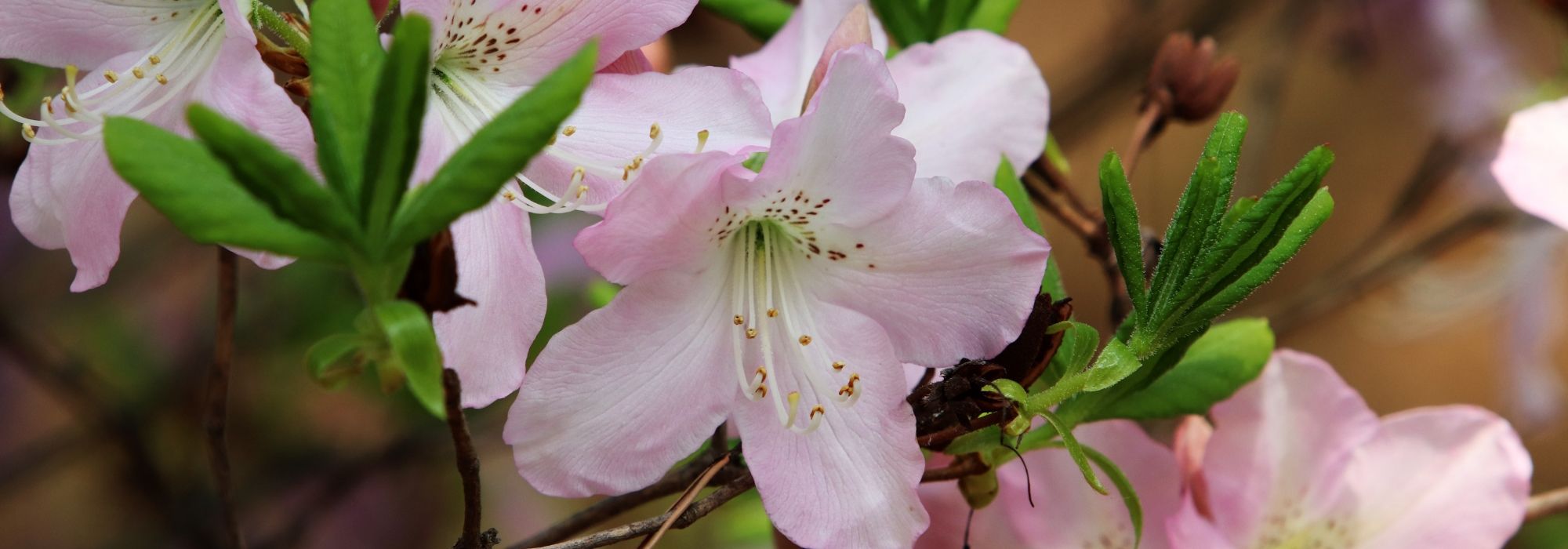
Azalea japonica Luzi in pictures
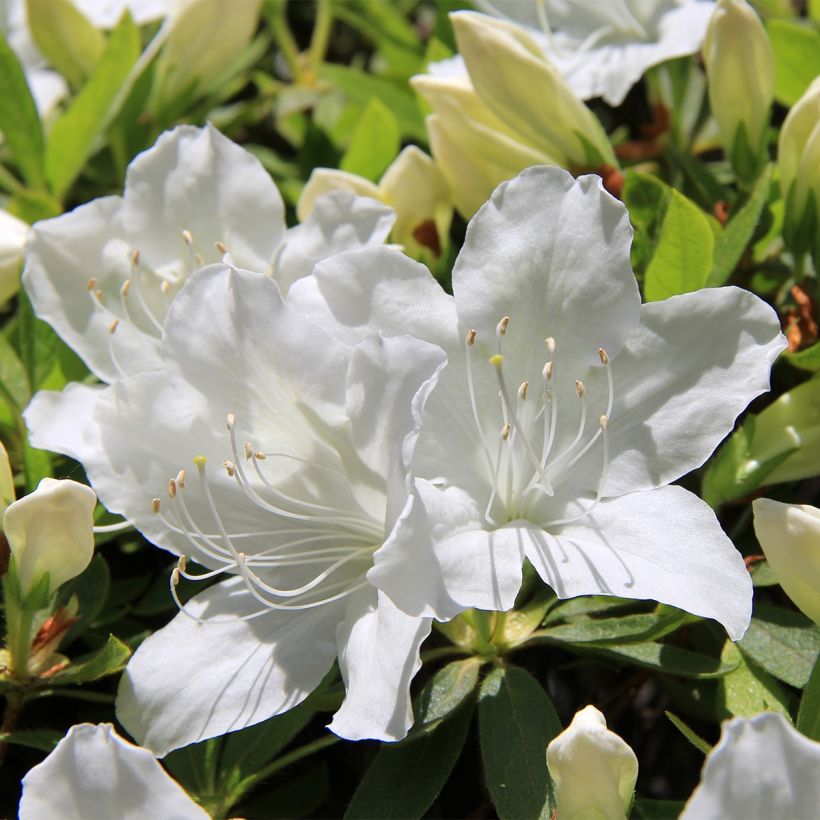

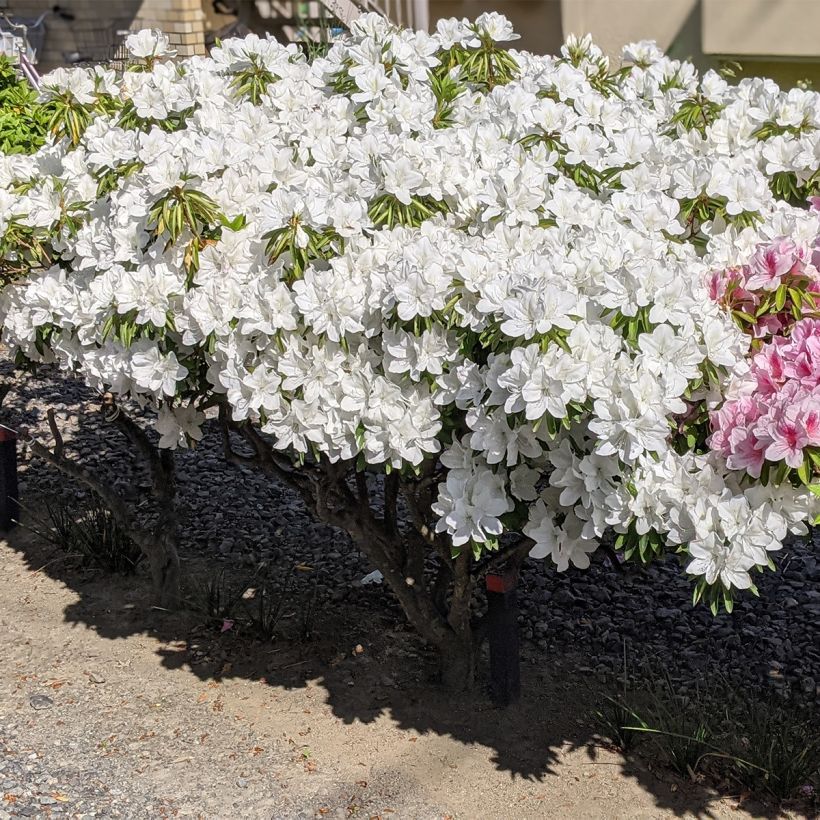
Plant habit
Flowering
Foliage
Planting and care
Plant the Rhododendron 'Luzi' in a moderately sunny to semi-shady location, protected from cold, drying winds, in moist, humus-rich, light, acidic soil. Like all ericaceous, it does not tolerate chalky or heavy soils that are waterlogged in winter. Dig a hole three times larger than the pot. Soak the root ball in alkaline-free water and plant it level with the surface of the soil, in a mixture composed of 1/4 coir, leaf mould, horticultural grit or perlite, and loam. Water generously and keep the soil moist in summer.
Azaleas and Rhododendrons have a shallow root system. As a result, they are sensitive to long periods of drought. That is why a soil enriched with humus and generous watering during dry periods is recommended. In addition, this root system is not very strong, so it is essential to lighten heavy soils with free-draining materials (horticultural grit, clay pellets) when planting. Apply a mulch of shredded pine bark around the base of the shrub every spring to keep the soil moist while maintaining an acidic pH. Maintenance involves removing faded flowers in summer and clearing out dead branches. Azaleas and Rhododendrons can sometimes be attacked by weevils that eat the edges of leaves and rootlets, as well as the famous "Rhododendron lacebug", not often causing significant damage. Yellowing of the leaves (chlorosis) in rhododendrons indicates poor uptake of iron from the soil and can lead to the premature death of the plant. While chalk is often the cause, poorly drained soil or root balls planted too deeply can also explain the phenomenon.
Planting period
Intended location
Care
Planting & care advice
-

-

-

-

-

-

-

-

This item has not been reviewed yet - be the first to leave a review about it.
Recently viewed products
Haven't found what you were looking for?
Hardiness is the lowest winter temperature a plant can endure without suffering serious damage or even dying. However, hardiness is affected by location (a sheltered area, such as a patio), protection (winter cover) and soil type (hardiness is improved by well-drained soil).

In temperate climates, pruning of spring-flowering shrubs (forsythia, spireas, etc.) should be done just after flowering.
Pruning of summer-flowering shrubs (Indian Lilac, Perovskia, etc.) can be done in winter or spring.
In cold regions as well as with frost-sensitive plants, avoid pruning too early when severe frosts may still occur.
The harvesting period indicated on our website applies to countries and regions in USDA zone 8 (France, England, Ireland, the Netherlands).
In colder areas (Scandinavia, Poland, Austria...) fruit and vegetable harvests are likely to be delayed by 3-4 weeks.
In warmer areas (Italy, Spain, Greece, etc.), harvesting will probably take place earlier, depending on weather conditions.
The sowing periods indicated on our website apply to countries and regions within USDA Zone 8 (France, UK, Ireland, Netherlands).
In colder areas (Scandinavia, Poland, Austria...), delay any outdoor sowing by 3-4 weeks, or sow under glass.
In warmer climes (Italy, Spain, Greece, etc.), bring outdoor sowing forward by a few weeks.
The planting period indicated on our website applies to regions in USDA Zone 9a (East Coast and Midlands: Dublin, Wexford, Waterford, Kilkenny, Portlaoise). It will vary depending on where you live:
- On the west coast and in the north-west (Galway, Limerick, Sligo, Donegal, Westport), delay planting by 1 to 2 weeks in spring and bring it forward by 1 to 2 weeks in autumn compared to the dates given, preferably choosing periods without strong winds.
- In the inland hills and plateaus (Wicklow Mountains, Macgillycuddy’s Reeks, Connemara, Killarney), it is best to plant in spring (April–May) or autumn (September–October), avoiding periods of waterlogged soil in winter and strong winds, which pose the main risk to newly planted trees in these areas.
The flowering period indicated on our website applies to regions in USDA Zone 9a, such as the East Coast and Midlands, including Dublin, Wexford, Waterford, Kilkenny and Portlaoise.
This will vary depending on where you live:
- On the west coast and in the northwest (Galway, Limerick, Sligo, Donegal and Westport), it will be delayed by one to two weeks compared to the given dates, due to stronger Atlantic winds and less spring sunshine.
- In the inland hills and plateaus (the Wicklow Mountains, the Macgillycuddy's Reeks, Connemara and Killarney), flowering will be delayed by two to three weeks. Flowering mainly occurs between May and July, with the limiting factors being less frost and more of the excessive humidity, strong winds and lack of sunshine that are characteristic of these areas.
Shipping country and language
Your country of residence may be:
Your country of residence is:
For a better user experience on our website, you can select:
Your shipping country:
-
 Austria
-
 Belgium
-
 Bosnia & Herzegovina
-
 Bulgaria
-
 Croatia
-
 Cyprus
-
 Czechia
-
 Denmark
-
 Estonia
-
 Finland
-
 France
-
 Germany
-
 Greece
-
 Hungary
-
 Iceland
-
 Ireland
-
 Italy
Italy
-
 Latvia
-
 Liechtenstein
-
 Lithuania
-
 Luxembourg
-
 Malta
Malta
-
 Netherlands
-
 Poland
-
 Portugal
-
 Romania
-
 Serbia
-
 Slovakia
-
 Slovenia
-
 Spain
Spain
-
 Sweden
-
 Switzerland
Language:
-
French
-
 English
-
Spanish
-
Italian
-
German
-
Portuguese
-
Dutch
-
Finnish
My Account
Hello
My wish lists
My cart
Log in / Register
Existing customer?
This form is protected by reCAPTCHA - the Google Privacy Policy and Terms of Service apply.
New customer?
Create an account to track your orders, access our customer service and, if you wish, make the most of our upcoming offers.