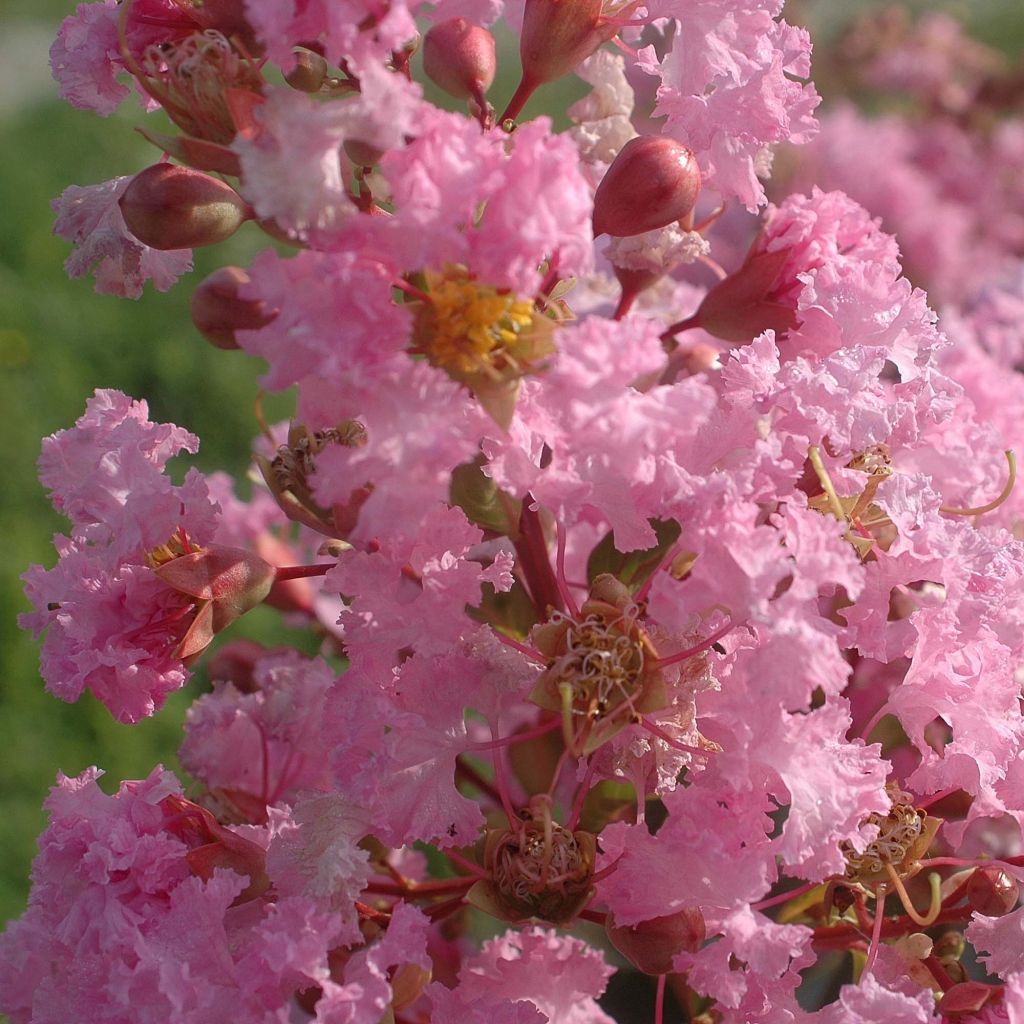
Lagerstroemia indica Tea Rose - Crape Myrtle
Lagerstroemia indica Tea Rose - Crape Myrtle
Lagerstroemia indica Rose Thé
Crape Myrtle, Crepe Myrtle, Indian Lilac
Back-to-school special offer!
Get €10 off for every €50 you spend! And get up to €40 off on a single order.
How does it work?
1. Shop your favourites
Add your favourite plants to your basket. For every €50 you spend (excluding delivery charges, store credit and the plastic-free option), you’ll receive a €10 voucher.
€50 spent = €10 voucher
€100 spent = €20 voucher
€150 spent = €30 voucher
€200 spent = €40 voucher
2. Place your order
Once your basket reaches one of the spending thresholds, place your order. You can even choose your delivery date!
3. Receive your voucher
As soon as your order has been shipped, you’ll receive an email containing your personal voucher code and its value.
4. Use it on your next order
Your voucher is valid for 90 days from the date you receive it. It can be used once only, on a new order worth at least the value of the voucher, excluding delivery charges.
Please note: Vouchers can be combined with other offers, but cannot be split or refunded.
Why not try an alternative variety in stock?
View all →
Available in 3 sizes

Available in 2 sizes
Available in 1 sizes

Available in 2 sizes

Available in 1 sizes

Available in 2 sizes
Available in 1 sizes

Available in 3 sizes

Available in 1 sizes

Available in 2 sizes
This plant carries a 24 months recovery warranty
More information
We guarantee the quality of our plants for a full growing cycle, and will replace at our expense any plant that fails to recover under normal climatic and planting conditions.
Does this plant fit my garden?
Set up your Plantfit profile →
Description
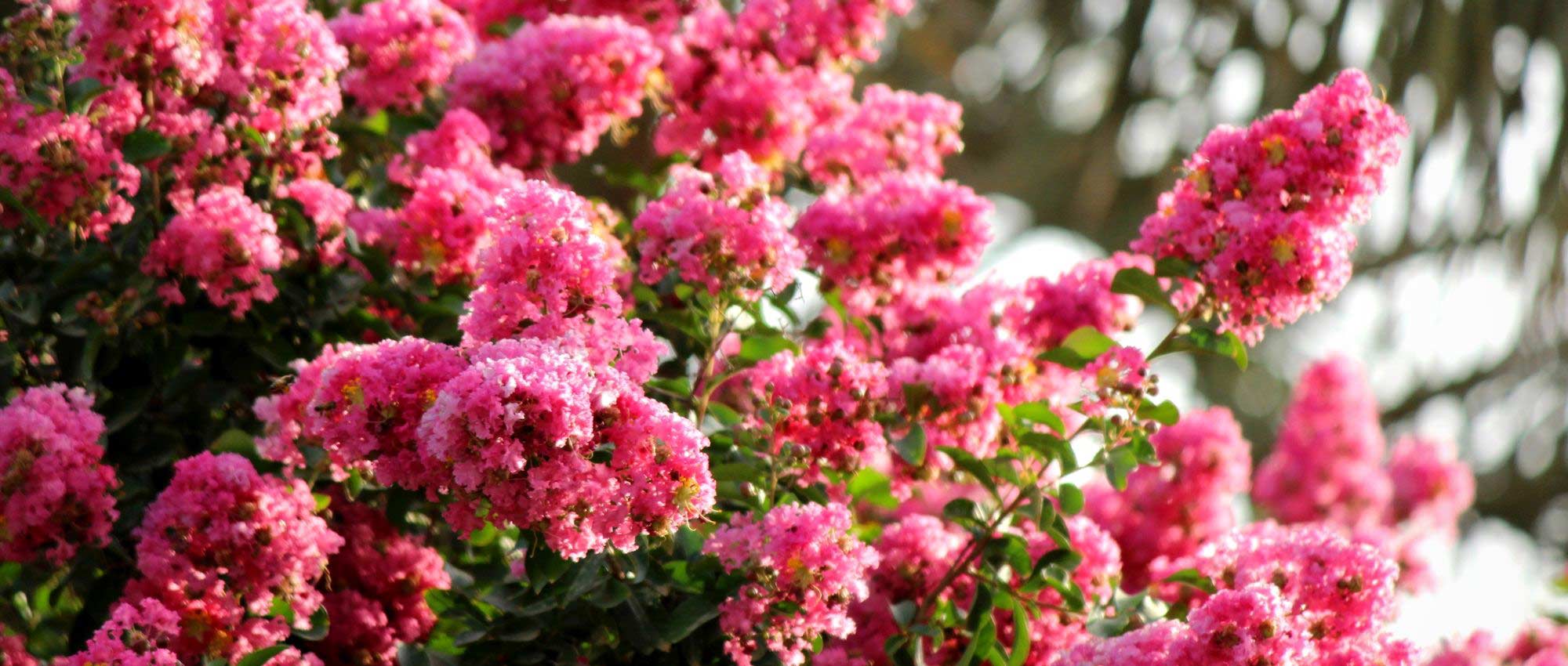
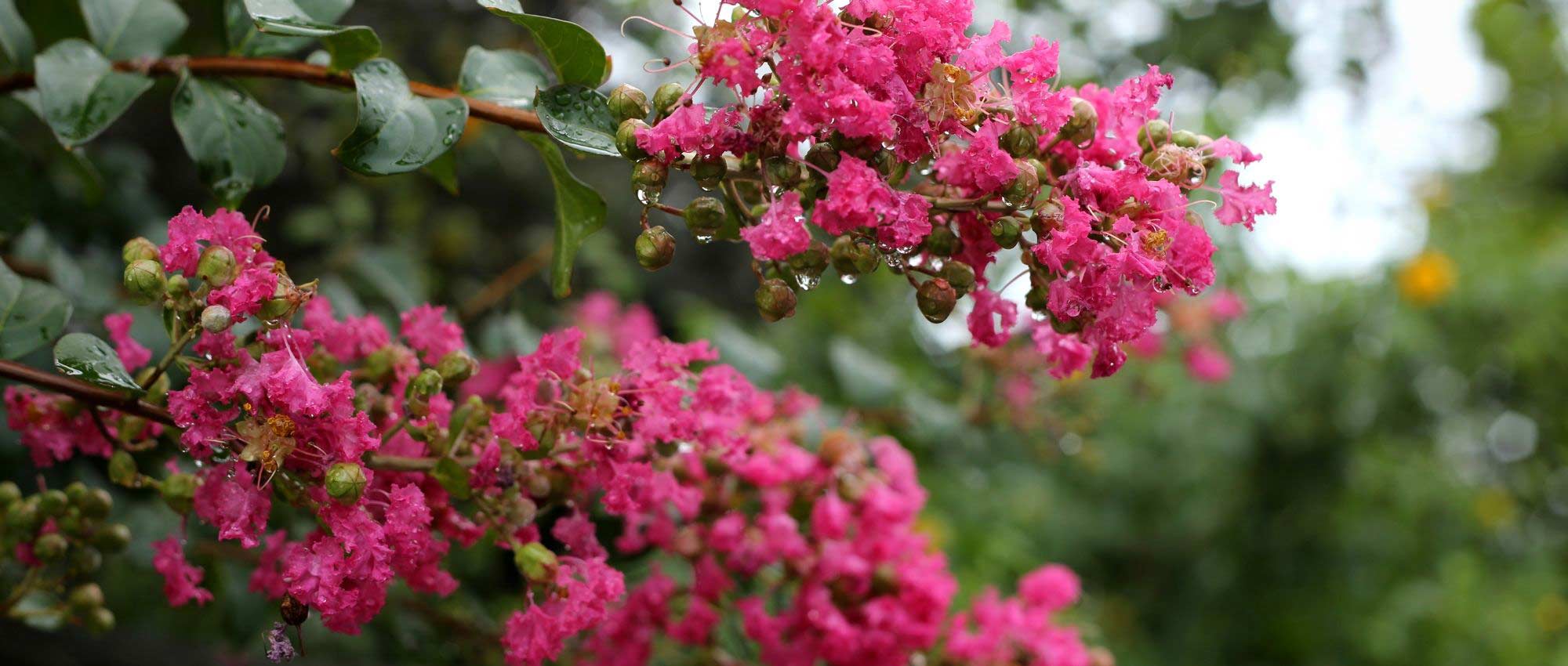
The Lagerstroemia indica ‘Tea Rose’ is a medium-sized, resilient Indian Lilac, offering early and lavish summer flowering: its flower clusters are a very delicate pastel pink, enhanced by yellow stamens. This naturally ramified bush can become a small tree if patiently and meticulously pruned. It also charms with its matte green foliage that colours in the autumn and its decorative bark. Craving sun and warmth, this variety will flourish better warmer climates. Boasting multiple attributes, Indian Lilacs are among the most beautiful bushes for summer flowering. As such, they deserve a prime spot in the garden or on the terrace.
The Lagerstroemia indica ‘Tea Rose’ is a rather old cultivar, often overlooked in favour of modern cultivars despite its beautiful presence in the garden. It is a small tree or large bush from the Lythraceae family, originating from China. It has a bushy and ramified habit, with a rounded crown. It will reach on average of 3 m (9 ft 10 in) in height at ripeness, with a span of 2 m. Its growth is quite fast. It needs warmth to flower and often chooses the beginning of July to start its flowering, which will continue until October. The flowers are characterised by thin pedicels each carrying five undulate-edged petals that make up this flower. The flowers, whose texture is reminiscent of crepe, are gathered in large, dense panicles at the ends of the year's branches. The buds of the 'Tea Rose' are pink, and then they bloom into a bright and soft pale pink. The deciduous foliage, leathery, is born red, then becomes shiny green. It is made up of small ovate leaves, which often take on pretty yellow, orange or red hues in the autumn, before falling. Lastly, and to end on a beautiful note, its bark is magnificent on old specimens: smooth, beige, striated with reddish-brown, it peels off in beautifully coloured plates (cinnamon, faded red, old pink, cream).
Indian Lilacs bring glory to the gardens of the South West, and prefer humid and warm climates. It is in isolation, near the house, that you can fully enjoy this plant's generosity. It will look good in a bush bed, a flowering hedge, or emerging from a mound of perennials. Compose a bed like a bouquet, with Artemisia Powis Castle, Campanula pyramidalis, Salvia sclarea, Aster laevis. In the autumn, it accompanies the aster, which is as colourful as itself. In a large pot on the terrace, it steals the show when the summer flowerings fade. We have simply imagined a tricolour plant tapestry as a ground cover to highlight the Summer Lilac 'Tea Rose’. A cradle of Swany roses and Valerie Finnis wormwood, punctuated with small tufts of lavender and red carnations will dress the base of its trunk, underline its bark and accompany its sparkling flowering.
The Indian Lilac also bears many other evocative and charming names: muslin flower, crepe myrtle, lagerose, Chinese crepe myrtle, crepe paper flower.
NB: Karl Von Linne named this tree to honour his friend Magnus Von Lagerstroem (1696 – 1759), who had sent it to him from India for identification. Originally, this tree was used to decorate Chinese temples. We would like to point out that this tree produces fruits that have a narcotic action if ingested.
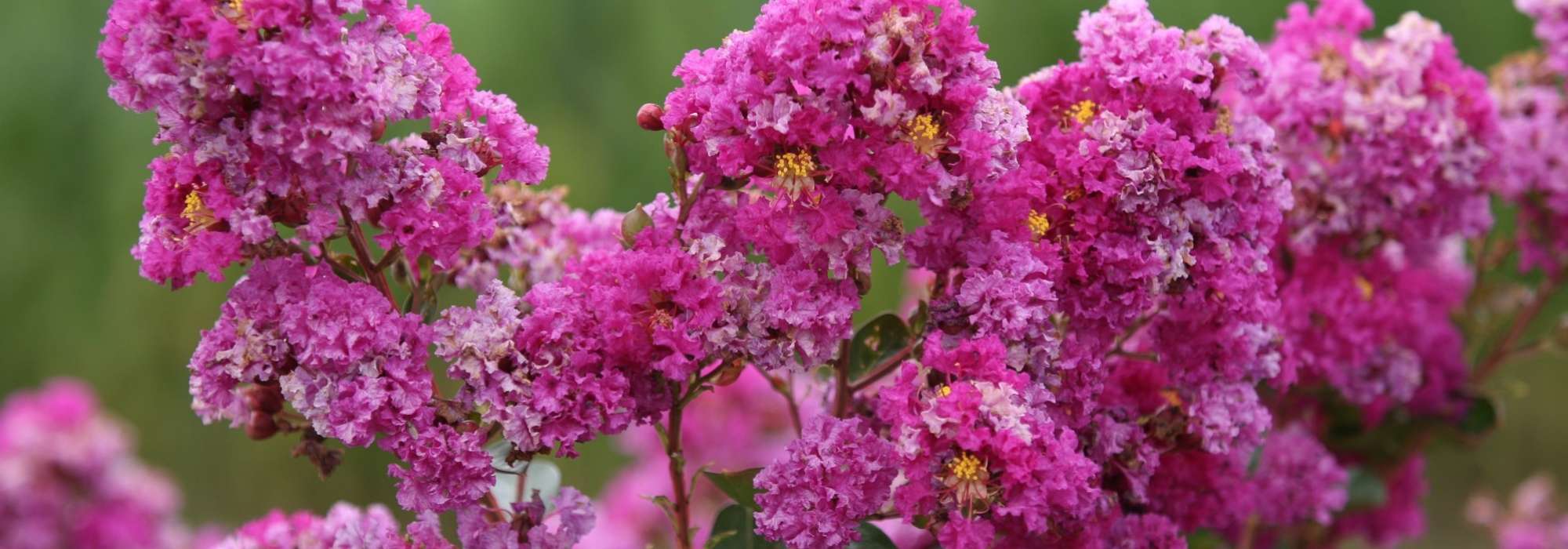
Lagerstroemia indica Tea Rose - Crape Myrtle in pictures
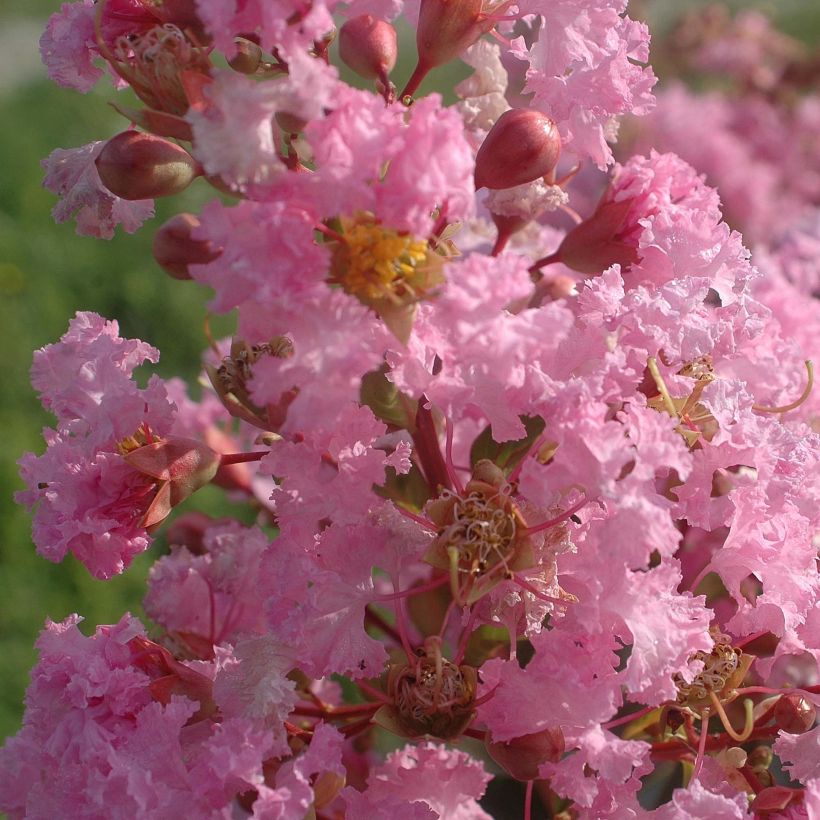
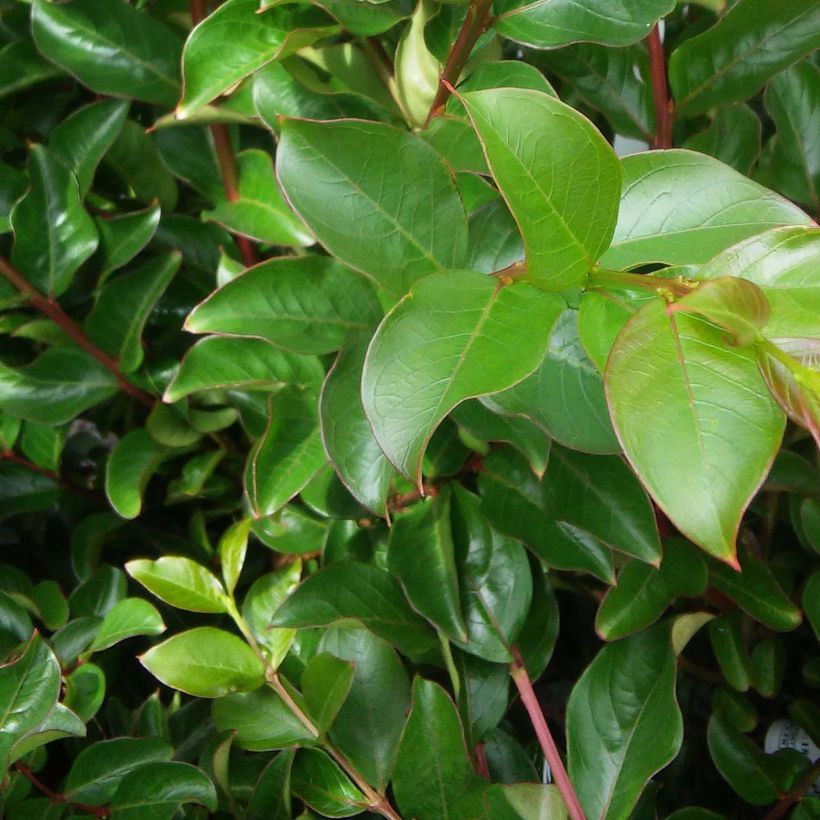
Plant habit
Flowering
Foliage
Planting and care
We advise you to plant the Lagerstroemia indica 'Rose Tea' in the spring, when frosts are no longer to be feared, in a very sunny and sheltered, warm position, in a rich, fresh, well-drained soil, and if possible non-limestone (or at least without excess of limestone). It will appreciate a compost input and a thick layer of dead leaves, especially during the first two winters in colder regions. It is necessary to prune the floriferous branches very short in February-March, leaving only 4 to 6 buds to balance its branches and stimulate the growth of future flower-bearing branches. If necessary, remove the weak twigs and poorly positioned branches. In a hot and dry situation, it is not uncommon for the Lagerstroemia to be sensitive to powdery mildew; water regularly in hot and dry climates. Propagation is done by using cuttings of young stems or roots, the latter succeeding remarkably.
Planting period
Intended location
Care
Planting & care advice
-
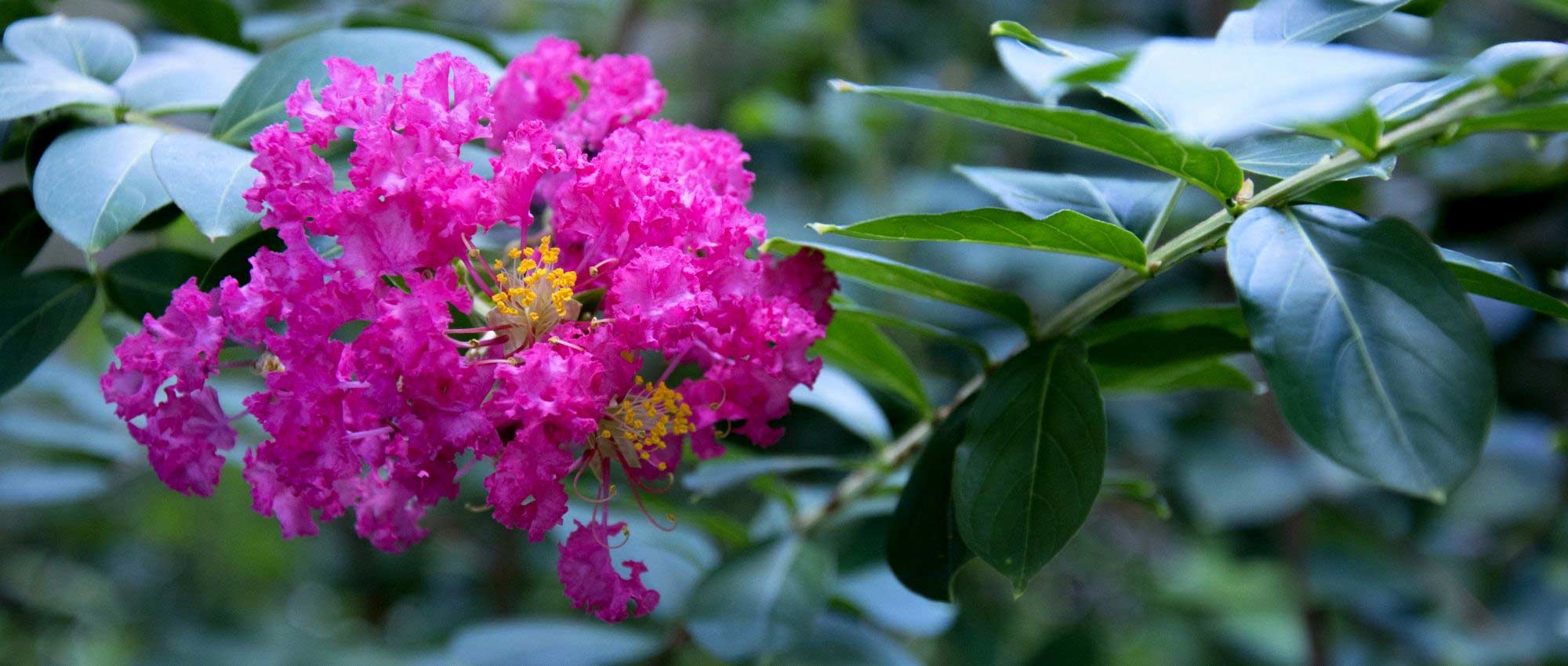
-
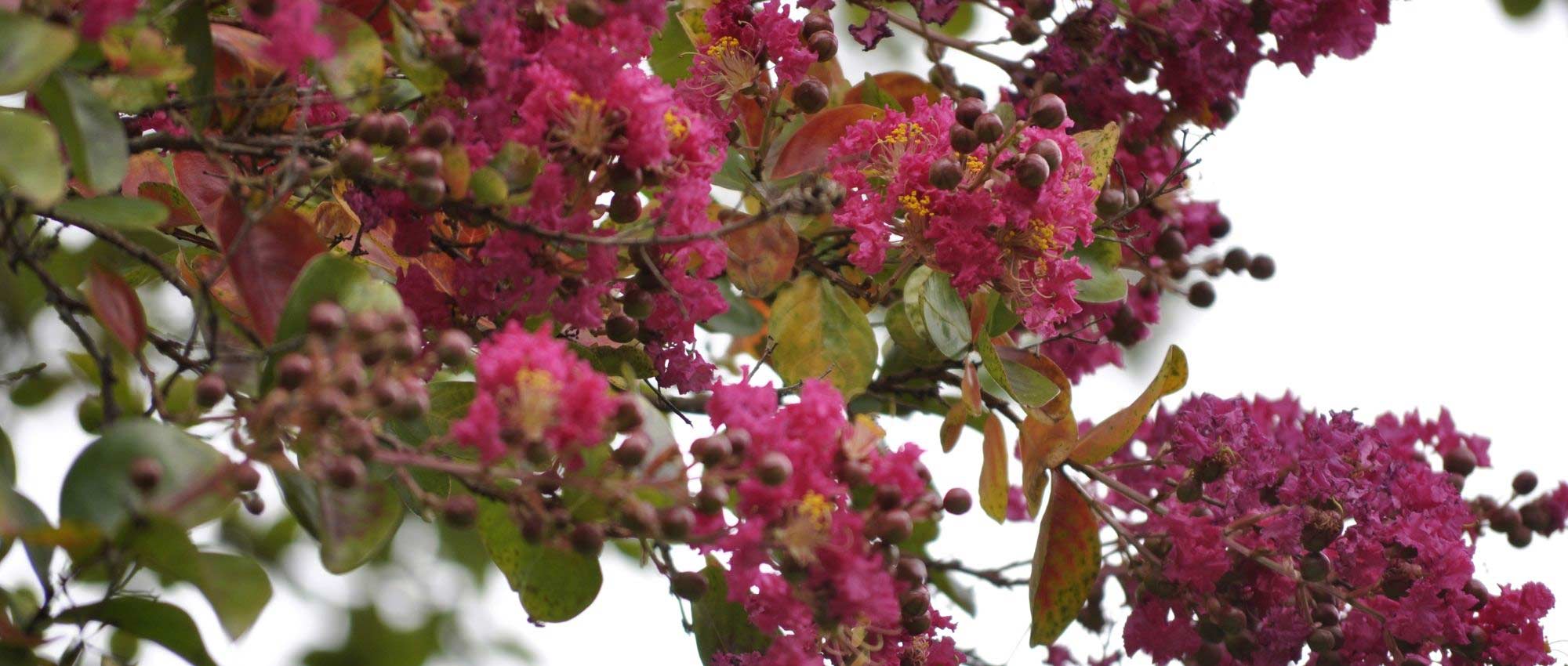
-
-
-

-
-

-

This item has not been reviewed yet - be the first to leave a review about it.
Recently viewed products
Haven't found what you were looking for?
Hardiness is the lowest winter temperature a plant can endure without suffering serious damage or even dying. However, hardiness is affected by location (a sheltered area, such as a patio), protection (winter cover) and soil type (hardiness is improved by well-drained soil).
In temperate climates, pruning of spring-flowering shrubs (forsythia, spireas, etc.) should be done just after flowering.
Pruning of summer-flowering shrubs (Indian Lilac, Perovskia, etc.) can be done in winter or spring.
In cold regions as well as with frost-sensitive plants, avoid pruning too early when severe frosts may still occur.
The harvesting period indicated on our website applies to countries and regions in USDA zone 8 (France, England, Ireland, the Netherlands).
In colder areas (Scandinavia, Poland, Austria...) fruit and vegetable harvests are likely to be delayed by 3-4 weeks.
In warmer areas (Italy, Spain, Greece, etc.), harvesting will probably take place earlier, depending on weather conditions.
The sowing periods indicated on our website apply to countries and regions within USDA Zone 8 (France, UK, Ireland, Netherlands).
In colder areas (Scandinavia, Poland, Austria...), delay any outdoor sowing by 3-4 weeks, or sow under glass.
In warmer climes (Italy, Spain, Greece, etc.), bring outdoor sowing forward by a few weeks.
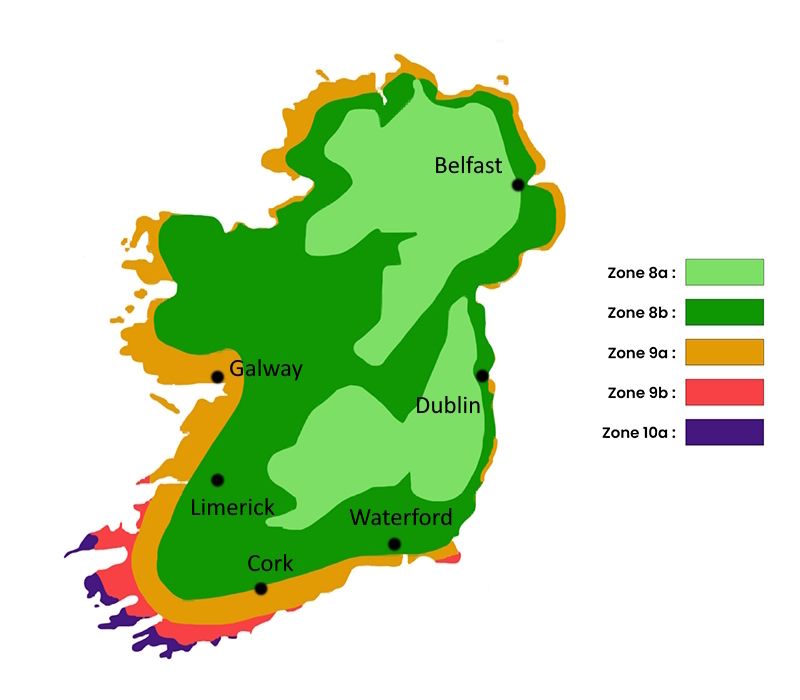
The planting period indicated on our website applies to regions in USDA Zone 9a (East Coast and Midlands: Dublin, Wexford, Waterford, Kilkenny, Portlaoise). It will vary depending on where you live:
- On the west coast and in the north-west (Galway, Limerick, Sligo, Donegal, Westport), delay planting by 1 to 2 weeks in spring and bring it forward by 1 to 2 weeks in autumn compared to the dates given, preferably choosing periods without strong winds.
- In the inland hills and plateaus (Wicklow Mountains, Macgillycuddy’s Reeks, Connemara, Killarney), it is best to plant in spring (April–May) or autumn (September–October), avoiding periods of waterlogged soil in winter and strong winds, which pose the main risk to newly planted trees in these areas.
The flowering period indicated on our website applies to regions in USDA Zone 9a, such as the East Coast and Midlands, including Dublin, Wexford, Waterford, Kilkenny and Portlaoise.
This will vary depending on where you live:
- On the west coast and in the northwest (Galway, Limerick, Sligo, Donegal and Westport), it will be delayed by one to two weeks compared to the given dates, due to stronger Atlantic winds and less spring sunshine.
- In the inland hills and plateaus (the Wicklow Mountains, the Macgillycuddy's Reeks, Connemara and Killarney), flowering will be delayed by two to three weeks. Flowering mainly occurs between May and July, with the limiting factors being less frost and more of the excessive humidity, strong winds and lack of sunshine that are characteristic of these areas.
Shipping country and language
Your country of residence may be:
Your country of residence is:
For a better user experience on our website, you can select:
Your shipping country:
-
 Austria
-
 Belgium
-
 Bosnia & Herzegovina
-
 Bulgaria
-
 Croatia
-
 Cyprus
-
 Czechia
-
 Denmark
-
 Estonia
-
 Finland
-
 France
-
 Germany
-
 Greece
-
 Hungary
-
 Iceland
-
 Ireland
-
 Italy
Italy
-
 Latvia
-
 Liechtenstein
-
 Lithuania
-
 Luxembourg
-
 Malta
Malta
-
 Netherlands
-
 Poland
-
 Portugal
-
 Romania
-
 Serbia
-
 Slovakia
-
 Slovenia
-
 Spain
Spain
-
 Sweden
-
 Switzerland
Language:
-
French
-
 English
-
Spanish
-
Italian
-
German
-
Portuguese
-
Dutch
-
Finnish
My Account
Hello
My wish lists
My cart
Log in / Register
Existing customer?
This form is protected by reCAPTCHA - the Google Privacy Policy and Terms of Service apply.
New customer?
Create an account to track your orders, access our customer service and, if you wish, make the most of our upcoming offers.