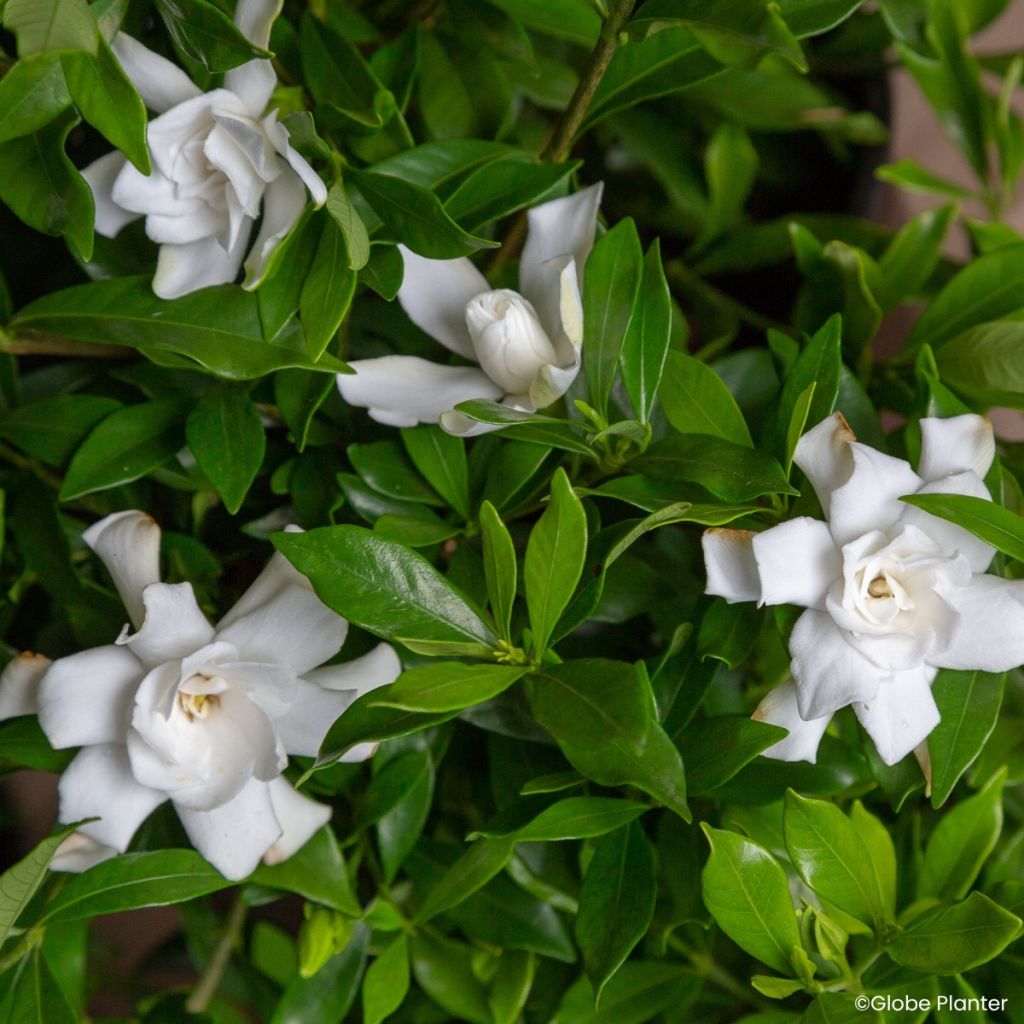
Gardenia jasminoides Fool Proof®
Gardenia jasminoides Fool Proof®
Gardenia x jasminoides 'Leesix' Fool Proof®
Cape Jasmine, Common Gardenia
Back-to-school special offer!
Get €10 off for every €50 you spend! And get up to €40 off on a single order.
How does it work?
1. Shop your favourites
Add your favourite plants to your basket. For every €50 you spend (excluding delivery charges, store credit and the plastic-free option), you’ll receive a €10 voucher.
€50 spent = €10 voucher
€100 spent = €20 voucher
€150 spent = €30 voucher
€200 spent = €40 voucher
2. Place your order
Once your basket reaches one of the spending thresholds, place your order. You can even choose your delivery date!
3. Receive your voucher
As soon as your order has been shipped, you’ll receive an email containing your personal voucher code and its value.
4. Use it on your next order
Your voucher is valid for 90 days from the date you receive it. It can be used once only, on a new order worth at least the value of the voucher, excluding delivery charges.
Please note: Vouchers can be combined with other offers, but cannot be split or refunded.
Why not try an alternative variety in stock?
View all →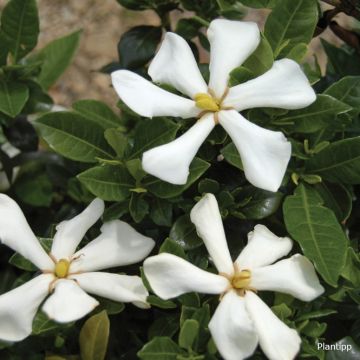
Available in 1 sizes

Available in 1 sizes
Available in 1 sizes
Available in 1 sizes

Available in 1 sizes
This plant carries a 24 months recovery warranty
More information
We guarantee the quality of our plants for a full growing cycle, and will replace at our expense any plant that fails to recover under normal climatic and planting conditions.
Does this plant fit my garden?
Set up your Plantfit profile →
Description
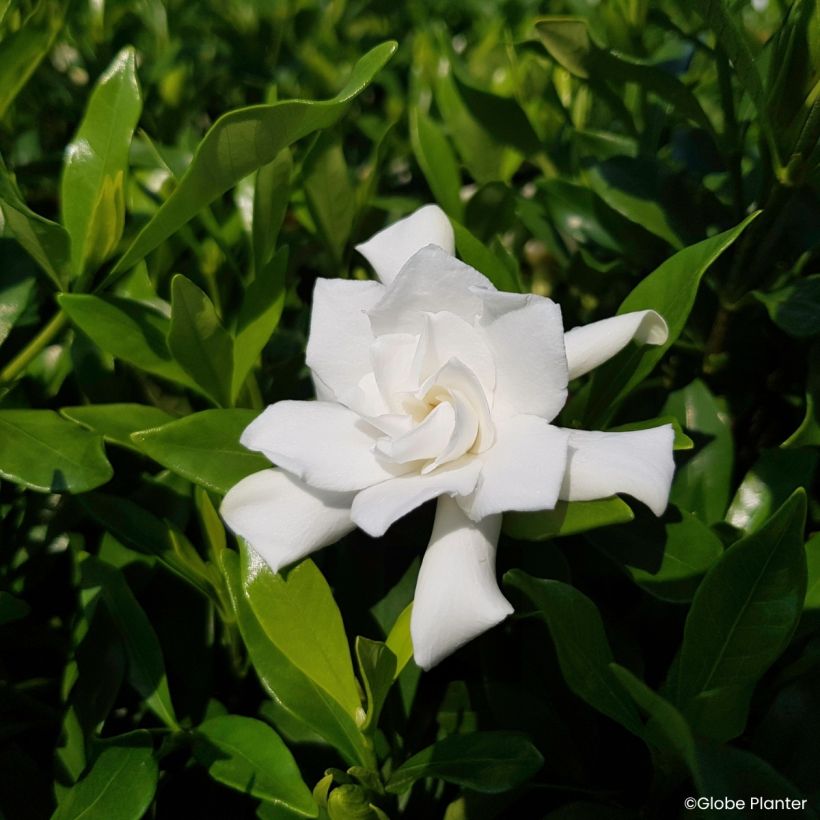
Gardenia jasminoides 'Leesix' Fool Proof® is a recent American variety of Cape Jasmine, selected for its generous flowering, which often repeats in autumn. Its beautiful, satiny dark green foliage forms a superb setting for the pure white flowers in spring and summer. The flowers, whose superb shape recalls certain roses, exude a powerful fragrance close to that of jasmine. Its limited growth (maximum 1.20 m in height) allows it to find a place even in the most compact gardens. And if the climate is too cold, or the soil is lime-bearing, preventing its planting in the garden, it will easily adapt to container cultivation and thus spend the winter under cover, with orangery plants.
Gardenia belongs to the vast Rubiaceae family, which includes about 600 genera and more than 10,000 species distributed worldwide, rarely in cold regions (only six genera in Europe, including Sweet Woodruff) and mostly in tropical zones (notably the Coffee plant). The Gardenia genus itself comprises several dozen species found mainly in tropical and subtropical zones. Among them, Gardenia jasminoides, nicknamed Cape Jasmine, is actually native to China and southern Japan. In its natural environment, it grows as a shrub or small tree that can reach 5 metres in height. It is distinguished by its evergreen foliage and its large flowers, 6 to 10cm in diameter, usually solitary, sometimes grouped in threes, at the ends of the twigs.
Fool Proof is a recent cultivar, introduced to the market in 2020 by the American breeder Robert Edward Lee. At maturity, it forms a compact shrub 1m to 1.20m in height, with a spread of 0.70 to 1m, after relatively slow growth. The numerous thin twigs are clothed in narrow, lanceolate leaves, most often measuring 4 to 8cm long. They are very elegant with a satiny to shiny surface, of a beautiful, true green, darker or lighter depending on the soil and exposure. They are evergreen and decorative all year round. Around May-June, magnificent flowers appear and bloom until July. The August heat marks a pause, then flowering resumes in September, even October. The flowers, which measure 6 to 8 cm in diameter, are double, with one row of petals forming a central cup, surrounded by narrower, spreading petals that open in a star shape. These distinguished flowers are among the most fragrant in the vegetable kingdom, spreading a strong jasmine scent around. This can even become overpowering in summer, so it is not advisable to plant the shrub in front of a bedroom window if you sleep with the windows open in summer.
Cape Jasmine Fool Proof is distinguished by appreciable hardiness: it can occasionally endure temperatures of -7°C to –12 °C when planted in good conditions. However, it is advisable to cover it with a fleece during repeated frosts to preserve its foliage. Furthermore, container cultivation is entirely feasible in regions that are too cold. This Gardenia jasminoides can even be grown indoors, in a bright space without direct sun, with a temperature between 18 and 24 °C and high ambient humidity, ideally above 60%. In western or southern regions (under protective shade), it will add an exotic touch to a border. Plant it for this purpose with other characterful plants, such as Indigofera heterantha, with its purplish flowering in summer, or Caesalpinia gilliesii, nicknamed the Bird of Paradise Bush for its evocative flowers, which will shelter it from overly harsh sun rays.

Gardenia jasminoides Fool Proof® in pictures
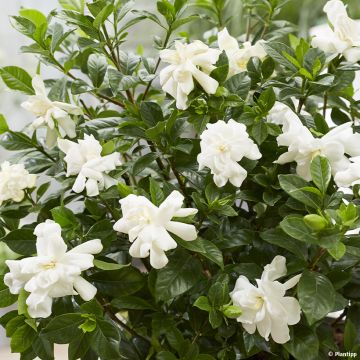
Plant habit
Flowering
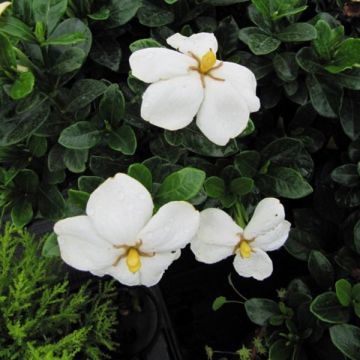
Foliage
Botanical data
Gardenia
x jasminoides
'Leesix' Fool Proof®
Rubiaceae
Cape Jasmine, Common Gardenia
Gardenia jasminoides Fool Proof®
Cultivar or hybrid
Planting and care
Plant Gardenia jasminoides Fool Proof® in a partially shaded bed, in neutral to acidic soil (it suffers from chlorosis in lime-bearing soil), rich in humus, moist and well-drained. The choice of exposure is important, as Gardenia enjoys warmth (but not drought), and the harsh rays of the sun can scorch its foliage. It will tolerate morning sun, but will appreciate dappled shade in the afternoon. Dig a hole 50 cm in all directions, and add slightly acidic planting compost (pH 6) to the existing soil. Soak the root ball in a bucket for 10 minutes, then place it in the hole, backfill around it and water thoroughly. During the growing season, and particularly in summer, ensure the soil does not dry out. Conversely, space out watering in autumn and cease when temperatures drop significantly. This shrub has roughly the same requirements as camellias.
In a climate that is truly too cold to grow it outdoors, its compact habit allows it to be easily grown in a container to be brought under cover in winter.
Planting period
Intended location
Care
Planting & care advice
-

-

-
-
-

-
-
-

This item has not been reviewed yet - be the first to leave a review about it.
Recently viewed products
Haven't found what you were looking for?
Hardiness is the lowest winter temperature a plant can endure without suffering serious damage or even dying. However, hardiness is affected by location (a sheltered area, such as a patio), protection (winter cover) and soil type (hardiness is improved by well-drained soil).
In temperate climates, pruning of spring-flowering shrubs (forsythia, spireas, etc.) should be done just after flowering.
Pruning of summer-flowering shrubs (Indian Lilac, Perovskia, etc.) can be done in winter or spring.
In cold regions as well as with frost-sensitive plants, avoid pruning too early when severe frosts may still occur.
The harvesting period indicated on our website applies to countries and regions in USDA zone 8 (France, England, Ireland, the Netherlands).
In colder areas (Scandinavia, Poland, Austria...) fruit and vegetable harvests are likely to be delayed by 3-4 weeks.
In warmer areas (Italy, Spain, Greece, etc.), harvesting will probably take place earlier, depending on weather conditions.
The sowing periods indicated on our website apply to countries and regions within USDA Zone 8 (France, UK, Ireland, Netherlands).
In colder areas (Scandinavia, Poland, Austria...), delay any outdoor sowing by 3-4 weeks, or sow under glass.
In warmer climes (Italy, Spain, Greece, etc.), bring outdoor sowing forward by a few weeks.
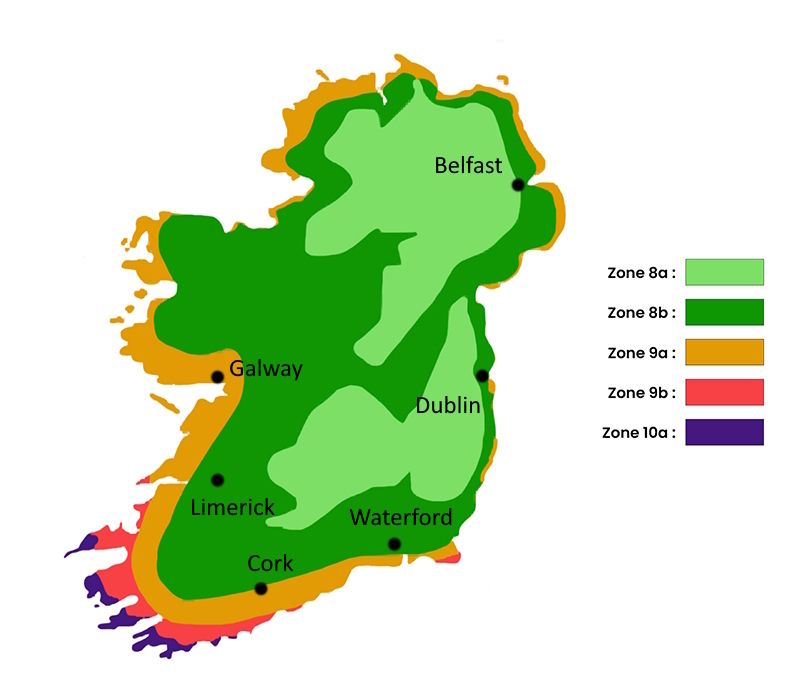
The planting period indicated on our website applies to regions in USDA Zone 9a (East Coast and Midlands: Dublin, Wexford, Waterford, Kilkenny, Portlaoise). It will vary depending on where you live:
- On the west coast and in the north-west (Galway, Limerick, Sligo, Donegal, Westport), delay planting by 1 to 2 weeks in spring and bring it forward by 1 to 2 weeks in autumn compared to the dates given, preferably choosing periods without strong winds.
- In the inland hills and plateaus (Wicklow Mountains, Macgillycuddy’s Reeks, Connemara, Killarney), it is best to plant in spring (April–May) or autumn (September–October), avoiding periods of waterlogged soil in winter and strong winds, which pose the main risk to newly planted trees in these areas.
The flowering period indicated on our website applies to regions in USDA Zone 9a, such as the East Coast and Midlands, including Dublin, Wexford, Waterford, Kilkenny and Portlaoise.
This will vary depending on where you live:
- On the west coast and in the northwest (Galway, Limerick, Sligo, Donegal and Westport), it will be delayed by one to two weeks compared to the given dates, due to stronger Atlantic winds and less spring sunshine.
- In the inland hills and plateaus (the Wicklow Mountains, the Macgillycuddy's Reeks, Connemara and Killarney), flowering will be delayed by two to three weeks. Flowering mainly occurs between May and July, with the limiting factors being less frost and more of the excessive humidity, strong winds and lack of sunshine that are characteristic of these areas.
Shipping country and language
Your country of residence may be:
Your country of residence is:
For a better user experience on our website, you can select:
Your shipping country:
-
 Austria
-
 Belgium
-
 Bosnia & Herzegovina
-
 Bulgaria
-
 Croatia
-
 Cyprus
-
 Czechia
-
 Denmark
-
 Estonia
-
 Finland
-
 France
-
 Germany
-
 Greece
-
 Hungary
-
 Iceland
-
 Ireland
-
 Italy
Italy
-
 Latvia
-
 Liechtenstein
-
 Lithuania
-
 Luxembourg
-
 Malta
Malta
-
 Netherlands
-
 Poland
-
 Portugal
-
 Romania
-
 Serbia
-
 Slovakia
-
 Slovenia
-
 Spain
Spain
-
 Sweden
-
 Switzerland
Language:
-
French
-
 English
-
Spanish
-
Italian
-
German
-
Portuguese
-
Dutch
-
Finnish
My Account
Hello
My wish lists
My cart
Log in / Register
Existing customer?
This form is protected by reCAPTCHA - the Google Privacy Policy and Terms of Service apply.
New customer?
Create an account to track your orders, access our customer service and, if you wish, make the most of our upcoming offers.