Spathodea campanulata - African tulip tree
Spathodea campanulata - African tulip tree
Spathodea campanulata - African tulip tree
Spathodea campanulata - African tulip tree
Spathodea campanulata - African tulip tree
Spathodea campanulata - African tulip tree
Spathodea campanulata - African tulip tree
Spathodea campanulata - African tulip tree
Spathodea campanulata - African tulip tree
Spathodea campanulata
African tulip tree, Nandi flame, flame tree, fountain tree
Back-to-school special offer!
Get €10 off for every €50 you spend! And get up to €40 off on a single order.
How does it work?
1. Shop your favourites
Add your favourite plants to your basket. For every €50 you spend (excluding delivery charges, store credit and the plastic-free option), you’ll receive a €10 voucher.
€50 spent = €10 voucher
€100 spent = €20 voucher
€150 spent = €30 voucher
€200 spent = €40 voucher
2. Place your order
Once your basket reaches one of the spending thresholds, place your order. You can even choose your delivery date!
3. Receive your voucher
As soon as your order has been shipped, you’ll receive an email containing your personal voucher code and its value.
4. Use it on your next order
Your voucher is valid for 90 days from the date you receive it. It can be used once only, on a new order worth at least the value of the voucher, excluding delivery charges.
Please note: Vouchers can be combined with other offers, but cannot be split or refunded.
Why not try an alternative variety in stock?
View all →
Available in 1 sizes
Available in 1 sizes

Available in 1 sizes
Available in 1 sizes
Available in 1 sizes

Available in 1 sizes

Available in 2 sizes
Available in 1 sizes

Available in 2 sizes
Available in 1 sizes
This plant carries a 24 months recovery warranty
More information
We guarantee the quality of our plants for a full growing cycle, and will replace at our expense any plant that fails to recover under normal climatic and planting conditions.
Does this plant fit my garden?
Set up your Plantfit profile →
Description
Spathodea campanulata, the African Tulip Tree, is an exceptional tropical tree, prized for its flamboyant orange-red flowering reminiscent of exotic tulips. Native to tropical Africa, it boasts a majestic habit and luxuriant foliage and grows rapidly in its native lands. Highly sensitive to cold and our long winters, it is reserved for collectors and enthusiasts of rare plants who can cultivate it with dedication in a heated greenhouse or a bright conservatory. Demanding in terms of warmth, sunlight, and humidity, it requires special attention but will reward you with an unforgettable botanical spectacle.
Spathodea campanulata, commonly known as the African Tulip Tree, is a tree from the Bignoniaceae family. Native to tropical Africa, particularly Gabon, it is also referred to as Flame of the Forest. It is widely cultivated in tropical regions for its spectacular flowering. This tree thrives in humid tropical climates, preferring temperatures between 20 and 30°C and high annual rainfall. It tolerates various soil types, provided they are well-drained, but is very sensitive to frost, limiting its cultivation to frost-free zones. After being introduced to many tropical regions for ornamental purposes, the African Tulip Tree has become invasive in some areas, specifically the Caribbean, Southeast Asia, and the Pacific, where it threatens local biodiversity.
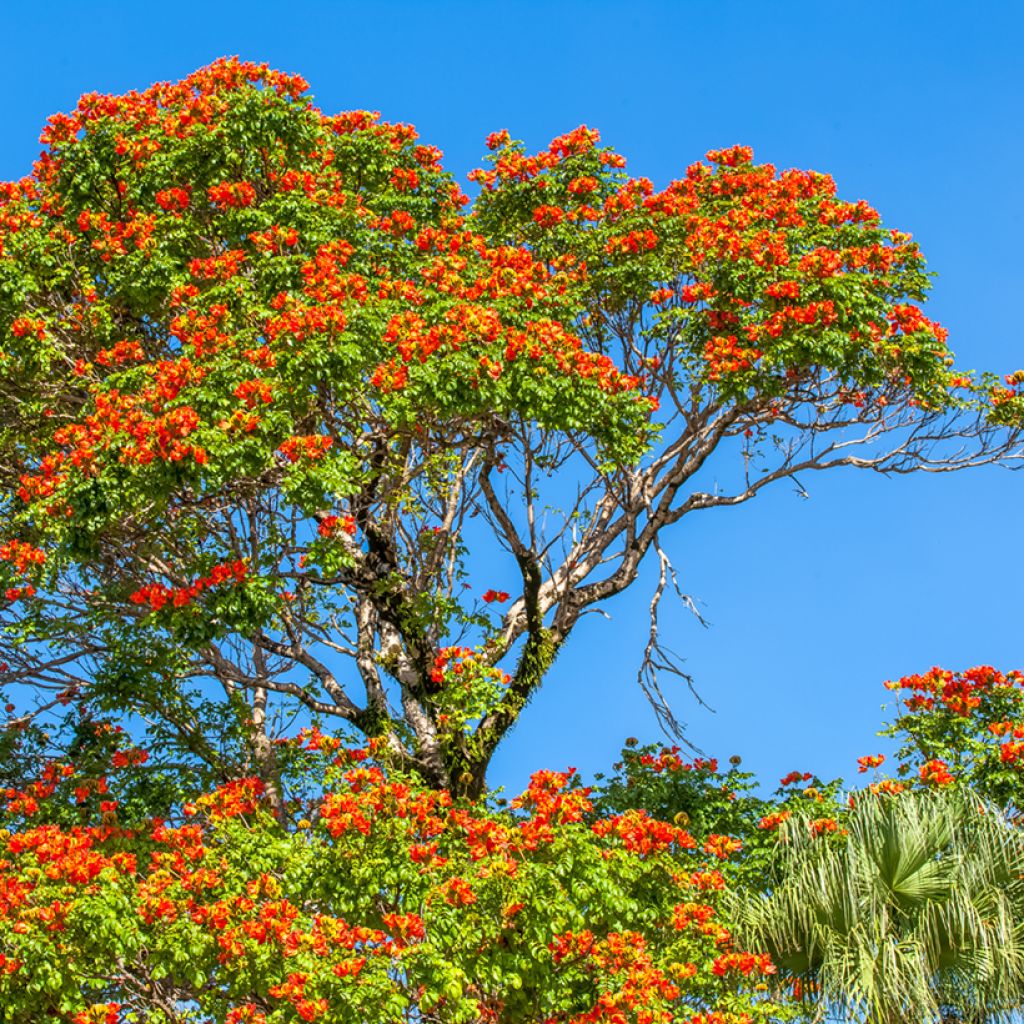
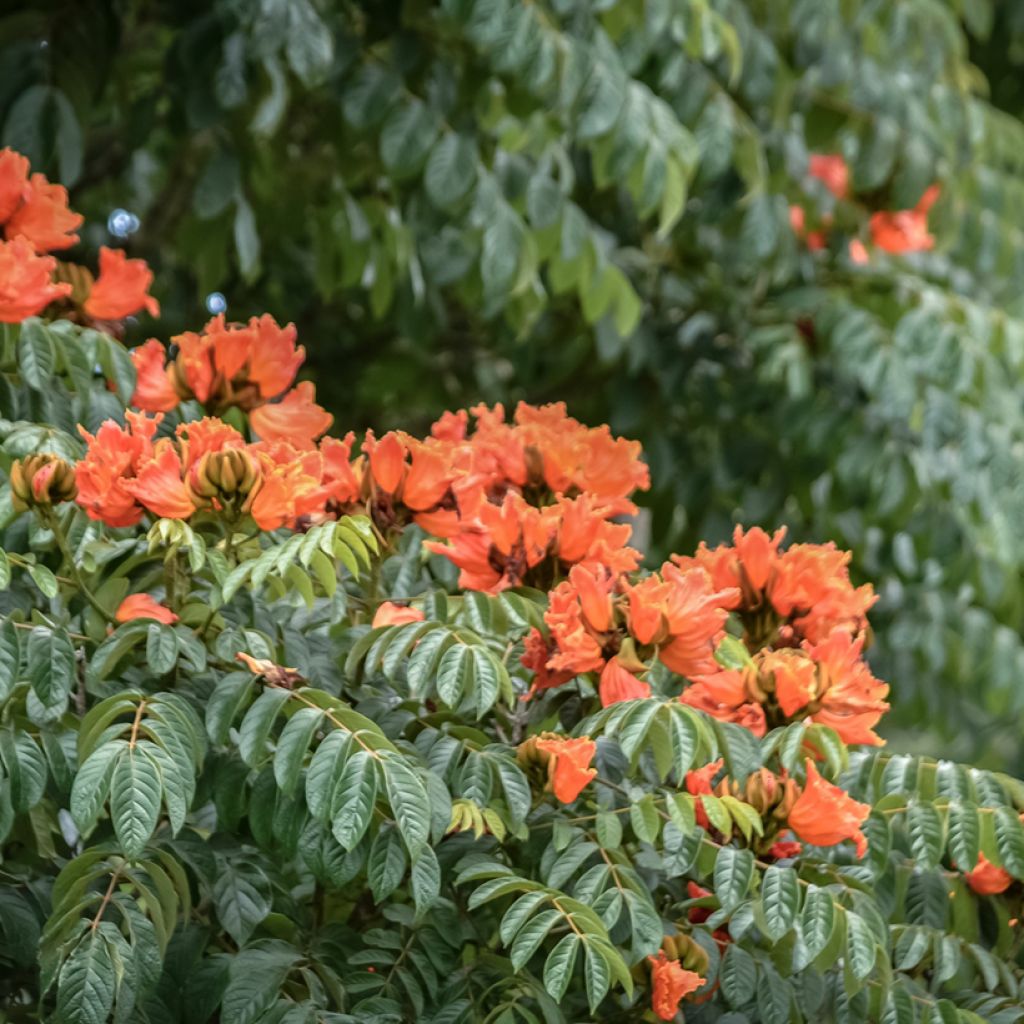
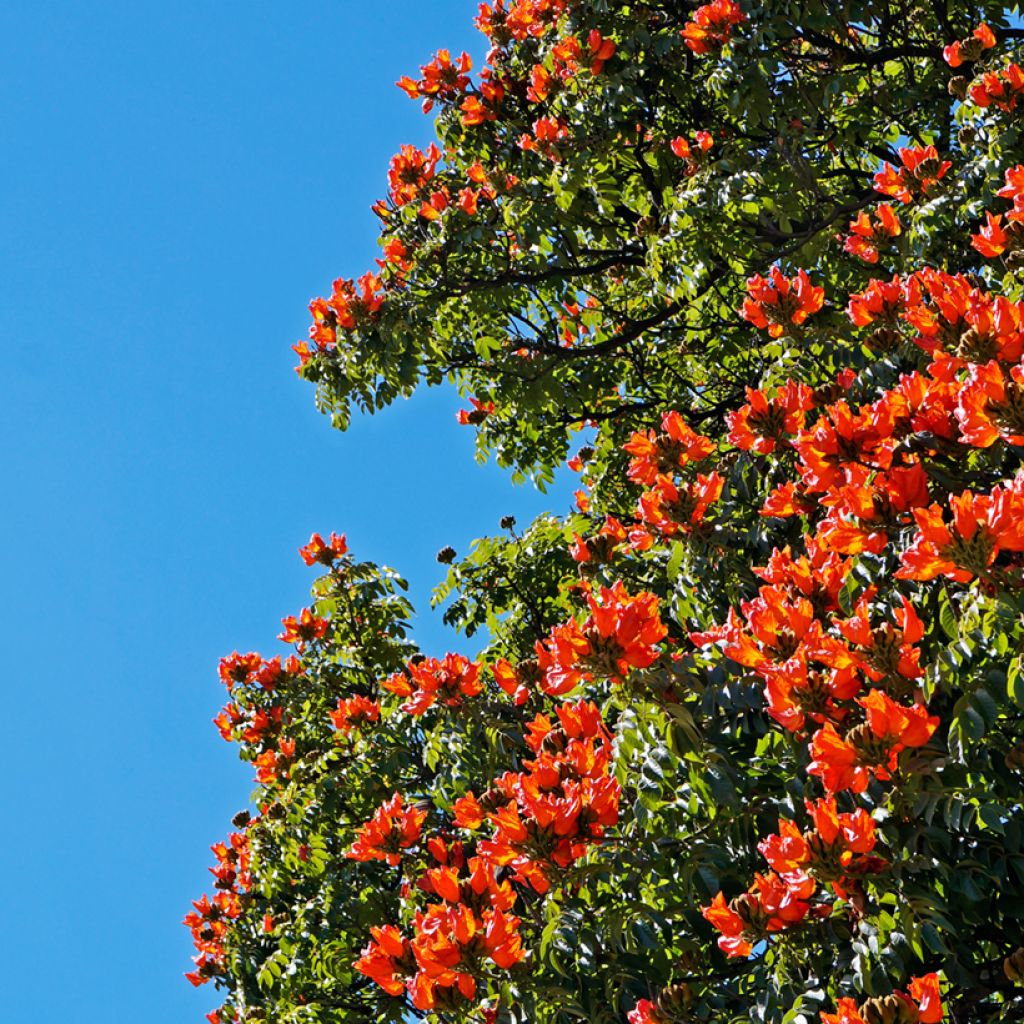
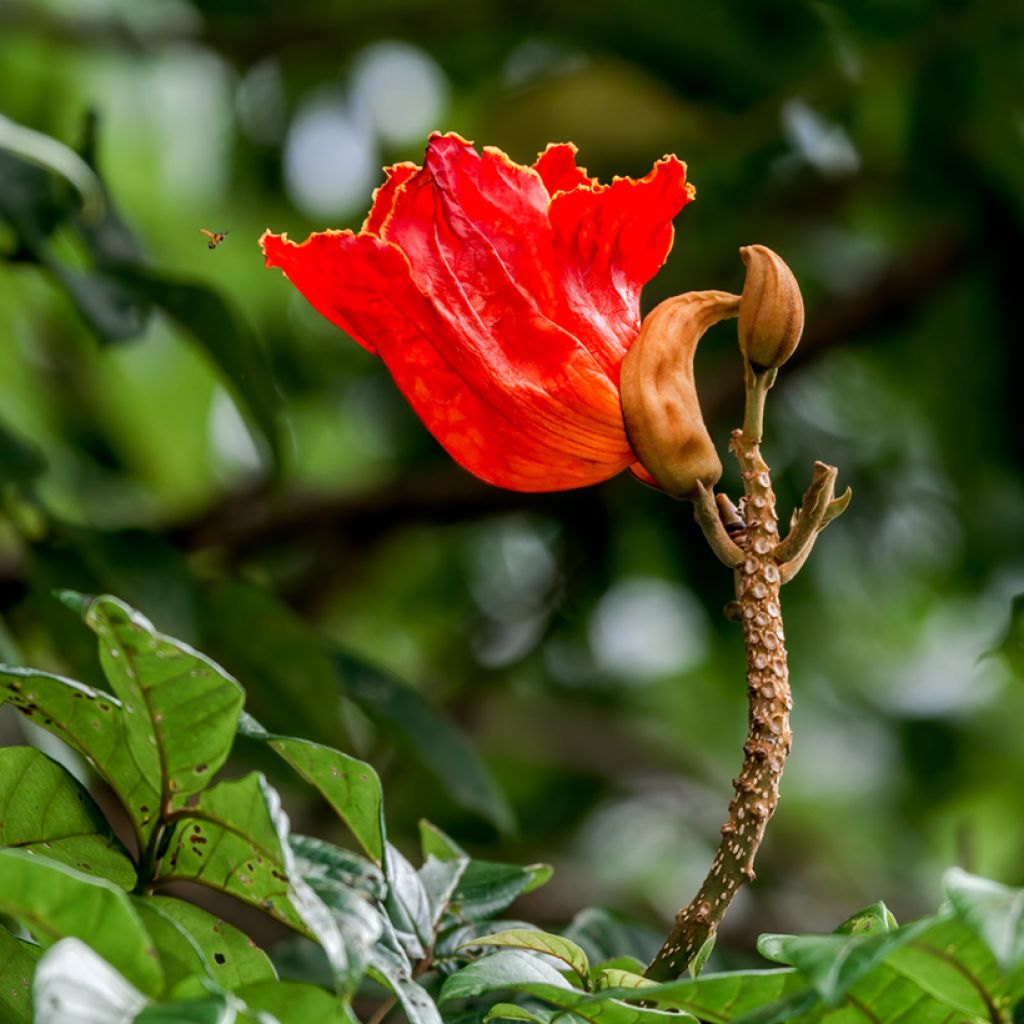
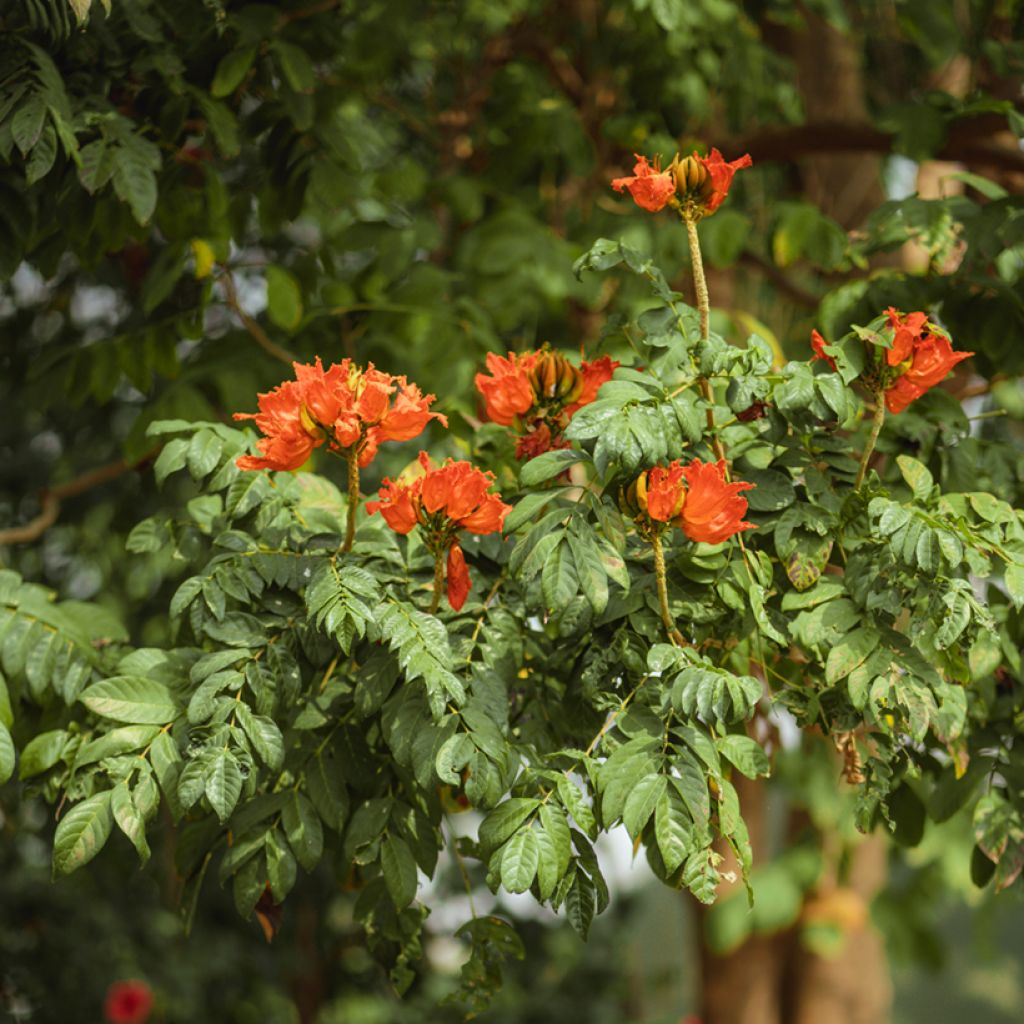
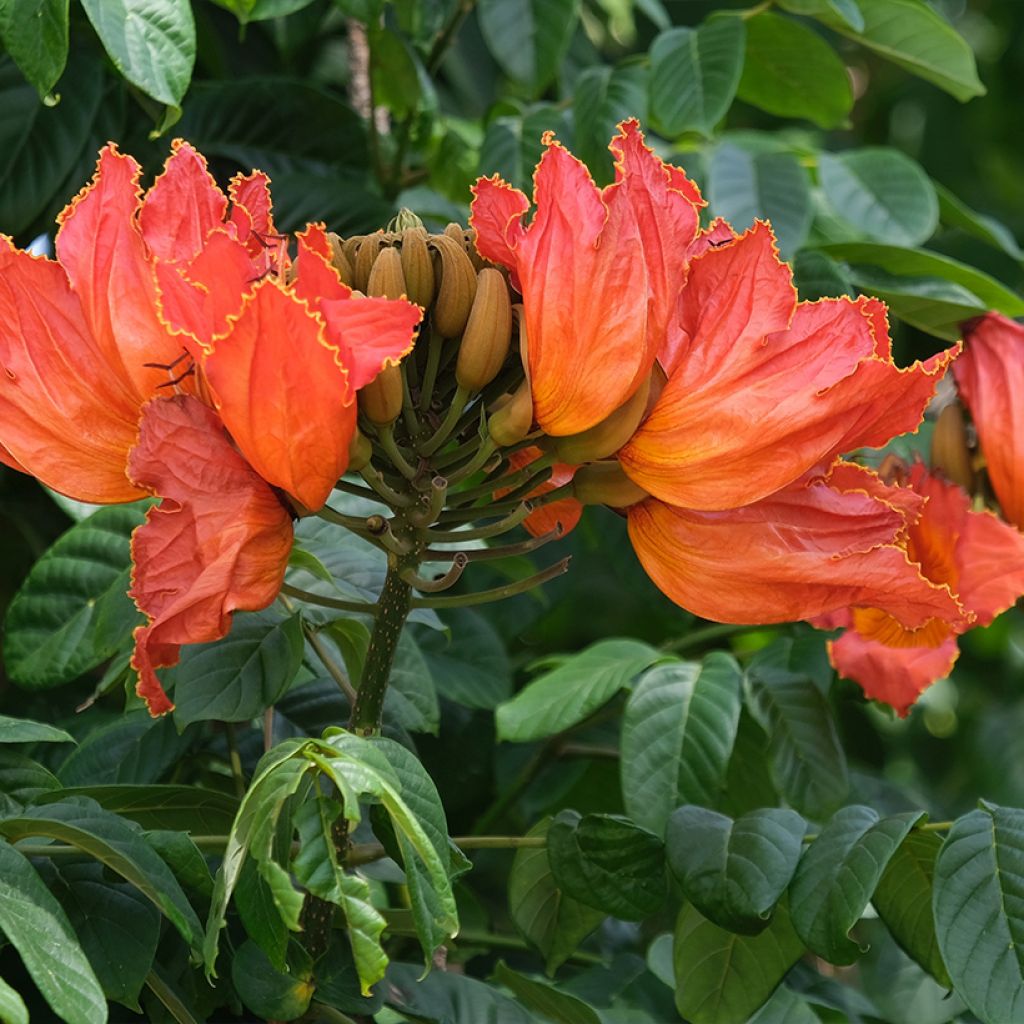
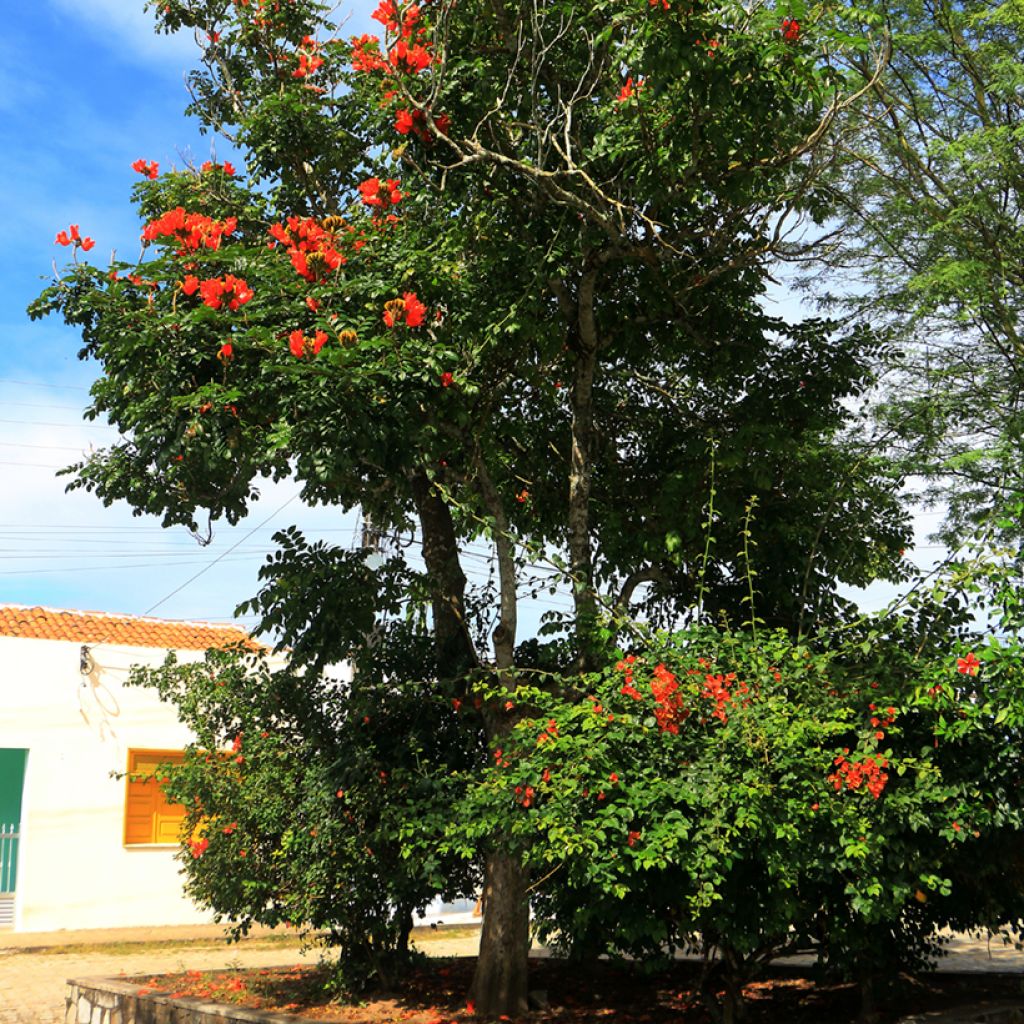
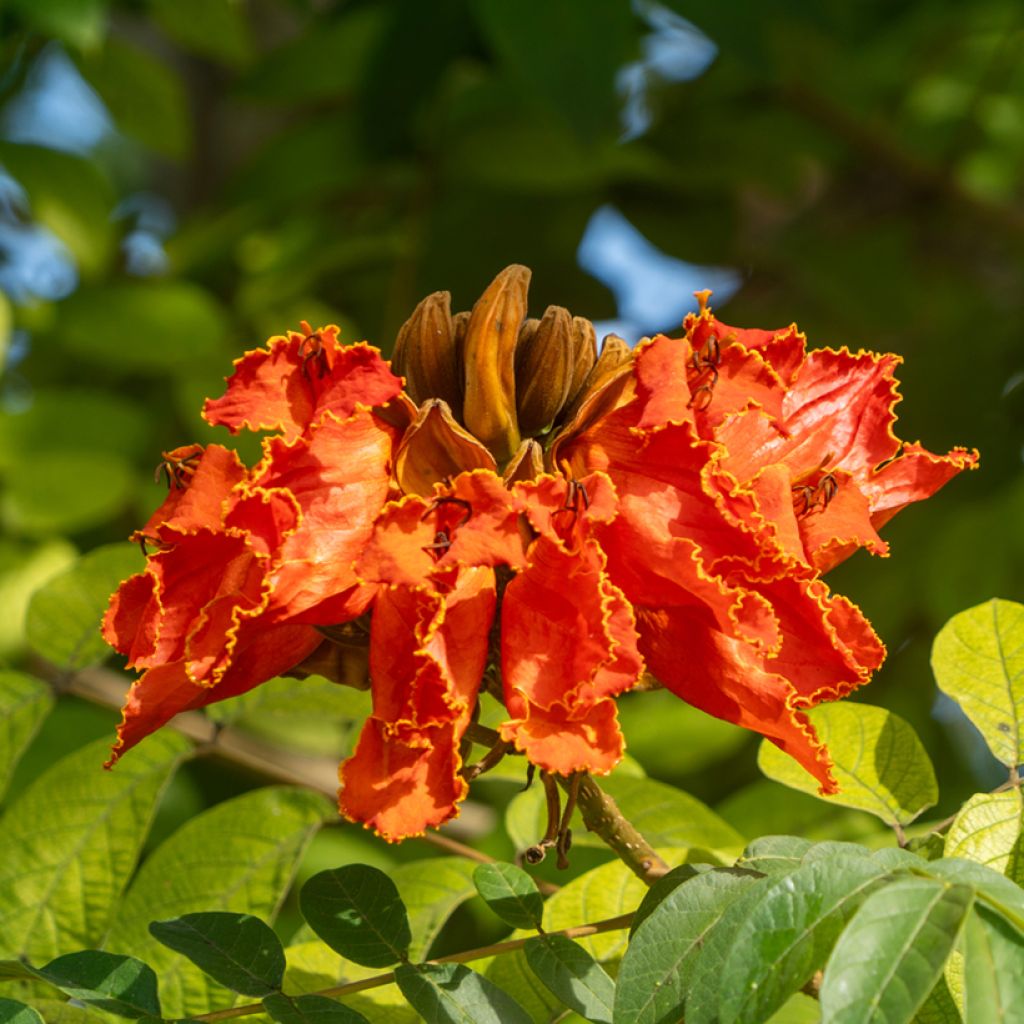
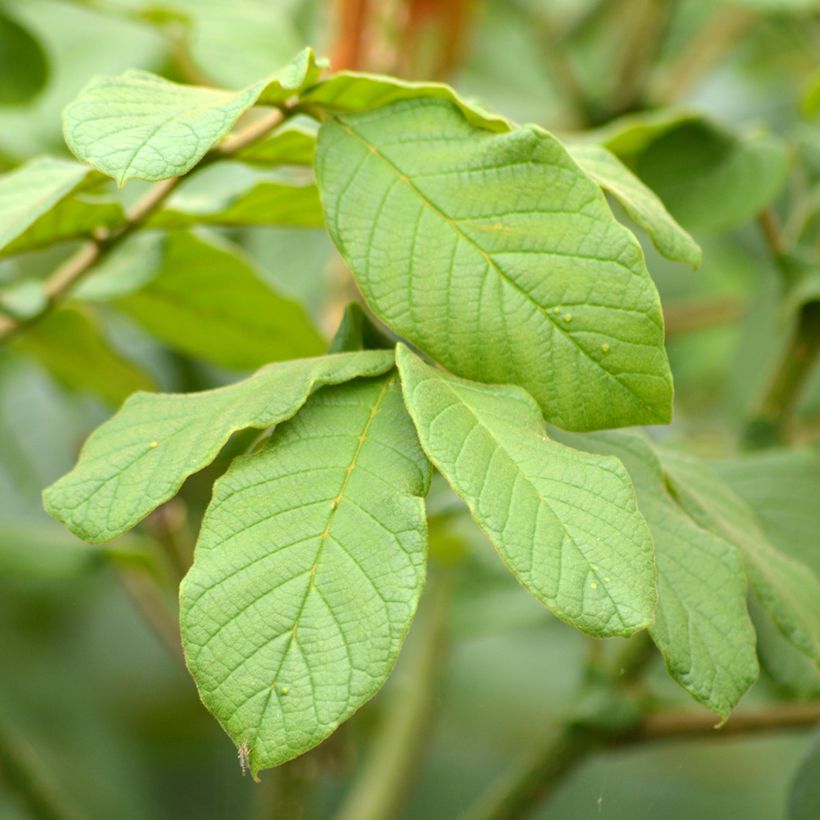
Spathodea campanulata is a fast-growing tree, reaching heights of 10 to 35 metres in the ground, with a trunk up to 60 cm in diameter. In a pot, its size is naturally limited. Container-grown specimens typically reach 1 to 2 metres in height, depending on pot size and growing conditions. Larger specimens, 3 to 4 metres, develop in 75-litre containers. The African Tulip Tree has an upright habit with a dense, rounded crown. The leaves, measuring up to 50 cm in length, consist of 7 to 17 ovate, dark green leaflets with entire margins. They persist year-round. The highly conspicuous flowers are arranged in terminal clusters. They measure 10 to 12 cm in length, displaying orange to coral-red hues with yellowish edges and a tulip-like shape. Flowering is nearly continuous in humid tropical climates but more seasonal in regions with a pronounced dry season. In temperate climates, flowering typically occurs between May and August. The fruits, which form in the wild, are large, elongated capsules, reaching up to 30 cm in length, containing numerous winged seeds that disperse easily by wind. The bark is initially smooth and grey-brown, becoming fissured and darker with age. The root system is extensive, providing the tree with good stability.
Children in regions where the African Tulip Tree grows often use its fluid-filled flower buds as natural "water bombs," as they burst and release their contents when squeezed.
The African Tulip Tree (Spathodea campanulata) is a tropical tree whose cultivation is quite challenging in temperate climates. It can be grown in a conservatory or greenhouse, where temperatures do not drop below 10°C. Care must also be taken to ensure the air is not too dry. Ideally, temperatures should range between 20 and 30°C to encourage growth. In winter, using grow lights can provide additional light to prevent etiolation of the plant.
Report an error about the product description
Spathodea campanulata - African tulip tree in pictures
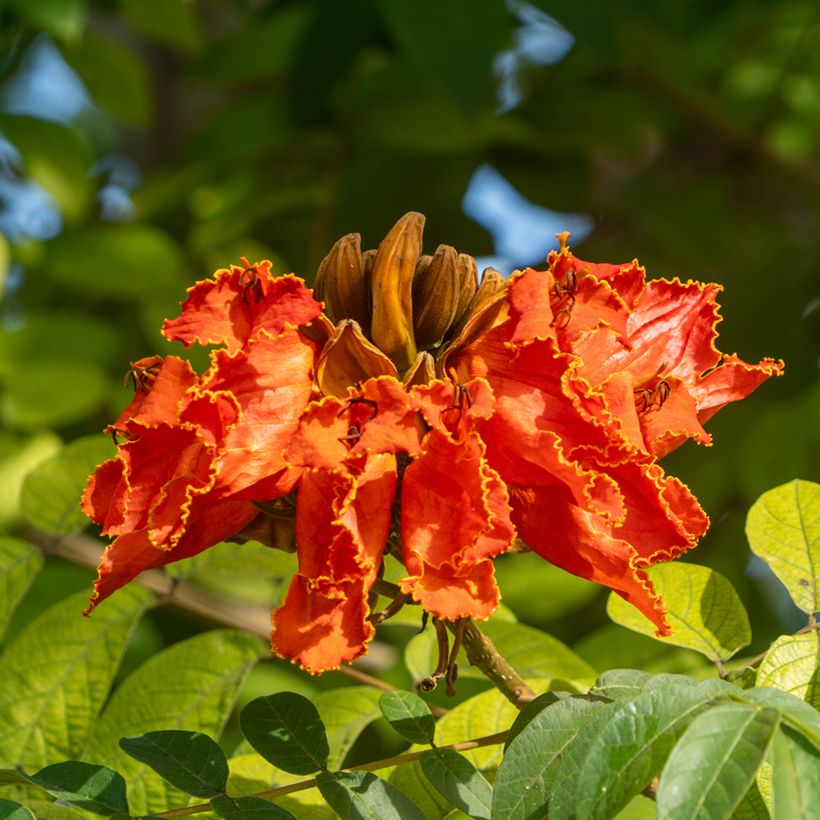
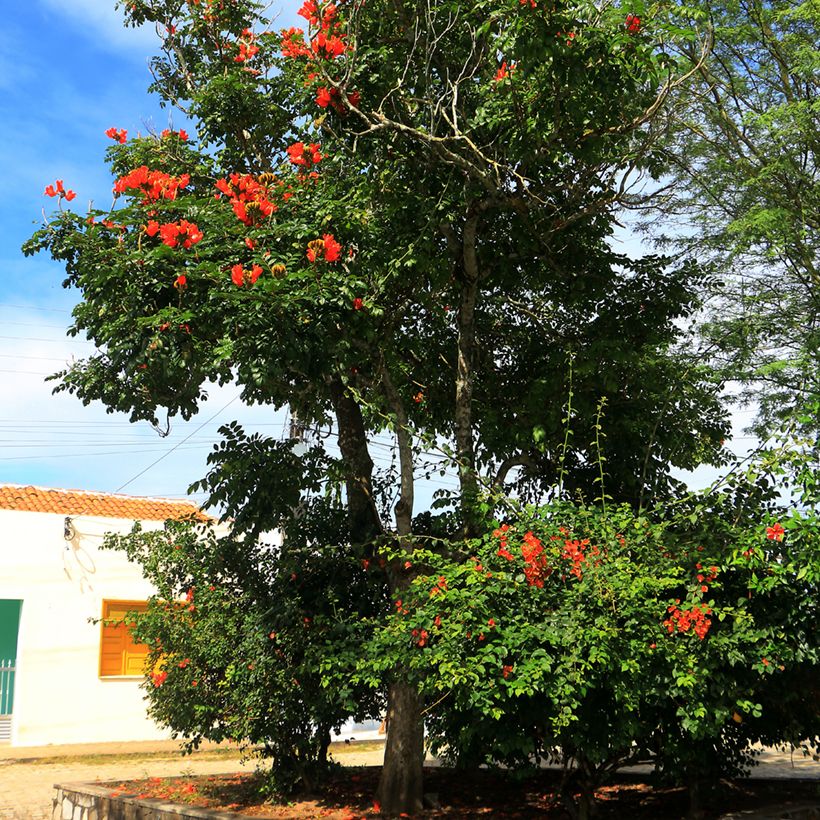
Plant habit
Flowering
Foliage
Botanical data
Spathodea
campanulata
Bignoniaceae
African tulip tree, Nandi flame, flame tree, fountain tree
Bignonia tulipifera, Spathodea danckelmaniana, Spathodea nilotica, Spathodea tulipifera
South America
Planting and care
The African Tulip Tree (Spathodea campanulata) is a tropical tree highly sensitive to cold, making its cultivation in pots in our temperate climate challenging. To succeed in growing it, it is essential to place it in a pot in a conservatory, greenhouse, or bright indoor space where temperatures do not drop below 10°C. Ideally, temperatures should range between 20 and 30°C to encourage its growth. In winter, if natural light is insufficient, it is recommended to use horticultural lamps to provide additional light and prevent the plant's etiolation.
Choose a container suited to its rapid growth and vigorous root system. Start with a medium-sized pot, approximately 20 to 30 cm in diameter, equipped with drainage holes to prevent excess moisture. As the tree develops, plan for regular repotting, ideally twice a year (in spring and autumn), gradually increasing the pot size to provide enough space for the roots. This practice helps avoid water stagnation and supplies the plant with fresh, nutrient-rich substrate. A pot that is too large from the outset can lead to excessive water retention, which is harmful to the tree's health. Thus, a gradual increase in pot size is recommended to ensure healthy and balanced growth of the African Tulip Tree in container cultivation.
The growing substrate should be rich, moist, and well-drained; a mix of loam, compost, potting soil, and sand in equal parts is advised. Regular watering is necessary, ensuring the soil remains moist but not waterlogged, with slightly reduced watering during the winter months. Feeding every two months can support its growth. Finally, formative pruning can be carried out from the third year onwards, in March or April, to shape the tree.
Planting period
Intended location
Care
Planting & care advice
-
-
-
-
-
-
-

-
This item has not been reviewed yet - be the first to leave a review about it.
Recently viewed products
Haven't found what you were looking for?
Hardiness is the lowest winter temperature a plant can endure without suffering serious damage or even dying. However, hardiness is affected by location (a sheltered area, such as a patio), protection (winter cover) and soil type (hardiness is improved by well-drained soil).
In temperate climates, pruning of spring-flowering shrubs (forsythia, spireas, etc.) should be done just after flowering.
Pruning of summer-flowering shrubs (Indian Lilac, Perovskia, etc.) can be done in winter or spring.
In cold regions as well as with frost-sensitive plants, avoid pruning too early when severe frosts may still occur.
The harvesting period indicated on our website applies to countries and regions in USDA zone 8 (France, England, Ireland, the Netherlands).
In colder areas (Scandinavia, Poland, Austria...) fruit and vegetable harvests are likely to be delayed by 3-4 weeks.
In warmer areas (Italy, Spain, Greece, etc.), harvesting will probably take place earlier, depending on weather conditions.
The sowing periods indicated on our website apply to countries and regions within USDA Zone 8 (France, UK, Ireland, Netherlands).
In colder areas (Scandinavia, Poland, Austria...), delay any outdoor sowing by 3-4 weeks, or sow under glass.
In warmer climes (Italy, Spain, Greece, etc.), bring outdoor sowing forward by a few weeks.
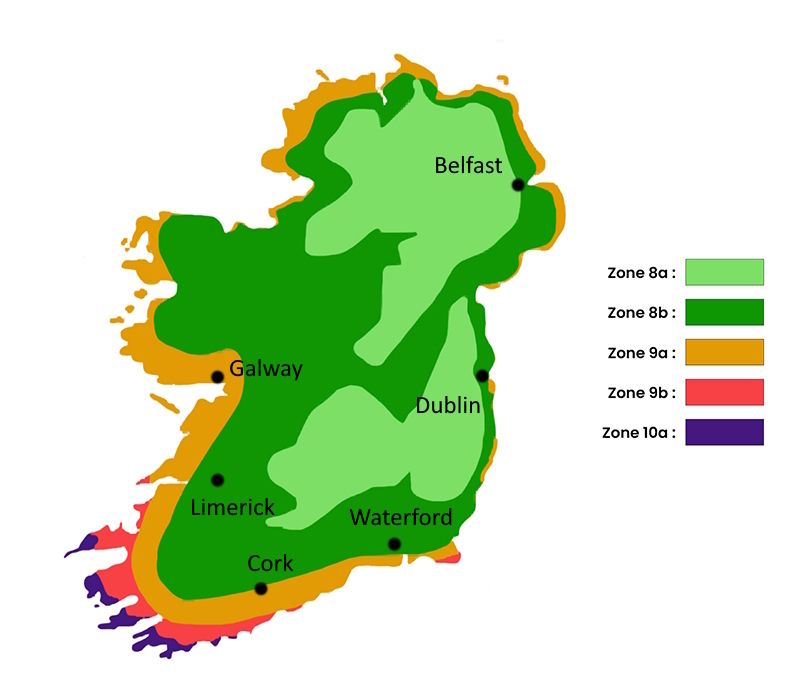
The planting period indicated on our website applies to regions in USDA Zone 9a (East Coast and Midlands: Dublin, Wexford, Waterford, Kilkenny, Portlaoise). It will vary depending on where you live:
- On the west coast and in the north-west (Galway, Limerick, Sligo, Donegal, Westport), delay planting by 1 to 2 weeks in spring and bring it forward by 1 to 2 weeks in autumn compared to the dates given, preferably choosing periods without strong winds.
- In the inland hills and plateaus (Wicklow Mountains, Macgillycuddy’s Reeks, Connemara, Killarney), it is best to plant in spring (April–May) or autumn (September–October), avoiding periods of waterlogged soil in winter and strong winds, which pose the main risk to newly planted trees in these areas.
The flowering period indicated on our website applies to regions in USDA Zone 9a, such as the East Coast and Midlands, including Dublin, Wexford, Waterford, Kilkenny and Portlaoise.
This will vary depending on where you live:
- On the west coast and in the northwest (Galway, Limerick, Sligo, Donegal and Westport), it will be delayed by one to two weeks compared to the given dates, due to stronger Atlantic winds and less spring sunshine.
- In the inland hills and plateaus (the Wicklow Mountains, the Macgillycuddy's Reeks, Connemara and Killarney), flowering will be delayed by two to three weeks. Flowering mainly occurs between May and July, with the limiting factors being less frost and more of the excessive humidity, strong winds and lack of sunshine that are characteristic of these areas.
Shipping country and language
Your country of residence may be:
Your country of residence is:
For a better user experience on our website, you can select:
Your shipping country:
-
 Austria
-
 Belgium
-
 Bosnia & Herzegovina
-
 Bulgaria
-
 Croatia
-
 Cyprus
-
 Czechia
-
 Denmark
-
 Estonia
-
 Finland
-
 France
-
 Germany
-
 Greece
-
 Hungary
-
 Iceland
-
 Ireland
-
 Italy
Italy
-
 Latvia
-
 Liechtenstein
-
 Lithuania
-
 Luxembourg
-
 Malta
Malta
-
 Netherlands
-
 Poland
-
 Portugal
-
 Romania
-
 Serbia
-
 Slovakia
-
 Slovenia
-
 Spain
Spain
-
 Sweden
-
 Switzerland
Language:
-
French
-
 English
-
Spanish
-
Italian
-
German
-
Portuguese
-
Dutch
-
Finnish
My Account
Hello
My wish lists
My cart
Log in / Register
Existing customer?
This form is protected by reCAPTCHA - the Google Privacy Policy and Terms of Service apply.
New customer?
Create an account to track your orders, access our customer service and, if you wish, make the most of our upcoming offers.