
Sambucus nigra Guincho Purple - Black Elder

Sambucus nigra Guincho Purple - Black Elder
Sambucus nigra Guincho Purple - Black Elder
Sambucus nigra Guincho Purple
European Elder, Black Elder, Elder, Elderberry, European Elderberry, European black Elderberry
Back-to-school special offer!
Get €10 off for every €50 you spend! And get up to €40 off on a single order.
How does it work?
1. Shop your favourites
Add your favourite plants to your basket. For every €50 you spend (excluding delivery charges, store credit and the plastic-free option), you’ll receive a €10 voucher.
€50 spent = €10 voucher
€100 spent = €20 voucher
€150 spent = €30 voucher
€200 spent = €40 voucher
2. Place your order
Once your basket reaches one of the spending thresholds, place your order. You can even choose your delivery date!
3. Receive your voucher
As soon as your order has been shipped, you’ll receive an email containing your personal voucher code and its value.
4. Use it on your next order
Your voucher is valid for 90 days from the date you receive it. It can be used once only, on a new order worth at least the value of the voucher, excluding delivery charges.
Please note: Vouchers can be combined with other offers, but cannot be split or refunded.
Why not try an alternative variety in stock?
View all →
Available in 2 sizes

Available in 4 sizes
Available in 1 sizes

Available in 2 sizes

Available in 1 sizes

Available in 3 sizes

Available in 2 sizes
Available in 1 sizes
Available in 2 sizes

Available in 2 sizes
This plant carries a 24 months recovery warranty
More information
We guarantee the quality of our plants for a full growing cycle, and will replace at our expense any plant that fails to recover under normal climatic and planting conditions.
Does this plant fit my garden?
Set up your Plantfit profile →
Description
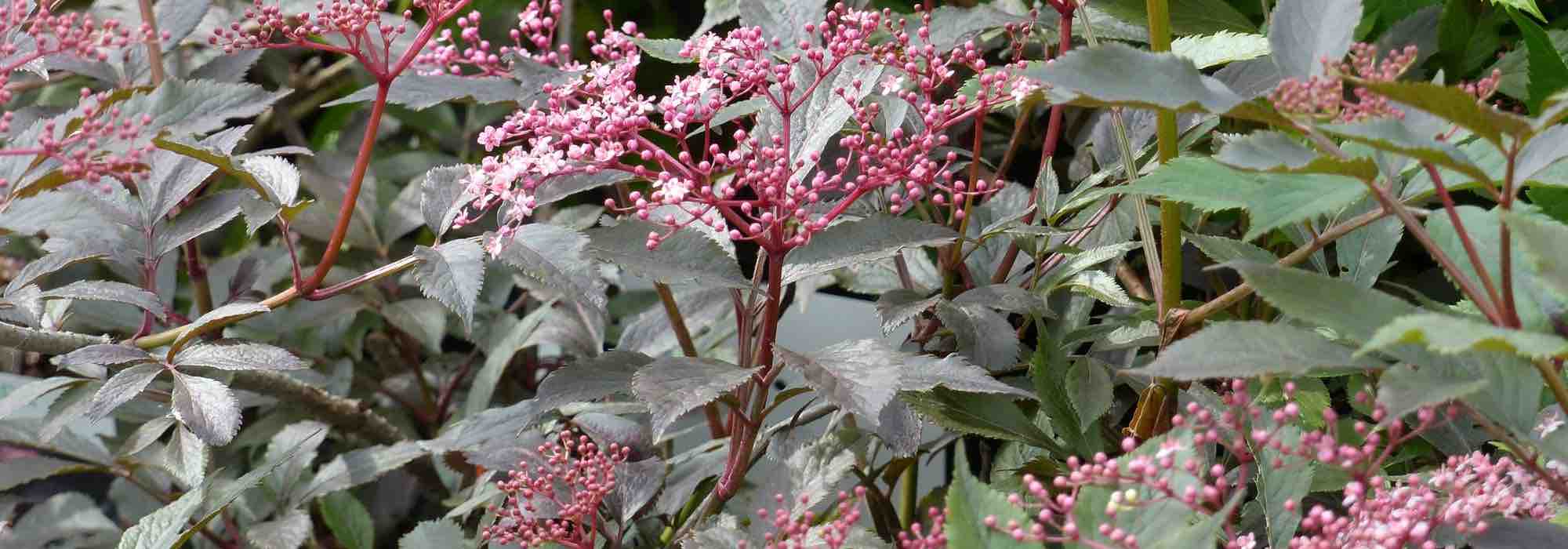
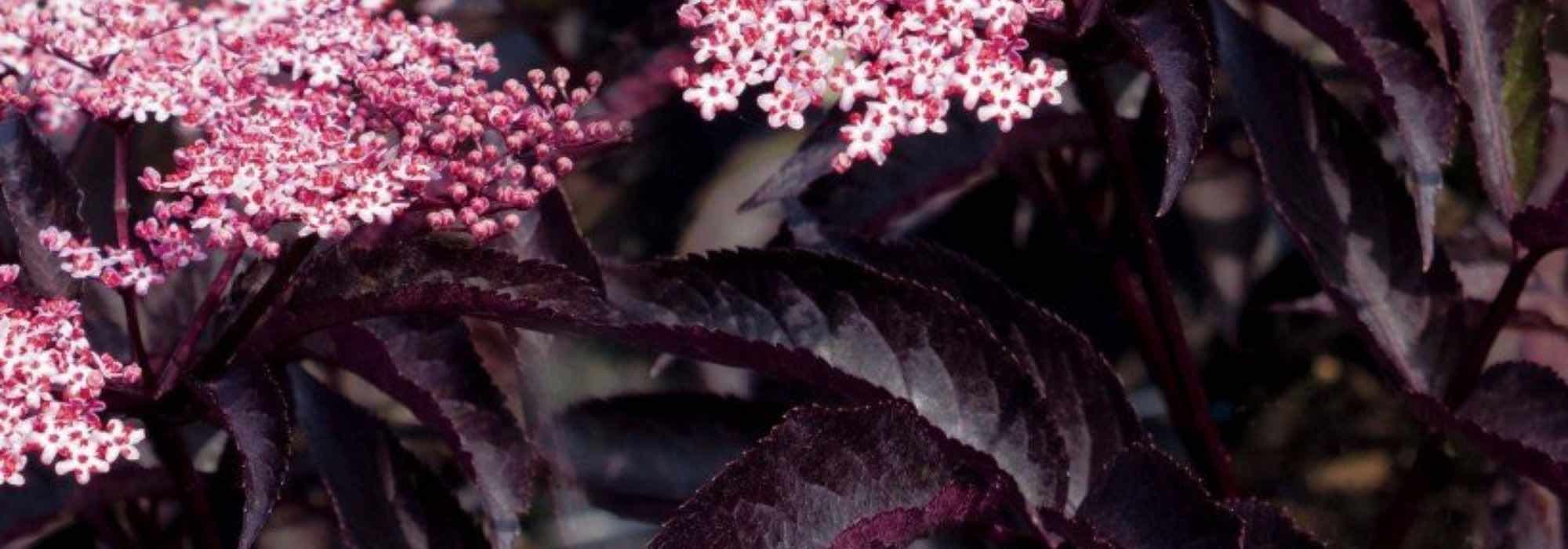
The black elderberry or Sambucus nigra 'Guincho Purple' is also known as 'Purpurea'. Its beautiful, elongated and dissected foliage changes colour throughout the seasons. Green to green-bronze in spring turns dark purple in summer and redder in autumn. It is a large bush or a small bushy tree adorned with a pinkish-white flowering in early summer and berries that turn red to black in late summer. This bush is comfortable in most gardens, adaptable to the soil, and perfectly hardy. It looks stunning when placed alone or in a free hedge.
The Sambucus nigra is a plant belonging to the Caprifoliaceae family, just like honeysuckles. It is a wild species widespread in Europe, North Africa, and Asia Minor. The black elderberry is an opportunistic and highly adaptable species found almost everywhere in France in clearings, hedges, fallow lands, coastal dunes, or near human settlements where it has coexisted for millennia. It is, therefore, a low-demanding bush and truly easy to grow everywhere. It tolerates clay-limestone soils perfectly, even if they are relatively dry, as long as they are deep.
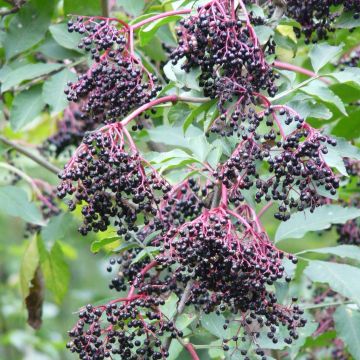
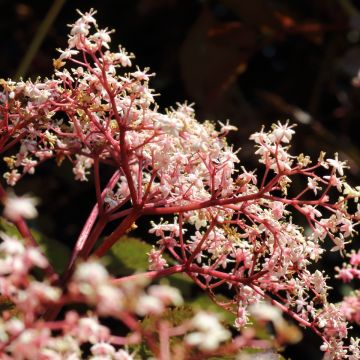
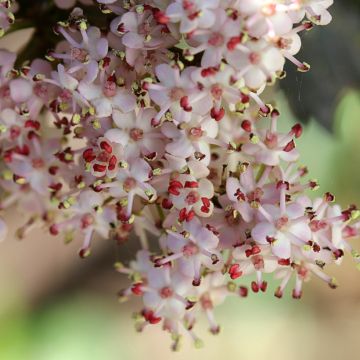
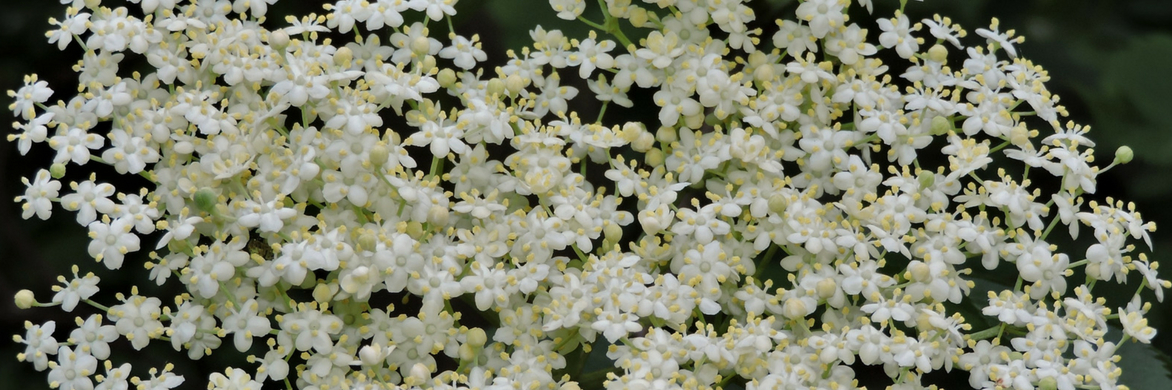
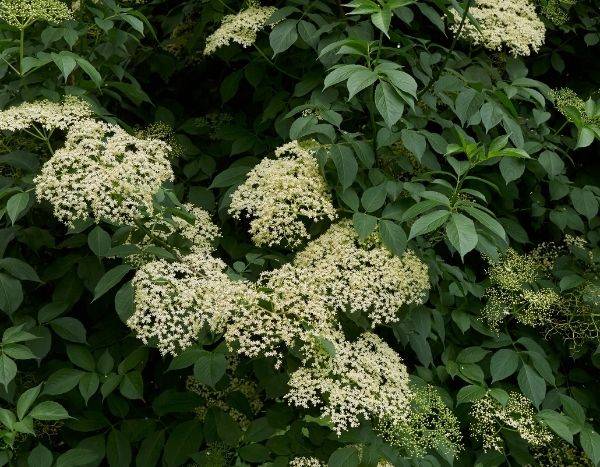
The 'Guincho Purple' form was discovered in Scotland in 1957 and cultivated at Guincho Garden in Northern Ireland. The bush has an upright habit and can reach up to 6m (20ft) in height and width. Its woody branches are verrucate, greyish, and filled with white pith. From spring to autumn, it bears elegant foliage: its leaves are divided into elongated leaflets with dentate edges, slightly glossy on the upper side. They are green-brown to bronze in spring, turning dark purple in summer and red in autumn. The flowering usually occurs in June (a little earlier or later, depending on the climate) as long-lasting false umbels 10 to 12 cm (4 to 5in) wide. The small flowers are white-pink fragrant, with five petals. Over a few days, they lighten almost to white, creating a stunning range of shades on the bush. This flowering attracts many pollinating insects. The edible and tasty fruits are black to violet berries with soft flesh, measuring 6 to 8 mm (1in) in diameter. The foliage is absent in winter.
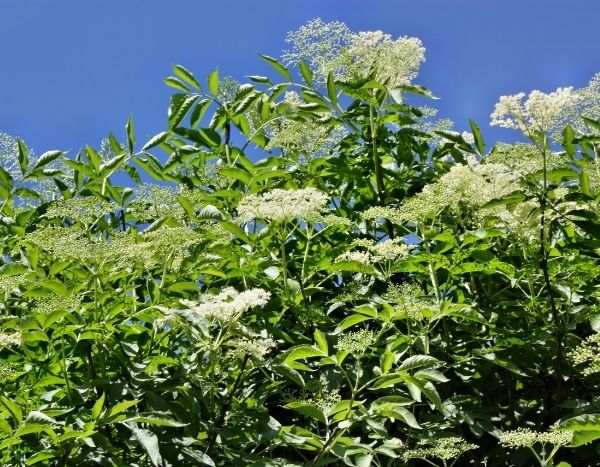
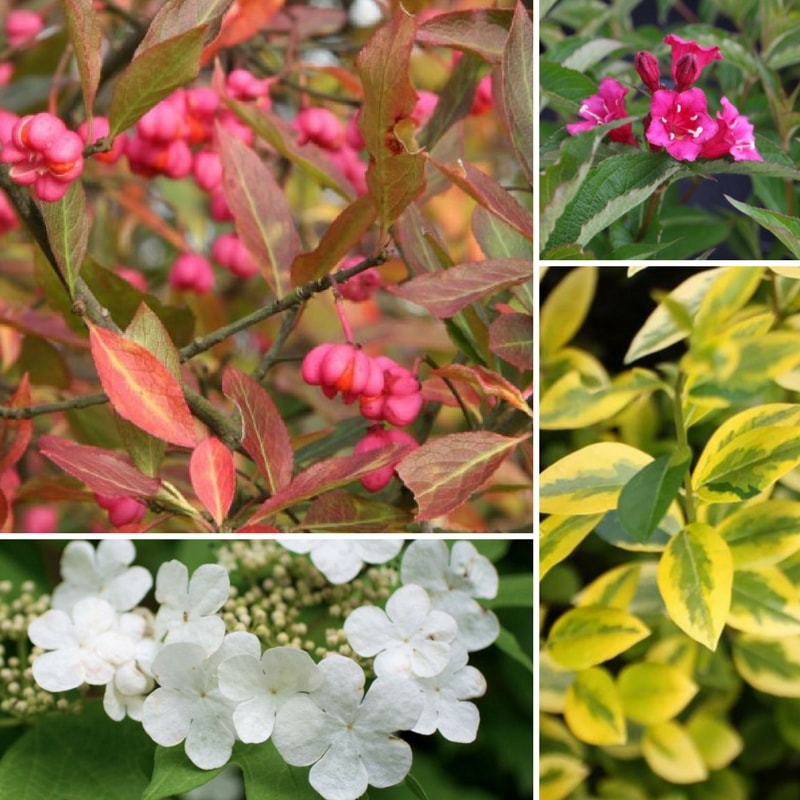
The 'Guincho Purple' elderberry makes a beautiful specimen when placed alone, and it is also an excellent bush for large free hedges. Plant it at the back of a shrub bed. Its purple leaves appreciate a sunny exposure. Like all elderberries, it is very hardy and easy to combine with other shrubs that bloom in spring or summer. Pair it with pink blossoms like Lilacs, ornamental Apple trees, Prunus, and Viburnum. It can create a backdrop for very tall perennials such as Gunneras, Ligularias, or giant ferns in moist soil.
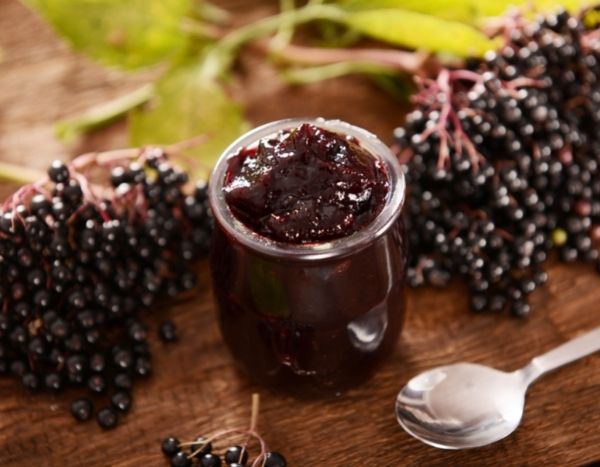
In the kitchen, the flowers can be prepared as fritters or syrup by soaking them in sugar. The vinegar-pickled buds enhance salads, and the berries are consumed as juice, jellies, jams, or wine. They pleasantly flavour apple cakes. Only the flowers and berries without petioles are edible, as the rest of the plant can be toxic.
In the garden, elderberry leaves are known to accelerate compost decomposition. The black elderberry leaf infusion is useful in organic gardening to fight against mildew and attacks from aphids or rodents: soak 1 kg of leaves in 10 L of water for a few days, then spray as needed. It can also be planted in an orchard, attracting insect-predatory birds.
Plant habit
Flowering
Foliage
Botanical data
Sambucus
nigra
Guincho Purple
Viburnaceae
European Elder, Black Elder, Elder, Elderberry, European Elderberry, European black Elderberry
Cultivar or hybrid
Planting and care
Easy to grow, the 'Guincho Purple' black elderberry can be planted in spring or autumn in any soil that is not too poor, deep enough and not too dry, even though it tolerates periods of temporary drought in deep soil and once well-established. It requires little maintenance. Plant it preferably in a sunny location, but avoid hot and arid situations. It is not demanding on the soil, accepting clay, limestone, sand, and even poor soils. The ideal at planting is half compost/half garden soil. It is very hardy. To promote flowering, prune the old branches short to rejuvenate them and cut back the young branches by a third at the end of winter.
It can be targeted by the black aphid Aphis sambuci, whose natural predator is the two-spot ladybird Coccinella bipunctata. This very specific aphid does not infect other plants in the garden. We often find an edible fungus called Judas's ear (Auricularia auricula-judae) on the black elderberry.
Planting period
Intended location
Care
Planting & care advice
-
-
-
-
-
-

-
-
This item has not been reviewed yet - be the first to leave a review about it.
Recently viewed products
Haven't found what you were looking for?
Hardiness is the lowest winter temperature a plant can endure without suffering serious damage or even dying. However, hardiness is affected by location (a sheltered area, such as a patio), protection (winter cover) and soil type (hardiness is improved by well-drained soil).
In temperate climates, pruning of spring-flowering shrubs (forsythia, spireas, etc.) should be done just after flowering.
Pruning of summer-flowering shrubs (Indian Lilac, Perovskia, etc.) can be done in winter or spring.
In cold regions as well as with frost-sensitive plants, avoid pruning too early when severe frosts may still occur.
The harvesting period indicated on our website applies to countries and regions in USDA zone 8 (France, England, Ireland, the Netherlands).
In colder areas (Scandinavia, Poland, Austria...) fruit and vegetable harvests are likely to be delayed by 3-4 weeks.
In warmer areas (Italy, Spain, Greece, etc.), harvesting will probably take place earlier, depending on weather conditions.
The sowing periods indicated on our website apply to countries and regions within USDA Zone 8 (France, UK, Ireland, Netherlands).
In colder areas (Scandinavia, Poland, Austria...), delay any outdoor sowing by 3-4 weeks, or sow under glass.
In warmer climes (Italy, Spain, Greece, etc.), bring outdoor sowing forward by a few weeks.
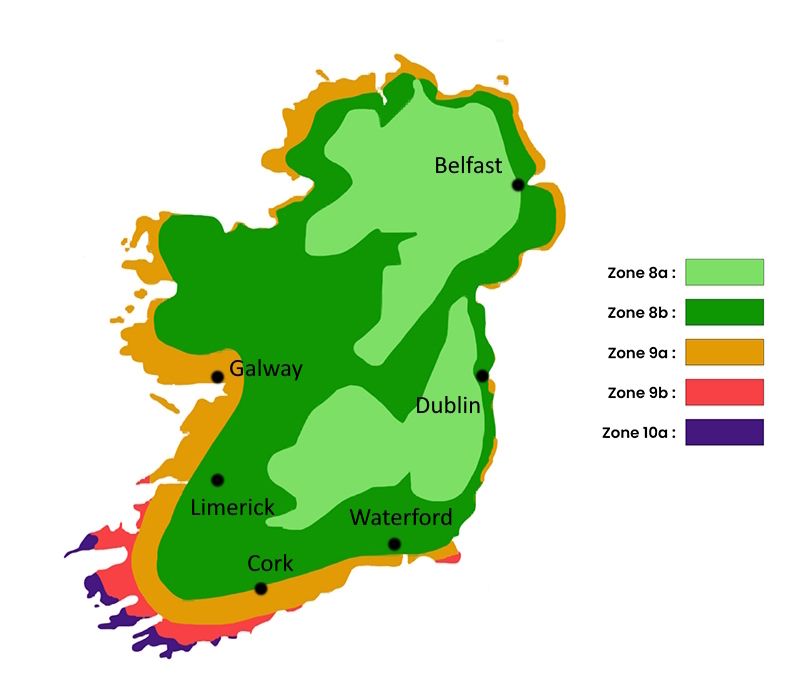
The planting period indicated on our website applies to regions in USDA Zone 9a (East Coast and Midlands: Dublin, Wexford, Waterford, Kilkenny, Portlaoise). It will vary depending on where you live:
- On the west coast and in the north-west (Galway, Limerick, Sligo, Donegal, Westport), delay planting by 1 to 2 weeks in spring and bring it forward by 1 to 2 weeks in autumn compared to the dates given, preferably choosing periods without strong winds.
- In the inland hills and plateaus (Wicklow Mountains, Macgillycuddy’s Reeks, Connemara, Killarney), it is best to plant in spring (April–May) or autumn (September–October), avoiding periods of waterlogged soil in winter and strong winds, which pose the main risk to newly planted trees in these areas.
The flowering period indicated on our website applies to regions in USDA Zone 9a, such as the East Coast and Midlands, including Dublin, Wexford, Waterford, Kilkenny and Portlaoise.
This will vary depending on where you live:
- On the west coast and in the northwest (Galway, Limerick, Sligo, Donegal and Westport), it will be delayed by one to two weeks compared to the given dates, due to stronger Atlantic winds and less spring sunshine.
- In the inland hills and plateaus (the Wicklow Mountains, the Macgillycuddy's Reeks, Connemara and Killarney), flowering will be delayed by two to three weeks. Flowering mainly occurs between May and July, with the limiting factors being less frost and more of the excessive humidity, strong winds and lack of sunshine that are characteristic of these areas.
Shipping country and language
Your country of residence may be:
Your country of residence is:
For a better user experience on our website, you can select:
Your shipping country:
-
 Austria
-
 Belgium
-
 Bosnia & Herzegovina
-
 Bulgaria
-
 Croatia
-
 Cyprus
-
 Czechia
-
 Denmark
-
 Estonia
-
 Finland
-
 France
-
 Germany
-
 Greece
-
 Hungary
-
 Iceland
-
 Ireland
-
 Italy
-
 Latvia
-
 Liechtenstein
-
 Lithuania
-
 Luxembourg
-
 Malta
-
 Netherlands
-
 Poland
-
 Portugal
-
 Romania
-
 Serbia
-
 Slovakia
-
 Slovenia
-
 Spain
-
 Sweden
-
 Switzerland
Language:
-
French
-
 English
-
Spanish
-
Italian
-
German
-
Portuguese
-
Dutch
-
Finnish
My Account
Hello
My wish lists
My cart
Log in / Register
Existing customer?
This form is protected by reCAPTCHA - the Google Privacy Policy and Terms of Service apply.
New customer?
Create an account to track your orders, access our customer service and, if you wish, make the most of our upcoming offers.