Metasequoia glyptostroboides seeds - Dawn redwood
Metasequoia glyptostroboides seeds - Dawn redwood
Metasequoia glyptostroboides
Dawn Redwood, Water Fir
Back-to-school special offer!
Get €10 off for every €50 you spend! And get up to €40 off on a single order.
How does it work?
1. Shop your favourites
Add your favourite plants to your basket. For every €50 you spend (excluding delivery charges, store credit and the plastic-free option), you’ll receive a €10 voucher.
€50 spent = €10 voucher
€100 spent = €20 voucher
€150 spent = €30 voucher
€200 spent = €40 voucher
2. Place your order
Once your basket reaches one of the spending thresholds, place your order. You can even choose your delivery date!
3. Receive your voucher
As soon as your order has been shipped, you’ll receive an email containing your personal voucher code and its value.
4. Use it on your next order
Your voucher is valid for 90 days from the date you receive it. It can be used once only, on a new order worth at least the value of the voucher, excluding delivery charges.
Please note: Vouchers can be combined with other offers, but cannot be split or refunded.
Why not try an alternative variety in stock?
View all →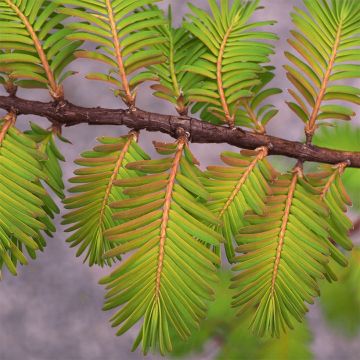
Available in 1 sizes
Available in 2 sizes
This plant carries a 6 months recovery warranty
More information
We guarantee the quality of our plants for a full growing cycle, and will replace at our expense any plant that fails to recover under normal climatic and planting conditions.
Does this plant fit my garden?
Set up your Plantfit profile →
Description
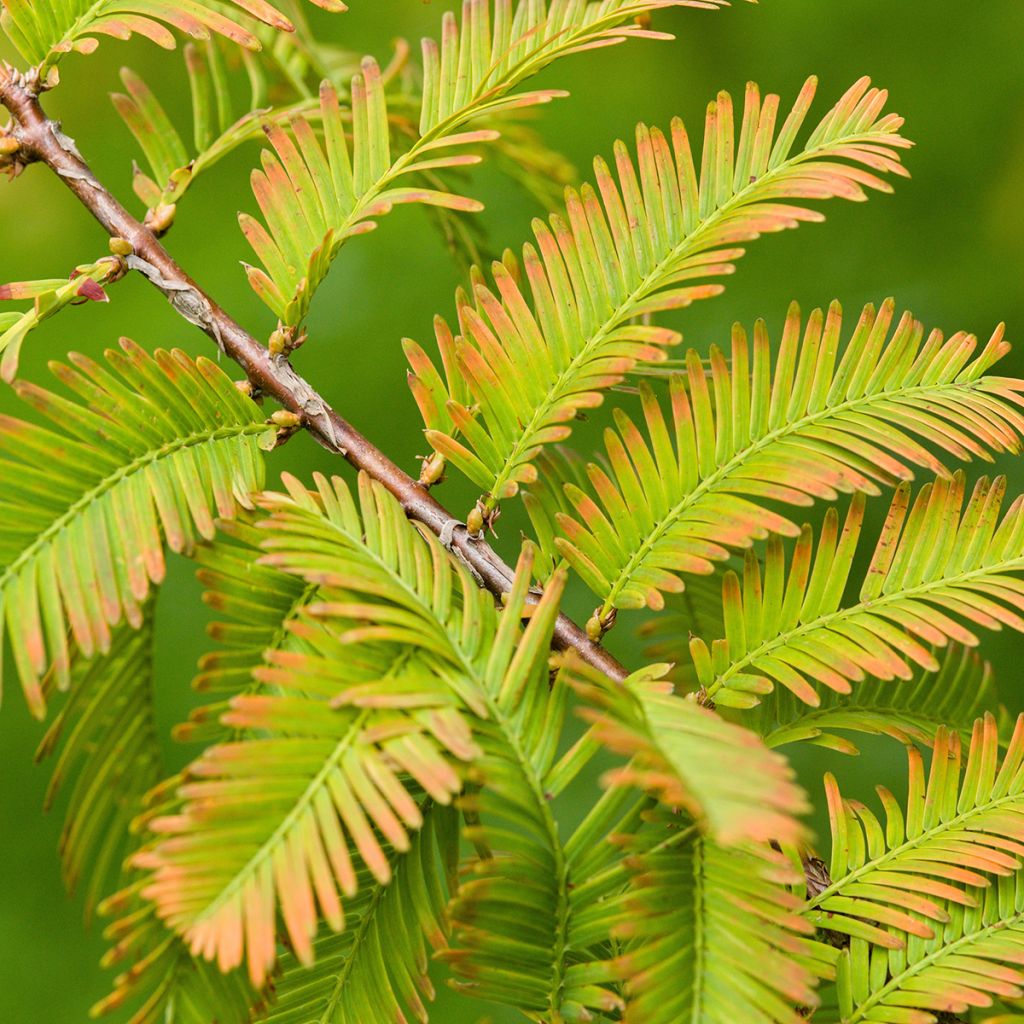
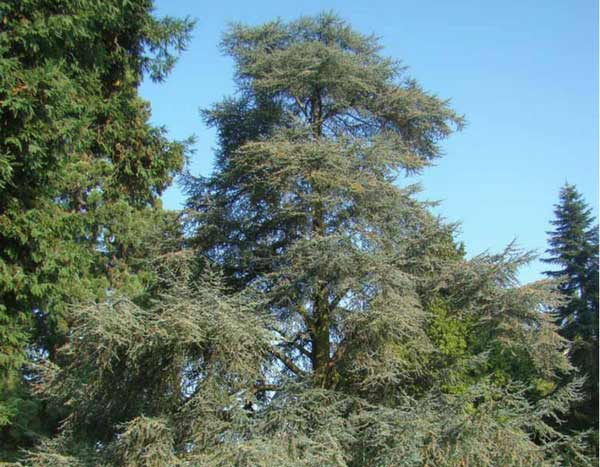
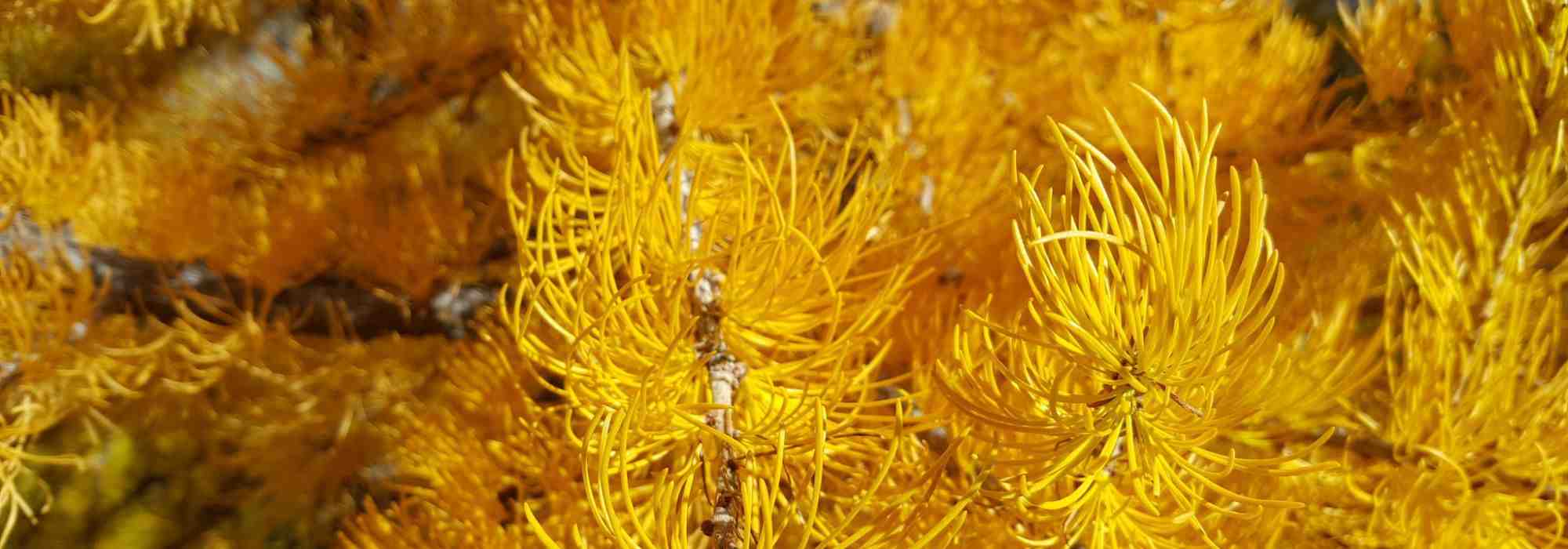
Metasequoia glyptostroboides, commonly known as the Dawn Redwood, or Water Fir, is a tree of great stature, whose regular conical to pyramidal habit gives it an architectural, characteristic silhouette. It is distinguished by a rarity among conifers: deciduous foliage, like the Larch of our mountains or the exotic Swamp Cypress. Its rapid growth makes it a prime specimen for large spaces, where it quickly becomes spectacular. Its fine, flat needles, delicately cut and pleasant to the touch, appear in spring in a luminous light green. In autumn, the tree is transformed with a warm palette ranging from brown to russet, mingled with coppery highlights. A species that has become rare in its native range, it proves highly adaptable in temperate climates. Its rapid growth justifies propagation by sowing, still allowing you to obtain a fine-sized tree without waiting a lifetime!
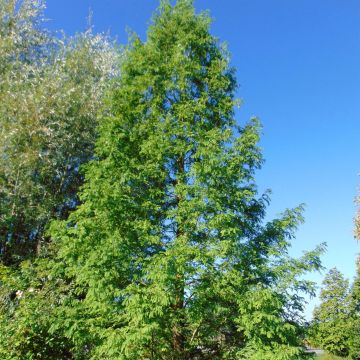
A close relative of Sequoiadendron, the Californian giant, Metasequoia belongs to the Cupressaceae family (or Taxodiaceae depending on the classification). The tree was named by a Japanese botanist following its discovery in fossil form in 1941, from the Greek words "meta" meaning near (to the Sequoia), and glyptostroboides: resembling Glyptostrobus pensilis, a Chinese species. In 1946, Chinese botanists discovered significant natural stands in the Shui Hsa Pa valley, Shui Hsa meaning Water Fir, the usual local name for this tree. It represents the last survivor of an extremely ancient genus, whose origins date back to the Cretaceous period, an era marked by profound climatic and biological upheavals. In its natural habitat, this tree can reach approximately 30 to 40 metres in height with a spread of nearly 10 metres, adopting an upright, sometimes almost columnar silhouette. It reaches its full potential in moist, non-calcareous soils and appreciates temperate climates as well as wet, even marshy, ground.
Bearing a powerful trunk reaching 2 metres in diameter, covered with deeply fissured reddish-brown bark, this conifer is remarkably ornamental. Its sustained growth allows it to gain between 50cm and 1 metre per year. In its natural habitat, it reaches 20 metres in height in 25 years; in our climates, a 10-year-old specimen can already stand 5 or 6 metres tall. The branches bear long shoots on which shorter, deciduous branchlets develop. The deciduous leaves are arranged in two rows on a single plane: fine, supple and flattened, they measure 8 to 15cm long and a few millimetres wide. Initially light green in spring, they darken slightly in summer before becoming yellow, orange, brown and pale red in autumn before falling. The female flowers measure 6mm long and appear with the foliage. Fruiting only occurs on mature specimens, in the form of small globose, scaly cones borne on a stalk, 1.8 to 2.5cm in diameter.
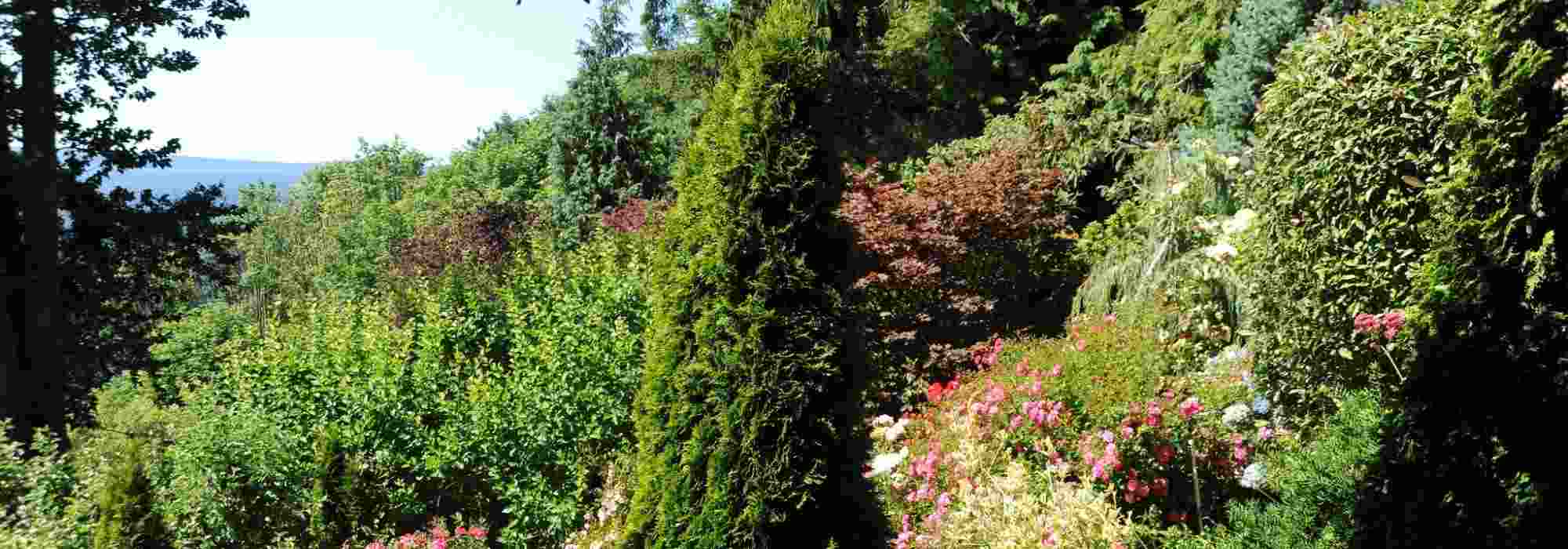
Metasequoia glyptostroboides needs generous space to express its full potential; it is not a plant for small gardens. In suitable conditions, it becomes an exceptional tree, destined to span generations and become a lasting part of a garden's history. It can be used as a specimen tree as a focal point, or in avenues, particularly along watercourses. Its imposing stature demands deep soil and a well-cleared location, carefully chosen at planting time. Once well established, it requires little care and pairs harmoniously with other large trees with autumn foliage, such as the superb Nyssa sylvatica, which would be best placed towards the front due to its relatively slow growth. Ginkgo biloba, the Maidenhair Tree renowned for its golden yellow autumn foliage, will also be a good companion, creating an exceptional scene. Sowing seed is an economical and viable method of propagation, even if the success rate is at best average, because the plant's speed of development allows you to obtain a fine-sized tree fairly quickly.

Foliage
Plant habit
Botanical data
Metasequoia
glyptostroboides
Cupressaceae
Dawn Redwood, Water Fir
Sequoia glyptostroboides
China
Planting and care
The seeds of Metasequoia glyptostroboides are very fine and their seed viability can be variable, particularly because some of them are empty or non-viable (poor fertilisation, sensitivity to heat...). To give yourself the best chance of success, it is important to use fresh seeds, to stratify them and to sow them on the surface (they need light).
Under these conditions, the success rate fluctuates between 30 and 60% (whereas with old seeds, 2 or 3 years old, it drops below 10%).
To break seed dormancy, it is important to cold stratify them: mix the seeds with damp sand or vermiculite in a bag, and place it in the refrigerator at 3-5°C for 4 to 8 weeks.
At the end of winter/beginning of spring, prepare a seed tray with a 50/50 mix of potting compost and sand (or perlite), and sow on the surface. Spray a little water regularly to keep the substrate moist, without overdoing it. Place the tray in a bright spot out of direct sunlight, at a temperature of 18 to 22°C. Germination is staggered over 10 to 30 days.
Prick out into individual pots when the young plants reach 3 to 5cm. Keep the young specimens frost-free for the first year and plant them in their final position in the garden in the spring of the following year, from April to June.
Metasequoia grows in deep soil, close to neutral or slightly acidic, fertile, damp to moist. Although it tolerates clay soils, it prefers loose, loamy or sandy soils, not too chalky. Choose a moderately sunny, well-open spot to give it room to grow. Add organic matter at planting time and water generously for the first three years, and during drought, as it must never lack water. In poor soil, you can apply a special conifer fertiliser every 2 years, in April. Hoe the soil in summer. This hardy conifer (down to at least -15°C) dislikes scorching summers, alkaline and overly dry soils. Pruning is not necessary.
Sowing period
Intended location
Planting & care advice
-
-
-

-
-
-
-
-
This item has not been reviewed yet - be the first to leave a review about it.
Recently viewed products
Haven't found what you were looking for?
Hardiness is the lowest winter temperature a plant can endure without suffering serious damage or even dying. However, hardiness is affected by location (a sheltered area, such as a patio), protection (winter cover) and soil type (hardiness is improved by well-drained soil).
In temperate climates, pruning of spring-flowering shrubs (forsythia, spireas, etc.) should be done just after flowering.
Pruning of summer-flowering shrubs (Indian Lilac, Perovskia, etc.) can be done in winter or spring.
In cold regions as well as with frost-sensitive plants, avoid pruning too early when severe frosts may still occur.
The harvesting period indicated on our website applies to countries and regions in USDA zone 8 (France, England, Ireland, the Netherlands).
In colder areas (Scandinavia, Poland, Austria...) fruit and vegetable harvests are likely to be delayed by 3-4 weeks.
In warmer areas (Italy, Spain, Greece, etc.), harvesting will probably take place earlier, depending on weather conditions.
The sowing periods indicated on our website apply to countries and regions within USDA Zone 8 (France, UK, Ireland, Netherlands).
In colder areas (Scandinavia, Poland, Austria...), delay any outdoor sowing by 3-4 weeks, or sow under glass.
In warmer climes (Italy, Spain, Greece, etc.), bring outdoor sowing forward by a few weeks.
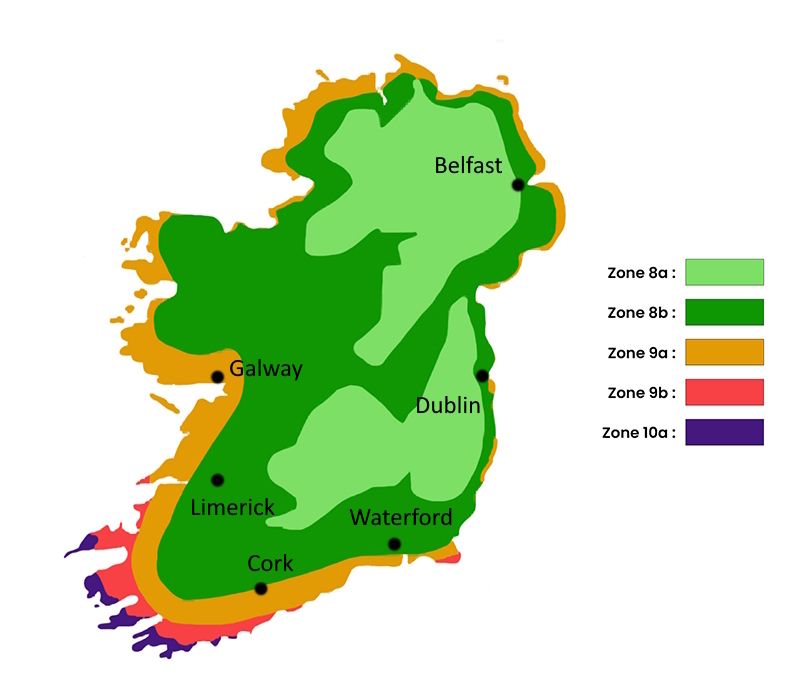
The planting period indicated on our website applies to regions in USDA Zone 9a (East Coast and Midlands: Dublin, Wexford, Waterford, Kilkenny, Portlaoise). It will vary depending on where you live:
- On the west coast and in the north-west (Galway, Limerick, Sligo, Donegal, Westport), delay planting by 1 to 2 weeks in spring and bring it forward by 1 to 2 weeks in autumn compared to the dates given, preferably choosing periods without strong winds.
- In the inland hills and plateaus (Wicklow Mountains, Macgillycuddy’s Reeks, Connemara, Killarney), it is best to plant in spring (April–May) or autumn (September–October), avoiding periods of waterlogged soil in winter and strong winds, which pose the main risk to newly planted trees in these areas.
The flowering period indicated on our website applies to regions in USDA Zone 9a, such as the East Coast and Midlands, including Dublin, Wexford, Waterford, Kilkenny and Portlaoise.
This will vary depending on where you live:
- On the west coast and in the northwest (Galway, Limerick, Sligo, Donegal and Westport), it will be delayed by one to two weeks compared to the given dates, due to stronger Atlantic winds and less spring sunshine.
- In the inland hills and plateaus (the Wicklow Mountains, the Macgillycuddy's Reeks, Connemara and Killarney), flowering will be delayed by two to three weeks. Flowering mainly occurs between May and July, with the limiting factors being less frost and more of the excessive humidity, strong winds and lack of sunshine that are characteristic of these areas.
Shipping country and language
Your country of residence may be:
Your country of residence is:
For a better user experience on our website, you can select:
Your shipping country:
-
 Austria
-
 Belgium
-
 Bosnia & Herzegovina
-
 Bulgaria
-
 Croatia
-
 Cyprus
-
 Czechia
-
 Denmark
-
 Estonia
-
 Finland
-
 France
-
 Germany
-
 Greece
-
 Hungary
-
 Iceland
-
 Ireland
-
 Italy
Italy
-
 Latvia
-
 Liechtenstein
-
 Lithuania
-
 Luxembourg
-
 Malta
Malta
-
 Netherlands
-
 Poland
-
 Portugal
-
 Romania
-
 Serbia
-
 Slovakia
-
 Slovenia
-
 Spain
Spain
-
 Sweden
-
 Switzerland
Language:
-
French
-
 English
-
Spanish
-
Italian
-
German
-
Portuguese
-
Dutch
-
Finnish
My Account
Hello
My wish lists
My cart
Log in / Register
Existing customer?
This form is protected by reCAPTCHA - the Google Privacy Policy and Terms of Service apply.
New customer?
Create an account to track your orders, access our customer service and, if you wish, make the most of our upcoming offers.