
Lucky bamboo - Dracaena sanderiana

Lucky bamboo - Dracaena sanderiana

Lucky bamboo - Dracaena sanderiana

Lucky bamboo - Dracaena sanderiana

Lucky bamboo - Dracaena sanderiana

Lucky bamboo - Dracaena sanderiana
Lucky bamboo - Dracaena sanderiana
Dracaena sanderiana
Lucky bamboo, Belgian evergreen, Ribbon plant
Back-to-school special offer!
Get €10 off for every €50 you spend! And get up to €40 off on a single order.
How does it work?
1. Shop your favourites
Add your favourite plants to your basket. For every €50 you spend (excluding delivery charges, store credit and the plastic-free option), you’ll receive a €10 voucher.
€50 spent = €10 voucher
€100 spent = €20 voucher
€150 spent = €30 voucher
€200 spent = €40 voucher
2. Place your order
Once your basket reaches one of the spending thresholds, place your order. You can even choose your delivery date!
3. Receive your voucher
As soon as your order has been shipped, you’ll receive an email containing your personal voucher code and its value.
4. Use it on your next order
Your voucher is valid for 90 days from the date you receive it. It can be used once only, on a new order worth at least the value of the voucher, excluding delivery charges.
Please note: Vouchers can be combined with other offers, but cannot be split or refunded.
Why not try an alternative variety in stock?
View all →
Available in 2 sizes

Available in 2 sizes

Available in 1 sizes
Available in 1 sizes
Available in 1 sizes
Available in 2 sizes
Available in 2 sizes

Available in 2 sizes
This plant carries a 30 days recovery warranty
More information
We guarantee the quality of our plants for a full growing cycle, and will replace at our expense any plant that fails to recover under normal climatic and planting conditions.
Description
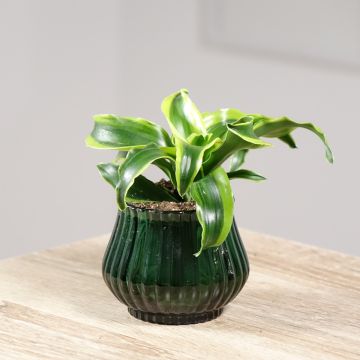
The Dracaena sanderiana is much better known by its common name Lucky Bamboo, or in French Bambou de la chance. According to Chinese tradition, it is believed to bring happiness, fortune, and positive energy. This slow-growing indoor Dragoon plant forms green ringed stems that indeed resemble the canes of certain bamboos. Typically straight and upright, they can be playfully twisted into spirals or braided together. Not particularly bushy, they bear one to three clusters of green, sword-shaped leaves at their tips. The plant adapts well to various growing conditions, whether in terms of humidity (from moderate to high), light levels (from low to bright, avoiding direct sunlight), or temperature (above 15°C).
After several reclassifications due to advances in systematic botany, the genus Dracaena (or Dragoon plant) is now a member of the Asparagaceae family. This family hosts many other ornamental genera as diverse in appearance as the Solomon's Seal (Polygonatum commutatum), with its arching stems adorned with graceful strings of white flowers, or the sculptural Dasylirion, with its rosettes of tough, extremely slender leaves. There are 111 species of Dracaena, primarily (though not exclusively) distributed across Africa and Southeast Asia. The Dracaena sanderiana itself originates from Cameroon in Central Africa, forming a ramified bush adapted to tropical climates and sensitive to cold. This botanical species can therefore only be grown indoors in our regions, at a minimum temperature of 15°C or preferably higher. Although not native to China, the Chinese have adopted it as a lucky plant associated with Feng Shui.
This Dracaena forms a a bright green stem about the thickness of a finger, marked by evenly spaced, pale-coloured nodes, giving the plant a bamboo-like appearance. Of course, it does not belong to the same botanical family as bamboos, which are Poaceae (grasses), and it's worth noting that other plants from different families share this whimsical resemblance, such as the Giant Dahlia (Dahlia imperialis) or Bamboo Dahlia. Your Lucky Bamboo, however, won’t become invasive, as its growth is slow and it won’t exceed 1.50 m at full maturity. Indoors, the stem does not branch out and stands upright unless twisted into a spiral, as horticulturists often do. It is crowned by one, two, or rarely three clusters of lanceolate leaves measuring 10 to 20 cm long. Their sheathing bases overlap, yet they stand almost vertically before arching elegantly. Tough, a vibrant green with a glossy surface, they also evoke the leaves of certain bamboos. The Lucky Bamboo is primarily valued for its graphic appearance as it does not flower indoors.
The plant can be grown in a pot with compost or in hydroponics, with the base of the stems submerged in a container of water—adding a piece of charcoal can help prevent disease. However, it cannot thrive fully submerged in an aquarium...
The Lucky Bamboo is unmatched for adding a zen touch to any room. In a contemporary setting, it pairs beautifully with other graphic plants such as the Areca palm with its aesthetically divided leaves, or the Beaucarnea recurvata (Elephant's Foot) with its thick base resembling an elephant’s foot, topped by a dense tuft of long ribbon-like leaves. Some plants from the Bromeliads family that includes the pineapple, such as the Aechmea, which forms decorative leaf rosettes, will also make perfect companions for your Dracaena.
Report an error about the product description
Lucky bamboo - Dracaena sanderiana in pictures

Foliage
Plant habit
Botanical data
Dracaena
sanderiana
Asparagaceae
Lucky bamboo, Belgian evergreen, Ribbon plant
Central Africa
Location
Location
Maintenance & care
Watering tips
Potting advice, substrates and fertilisers
Houseplant care
Disease and pest advice
Maintenance & care
This item has not been reviewed yet - be the first to leave a review about it.
Recently viewed products
Haven't found what you were looking for?
Hardiness is the lowest winter temperature a plant can endure without suffering serious damage or even dying. However, hardiness is affected by location (a sheltered area, such as a patio), protection (winter cover) and soil type (hardiness is improved by well-drained soil).
In temperate climates, pruning of spring-flowering shrubs (forsythia, spireas, etc.) should be done just after flowering.
Pruning of summer-flowering shrubs (Indian Lilac, Perovskia, etc.) can be done in winter or spring.
In cold regions as well as with frost-sensitive plants, avoid pruning too early when severe frosts may still occur.
The harvesting period indicated on our website applies to countries and regions in USDA zone 8 (France, England, Ireland, the Netherlands).
In colder areas (Scandinavia, Poland, Austria...) fruit and vegetable harvests are likely to be delayed by 3-4 weeks.
In warmer areas (Italy, Spain, Greece, etc.), harvesting will probably take place earlier, depending on weather conditions.
The sowing periods indicated on our website apply to countries and regions within USDA Zone 8 (France, UK, Ireland, Netherlands).
In colder areas (Scandinavia, Poland, Austria...), delay any outdoor sowing by 3-4 weeks, or sow under glass.
In warmer climes (Italy, Spain, Greece, etc.), bring outdoor sowing forward by a few weeks.
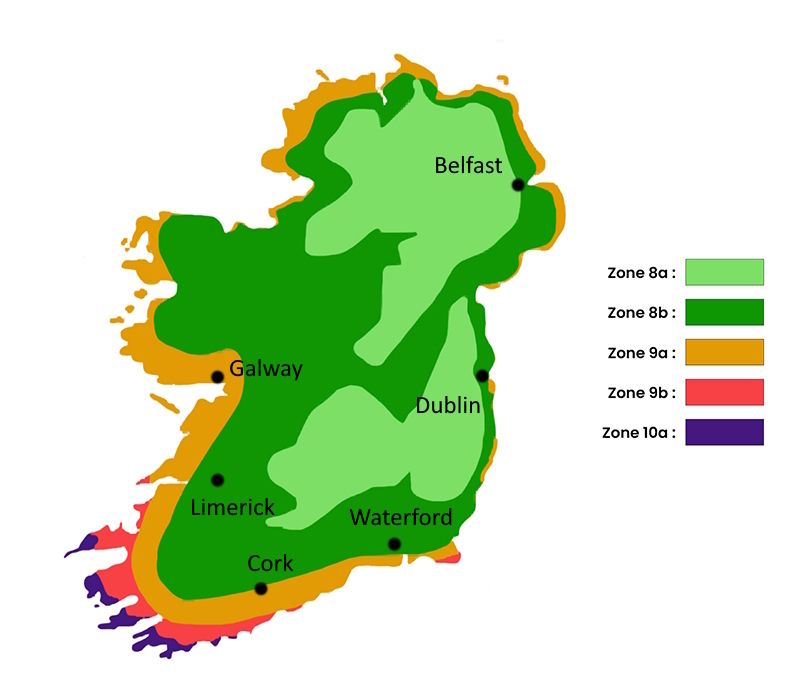
The planting period indicated on our website applies to regions in USDA Zone 9a (East Coast and Midlands: Dublin, Wexford, Waterford, Kilkenny, Portlaoise). It will vary depending on where you live:
- On the west coast and in the north-west (Galway, Limerick, Sligo, Donegal, Westport), delay planting by 1 to 2 weeks in spring and bring it forward by 1 to 2 weeks in autumn compared to the dates given, preferably choosing periods without strong winds.
- In the inland hills and plateaus (Wicklow Mountains, Macgillycuddy’s Reeks, Connemara, Killarney), it is best to plant in spring (April–May) or autumn (September–October), avoiding periods of waterlogged soil in winter and strong winds, which pose the main risk to newly planted trees in these areas.
The flowering period indicated on our website applies to regions in USDA Zone 9a, such as the East Coast and Midlands, including Dublin, Wexford, Waterford, Kilkenny and Portlaoise.
This will vary depending on where you live:
- On the west coast and in the northwest (Galway, Limerick, Sligo, Donegal and Westport), it will be delayed by one to two weeks compared to the given dates, due to stronger Atlantic winds and less spring sunshine.
- In the inland hills and plateaus (the Wicklow Mountains, the Macgillycuddy's Reeks, Connemara and Killarney), flowering will be delayed by two to three weeks. Flowering mainly occurs between May and July, with the limiting factors being less frost and more of the excessive humidity, strong winds and lack of sunshine that are characteristic of these areas.
Shipping country and language
Your country of residence may be:
Your country of residence is:
For a better user experience on our website, you can select:
Your shipping country:
-
 Austria
-
 Belgium
-
 Bosnia & Herzegovina
-
 Bulgaria
-
 Croatia
-
 Cyprus
-
 Czechia
-
 Denmark
-
 Estonia
-
 Finland
-
 France
-
 Germany
-
 Greece
-
 Hungary
-
 Iceland
-
 Ireland
-
 Italy
Italy
-
 Latvia
-
 Liechtenstein
-
 Lithuania
-
 Luxembourg
-
 Malta
Malta
-
 Netherlands
-
 Poland
-
 Portugal
-
 Romania
-
 Serbia
-
 Slovakia
-
 Slovenia
-
 Spain
Spain
-
 Sweden
-
 Switzerland
Language:
-
French
-
 English
-
Spanish
-
Italian
-
German
-
Portuguese
-
Dutch
-
Finnish
My Account
Hello
My wish lists
My cart
Log in / Register
Existing customer?
This form is protected by reCAPTCHA - the Google Privacy Policy and Terms of Service apply.
New customer?
Create an account to track your orders, access our customer service and, if you wish, make the most of our upcoming offers.