
Dracaena fragrans White Jewel - Corn plant

Dracaena fragrans White Jewel - Corn plant

Dracaena fragrans White Jewel - Corn plant

Dracaena fragrans White Jewel - Corn plant
Dracaena fragrans White Jewel - Corn plant
Dracaena fragrans White Jewel
Corn plant
Back-to-school special offer!
Get €10 off for every €50 you spend! And get up to €40 off on a single order.
How does it work?
1. Shop your favourites
Add your favourite plants to your basket. For every €50 you spend (excluding delivery charges, store credit and the plastic-free option), you’ll receive a €10 voucher.
€50 spent = €10 voucher
€100 spent = €20 voucher
€150 spent = €30 voucher
€200 spent = €40 voucher
2. Place your order
Once your basket reaches one of the spending thresholds, place your order. You can even choose your delivery date!
3. Receive your voucher
As soon as your order has been shipped, you’ll receive an email containing your personal voucher code and its value.
4. Use it on your next order
Your voucher is valid for 90 days from the date you receive it. It can be used once only, on a new order worth at least the value of the voucher, excluding delivery charges.
Please note: Vouchers can be combined with other offers, but cannot be split or refunded.
Home or relay delivery (depending on size and destination)
Important: You may be charged customs duties by your country’s customs authorities upon delivery.
Schedule delivery date
and select date in basket
This plant carries a 30 days recovery warranty
More information
We guarantee the quality of our plants for a full growing cycle, and will replace at our expense any plant that fails to recover under normal climatic and planting conditions.
Description
The Dracaena fragrans 'White Jewel' (also known as Dracaena deremensis 'White Jewel') is an extremely attractive variety of indoor Dragon Tree, prized both for its unparalleled graphic silhouette and its beautifully contrasting foliage. The long, sword-shaped leaves are striated lengthwise with varying shades of green and white, enhancing their aesthetic form. Resembling a small palm tree, the initial clump gradually rises above the slender stem that forms over the years. Sculptural and colourful, this plant is easy to grow and requires minimal maintenance. It will add a touch of exotic flair to your room.
The Dracaena has changed botanical families several times before joining the asparagus family, the Asparagaceae. Here, it coexists with many other highly varied ornamental genera such as hyacinths (Hyacinthus) or Agaves. Depending on classifications, there are roughly 111 species of Dragon Tree, the common name for Dracaena, mostly native to Africa and Southeast Asia, but they can also be found in other regions (Canary Islands, Central America, etc.). The Dracaena fragrans, formerly also called Cordyline fragrans, grows in Africa's tropical zones, from sea level up to 1,500 metres in altitude. Forming dense stands in dry forests or on hillsides, the bush can reach 6 metres in height, with rarely ramified stems, measuring 2.5 to 10 cm in diameter. These support clusters of elongated, sword-shaped leaves measuring 30 cm to 1 metre in length. The inflorescences, 40 to 60 cm long, are made of a multitude of small, white-yellow flowers that open at night, releasing a very pleasant fragrance—hence the species name ('fragrans' meaning fragrant).
The Dracaena fragrans 'White Jewel' is a horticultural variety selected for the beauty of its foliage. With moderate to slow growth, this plant will not exceed 2 metres in height and 60 to 80 cm in width at maturity indoors. Still, patience is required, as after 10 years of cultivation, it may only reach 1.20 to 1.50 metres in height. With its upright, columnar habit and much more modest development than the species type, this Dragon Tree will easily find its place in your home. Its absent flowering is more than compensated by the superior aesthetics of its foliage. This cultivar is indeed captivating due to the colouration of its leaves. Very elongated and tapering gradually to a point, they display a superb variegation with subtle variations between them. Several shades of green—dark green, olive green, or even lighter—coexist with white, stretching along the length of the lamina. Sometimes the white forms a peripheral margin, other times it creates variably broad stripes bordered by dark green... and the proportion of green tones is just as random, so that the plant's seemingly uniform appearance at first glance reveals itself as more complex and original upon closer inspection... Measuring around 30 centimetres in length, the leaves are gracefully incurved, forming a palm-like clump in their juvenile state. Gradually, a stem develops, lifting the clump and altering the plant's physionomy. Its graphic form will perfectly suit a contemporary décor and will harmonise equally well in an exotic plant setting. Beyond their beauty, Dragon Trees are reputed to purify the air around them—another reason to adopt one.
An attractive and easy-to-grow plant, capable of adapting to various light levels and humidity conditions, the Dragon Tree 'White Jewel' is an excellent choice for flats or houses as it will bring a touch of light without ever becoming cumbersome. Pair it with other plants offering a colourful foliage such as that the Aglaonema, choosing a cultivar with a dominant pink hue. An Anthurium 'Renaissance Variegata' with beautifully variegated foliage will also enable you to create a vibrant contrast. If, on the other hand, you prefer to play with colour similarities, opt for a Spathiphyllum whose dark green leaves and white spathes will perfectly complement your Dragon Tree.
Report an error about the product description
Dracaena fragrans White Jewel - Corn plant in pictures
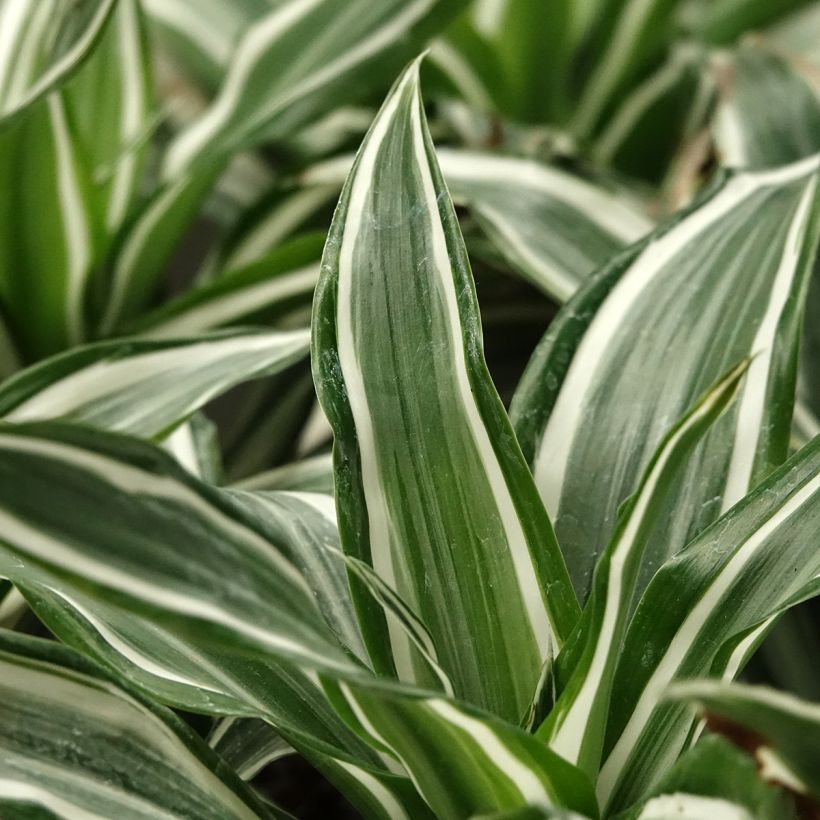

Foliage
Plant habit
Botanical data
Dracaena
fragrans
White Jewel
Asparagaceae
Corn plant
Cultivar or hybrid
Location
Location
Maintenance & care
Watering tips
Potting advice, substrates and fertilisers
Houseplant care
Disease and pest advice
Maintenance & care
This item has not been reviewed yet - be the first to leave a review about it.
Recently viewed products
Haven't found what you were looking for?
Hardiness is the lowest winter temperature a plant can endure without suffering serious damage or even dying. However, hardiness is affected by location (a sheltered area, such as a patio), protection (winter cover) and soil type (hardiness is improved by well-drained soil).
In temperate climates, pruning of spring-flowering shrubs (forsythia, spireas, etc.) should be done just after flowering.
Pruning of summer-flowering shrubs (Indian Lilac, Perovskia, etc.) can be done in winter or spring.
In cold regions as well as with frost-sensitive plants, avoid pruning too early when severe frosts may still occur.
The harvesting period indicated on our website applies to countries and regions in USDA zone 8 (France, England, Ireland, the Netherlands).
In colder areas (Scandinavia, Poland, Austria...) fruit and vegetable harvests are likely to be delayed by 3-4 weeks.
In warmer areas (Italy, Spain, Greece, etc.), harvesting will probably take place earlier, depending on weather conditions.
The sowing periods indicated on our website apply to countries and regions within USDA Zone 8 (France, UK, Ireland, Netherlands).
In colder areas (Scandinavia, Poland, Austria...), delay any outdoor sowing by 3-4 weeks, or sow under glass.
In warmer climes (Italy, Spain, Greece, etc.), bring outdoor sowing forward by a few weeks.
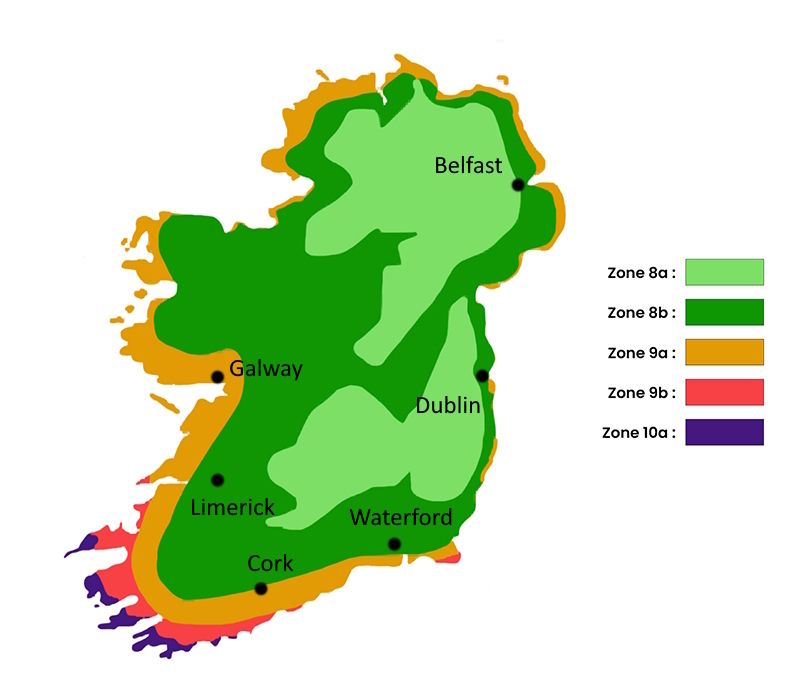
The planting period indicated on our website applies to regions in USDA Zone 9a (East Coast and Midlands: Dublin, Wexford, Waterford, Kilkenny, Portlaoise). It will vary depending on where you live:
- On the west coast and in the north-west (Galway, Limerick, Sligo, Donegal, Westport), delay planting by 1 to 2 weeks in spring and bring it forward by 1 to 2 weeks in autumn compared to the dates given, preferably choosing periods without strong winds.
- In the inland hills and plateaus (Wicklow Mountains, Macgillycuddy’s Reeks, Connemara, Killarney), it is best to plant in spring (April–May) or autumn (September–October), avoiding periods of waterlogged soil in winter and strong winds, which pose the main risk to newly planted trees in these areas.
The flowering period indicated on our website applies to regions in USDA Zone 9a, such as the East Coast and Midlands, including Dublin, Wexford, Waterford, Kilkenny and Portlaoise.
This will vary depending on where you live:
- On the west coast and in the northwest (Galway, Limerick, Sligo, Donegal and Westport), it will be delayed by one to two weeks compared to the given dates, due to stronger Atlantic winds and less spring sunshine.
- In the inland hills and plateaus (the Wicklow Mountains, the Macgillycuddy's Reeks, Connemara and Killarney), flowering will be delayed by two to three weeks. Flowering mainly occurs between May and July, with the limiting factors being less frost and more of the excessive humidity, strong winds and lack of sunshine that are characteristic of these areas.
Shipping country and language
Your country of residence may be:
Your country of residence is:
For a better user experience on our website, you can select:
Your shipping country:
-
 Austria
-
 Belgium
-
 Bosnia & Herzegovina
-
 Bulgaria
-
 Croatia
-
 Cyprus
-
 Czechia
-
 Denmark
-
 Estonia
-
 Finland
-
 France
-
 Germany
-
 Greece
-
 Hungary
-
 Iceland
-
 Ireland
-
 Italy
Italy
-
 Latvia
-
 Liechtenstein
-
 Lithuania
-
 Luxembourg
-
 Malta
Malta
-
 Netherlands
-
 Poland
-
 Portugal
-
 Romania
-
 Serbia
-
 Slovakia
-
 Slovenia
-
 Spain
Spain
-
 Sweden
-
 Switzerland
Language:
-
French
-
 English
-
Spanish
-
Italian
-
German
-
Portuguese
-
Dutch
-
Finnish
My Account
Hello
My wish lists
My cart
Log in / Register
Existing customer?
This form is protected by reCAPTCHA - the Google Privacy Policy and Terms of Service apply.
New customer?
Create an account to track your orders, access our customer service and, if you wish, make the most of our upcoming offers.