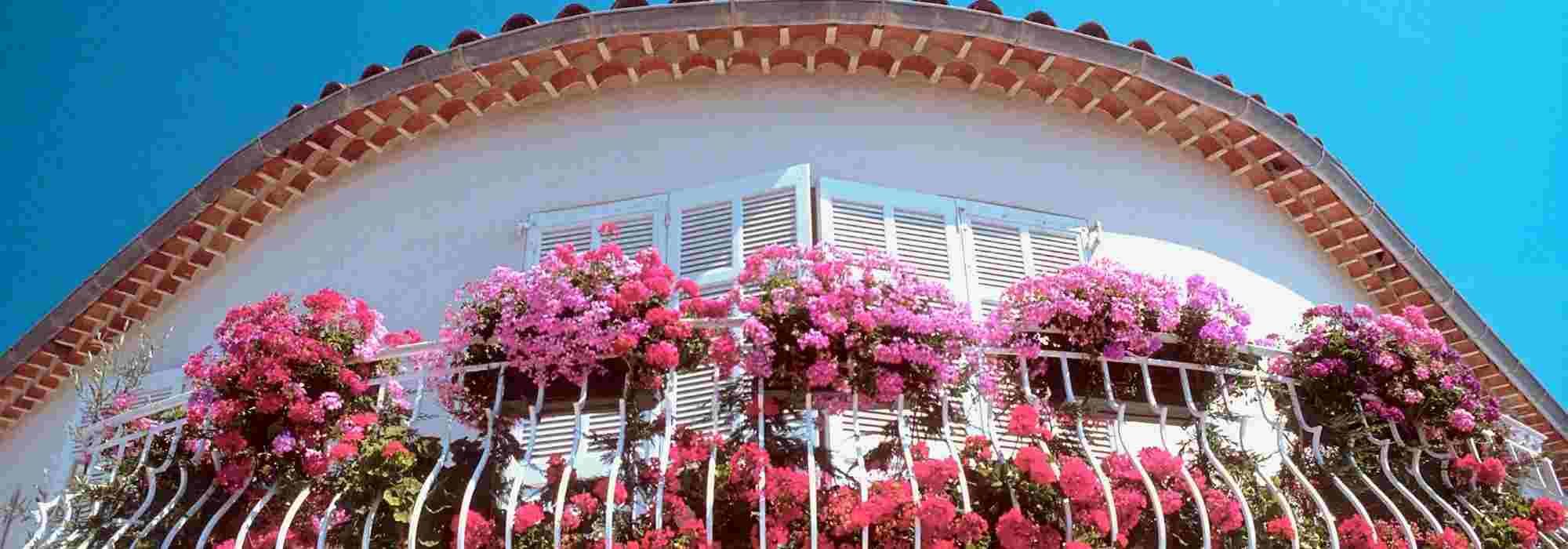
Fertilisers for window boxes and containers: when and how to use them?
Tips for choosing the most suitable fertilisation
Contents
Dipladenias, petunias, surfinias and calibrachoas, geraniums and pelargoniums, begonias and bacopas… in summer, on windowsills, balconies and terraces, in courtyards and patios, or even in the garden, annual, biennial or perennial plants grown in window boxes, tubs or pots put on a spectacular display with their abundant, colourful flowering. However, to achieve a profusion of flowers, watering must be regular, as must the removal of faded flowers.
As for fertilisation, it is essential. Applying fertiliser specially designed for window boxes and containers allows the plants to perform at their best.
Discover our complete guide to fertilisers for flowering plants in window boxes and containers: which forms should you choose? How much should you use? When should you apply them?
How to choose fertiliser for containers and pots?
Quite reasonably, you expect your annuals, biennials or perennials, grown in window boxes, hanging baskets or pots, to reward you with beautiful, abundant and colourful flowers throughout the summer.
Why add fertiliser to balcony plants?
At the same time, however, these plants grow in sometimes difficult conditions, constrained as they are by the limited space in their containers and their largely sunny position. Indeed, these geraniums, petunias, lobelias, annual verbenas and other bacopas expend a great deal of energy to flower. They therefore need nutrients to put on a show. Much more than the same plants grown in the open ground.
On the one hand, flowering plants grown in containers have much less growing medium. This means fewer minerals and trace elements available to them. On the other hand, this same growing medium, provided in limited quantities, becomes depleted very quickly. Quite simply because of watering and rain. Any excess water added to window boxes, containers and hanging baskets tends to escape through the drainage holes, taking the nutrients with it. In the open ground, however, water charged with nutrients rises through capillary action to feed the plants. And as plants on balconies and terraces are generally watered several times a week, nutrients are lost in large quantities.
This is why regular applications of fertiliser are essential for healthy growth, but above all for spectacular flowering. But not just any fertiliser!
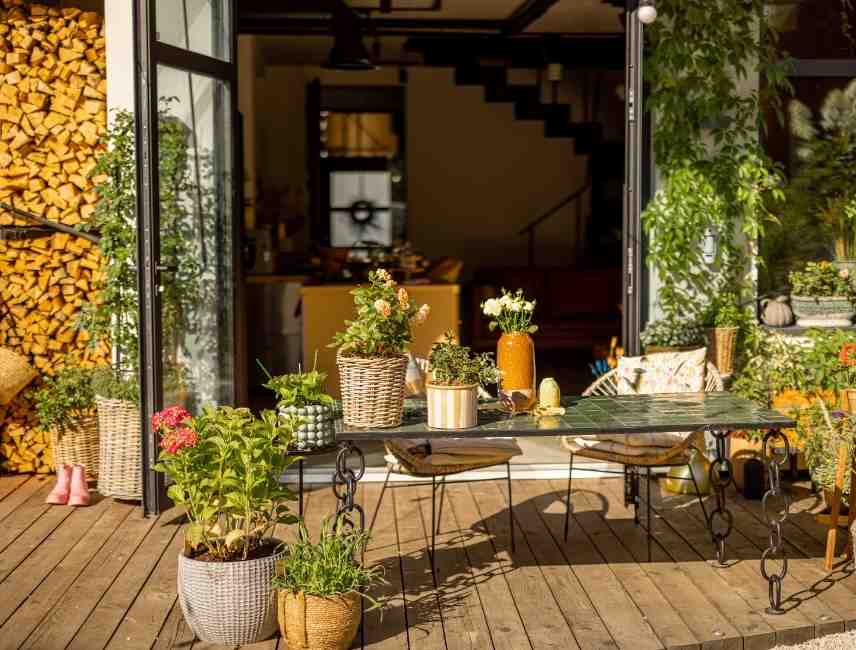
In pots or window boxes, the growing medium around plants becomes depleted quickly. Fertiliser provides plants with nourishment.
Which fertilisers are suitable for plants in window boxes and pots?
For flowering plants grown in pots, choose fertilisers rich in phosphorus (P) and potassium (K), two primary macro-elements that are useful for root system development and flower formation. Nitrogen, on the other hand, contributes more to the growth of the plant’s aerial parts, namely the stems, leaves and buds. However, if your window boxes contain flowering annuals and perennials chosen for their foliage (Coleus, heuchera, hosta…), nitrogen is also necessary.
That is why, for your window boxes and hanging baskets of flowering plants, you will need to select fertilisers with an NPK formulation in which potassium (K) has the highest value. Some are even enriched with trace elements such as boron, copper and iron… to remedy the main deficiencies. Others contain magnesium, which is necessary for the development of attractive, deep green foliage. In any case, these fertilisers are clearly identified as being specially suitable for geranium-type flowering balcony plants.
Read also
Potted plants: how to grow and care?The different types of fertiliser and their uses
You now know which fertiliser is best suited to your plants in containers, hanging baskets and pots. But a new dilemma presents itself. Organic, mineral and organo-mineral fertilisers are available in three particular forms: granules or powders, sticks and liquids. So which should you choose: solid or soluble fertilisers?
- Granular or powdered fertilisers: these are generally slow-release fertilisers that release nutrients over a long period, covering approximately the three months of peak flowering. Most often organic in origin, these solid fertilisers take time to break down and release their nutrients. They therefore help to prevent potential over-fertilisation problems, but they do require a little preparation to incorporate them into the growing medium.
- Fertiliser sticks: these are also slow-release solid fertilisers, perfectly suited to flowering plants grown in pots, hanging baskets or containers. Some are specifically intended for houseplants. They are very easy to use and there is no risk of over-fertilisation.
- Liquid fertilisers: these are diluted in the watering water for a “boost” effect. They are fast-release fertilisers that are also well suited to potted plants. The nutrients can therefore be absorbed very quickly. These fertilisers are very easy to use, but there is always a risk of over-fertilisation if the doses and application frequency are not followed.
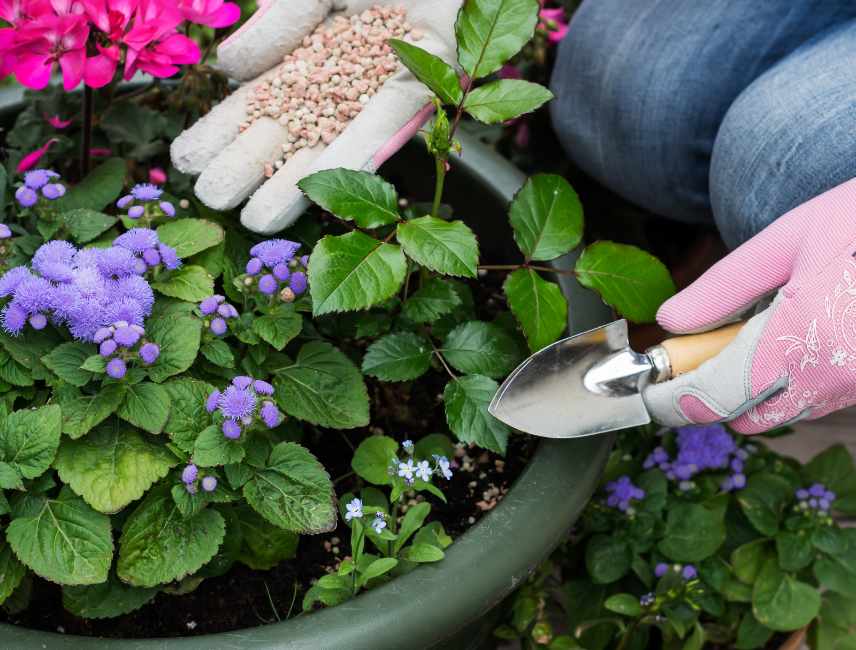
There are three types of fertiliser for containers and pots: granules or powder, sticks or liquid.
In practical terms, for plants in containers, pots or hanging baskets, we recommend using a slow-release solid fertiliser and a liquid fertiliser with a booster effect. These plants have considerably increased nutrient requirements, and both types of fertiliser will be needed to meet them. Without this fertilisation, your annual or perennial plants may languish and fail to flower as well as they could.
When and how should they be applied?
Let us now look at how and when to apply them. As we have seen above, to keep container-grown and potted plants healthy and encourage flowering, it is advisable to use two different fertilisers.
Slow-release fertilisers, whether in powder, granule or stick form, are applied when planting in spring. They will then release their nutrients to the plants gradually over a long period. As this type of fertiliser releases its nutrients for around two to three months, you can apply it again during the summer, in August or September, to enjoy beautiful flowers for even longer. When it comes to dosage, it is essential to follow the instructions on the labels of the different brands. Above all, respect the recommended doses to avoid deficiencies and causing the opposite effects.
When planting, simply mix the solid fertiliser into the growing medium. If you wish to add more during the growing season, scatter the powder or granules over the potting compost, then incorporate them by lightly raking the surface. Then water thoroughly to dissolve the fertiliser.
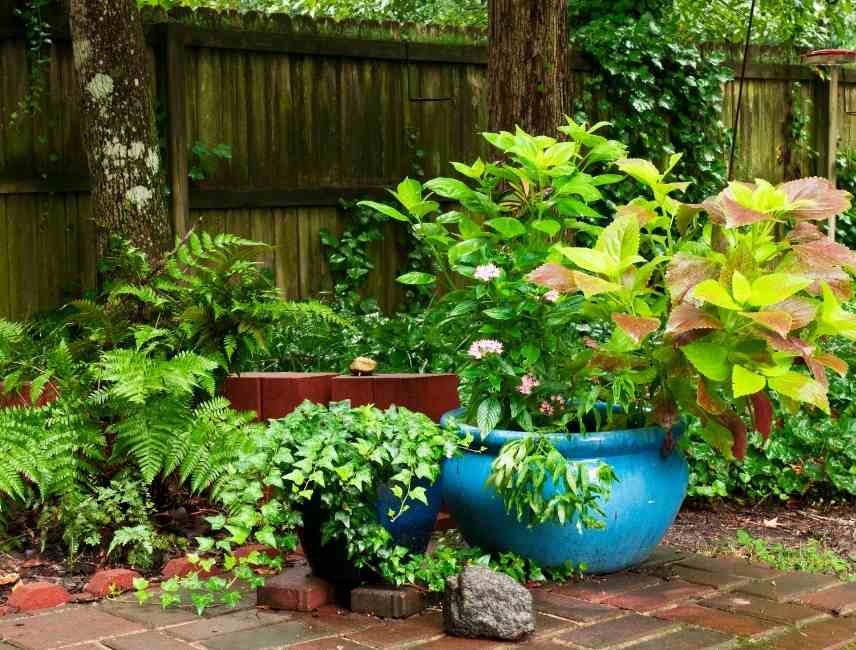
Plants grown in pots need regular applications of fertiliser.
Fertiliser sticks are easier to use. Simply push them into the potting compost. Their nutrients will be released gradually as you water.
Immediate- or fast-release fertilisers, usually soluble, are used when watering during the growing season, which runs approximately from April to September, depending on the varieties of annuals or perennials. Dosages and application intervals vary between brands. This information is clearly explained on the packaging.
Simply mix the contents of the cap into the water in the watering can. For better dilution, it is preferable to moisten the growing medium slightly before watering with the fertiliser solution.
- Subscribe!
- Contents
This form is protected by reCAPTCHA - the Google Privacy Policy and Terms of Service apply.

































Comments