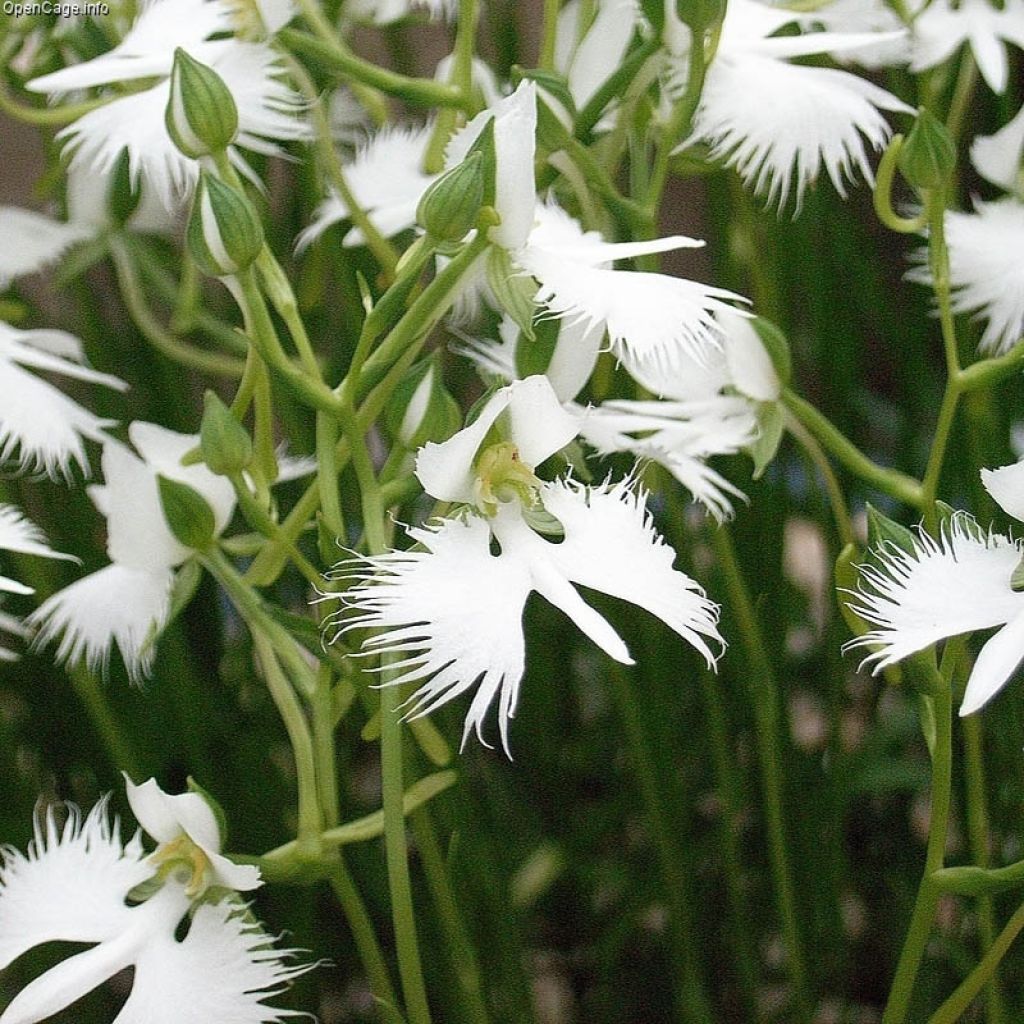
Habenaria radiata Variegata
Habenaria radiata Variegata
Habenaria radiata Variegata
White egret flower, Fringed orchid, Crane orchid
The bud is normal I'll see if it sprouts
Annie, 23/04/2021
Back-to-school special offer!
Get €10 off for every €50 you spend! And get up to €40 off on a single order.
How does it work?
1. Shop your favourites
Add your favourite plants to your basket. For every €50 you spend (excluding delivery charges, store credit and the plastic-free option), you’ll receive a €10 voucher.
€50 spent = €10 voucher
€100 spent = €20 voucher
€150 spent = €30 voucher
€200 spent = €40 voucher
2. Place your order
Once your basket reaches one of the spending thresholds, place your order. You can even choose your delivery date!
3. Receive your voucher
As soon as your order has been shipped, you’ll receive an email containing your personal voucher code and its value.
4. Use it on your next order
Your voucher is valid for 90 days from the date you receive it. It can be used once only, on a new order worth at least the value of the voucher, excluding delivery charges.
Please note: Vouchers can be combined with other offers, but cannot be split or refunded.
Why not try an alternative variety in stock?
View all →
Available in 1 sizes

Available in 1 sizes
Available in 3 sizes
Available in 3 sizes

Available in 2 sizes
Available in 5 sizes
Available in 3 sizes
Available in 3 sizes
Available in 1 sizes
Available in 2 sizes
This plant carries a 6 months recovery warranty
More information
We guarantee the quality of our plants for a full growing cycle, and will replace at our expense any plant that fails to recover under normal climatic and planting conditions.
Does this plant fit my garden?
Set up your Plantfit profile →
Description
Habenaria radiata 'Variegata', known as Variegated Dove Orchid or Egret Orchid, is a rare terrestrial orchid native to Japan that surpasses anything that can exist in the vegetable kingdom. Its summer flowering closely imitates a cluster of doves, as each pure white flower blooms like a bird taking flight, with wings spread. The foliage of this form is variegated with green and white. Not content with being beautiful, the flowers are slightly fragrant. This bulbous plant requires light substrate, water, and a bright exposure. It cannot tolerate any frost. It is a dreamlike plant, but quite difficult to cultivate, which will delight discerning collectors in wonderful pots.
Habenaria radiata 'Variegata' belongs to the Orchidaceae family. It is native to eastern Asia, but it is also found in temperate areas of America and Africa, where it grows in marshy but permeable soils that dry out in autumn. It is a 'cold' orchid, meaning it is not tropical and its vital optimum temperature is between 12 and 16°C (53.6 and 60.8°F). Habenaria radiata produces clusters of 2 to 8 delicately fragrant small white flowers for about four weeks in summer. They measure barely 3cm (1in) in diameter but deserve to be observed up close. The silhouette of each one evokes a white bird taking flight, its fringed wings widely spread, hence the vernacular name of dove orchid. The floral stems can reach 25 to 30cm (10 to 12in) in height, or even more. The leaves are also small (5 to 20 cm (2 to 8in) long), narrow (1cm (0.4in) wide), and ribbon-like. They are shiny medium green edged with white, and grouped in a tuft at the base of the stalks. Individuals that are born completely white die before flowering due to a lack of photosynthesis. Once the flowering is over, the floral stem and leaves dry up. The tuber that allowed them to develop becomes desiccated, having developed very small filamentous tubers. These baby tubers mature in October, before entering a dormant period until spring. This plant is currently endangered in its natural habitat.
The Variegated Egret Orchid is mainly cultivated in pots. Like a collectible item, it deserves care and some attention that will allow it to bloom in our latitudes. Nowadays, Habenaria radiata is mainly found in turf moors in highlands at altitudes above 500m (1640ft). These areas are not, in most cases, suitable for rice cultivation, so this plant, along with many other rare species, has found refuge in the last wild strongholds of modern Japan.
Report an error about the product description
Plant habit
Flowering
Foliage
Botanical data
Habenaria
radiata
Variegata
Orchidaceae
White egret flower, Fringed orchid, Crane orchid
Southeast Asia
Planting and care
The tubercles of Habenaria radiata 'Variegata' are very small. Plant them in a mixture of sphagnum and perlite or vermiculite (mostly sphagnum), or a mixture of light soil, sand, and gravel. The bulb should be placed vertically with the tip facing upwards and covered with 1cm (0.4in) of substrate. Water (only with osmosis water, rainwater or demineralised water) only when the sprout appears. From this stage, the substrate should never dry out until the plant starts to turn yellow in late summer, after flowering. Then, place the pot in a dry environment, with a humid atmosphere (the substrate remains dry), until spring. During the growing period, you can place the small pots in large containers filled with sphagnum, which have a water reserve that should be kept full, next to a source of light (bay window, large window, or outside). During the resting period, remove the pots from the turf moor and place them nearby where the ambient air remains humid. Habenaria radiata needs a sunny location to thrive. It does well on a patio or in a greenhouse. As it is very susceptible to rot, it requires light and regular watering during growth, while avoiding excess water, like all orchids. Tubercle repotting should be done at the end of the resting periods, in late winter.
Planting period
Intended location
Care
Planting & care advice
-

-
-
-

-
-

-
-
-
, onOrder confirmed
Reply from on Promesse de fleurs
Recently viewed products
Haven't found what you were looking for?
Hardiness is the lowest winter temperature a plant can endure without suffering serious damage or even dying. However, hardiness is affected by location (a sheltered area, such as a patio), protection (winter cover) and soil type (hardiness is improved by well-drained soil).
In temperate climates, pruning of spring-flowering shrubs (forsythia, spireas, etc.) should be done just after flowering.
Pruning of summer-flowering shrubs (Indian Lilac, Perovskia, etc.) can be done in winter or spring.
In cold regions as well as with frost-sensitive plants, avoid pruning too early when severe frosts may still occur.
The harvesting period indicated on our website applies to countries and regions in USDA zone 8 (France, England, Ireland, the Netherlands).
In colder areas (Scandinavia, Poland, Austria...) fruit and vegetable harvests are likely to be delayed by 3-4 weeks.
In warmer areas (Italy, Spain, Greece, etc.), harvesting will probably take place earlier, depending on weather conditions.
The sowing periods indicated on our website apply to countries and regions within USDA Zone 8 (France, UK, Ireland, Netherlands).
In colder areas (Scandinavia, Poland, Austria...), delay any outdoor sowing by 3-4 weeks, or sow under glass.
In warmer climes (Italy, Spain, Greece, etc.), bring outdoor sowing forward by a few weeks.
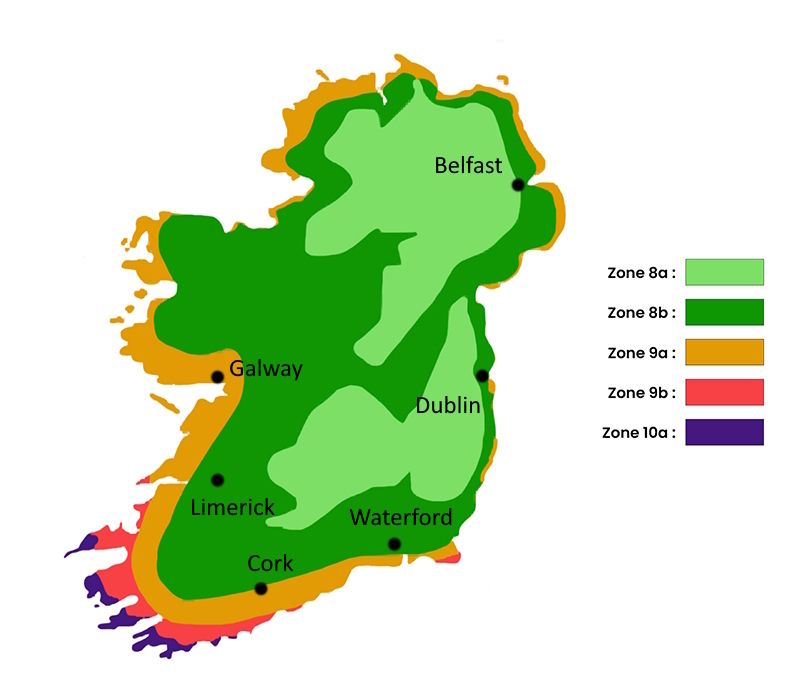
The planting period indicated on our website applies to regions in USDA Zone 9a (East Coast and Midlands: Dublin, Wexford, Waterford, Kilkenny, Portlaoise). It will vary depending on where you live:
- On the west coast and in the north-west (Galway, Limerick, Sligo, Donegal, Westport), delay planting by 1 to 2 weeks in spring and bring it forward by 1 to 2 weeks in autumn compared to the dates given, preferably choosing periods without strong winds.
- In the inland hills and plateaus (Wicklow Mountains, Macgillycuddy’s Reeks, Connemara, Killarney), it is best to plant in spring (April–May) or autumn (September–October), avoiding periods of waterlogged soil in winter and strong winds, which pose the main risk to newly planted trees in these areas.
The flowering period indicated on our website applies to regions in USDA Zone 9a, such as the East Coast and Midlands, including Dublin, Wexford, Waterford, Kilkenny and Portlaoise.
This will vary depending on where you live:
- On the west coast and in the northwest (Galway, Limerick, Sligo, Donegal and Westport), it will be delayed by one to two weeks compared to the given dates, due to stronger Atlantic winds and less spring sunshine.
- In the inland hills and plateaus (the Wicklow Mountains, the Macgillycuddy's Reeks, Connemara and Killarney), flowering will be delayed by two to three weeks. Flowering mainly occurs between May and July, with the limiting factors being less frost and more of the excessive humidity, strong winds and lack of sunshine that are characteristic of these areas.
Shipping country and language
Your country of residence may be:
Your country of residence is:
For a better user experience on our website, you can select:
Your shipping country:
-
 Austria
-
 Belgium
-
 Bosnia & Herzegovina
-
 Bulgaria
-
 Croatia
-
 Cyprus
-
 Czechia
-
 Denmark
-
 Estonia
-
 Finland
-
 France
-
 Germany
-
 Greece
-
 Hungary
-
 Iceland
-
 Ireland
-
 Italy
Italy
-
 Latvia
-
 Liechtenstein
-
 Lithuania
-
 Luxembourg
-
 Malta
Malta
-
 Netherlands
-
 Poland
-
 Portugal
-
 Romania
-
 Serbia
-
 Slovakia
-
 Slovenia
-
 Spain
Spain
-
 Sweden
-
 Switzerland
Language:
-
French
-
 English
-
Spanish
-
Italian
-
German
-
Portuguese
-
Dutch
-
Finnish
My Account
Hello
My wish lists
My cart
Log in / Register
Existing customer?
This form is protected by reCAPTCHA - the Google Privacy Policy and Terms of Service apply.
New customer?
Create an account to track your orders, access our customer service and, if you wish, make the most of our upcoming offers.