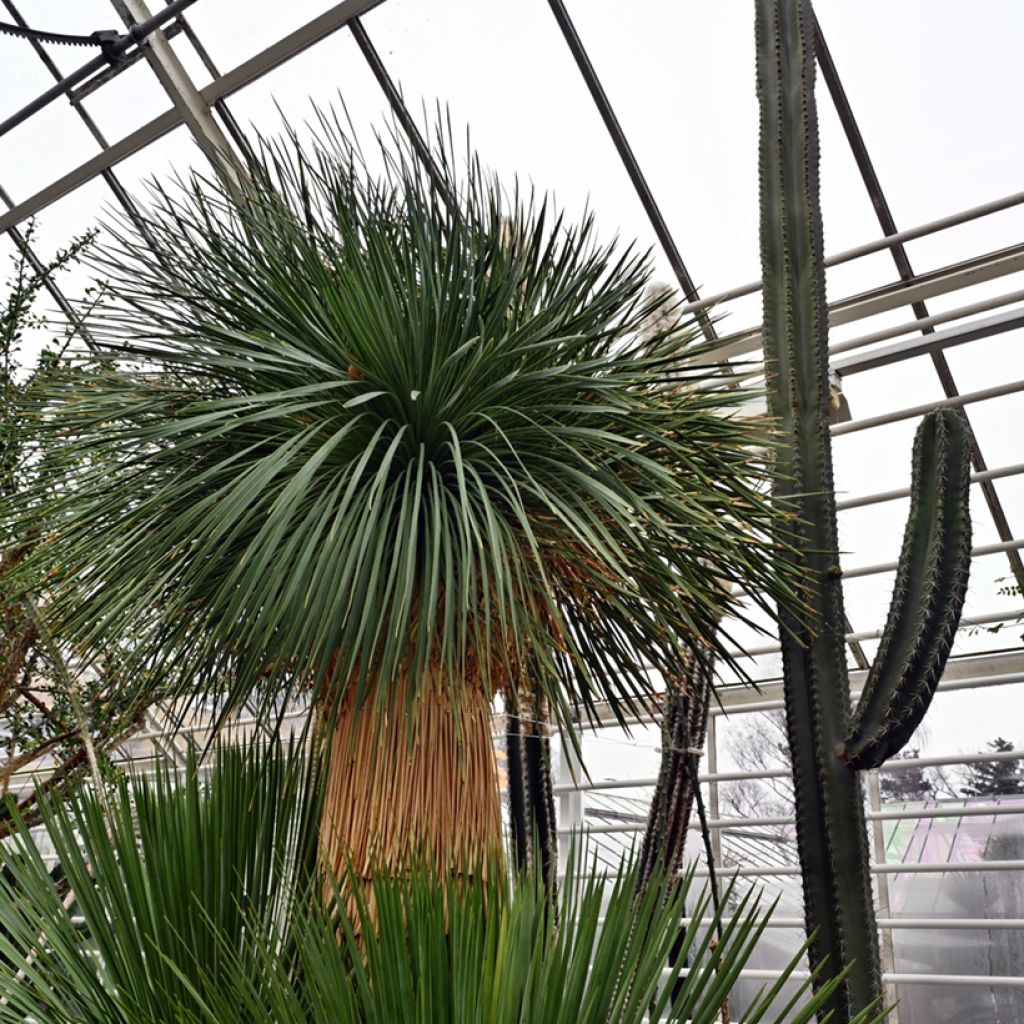
Yucca linearifolia GreenFin
Yucca linearifolia GreenFin
Yucca linearifolia GreenFin
Back-to-school special offer!
Get €10 off for every €50 you spend! And get up to €40 off on a single order.
How does it work?
1. Shop your favourites
Add your favourite plants to your basket. For every €50 you spend (excluding delivery charges, store credit and the plastic-free option), you’ll receive a €10 voucher.
€50 spent = €10 voucher
€100 spent = €20 voucher
€150 spent = €30 voucher
€200 spent = €40 voucher
2. Place your order
Once your basket reaches one of the spending thresholds, place your order. You can even choose your delivery date!
3. Receive your voucher
As soon as your order has been shipped, you’ll receive an email containing your personal voucher code and its value.
4. Use it on your next order
Your voucher is valid for 90 days from the date you receive it. It can be used once only, on a new order worth at least the value of the voucher, excluding delivery charges.
Please note: Vouchers can be combined with other offers, but cannot be split or refunded.
Why not try an alternative variety in stock?
View all →
Available in 3 sizes

Available in 2 sizes
Available in 2 sizes
Available in 1 sizes

Available in 1 sizes

Available in 1 sizes

Available in 1 sizes

Available in 1 sizes

Available in 1 sizes

Available in 1 sizes
This plant carries a 24 months recovery warranty
More information
We guarantee the quality of our plants for a full growing cycle, and will replace at our expense any plant that fails to recover under normal climatic and planting conditions.
Does this plant fit my garden?
Set up your Plantfit profile →
Description
Yucca linearifolia 'GreenFin' is a spectacular tree-like plant, with a desert charm, hardy in many regions. This variety of Yucca with linear leaves forms one or more trunks topped with a sphere composed of very fine, rigid, green leaves that become bluish in summer, playing with the light. After a few years, this variety will become the centrepiece of a large rock garden or exotic bed. Give it sun and well-drained, sandy or rocky soil.
Yucca linearifolia 'GreenFin' is a French horticultural selection by Frédéric Julien. The species, the Yucca with linear leaves, is native to the Chihuahuan Desert in the Mexican states of Coahuila and Nuevo Leon. It is a species closely related to Yucca rostrata known to be less sensitive to winter moisture and to have slightly faster growth. Yucca linearifolia can withstand temperatures to around -15°C in well-drained soil, and summer drought. It is a tree-like plant belonging to the asparagus family.
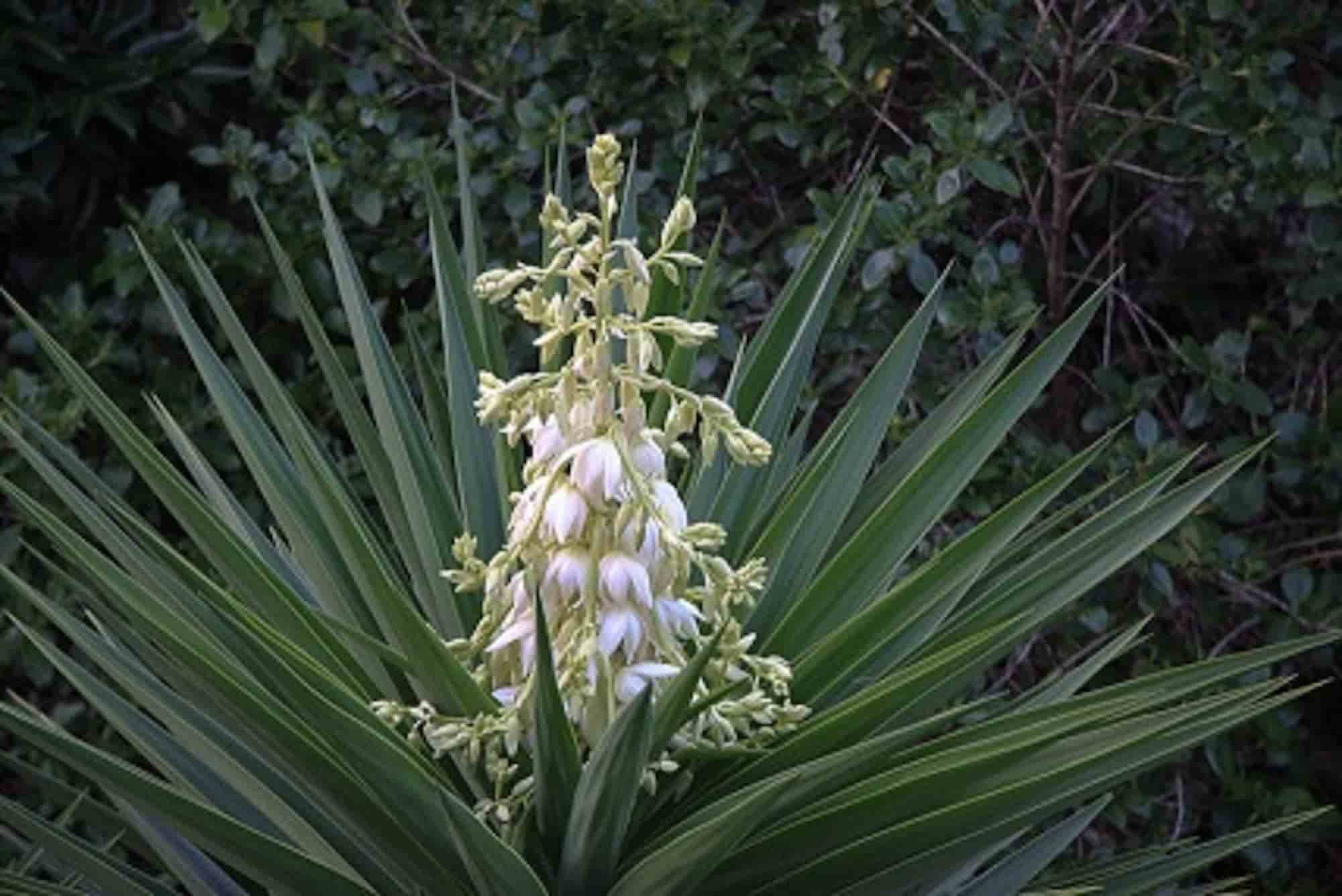
When young, the 'GreenFin' Yucca forms a dense, hairy ball composed of fine, long, finely toothed, rigid leaves. After several years, it forms a 2m tall trunk covered with a 'skirt' of dry leaves, which can branch out. This trunk bears a large spherical crown 1m to 1.20m wide, composed of a multitude of leaves. The leaves are initially grass green, then become bluish due to the layer of wax that forms on their epidermis. They measure 40 to 60cm in length and 5 to 7mm in width. The spectacular flowering occurs after 3 to 4 years of cultivation, from May to July. In this variety, the inflorescence is unique and emerges distinctly from the foliage. It develops into a large ovoid panicle. The bell-shaped, pendulous flowers are creamy yellow and waxy. They are borne on upright and branched panicles measuring 50 to 80cm high and carried at over 4m in height. When watered during the summer, this Yucca shows rapid growth. It produces a few shoots near its crown.
The 'GreenFin' Yucca requires plenty of sun and well-drained, rather poor and dry soil. It particularly dislikes waterlogged soils in winter. This beautiful plant will find a place on a large slope, in the centre of an exotic or contemporary rock garden, or even near a swimming pool. It should be kept away from walkways and young children, due to its sharp-pointed leaves. This large plant will simply be magnificent as a specimen, accompanied by a carpet of snow-in-summer (Cerastium), or even a lawn of Zoysia tenuifolia, the Mascarene grass. In a rocky setting, it can also be associated with agaves, prickly pears (Opuntia), and hardy candle cacti like Cylindropuntia imbricata. It can also be planted in a very large pot on the terrace. Choose the most sheltered spot, in full sun, and away from foot traffic to avoid contact with its sharp leaves.

Plant habit
Flowering
Foliage
Planting and care
Plant Yucca linearifolia GreenFin in spring, in a very sunny and sheltered location if your garden is in a borderline hardiness zone. An adult specimen will withstand brief frosts of around -15°C. Its growth is quite slow, boosted by generous but spaced waterings in summer, and fertile soil. In mild climates, plant in autumn, especially in regions with hot and dry summers. This plant hates very clayey soils and humidity, particularly when combined with severe cold: plant in well-drained soil, ideally in a large rockery, a raised bed with gravel-enriched soil, or a rocky slope. It is not fussy about soil pH, which can be slightly acidic, sandy, stony, loamy, or limestone. It tolerates poor soil, but its growth will be slightly faster in soil that is still fertile. Monitor watering during the first 2 years, especially in hot and dry periods. Remove faded stems.
Your Yucca is superb, but it doesn't flower? It is probably too young, or has only been planted in your garden for 3 or 4 years. This plant takes time to establish itself and only flowers after several years. Then, depending on the sunlight and climate, it will flower every year, or every two or three years.
Fertilisation in yuccas:
In their countries of origin, Yucca flowers are pollinated only by a few species of tiny primitive butterflies without proboscis that live in symbiosis with the plant, such as Prodoxus. The female of these butterflies carries pollen grains from one flower to the pistil of another. She lays a few eggs at the base of the flower. The young caterpillars feed on some of the seeds. Since Prodoxus is not part of our fauna, most yuccas cultivated in our gardens never produce fruits. Only Yucca aloifolia is capable of it, because its pollination does not depend on the presence of these micromoths.
Planting period
Intended location
Care
Planting & care advice







This item has not been reviewed yet - be the first to leave a review about it.
Recently viewed products
Haven't found what you were looking for?
Hardiness is the lowest winter temperature a plant can endure without suffering serious damage or even dying. However, hardiness is affected by location (a sheltered area, such as a patio), protection (winter cover) and soil type (hardiness is improved by well-drained soil).
In temperate climates, pruning of spring-flowering shrubs (forsythia, spireas, etc.) should be done just after flowering.
Pruning of summer-flowering shrubs (Indian Lilac, Perovskia, etc.) can be done in winter or spring.
In cold regions as well as with frost-sensitive plants, avoid pruning too early when severe frosts may still occur.
The harvesting period indicated on our website applies to countries and regions in USDA zone 8 (France, England, Ireland, the Netherlands).
In colder areas (Scandinavia, Poland, Austria...) fruit and vegetable harvests are likely to be delayed by 3-4 weeks.
In warmer areas (Italy, Spain, Greece, etc.), harvesting will probably take place earlier, depending on weather conditions.
The sowing periods indicated on our website apply to countries and regions within USDA Zone 8 (France, UK, Ireland, Netherlands).
In colder areas (Scandinavia, Poland, Austria...), delay any outdoor sowing by 3-4 weeks, or sow under glass.
In warmer climes (Italy, Spain, Greece, etc.), bring outdoor sowing forward by a few weeks.
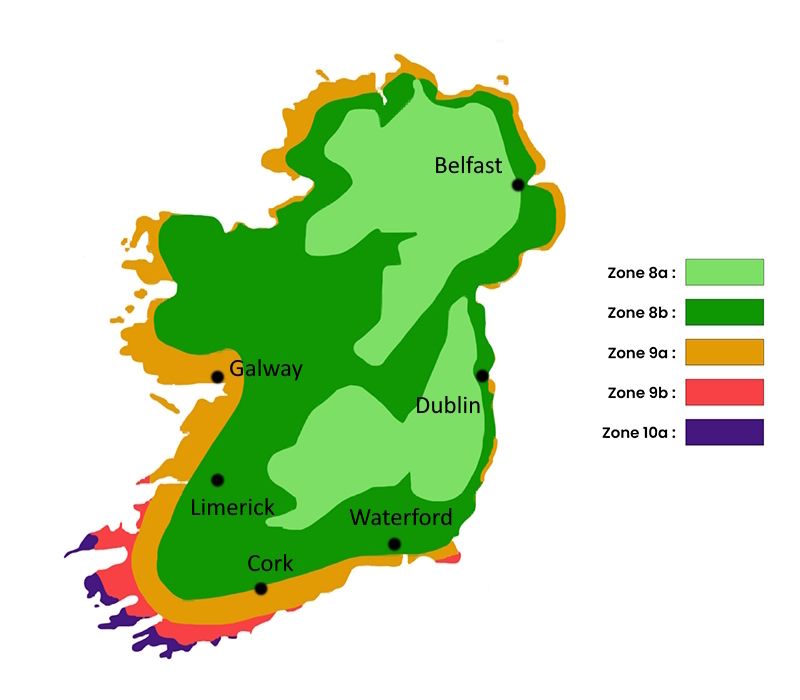
The planting period indicated on our website applies to regions in USDA Zone 9a (East Coast and Midlands: Dublin, Wexford, Waterford, Kilkenny, Portlaoise). It will vary depending on where you live:
- On the west coast and in the north-west (Galway, Limerick, Sligo, Donegal, Westport), delay planting by 1 to 2 weeks in spring and bring it forward by 1 to 2 weeks in autumn compared to the dates given, preferably choosing periods without strong winds.
- In the inland hills and plateaus (Wicklow Mountains, Macgillycuddy’s Reeks, Connemara, Killarney), it is best to plant in spring (April–May) or autumn (September–October), avoiding periods of waterlogged soil in winter and strong winds, which pose the main risk to newly planted trees in these areas.
The flowering period indicated on our website applies to regions in USDA Zone 9a, such as the East Coast and Midlands, including Dublin, Wexford, Waterford, Kilkenny and Portlaoise.
This will vary depending on where you live:
- On the west coast and in the northwest (Galway, Limerick, Sligo, Donegal and Westport), it will be delayed by one to two weeks compared to the given dates, due to stronger Atlantic winds and less spring sunshine.
- In the inland hills and plateaus (the Wicklow Mountains, the Macgillycuddy's Reeks, Connemara and Killarney), flowering will be delayed by two to three weeks. Flowering mainly occurs between May and July, with the limiting factors being less frost and more of the excessive humidity, strong winds and lack of sunshine that are characteristic of these areas.
Shipping country and language
Your country of residence may be:
Your country of residence is:
For a better user experience on our website, you can select:
Your shipping country:
-
 Austria
-
 Belgium
-
 Bosnia & Herzegovina
-
 Bulgaria
-
 Croatia
-
 Cyprus
-
 Czechia
-
 Denmark
-
 Estonia
-
 Finland
-
 France
-
 Germany
-
 Greece
-
 Hungary
-
 Iceland
-
 Ireland
-
 Italy
Italy
-
 Latvia
-
 Liechtenstein
-
 Lithuania
-
 Luxembourg
-
 Malta
Malta
-
 Netherlands
-
 Poland
-
 Portugal
-
 Romania
-
 Serbia
-
 Slovakia
-
 Slovenia
-
 Spain
Spain
-
 Sweden
-
 Switzerland
Language:
-
French
-
 English
-
Spanish
-
Italian
-
German
-
Portuguese
-
Dutch
-
Finnish
My Account
Hello
My wish lists
My cart
Log in / Register
Existing customer?
This form is protected by reCAPTCHA - the Google Privacy Policy and Terms of Service apply.
New customer?
Create an account to track your orders, access our customer service and, if you wish, make the most of our upcoming offers.