Hebe buxifolia - Box-leaved Hebe
Hebe buxifolia - Box-leaved Hebe
Hebe buxifolia
Box-leaved Hebe, Boxleaf Hebe, Boxwood Hebe
Back-to-school special offer!
Get €10 off for every €50 you spend! And get up to €40 off on a single order.
How does it work?
1. Shop your favourites
Add your favourite plants to your basket. For every €50 you spend (excluding delivery charges, store credit and the plastic-free option), you’ll receive a €10 voucher.
€50 spent = €10 voucher
€100 spent = €20 voucher
€150 spent = €30 voucher
€200 spent = €40 voucher
2. Place your order
Once your basket reaches one of the spending thresholds, place your order. You can even choose your delivery date!
3. Receive your voucher
As soon as your order has been shipped, you’ll receive an email containing your personal voucher code and its value.
4. Use it on your next order
Your voucher is valid for 90 days from the date you receive it. It can be used once only, on a new order worth at least the value of the voucher, excluding delivery charges.
Please note: Vouchers can be combined with other offers, but cannot be split or refunded.
Why not try an alternative variety in stock?
View all →
Available in 1 sizes

Available in 1 sizes

Available in 1 sizes

Available in 1 sizes

Available in 1 sizes
Available in 1 sizes
Available in 1 sizes
Available in 1 sizes
Available in 1 sizes

Available in 1 sizes
This plant carries a 24 months recovery warranty
More information
We guarantee the quality of our plants for a full growing cycle, and will replace at our expense any plant that fails to recover under normal climatic and planting conditions.
Does this plant fit my garden?
Set up your Plantfit profile →
Description
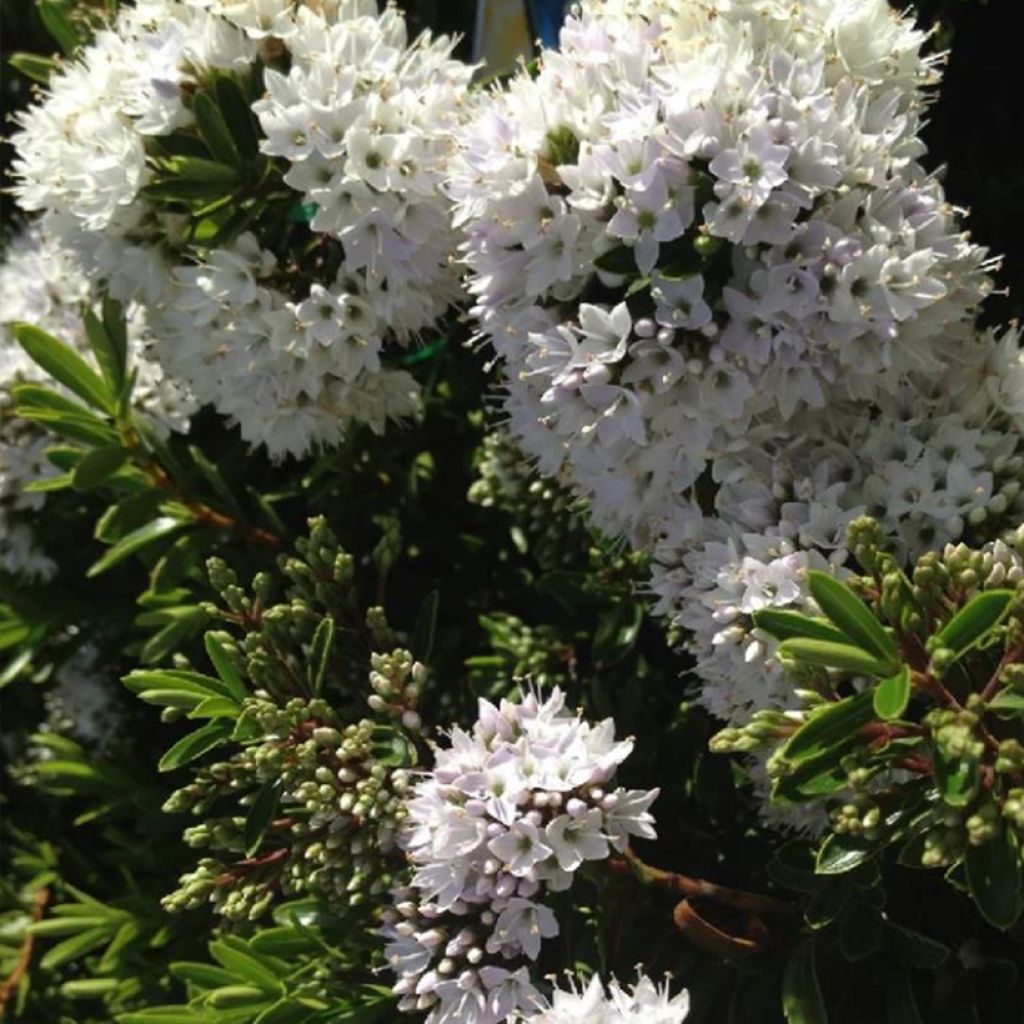
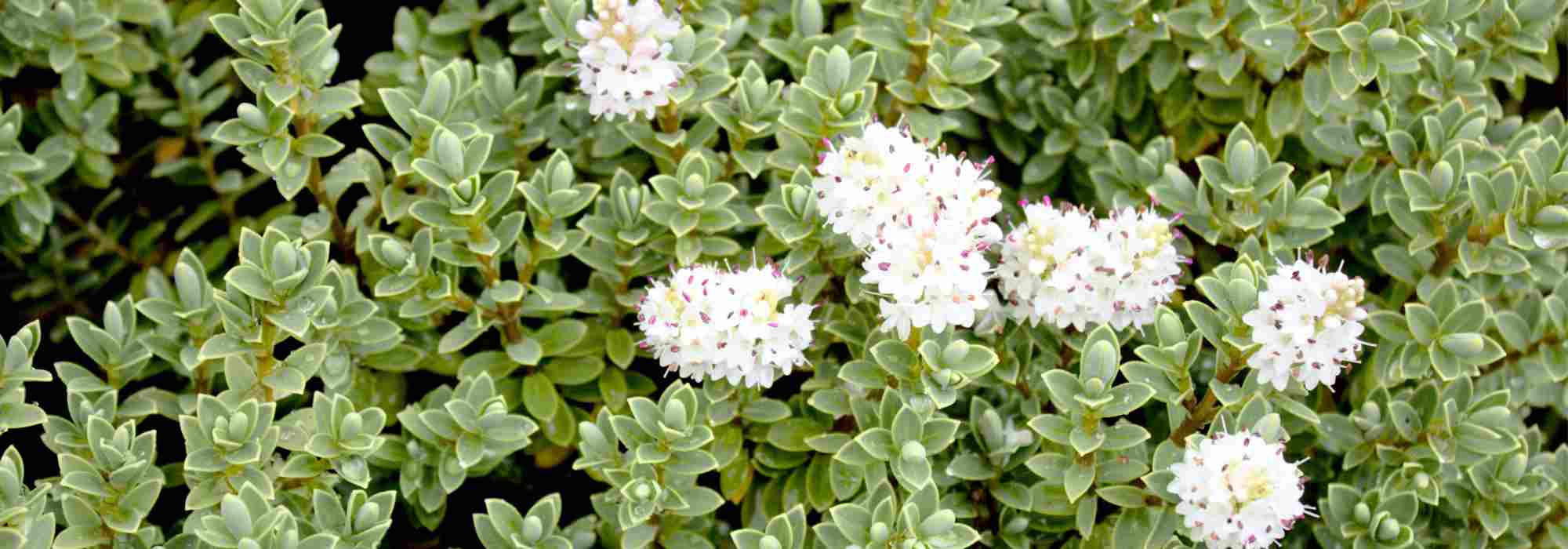
Hebe buxifolia is a variety of bush veronica that forms a spreading cushion, broader than high, evergreen, with a very ornamental design all year round. Its small glossy leaves are arranged in a cross pattern on the branches, giving it a very recognisable and aesthetic silhouette. At the end of spring, the plant produces white flowers grouped in short spikes at the tips of the branches. One of the hardiest of all (down to -15°C), this veronica can be planted in a border, a rockery, a bed, or in a pot on a terrace in particularly harsh climates.
Hebe, which traditionally belonged to the Scrophulariaceae family, has been reclassified by botanists since 2009 into the Plantaginaceae family, alongside Snapdragon (Antirrhinum) and Foxgloves, which are also transplants... The plants of the Hebe genus were themselves once part of the Veronica genus, the herbaceous veronicas, before being extracted to form a separate group that is indeed quite different. There are about one hundred species of Hebe, most of which are native to New Zealand, with others coming from Tasmania and southern Australia. The first bushy veronica introduced to Europe, Hebe elliptica, was brought back by George Forster during an expedition with the famous Captain Cook. Most of the species currently cultivated on our continent were imported a century later.
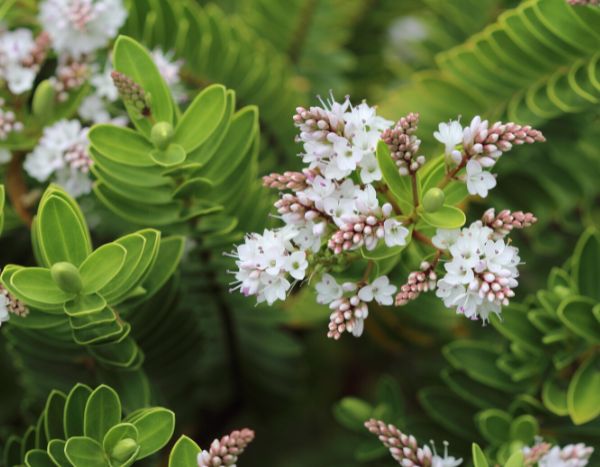
Hebe buxifolia, also known by the synonym Hebe odora, grows in both islands that make up New Zealand, at altitudes above 1200 m. This explains why it is one of the hardiest species, tolerating temperatures down to -15°C, or even lower in very good soil and exposure conditions. It is also the fastest-growing species with small leaves... in comparison to others, as bush veronicas are not speed champions. This low bush forms a regular, spreading cushion, usually reaching 50 cm in height and 70 cm in spread, but it can grow up to 1 m and form a much wider mass when it is happy in its location. The dense and compact branches create a very lush vegetation, which is excellent for forming bushy borders. They are adorned with small elongated obovate leaves that taper to a point, measuring only 8 to 12 mm in length. These thin leaves are dark green with a shiny surface on top, while the underside displays a lighter green. Their main originality, which contributes to the beauty of this bush, is that they are aligned in four ranks, giving the branches a very sculptural cross-section.
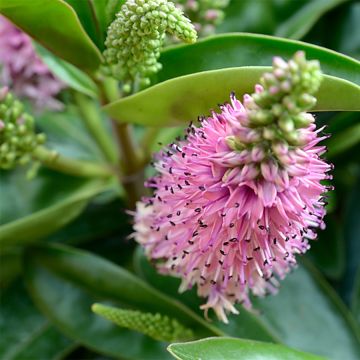
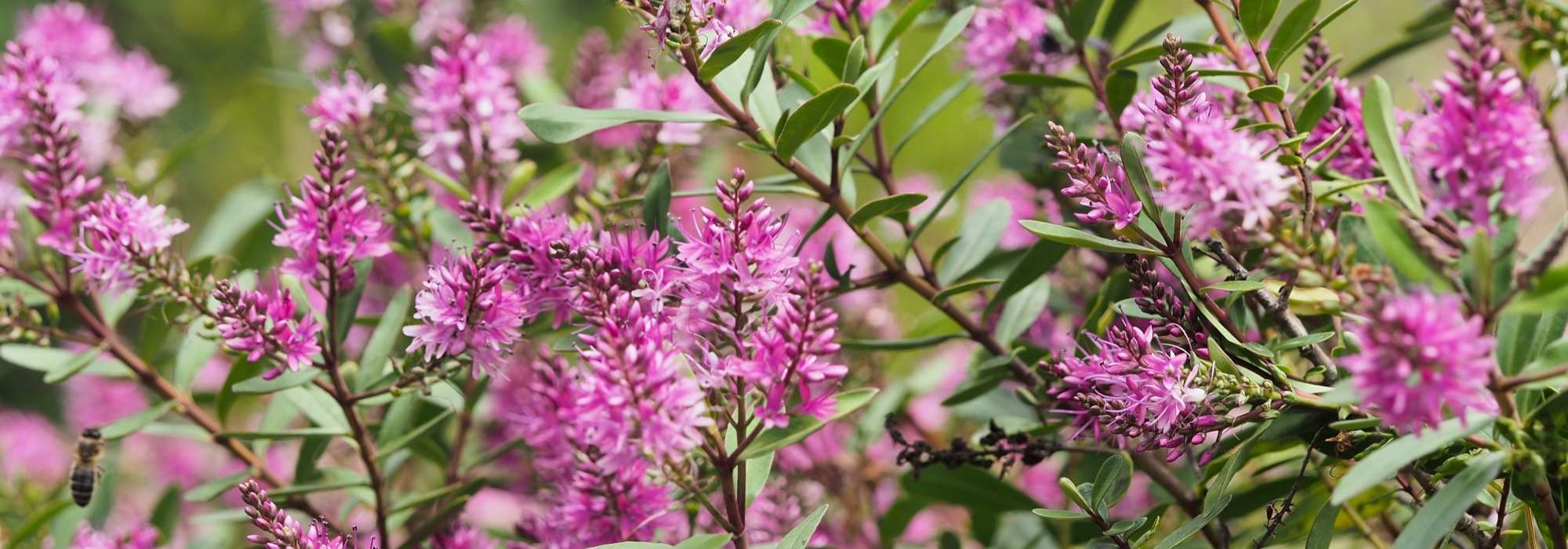
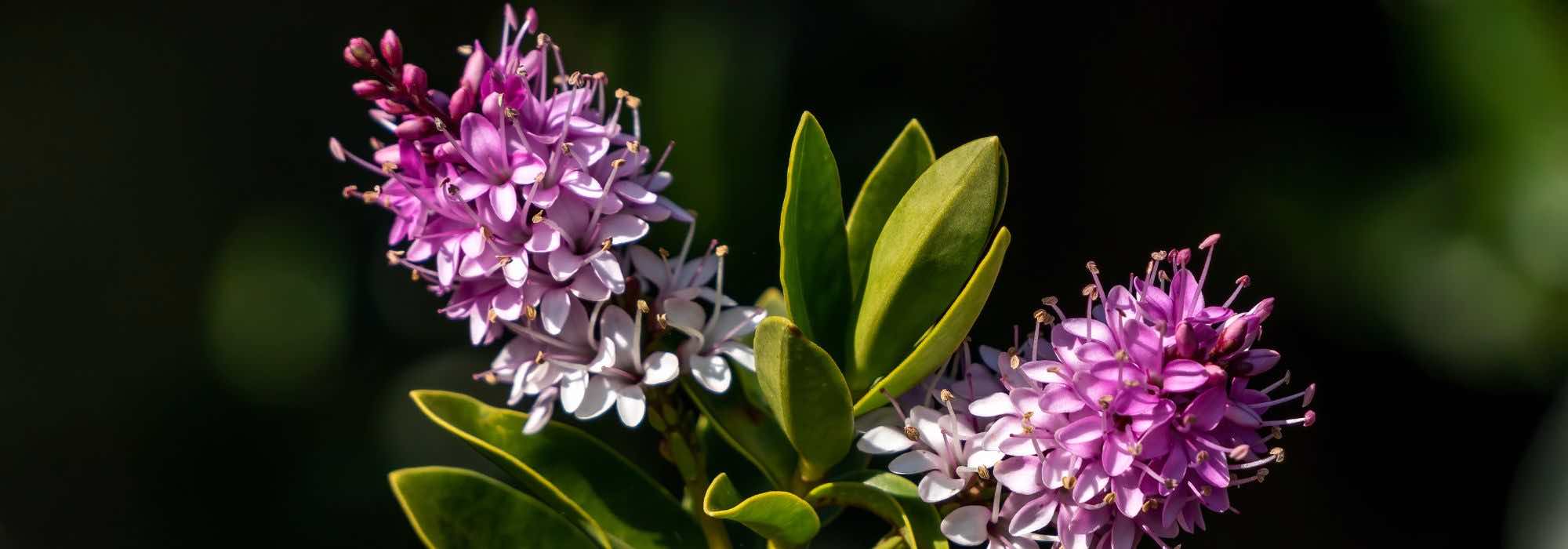
In June and July, 1.5 to 2.5 cm long spikes of very small flowers, measuring 6 to 8 mm in diameter, appear at the ends of the numerous branches. They are white, sometimes slightly tinged with lilac.
Hebe buxifolia, literally "box-leaved" due to its particular and sculptural foliage, is certainly not the most floriferous of species, but its good hardiness will allow most gardens to welcome it in open ground. In climates that are still too cold, it can be grown in a pot, trimming it occasionally if necessary. Thriving in sunny positions in most soils, it only dislikes stagnant water. Plant it in a bed alongside flowering plants, which will be highlighted by its dark foliage. The charming miniature rose 'Cutie Pie' will thus be enhanced at its feet, with its white and pink flowering renewing throughout the summer on a dome of vegetation only about fifteen centimetres high. Berberis thunbergii 'Tiny Gold' is another dwarf bush, 40 cm in all directions, whose foliage leaning towards yellow will create a superb colour contrast alongside your Hebe. In the background, you can reinforce this contrast by placing a specimen of Cotinus coggygria 'Winecraft Black', a dark purple bush, whose much larger rounded leaves than those of the Berberis and the Hebe will create a surprise effect. Its long-lasting, airy flowering and warm autumn colours will enliven your scene.
Plant habit
Flowering
Foliage
Botanical data
Hebe
buxifolia
Plantaginaceae
Box-leaved Hebe, Boxleaf Hebe, Boxwood Hebe
Hebe odora, Veronica odora, Hebe anomala, Veronica anomala, Veronica buxifolia
Oceania
Planting and care
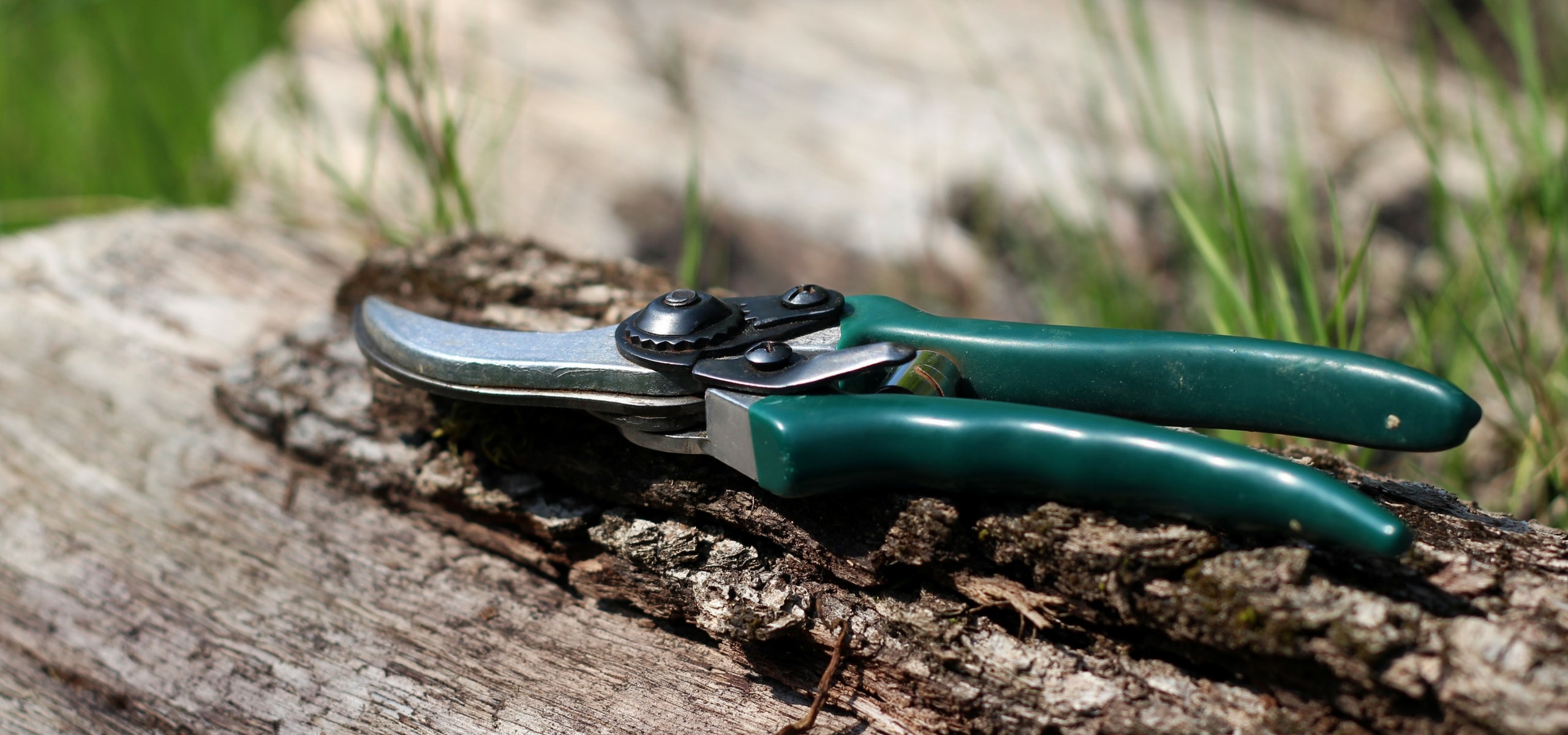
Easy to care for, Hebe buxifolia prefers sunny situations, while tolerating partial shade, and well-drained soils that do not retain too much water. It tolerates salt spray quite well and adapts very well to seaside gardens. Once established, it can withstand short periods of drought. It is one of the hardiest species of the genus, capable of withstanding temperatures down to -12 / -15°C in well-drained soil. In the coldest regions, protect it during the winter or plant it in a pot and bring it into a greenhouse or frost-free conservatory. After flowering, remove the faded inflorescences using a pair of shears. This light trimming will help maintain a compact habit.
Planting period
Intended location
Care
Planting & care advice


This item has not been reviewed yet - be the first to leave a review about it.
Recently viewed products
Haven't found what you were looking for?
Hardiness is the lowest winter temperature a plant can endure without suffering serious damage or even dying. However, hardiness is affected by location (a sheltered area, such as a patio), protection (winter cover) and soil type (hardiness is improved by well-drained soil).
In temperate climates, pruning of spring-flowering shrubs (forsythia, spireas, etc.) should be done just after flowering.
Pruning of summer-flowering shrubs (Indian Lilac, Perovskia, etc.) can be done in winter or spring.
In cold regions as well as with frost-sensitive plants, avoid pruning too early when severe frosts may still occur.
The harvesting period indicated on our website applies to countries and regions in USDA zone 8 (France, England, Ireland, the Netherlands).
In colder areas (Scandinavia, Poland, Austria...) fruit and vegetable harvests are likely to be delayed by 3-4 weeks.
In warmer areas (Italy, Spain, Greece, etc.), harvesting will probably take place earlier, depending on weather conditions.
The sowing periods indicated on our website apply to countries and regions within USDA Zone 8 (France, UK, Ireland, Netherlands).
In colder areas (Scandinavia, Poland, Austria...), delay any outdoor sowing by 3-4 weeks, or sow under glass.
In warmer climes (Italy, Spain, Greece, etc.), bring outdoor sowing forward by a few weeks.
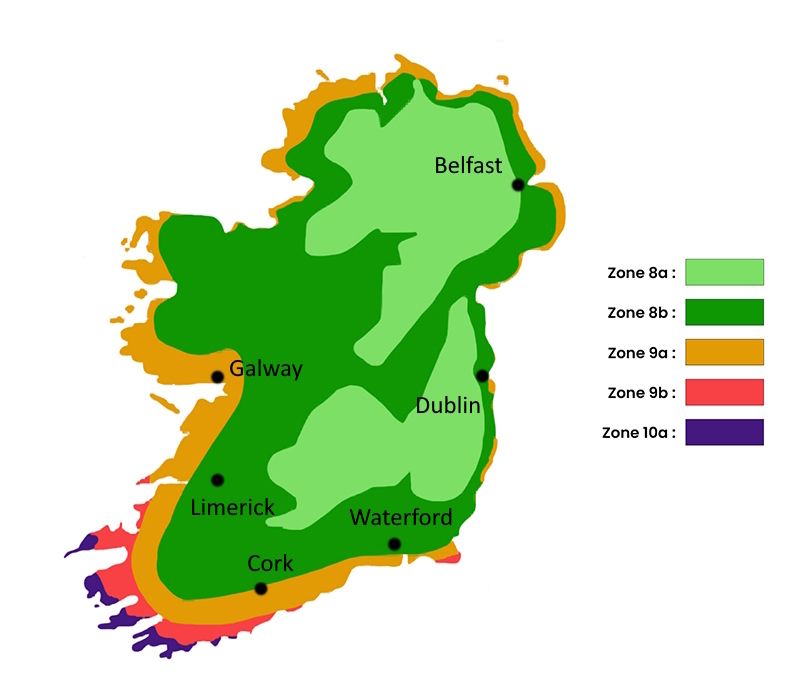
The planting period indicated on our website applies to regions in USDA Zone 9a (East Coast and Midlands: Dublin, Wexford, Waterford, Kilkenny, Portlaoise). It will vary depending on where you live:
- On the west coast and in the north-west (Galway, Limerick, Sligo, Donegal, Westport), delay planting by 1 to 2 weeks in spring and bring it forward by 1 to 2 weeks in autumn compared to the dates given, preferably choosing periods without strong winds.
- In the inland hills and plateaus (Wicklow Mountains, Macgillycuddy’s Reeks, Connemara, Killarney), it is best to plant in spring (April–May) or autumn (September–October), avoiding periods of waterlogged soil in winter and strong winds, which pose the main risk to newly planted trees in these areas.
The flowering period indicated on our website applies to regions in USDA Zone 9a, such as the East Coast and Midlands, including Dublin, Wexford, Waterford, Kilkenny and Portlaoise.
This will vary depending on where you live:
- On the west coast and in the northwest (Galway, Limerick, Sligo, Donegal and Westport), it will be delayed by one to two weeks compared to the given dates, due to stronger Atlantic winds and less spring sunshine.
- In the inland hills and plateaus (the Wicklow Mountains, the Macgillycuddy's Reeks, Connemara and Killarney), flowering will be delayed by two to three weeks. Flowering mainly occurs between May and July, with the limiting factors being less frost and more of the excessive humidity, strong winds and lack of sunshine that are characteristic of these areas.
Shipping country and language
Your country of residence may be:
Your country of residence is:
For a better user experience on our website, you can select:
Your shipping country:
-
 Austria
-
 Belgium
-
 Bosnia & Herzegovina
-
 Bulgaria
-
 Croatia
-
 Cyprus
-
 Czechia
-
 Denmark
-
 Estonia
-
 Finland
-
 France
-
 Germany
-
 Greece
-
 Hungary
-
 Iceland
-
 Ireland
-
 Italy
Italy
-
 Latvia
-
 Liechtenstein
-
 Lithuania
-
 Luxembourg
-
 Malta
Malta
-
 Netherlands
-
 Poland
-
 Portugal
-
 Romania
-
 Serbia
-
 Slovakia
-
 Slovenia
-
 Spain
Spain
-
 Sweden
-
 Switzerland
Language:
-
French
-
 English
-
Spanish
-
Italian
-
German
-
Portuguese
-
Dutch
-
Finnish
My Account
Hello
My wish lists
My cart
Log in / Register
Existing customer?
This form is protected by reCAPTCHA - the Google Privacy Policy and Terms of Service apply.
New customer?
Create an account to track your orders, access our customer service and, if you wish, make the most of our upcoming offers.