
Hosta undulata Mediovariegata

Hosta undulata Mediovariegata

Hosta undulata Mediovariegata
Hosta undulata Mediovariegata
Hosta undulata Mediovariegata
Wavy Plantain Lily, Plantain Lily, Funkia
Replanted this winter, it has exploded recently; it’s going to make a very beautiful pot display.
msan65, 06/04/2024
Back-to-school special offer!
Get €10 off for every €50 you spend! And get up to €40 off on a single order.
How does it work?
1. Shop your favourites
Add your favourite plants to your basket. For every €50 you spend (excluding delivery charges, store credit and the plastic-free option), you’ll receive a €10 voucher.
€50 spent = €10 voucher
€100 spent = €20 voucher
€150 spent = €30 voucher
€200 spent = €40 voucher
2. Place your order
Once your basket reaches one of the spending thresholds, place your order. You can even choose your delivery date!
3. Receive your voucher
As soon as your order has been shipped, you’ll receive an email containing your personal voucher code and its value.
4. Use it on your next order
Your voucher is valid for 90 days from the date you receive it. It can be used once only, on a new order worth at least the value of the voucher, excluding delivery charges.
Please note: Vouchers can be combined with other offers, but cannot be split or refunded.
Why not try an alternative variety in stock?
View all →
Available in 1 sizes

Available in 1 sizes

Available in 2 sizes

Available in 1 sizes

Available in 1 sizes

Available in 1 sizes

Available in 1 sizes

Available in 1 sizes

Available in 1 sizes

Available in 2 sizes
This plant carries a 12 months recovery warranty
More information
We guarantee the quality of our plants for a full growing cycle, and will replace at our expense any plant that fails to recover under normal climatic and planting conditions.

Does this plant fit my garden?
Set up your Plantfit profile →
Description
Hosta undulata 'Mediovariegata' is one of the great classics of shade gardens. Its strongly wavy, slightly twisted leaves display a broad creamy white centre irregularly edged in green. This variegation creates different patterns from one leaf to the next and gives the plant plenty of character. In summer, slender flower stems rise above the foliage, bearing pale mauve flowers.
Hosta undulata 'Mediovariegata' belongs to the Asparagaceae family. This old variety, cultivated in Japan, is part of the Undulata horticultural group, whose exact parentage remains unknown. The name 'Mediovariegata', still widely used in nurseries, refers to its central variegation. It is therefore distinct from the 'Albomarginata' form, whose leaves are green in the centre and edged in white. In 1993, it received the Royal Horticultural Society's Award of Garden Merit under the name Hosta undulata var. undulata. The plant has a perennial crown and forms a clump 30 to 45 cm high and 45 to 60 cm wide. In spring, its leaves gradually unfurl at the end of long petioles. Oval to elongated, pointed and 15 to 18 cm long, they have clearly visible veins and strongly wavy edges. Creamy white covers much of the lamina, while green forms an irregular margin that sometimes extends towards the centre. This margin may become slightly greener during the summer. This variety flowers in July and August. Its flower stems reach 60 to 75 cm in height and bear pendulous, funnel-shaped flowers in pale lavender. The foliage turns yellow before disappearing in autumn; the crown remains underground over winter and produces new shoots in spring. This hosta is very hardy, down to −20 °C at the lowest.
Hosta 'Mediovariegata' is suited to woodland gardens, Japanese gardens and shady courtyards. Planted in dense groups, it creates an elegant border or can be used as ground cover. In a bed, it combines well with Hosta 'Halcyon', with blue foliage, Astilbe 'Sprite', with pale pink panicles, and Polystichum setiferum 'Herrenhausen', a fern with finely divided fronds. The mixture of plain and variegated foliage prevents monotony and is enhanced by pastel flowers in summer. It can also be grown in a pot on a shady patio, and a few cut leaves will add interest to bouquets.

Hosta undulata Mediovariegata in pictures


Flowering
Foliage
Plant habit
Botanical data
Hosta
undulata
Mediovariegata
Asparagaceae
Wavy Plantain Lily, Plantain Lily, Funkia
Hosta ‘Undulata Mediovariegata’, Hosta undulata var. undulata
Cultivar or hybrid
Planting and care
Plant Hosta 'Mediovariegata' in spring or autumn, in partial shade or dappled shade. Morning sun is tolerated, but the white parts of the foliage are sensitive to sunlight. Plant it in deep, humus-rich, moisture-retentive soil that is slightly acidic to neutral. Clay soils are acceptable provided that water does not stagnate. Incorporate well-rotted compost when planting and place the top of the rootball level with the soil. Space the plants 45 to 60 cm apart.
Water after planting, then during dry periods. An organic mulch helps retain moisture. In a pot, use a container with drainage holes, 35 to 40 cm in diameter, filled with potting compost enriched with compost; water regularly throughout the growing season.
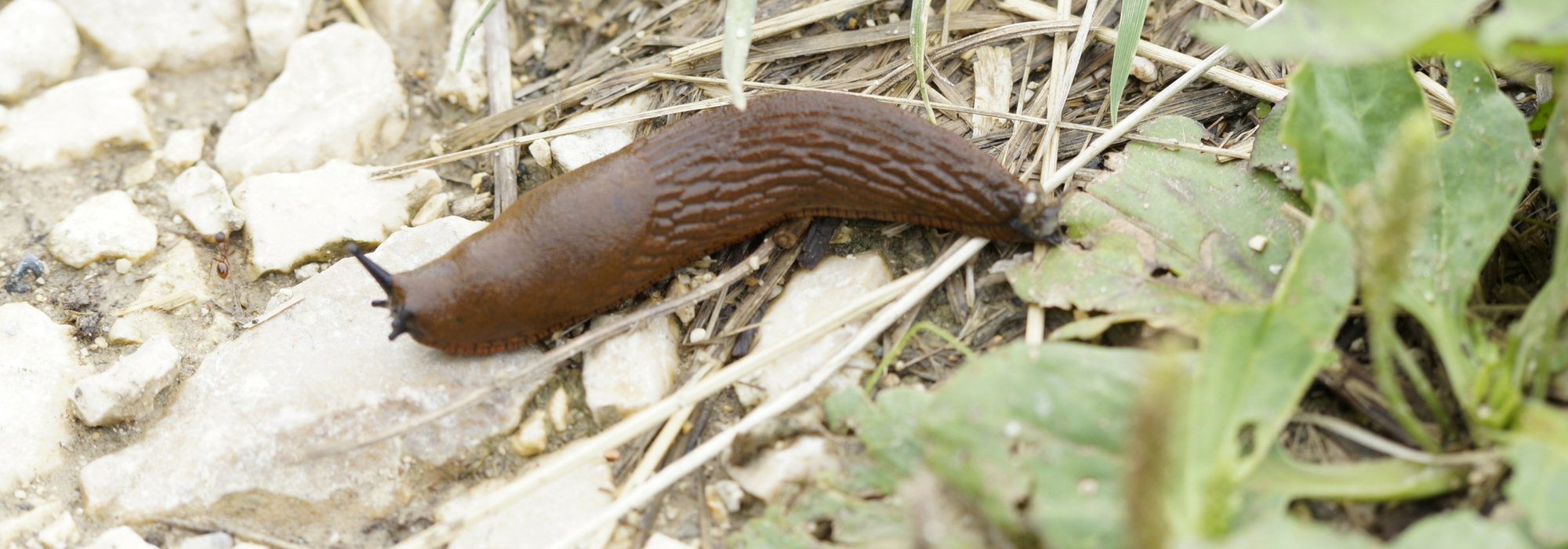
Watch for slugs and snails as soon as the shoots appear: the leaves of this variety are relatively thin and susceptible to their attacks. Clumps that have become too large can be divided in early spring or autumn. If entirely green shoots appear, remove them with their portion of crown so that they do not overtake the variegated parts.
Because slugs and snails share a preference for damp places, they are never found very far from hostas. Although blue or variegated hostas often have thicker, tougher foliage, making them less appetising to slugs, these plants still need protection from gastropods. Protect your hostas by surrounding them with ferramol-based pellets (approved for organic farming), eggshells, coffee grounds, shredded material or any other dry, rough natural substance that deters them. Hedgehogs are the gardener's best allies when it comes to controlling gastropods. Unlike hens, they do not disturb the soil or attack the bright green shoots of young plants. Finally, some plants have a smell that repels slugs, such as wormwood and garlic.
Planting period
Intended location
Care
Planting & care advice
-

-
-

-

-

-

-

-

-
, onOrder confirmed
Reply from on Promesse de fleurs
Recently viewed products
Haven't found what you were looking for?
Hardiness is the lowest winter temperature a plant can endure without suffering serious damage or even dying. However, hardiness is affected by location (a sheltered area, such as a patio), protection (winter cover) and soil type (hardiness is improved by well-drained soil).
In temperate climates, pruning of spring-flowering shrubs (forsythia, spireas, etc.) should be done just after flowering.
Pruning of summer-flowering shrubs (Indian Lilac, Perovskia, etc.) can be done in winter or spring.
In cold regions as well as with frost-sensitive plants, avoid pruning too early when severe frosts may still occur.
The harvesting period indicated on our website applies to countries and regions in USDA zone 8 (France, England, Ireland, the Netherlands).
In colder areas (Scandinavia, Poland, Austria...) fruit and vegetable harvests are likely to be delayed by 3-4 weeks.
In warmer areas (Italy, Spain, Greece, etc.), harvesting will probably take place earlier, depending on weather conditions.
The sowing periods indicated on our website apply to countries and regions within USDA Zone 8 (France, UK, Ireland, Netherlands).
In colder areas (Scandinavia, Poland, Austria...), delay any outdoor sowing by 3-4 weeks, or sow under glass.
In warmer climes (Italy, Spain, Greece, etc.), bring outdoor sowing forward by a few weeks.
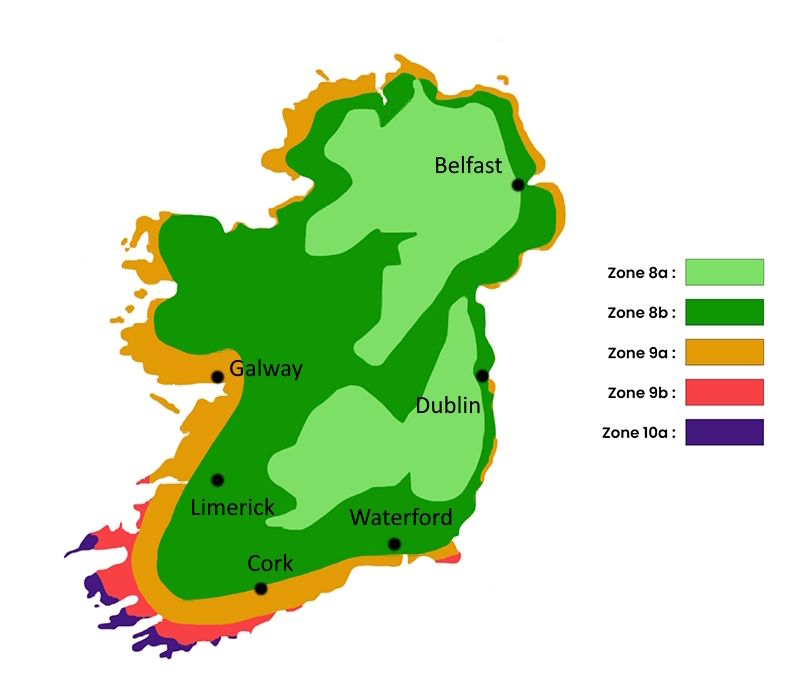
The planting period indicated on our website applies to regions in USDA Zone 9a (East Coast and Midlands: Dublin, Wexford, Waterford, Kilkenny, Portlaoise). It will vary depending on where you live:
- On the west coast and in the north-west (Galway, Limerick, Sligo, Donegal, Westport), delay planting by 1 to 2 weeks in spring and bring it forward by 1 to 2 weeks in autumn compared to the dates given, preferably choosing periods without strong winds.
- In the inland hills and plateaus (Wicklow Mountains, Macgillycuddy’s Reeks, Connemara, Killarney), it is best to plant in spring (April–May) or autumn (September–October), avoiding periods of waterlogged soil in winter and strong winds, which pose the main risk to newly planted trees in these areas.
The flowering period indicated on our website applies to regions in USDA Zone 9a, such as the East Coast and Midlands, including Dublin, Wexford, Waterford, Kilkenny and Portlaoise.
This will vary depending on where you live:
- On the west coast and in the northwest (Galway, Limerick, Sligo, Donegal and Westport), it will be delayed by one to two weeks compared to the given dates, due to stronger Atlantic winds and less spring sunshine.
- In the inland hills and plateaus (the Wicklow Mountains, the Macgillycuddy's Reeks, Connemara and Killarney), flowering will be delayed by two to three weeks. Flowering mainly occurs between May and July, with the limiting factors being less frost and more of the excessive humidity, strong winds and lack of sunshine that are characteristic of these areas.
Shipping country and language
Your country of residence may be:
Your country of residence is:
For a better user experience on our website, you can select:
Your shipping country:
-
 Austria
-
 Belgium
-
 Bosnia & Herzegovina
-
 Bulgaria
-
 Croatia
-
 Cyprus
-
 Czechia
-
 Denmark
-
 Estonia
-
 Finland
-
 France
-
 Germany
-
 Greece
-
 Hungary
-
 Iceland
-
 Ireland
-
 Italy
-
 Latvia
-
 Liechtenstein
-
 Lithuania
-
 Luxembourg
-
 Malta
-
 Netherlands
-
 Poland
-
 Portugal
-
 Romania
-
 Serbia
-
 Slovakia
-
 Slovenia
-
 Spain
-
 Sweden
-
 Switzerland
Language:
-
French
-
 English
-
Spanish
-
Italian
-
German
-
Portuguese
-
Dutch
-
Finnish
My Account
Hello
My wish lists
My cart
Log in / Register
Existing customer?
This form is protected by reCAPTCHA - the Google Privacy Policy and Terms of Service apply.
New customer?
Create an account to track your orders, access our customer service and, if you wish, make the most of our upcoming offers.