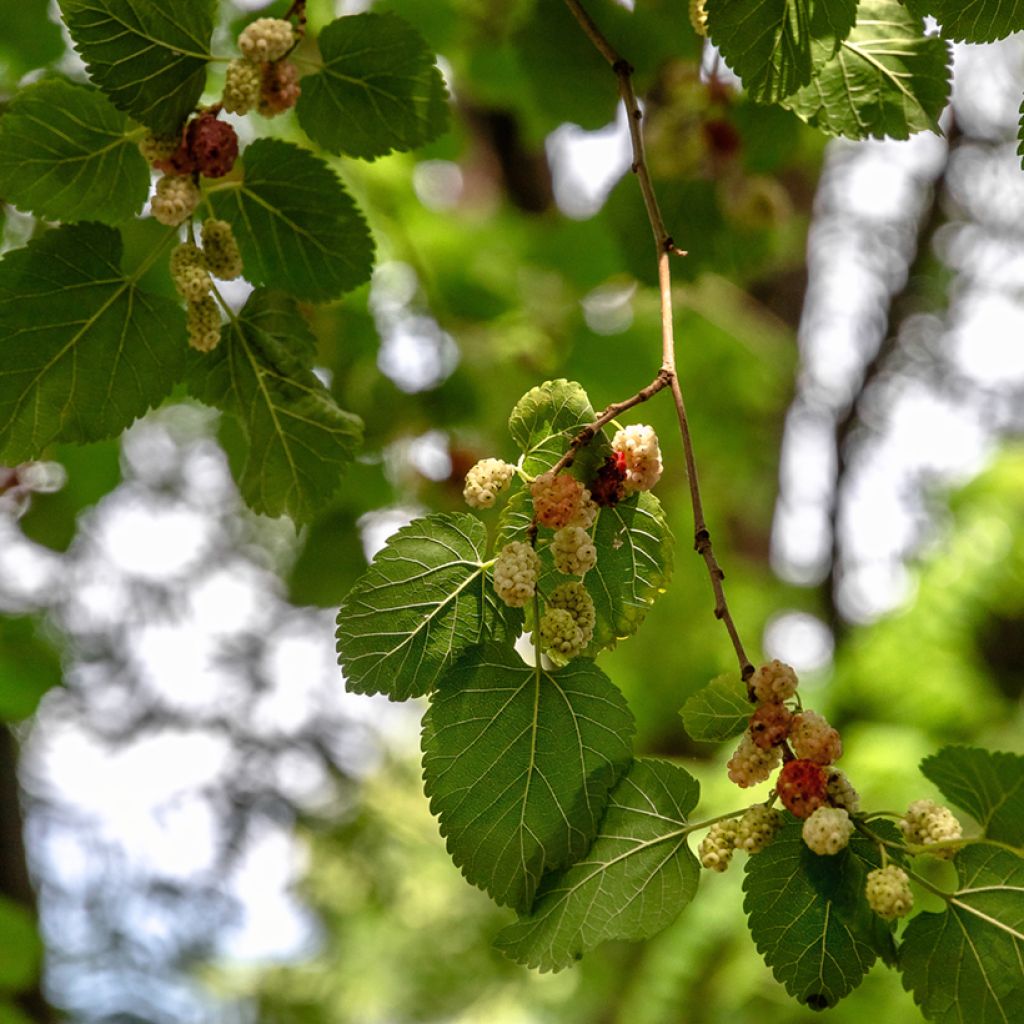
Morus alba seeds - Mullberry
Morus alba seeds - Mullberry
Morus alba
White Mulberry, Common Mulberry
Back-to-school special offer!
Get €10 off for every €50 you spend! And get up to €40 off on a single order.
How does it work?
1. Shop your favourites
Add your favourite plants to your basket. For every €50 you spend (excluding delivery charges, store credit and the plastic-free option), you’ll receive a €10 voucher.
€50 spent = €10 voucher
€100 spent = €20 voucher
€150 spent = €30 voucher
€200 spent = €40 voucher
2. Place your order
Once your basket reaches one of the spending thresholds, place your order. You can even choose your delivery date!
3. Receive your voucher
As soon as your order has been shipped, you’ll receive an email containing your personal voucher code and its value.
4. Use it on your next order
Your voucher is valid for 90 days from the date you receive it. It can be used once only, on a new order worth at least the value of the voucher, excluding delivery charges.
Please note: Vouchers can be combined with other offers, but cannot be split or refunded.
Home or relay delivery (depending on size and destination)
Important: You may be charged customs duties by your country’s customs authorities upon delivery.
Schedule delivery date
and select date in basket
This plant carries a 6 months recovery warranty
More information
We guarantee the quality of our plants for a full growing cycle, and will replace at our expense any plant that fails to recover under normal climatic and planting conditions.
Does this plant fit my garden?
Set up your Plantfit profile →
Description
Morus alba, or white mulberry, also known as the common mulberry, is a tree that is both ornamental and fruit-bearing, highly valued in southern regions for its dense and lush deciduous foliage. Its leaves are pale green in spring and turn a beautiful golden hue in autumn. It produces pinkish-white to purplish-red, even blackish edible fruits, which are harvested in late spring. Their flavour is sweet and sugary, though slightly bland. It is very hardy, withstanding temperatures as low as -28°C and tolerates heat as well as drought. Its strong root system prefers deep but well-drained soils. For centuries, its leaves have been the primary food source for silkworms.
This common mulberry, native to Mongolia and India, belongs to the Moraceae family, like fig trees, and contains latex in its tissues. Introduced to France in the late 15th century, it fostered the development of sericulture, or silkworm farming. Its natural habit is stocky, with a short, thick trunk topped by a spreading and slightly irregular crown if the tree is not pruned. However, it is often pruned into a ball shape for a more compact appearance. Its growth is rapid during its early years, then gradually slows. It can reach up to 10 metres in height and width. Its bark is initially smooth and light grey, then thickens with age and takes on a grey-brown hue as it cracks. The deciduous foliage of the white mulberry is particularly interesting, as its leaves are polymorphous: they vary in shape depending on their position on the branches. They measure 6 to 8 cm wide and 10 to 20 cm long, and can be either single and heart-shaped or divided into several lobes with toothed edges. Their upper surface is glossy, and their colour evolves from pale green to golden yellow in autumn. In April, the tree produces inconspicuous flowers, in the form of male and female catkins located on separate parts of the same tree. They are followed by fruits in June, or even early July, depending on the climate: these fleshy, ovoid fruits measure 2 to 3 cm and turn from white to purplish-pink when ripe. They do not stain the ground and can be eaten fresh or dried. They are also loved by birds.
The root system of this mulberry is both taprooted and running, making transplantation tricky and requiring planting it at a distance from buildings.
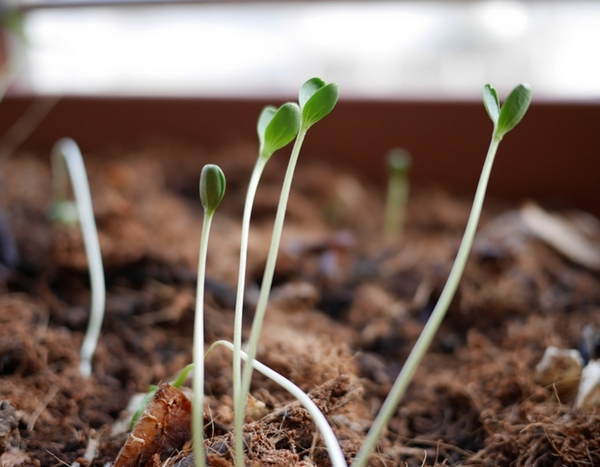
The seeds of Morus alba require cold stratification for several weeks to break their dormancy. Once ready, they can be sown in spring in light, moist soil at a temperature of around 20°C. Germination may take several weeks.
Highly adaptable Morus alba thrives in fertile, well-loosened and drained soil, in a warm and sunny position. It tolerates urban pollution but is sensitive to sea spray. Gradually enriching the soil through the decomposition of its fallen leaves, it is an excellent choice for fallow land. It is often used as a street tree, but also finds its place in a fruit hedge alongside blackthorn, Mirabelle de Nancy plum tree, and fruiting dogwoods, providing a refuge and food source for birds. Planted alone in the centre of a lawn, it offers welcome shade in summer. It is also effective on slopes to limit soil erosion.
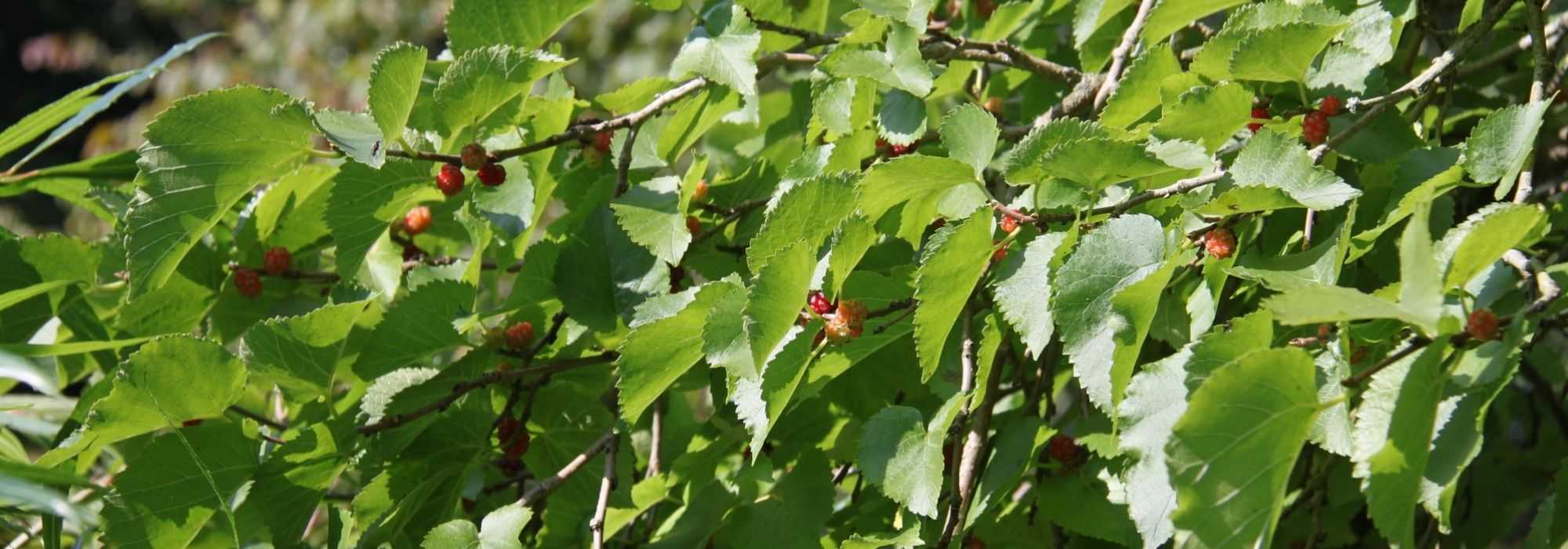
Flowering
Foliage
Plant habit
Botanical data
Morus
alba
Moraceae
White Mulberry, Common Mulberry
Morus multicaulis, Morus alba var. multicaulis, Morus australis ( Hort. ), Morus alba var. constantinopolitana, Morus alba f. tatarica
China
Planting and care
To germinate Morus alba seeds, a rigorous procedure must be followed. Begin by stratifying the seeds by placing them in a moist substrate, such as sand or a sand-peat mixture, at a temperature of around 4°C for 2 to 3 months. This cold period simulates the winter conditions needed to break the seed's dormancy. After stratification, in early spring, sow the seeds in deep trays, covering them with a thin layer of substrate equivalent to their diameter. Keep the soil moist and place in a warm, well-lit spot.
Once the seedlings have developed several leaves and are sturdy enough, usually a few weeks after germination, proceed with transplanting. Move each young plant into a larger individual pot or directly into the ground, ensuring you choose a sunny location with well-drained soil. Water regularly to encourage good root development.
Cultivation: the common mulberry is a hardy and easy-to-grow tree. It thrives in a sunny spot with well-drained, deep, and fertile soil, but it can also adapt to poorer soils. Once well-established, it tolerates drought well, though regular watering is beneficial during periods of intense heat, especially for young plants.
Plant it in autumn or early spring, avoiding frost periods. Dig a wide hole and add some compost to encourage good root development. Mulching around the base helps retain moisture and limits weed growth.
Hardy down to -28°C, white mulberry dislikes overly compacted or waterlogged soils, which can suffocate its roots.
Sowing period
Intended location
Planting & care advice
-

-
-

-

-

-

-

-

This item has not been reviewed yet - be the first to leave a review about it.
Recently viewed products
Haven't found what you were looking for?
Hardiness is the lowest winter temperature a plant can endure without suffering serious damage or even dying. However, hardiness is affected by location (a sheltered area, such as a patio), protection (winter cover) and soil type (hardiness is improved by well-drained soil).
In temperate climates, pruning of spring-flowering shrubs (forsythia, spireas, etc.) should be done just after flowering.
Pruning of summer-flowering shrubs (Indian Lilac, Perovskia, etc.) can be done in winter or spring.
In cold regions as well as with frost-sensitive plants, avoid pruning too early when severe frosts may still occur.
The harvesting period indicated on our website applies to countries and regions in USDA zone 8 (France, England, Ireland, the Netherlands).
In colder areas (Scandinavia, Poland, Austria...) fruit and vegetable harvests are likely to be delayed by 3-4 weeks.
In warmer areas (Italy, Spain, Greece, etc.), harvesting will probably take place earlier, depending on weather conditions.
The sowing periods indicated on our website apply to countries and regions within USDA Zone 8 (France, UK, Ireland, Netherlands).
In colder areas (Scandinavia, Poland, Austria...), delay any outdoor sowing by 3-4 weeks, or sow under glass.
In warmer climes (Italy, Spain, Greece, etc.), bring outdoor sowing forward by a few weeks.
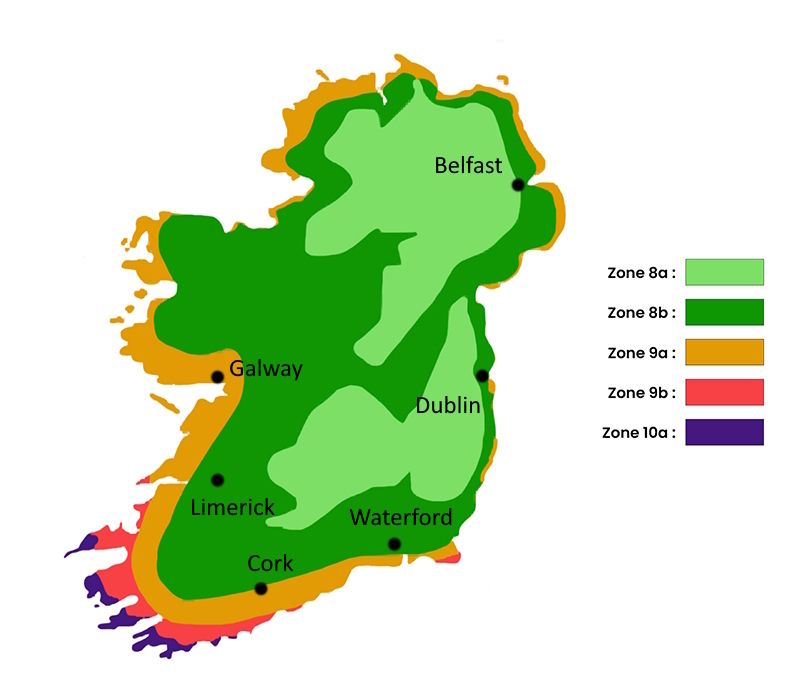
The planting period indicated on our website applies to regions in USDA Zone 9a (East Coast and Midlands: Dublin, Wexford, Waterford, Kilkenny, Portlaoise). It will vary depending on where you live:
- On the west coast and in the north-west (Galway, Limerick, Sligo, Donegal, Westport), delay planting by 1 to 2 weeks in spring and bring it forward by 1 to 2 weeks in autumn compared to the dates given, preferably choosing periods without strong winds.
- In the inland hills and plateaus (Wicklow Mountains, Macgillycuddy’s Reeks, Connemara, Killarney), it is best to plant in spring (April–May) or autumn (September–October), avoiding periods of waterlogged soil in winter and strong winds, which pose the main risk to newly planted trees in these areas.
The flowering period indicated on our website applies to regions in USDA Zone 9a, such as the East Coast and Midlands, including Dublin, Wexford, Waterford, Kilkenny and Portlaoise.
This will vary depending on where you live:
- On the west coast and in the northwest (Galway, Limerick, Sligo, Donegal and Westport), it will be delayed by one to two weeks compared to the given dates, due to stronger Atlantic winds and less spring sunshine.
- In the inland hills and plateaus (the Wicklow Mountains, the Macgillycuddy's Reeks, Connemara and Killarney), flowering will be delayed by two to three weeks. Flowering mainly occurs between May and July, with the limiting factors being less frost and more of the excessive humidity, strong winds and lack of sunshine that are characteristic of these areas.
Shipping country and language
Your country of residence may be:
Your country of residence is:
For a better user experience on our website, you can select:
Your shipping country:
-
 Austria
-
 Belgium
-
 Bosnia & Herzegovina
-
 Bulgaria
-
 Croatia
-
 Cyprus
-
 Czechia
-
 Denmark
-
 Estonia
-
 Finland
-
 France
-
 Germany
-
 Greece
-
 Hungary
-
 Iceland
-
 Ireland
-
 Italy
Italy
-
 Latvia
-
 Liechtenstein
-
 Lithuania
-
 Luxembourg
-
 Malta
Malta
-
 Netherlands
-
 Poland
-
 Portugal
-
 Romania
-
 Serbia
-
 Slovakia
-
 Slovenia
-
 Spain
Spain
-
 Sweden
-
 Switzerland
Language:
-
French
-
 English
-
Spanish
-
Italian
-
German
-
Portuguese
-
Dutch
-
Finnish
My Account
Hello
My wish lists
My cart
Log in / Register
Existing customer?
This form is protected by reCAPTCHA - the Google Privacy Policy and Terms of Service apply.
New customer?
Create an account to track your orders, access our customer service and, if you wish, make the most of our upcoming offers.