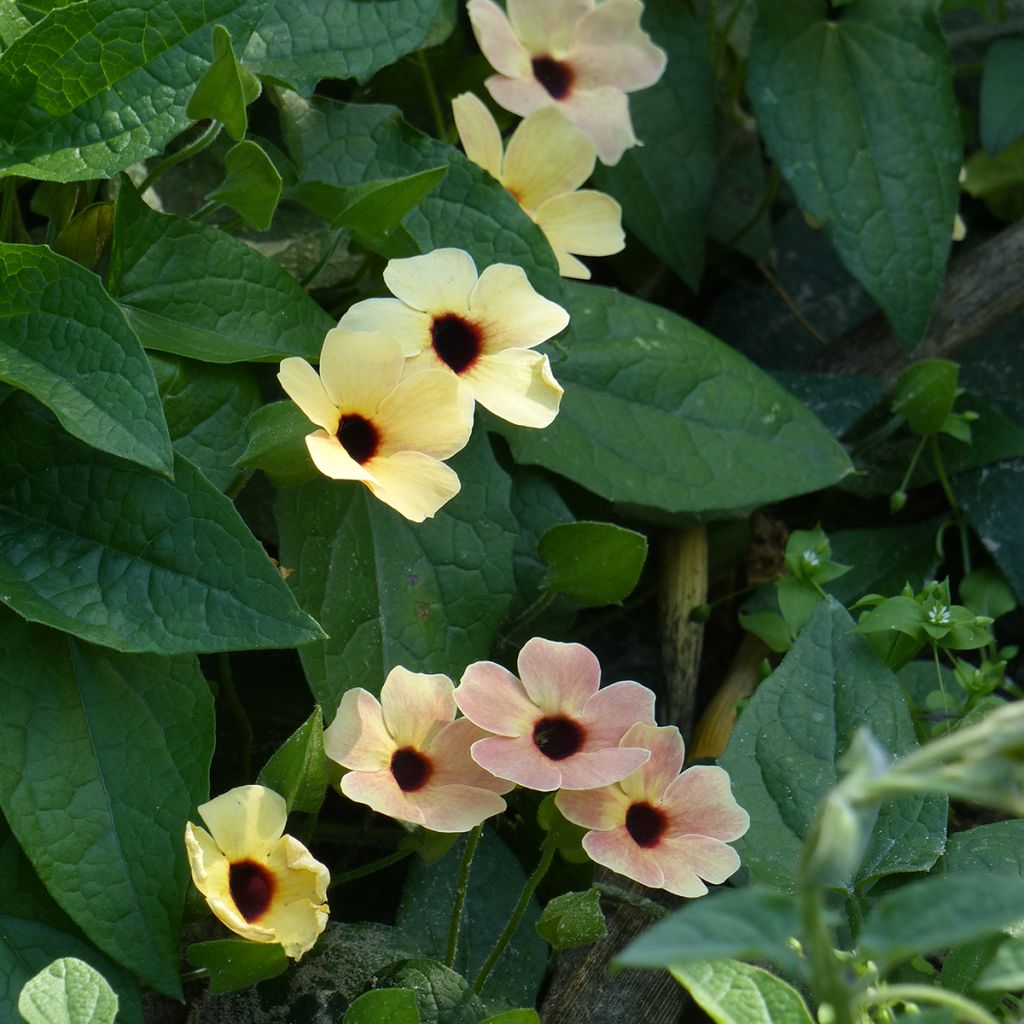
Black-eyed Susan Peach Eye seeds - Thunbergia alata
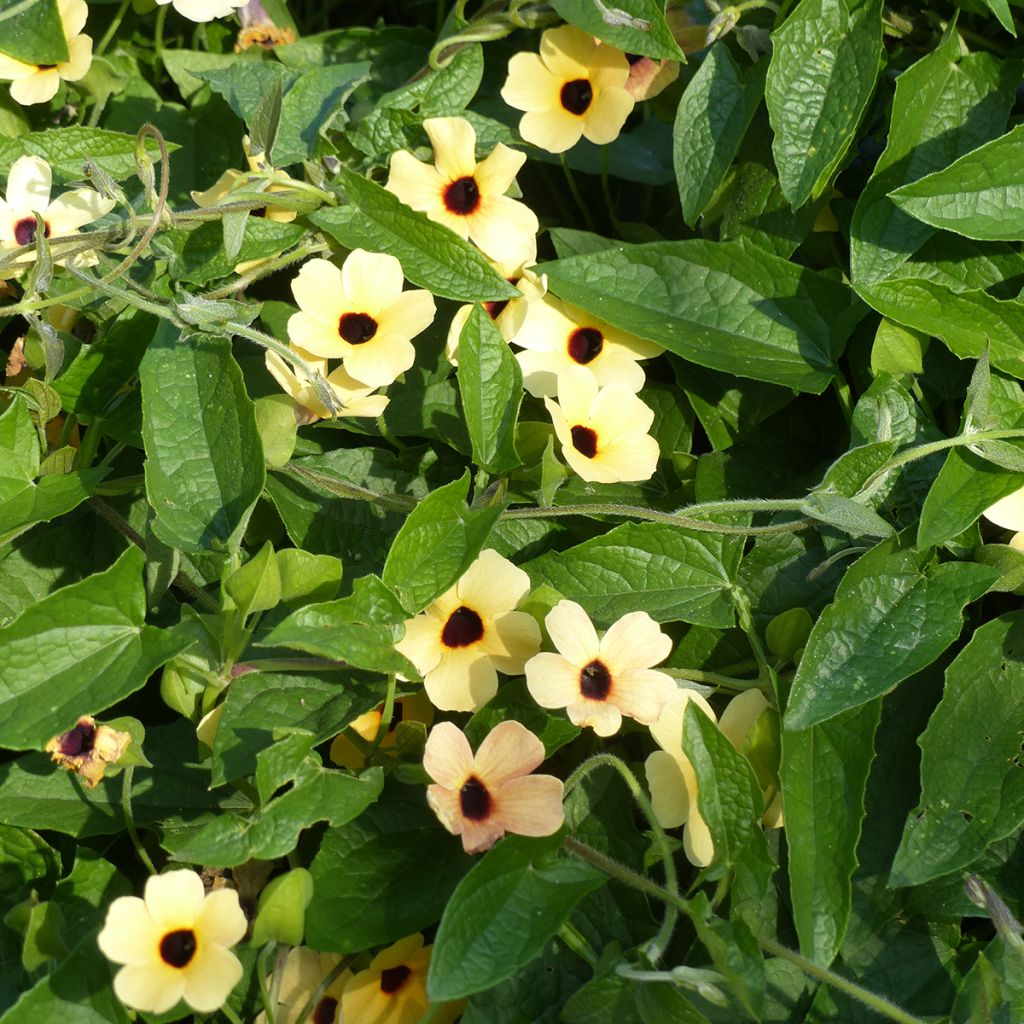
Black-eyed Susan Peach Eye seeds - Thunbergia alata

Black-eyed Susan Peach Eye seeds - Thunbergia alata
Black-eyed Susan Peach Eye seeds - Thunbergia alata
Thunbergia alata Peach Eye
Black-eyed Susan
Back-to-school special offer!
Get €10 off for every €50 you spend! And get up to €40 off on a single order.
How does it work?
1. Shop your favourites
Add your favourite plants to your basket. For every €50 you spend (excluding delivery charges, store credit and the plastic-free option), you’ll receive a €10 voucher.
€50 spent = €10 voucher
€100 spent = €20 voucher
€150 spent = €30 voucher
€200 spent = €40 voucher
2. Place your order
Once your basket reaches one of the spending thresholds, place your order. You can even choose your delivery date!
3. Receive your voucher
As soon as your order has been shipped, you’ll receive an email containing your personal voucher code and its value.
4. Use it on your next order
Your voucher is valid for 90 days from the date you receive it. It can be used once only, on a new order worth at least the value of the voucher, excluding delivery charges.
Please note: Vouchers can be combined with other offers, but cannot be split or refunded.
Home or relay delivery (depending on size and destination)
Important: You may be charged customs duties by your country’s customs authorities upon delivery.
Schedule delivery date,
and select date in basket
This plant carries a 6 months recovery warranty
More information
We guarantee the quality of our plants for a full growing cycle, and will replace at our expense any plant that fails to recover under normal climatic and planting conditions.
Does this plant fit my garden?
Set up your Plantfit profile →
Description
La Thunbergia alata 'Peach Eye' est une ravissante déclinaison de la célèbre Suzanne aux yeux noirs, offrant une alternative pastel à l'orange un peu agressif des variétés classiques. Ses corolles, aux nuances de pêche et d'abricot clair, lavées de rose à l’épanouissement, dévoilent un cœur presque noir. Cette plante grimpante annuelle au charme discret habille rapidement treillis, tuteurs ou grillages. Très florifère, elle embellit les balcons, les bacs de terrasse ou les endroits du jardin abrités du vent, par sa longue floraison qui s’étale de juillet à octobre.
Originaire des régions tropicales d’Afrique de l’Est, la Thunbergia alata est vivace sous les climats chauds, mais se cultive comme une annuelle sous nos latitudes. 'Peach Eye' est une sélection horticole issue de cette espèce. Elle forme en quelques mois une liane volubile pouvant atteindre 1,50 m à 2 m de haut. Ses tiges souples s’enroulent seules autour de leur support. Ses feuilles, vert foncé, en forme de cœur, légèrement dentelées, forment un bel écrin pour sa floraison généreuse. Les fleurs de 4-5 cm de diamètre, en forme de trompettes à cinq lobes arrondis, naissent à l’aisselle des feuilles et se renouvellent durant 4 mois. Leur centre noir attire les insectes pollinisateurs.
La Suzanne aux yeux noirs craint le froid, mais elle s’adapte bien en pot, ce qui permet de la rentrer dans la véranda en fin de saison.
'Peach Eye' est une variété de suzanne douce et romantique. Grimpante, volubile, légère, elle s'associe bien avec une petite clématite bleue 'Arabella' et peut aussi être utilisée en couvre-sol. Elle se marie à la perfection aux ipomées bleu ciel ('Heavenly Blue'), à la capucine 'Salmon Gleam' et au Sollya heterophylla 'Ultra Blue'.

Black-eyed Susan Peach Eye seeds - Thunbergia alata in pictures
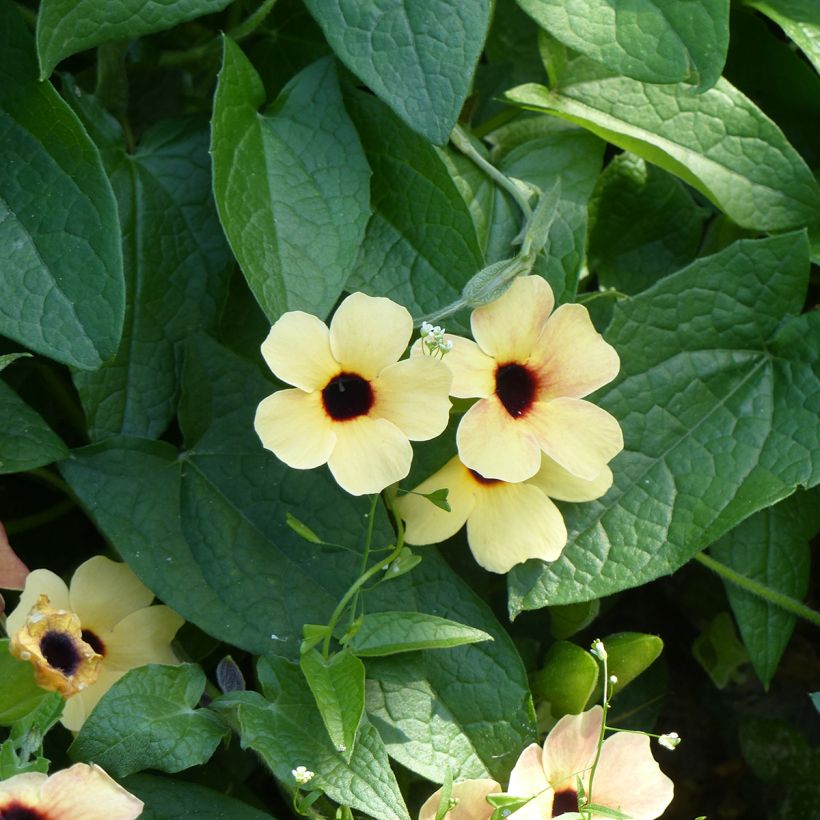
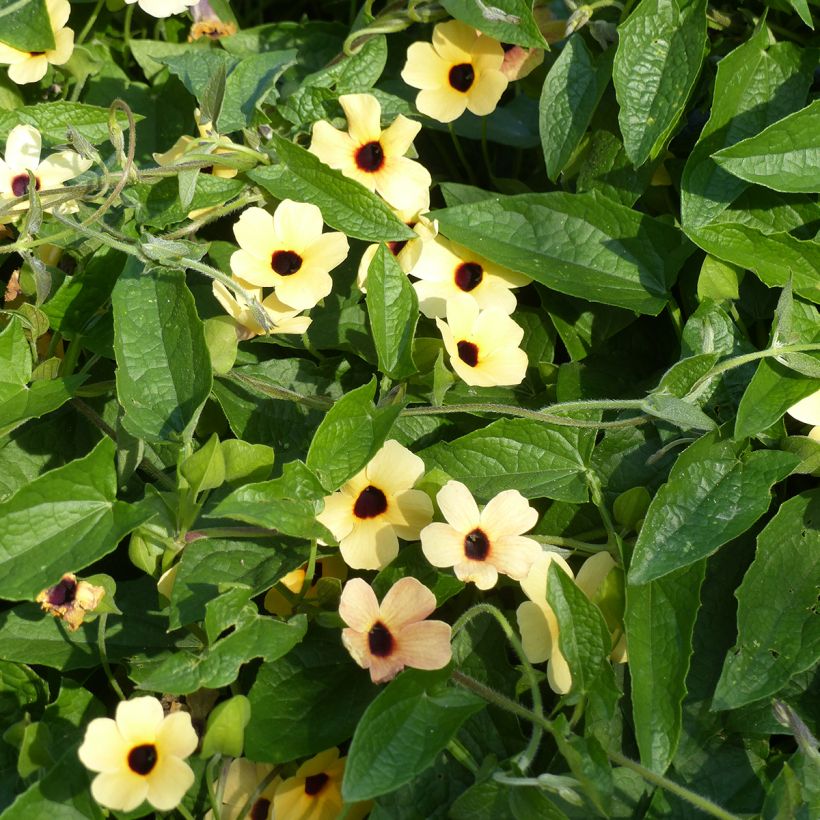
Flowering
Foliage
Plant habit
Botanical data
Thunbergia
alata
Peach Eye
Acanthaceae
Black-eyed Susan
Cultivar or hybrid
Planting and care
Sowing:
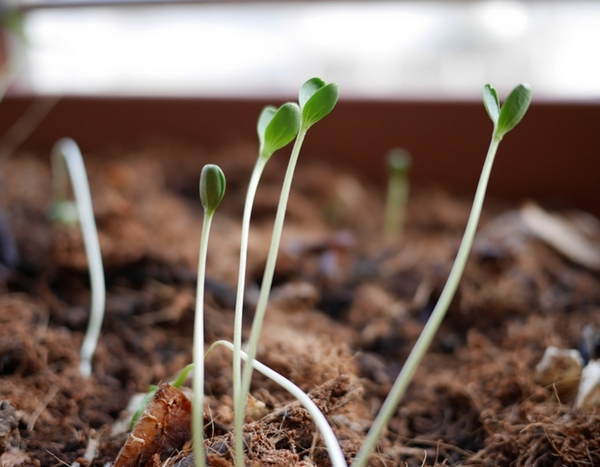
Sow the seeds of Thunbergia alata 'Peach Eye' from February to April in pots or trays filled with moist compost and cover with a 6mm layer of compost or vermiculite. Place in a propagator or warm spot and maintain at a constant temperature between 20 and 25°C. Keep the sowings in a bright location, as light promotes germination. Keep the compost surface moist but not waterlogged. Germination occurs in 14 to 21 days. A mid-summer sowing will produce plants capable of flowering in winter and spring in a cold greenhouse.
Transplant the young plants into 7.5cm diameter pots or trays. Acclimatise them gradually to cooler conditions for a few weeks before placing them outside, once all risk of frost has passed.
Growing:
You can plant your Thunbergia alata in open ground or in containers. If planting in open ground, you must wait until the last frosts have passed (Black-eyed Susans do not tolerate frost and cope poorly with temperatures below 8°C). Meanwhile, you can pre-grow them in pots in a warm, bright location to accelerate their growth.
Plant your Black-eyed Susans in a sunny or partially shaded position. They require light, humus-bearing soil. They tolerate short dry spells reasonably well, but will need regular watering during summer heatwaves to flower properly. In containers, they must be watered very regularly. Very floriferous and fast-growing, they can reach 2m in the space of a summer. Remember to stake if using as a climbing plant. Usually grown as annuals, they are actually very tender perennials: by bringing them indoors in September, you can extend their flowering through autumn and winter.
Sowing period
Intended location
Planting & care advice
-

-
-

-

-

-

-

-

This item has not been reviewed yet - be the first to leave a review about it.
Recently viewed products
Haven't found what you were looking for?
Hardiness is the lowest winter temperature a plant can endure without suffering serious damage or even dying. However, hardiness is affected by location (a sheltered area, such as a patio), protection (winter cover) and soil type (hardiness is improved by well-drained soil).
In temperate climates, pruning of spring-flowering shrubs (forsythia, spireas, etc.) should be done just after flowering.
Pruning of summer-flowering shrubs (Indian Lilac, Perovskia, etc.) can be done in winter or spring.
In cold regions as well as with frost-sensitive plants, avoid pruning too early when severe frosts may still occur.
The harvesting period indicated on our website applies to countries and regions in USDA zone 8 (France, England, Ireland, the Netherlands).
In colder areas (Scandinavia, Poland, Austria...) fruit and vegetable harvests are likely to be delayed by 3-4 weeks.
In warmer areas (Italy, Spain, Greece, etc.), harvesting will probably take place earlier, depending on weather conditions.
The sowing periods indicated on our website apply to countries and regions within USDA Zone 8 (France, UK, Ireland, Netherlands).
In colder areas (Scandinavia, Poland, Austria...), delay any outdoor sowing by 3-4 weeks, or sow under glass.
In warmer climes (Italy, Spain, Greece, etc.), bring outdoor sowing forward by a few weeks.
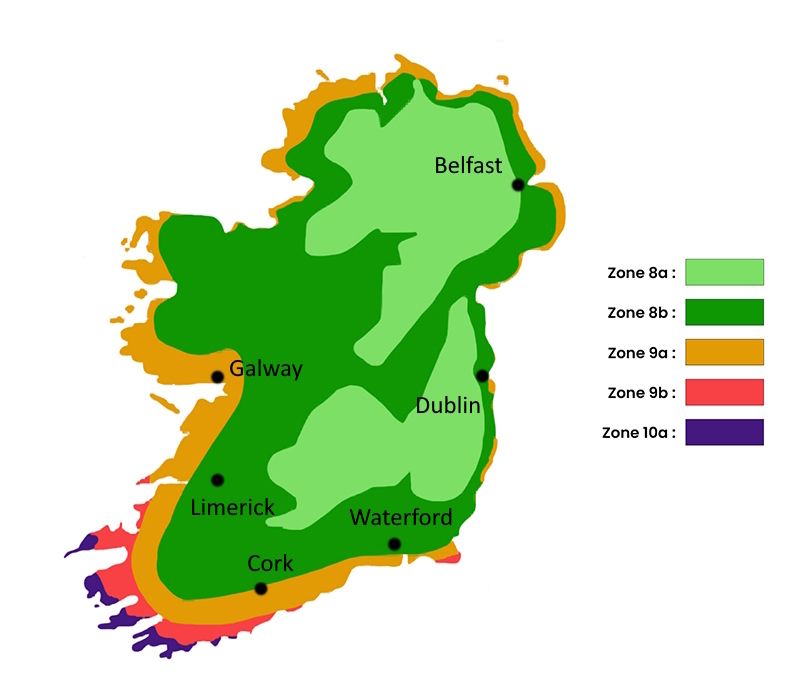
The planting period indicated on our website applies to regions in USDA Zone 9a (East Coast and Midlands: Dublin, Wexford, Waterford, Kilkenny, Portlaoise). It will vary depending on where you live:
- On the west coast and in the north-west (Galway, Limerick, Sligo, Donegal, Westport), delay planting by 1 to 2 weeks in spring and bring it forward by 1 to 2 weeks in autumn compared to the dates given, preferably choosing periods without strong winds.
- In the inland hills and plateaus (Wicklow Mountains, Macgillycuddy’s Reeks, Connemara, Killarney), it is best to plant in spring (April–May) or autumn (September–October), avoiding periods of waterlogged soil in winter and strong winds, which pose the main risk to newly planted trees in these areas.
The flowering period indicated on our website applies to regions in USDA Zone 9a, such as the East Coast and Midlands, including Dublin, Wexford, Waterford, Kilkenny and Portlaoise.
This will vary depending on where you live:
- On the west coast and in the northwest (Galway, Limerick, Sligo, Donegal and Westport), it will be delayed by one to two weeks compared to the given dates, due to stronger Atlantic winds and less spring sunshine.
- In the inland hills and plateaus (the Wicklow Mountains, the Macgillycuddy's Reeks, Connemara and Killarney), flowering will be delayed by two to three weeks. Flowering mainly occurs between May and July, with the limiting factors being less frost and more of the excessive humidity, strong winds and lack of sunshine that are characteristic of these areas.
Shipping country and language
Your country of residence may be:
Your country of residence is:
For a better user experience on our website, you can select:
Your shipping country:
-
 Austria
-
 Belgium
-
 Bosnia & Herzegovina
-
 Bulgaria
-
 Croatia
-
 Cyprus
-
 Czechia
-
 Denmark
-
 Estonia
-
 Finland
-
 France
-
 Germany
-
 Greece
-
 Hungary
-
 Iceland
-
 Ireland
-
 Italy
Italy
-
 Latvia
-
 Liechtenstein
-
 Lithuania
-
 Luxembourg
-
 Malta
Malta
-
 Netherlands
-
 Poland
-
 Portugal
-
 Romania
-
 Serbia
-
 Slovakia
-
 Slovenia
-
 Spain
Spain
-
 Sweden
-
 Switzerland
Language:
-
French
-
 English
-
Spanish
-
Italian
-
German
-
Portuguese
-
Dutch
-
Finnish
My Account
Hello
My wish lists
My cart
Log in / Register
Existing customer?
This form is protected by reCAPTCHA - the Google Privacy Policy and Terms of Service apply.
New customer?
Create an account to track your orders, access our customer service and, if you wish, make the most of our upcoming offers.