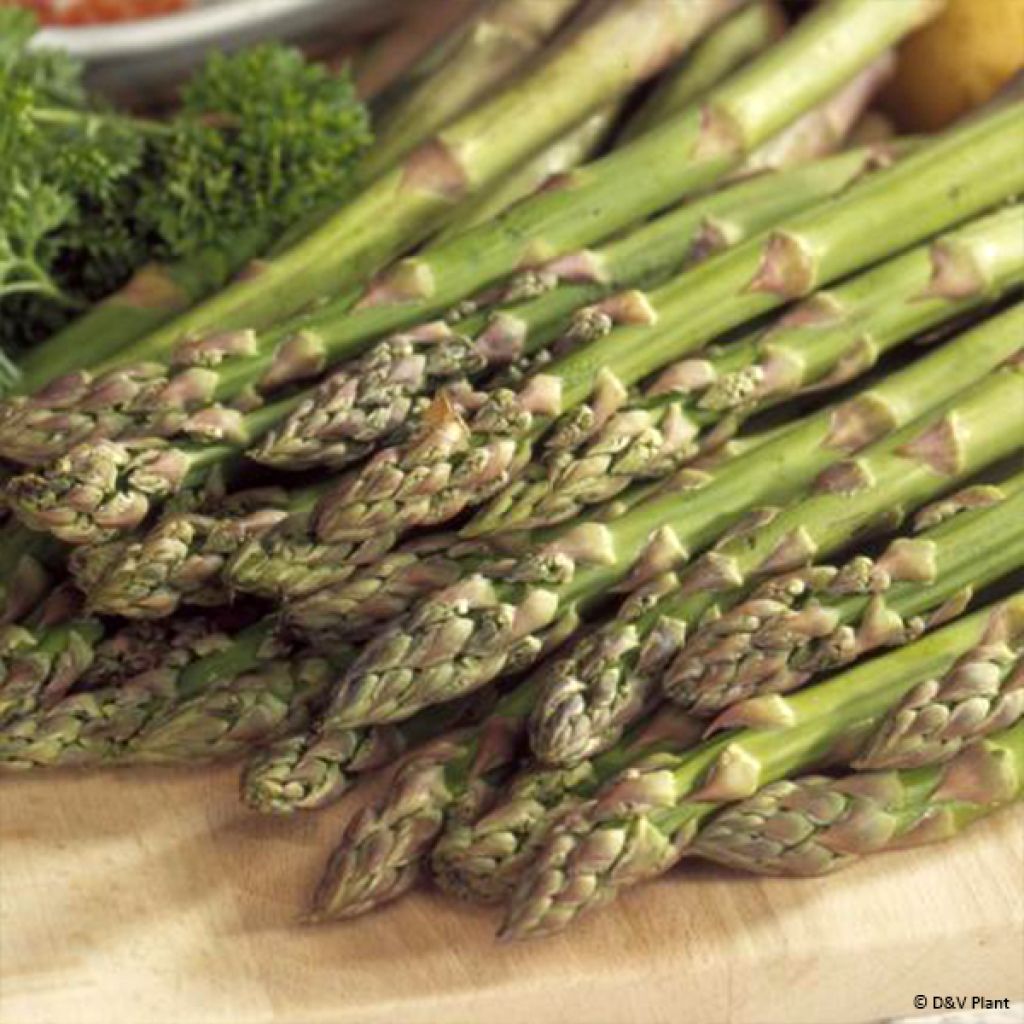
Mary Washington Green Asparagus - Asparagus officinalis
Mary Washington Green Asparagus - Asparagus officinalis
Asparagus officinalis Mary Washington
Garden asparagus, Asparagus, Sparrow grass
The 6 young plants are magnificent and vigorous. When I received them, they had stems between 10 and 20 cm, but after transplanting, everything wilted and disappeared. 4 to 5 weeks later, the first shoots grew back, and now they are very strong. Don't hesitate.
Alain, 02/08/2025
Back-to-school special offer!
Get €10 off for every €50 you spend! And get up to €40 off on a single order.
How does it work?
1. Shop your favourites
Add your favourite plants to your basket. For every €50 you spend (excluding delivery charges, store credit and the plastic-free option), you’ll receive a €10 voucher.
€50 spent = €10 voucher
€100 spent = €20 voucher
€150 spent = €30 voucher
€200 spent = €40 voucher
2. Place your order
Once your basket reaches one of the spending thresholds, place your order. You can even choose your delivery date!
3. Receive your voucher
As soon as your order has been shipped, you’ll receive an email containing your personal voucher code and its value.
4. Use it on your next order
Your voucher is valid for 90 days from the date you receive it. It can be used once only, on a new order worth at least the value of the voucher, excluding delivery charges.
Please note: Vouchers can be combined with other offers, but cannot be split or refunded.
Why not try an alternative variety in stock?
View all →
Available in 1 sizes
Available in 1 sizes
This plant carries a 6 months recovery warranty
More information
We guarantee the quality of our plants for a full growing cycle, and will replace at our expense any plant that fails to recover under normal climatic and planting conditions.

Description
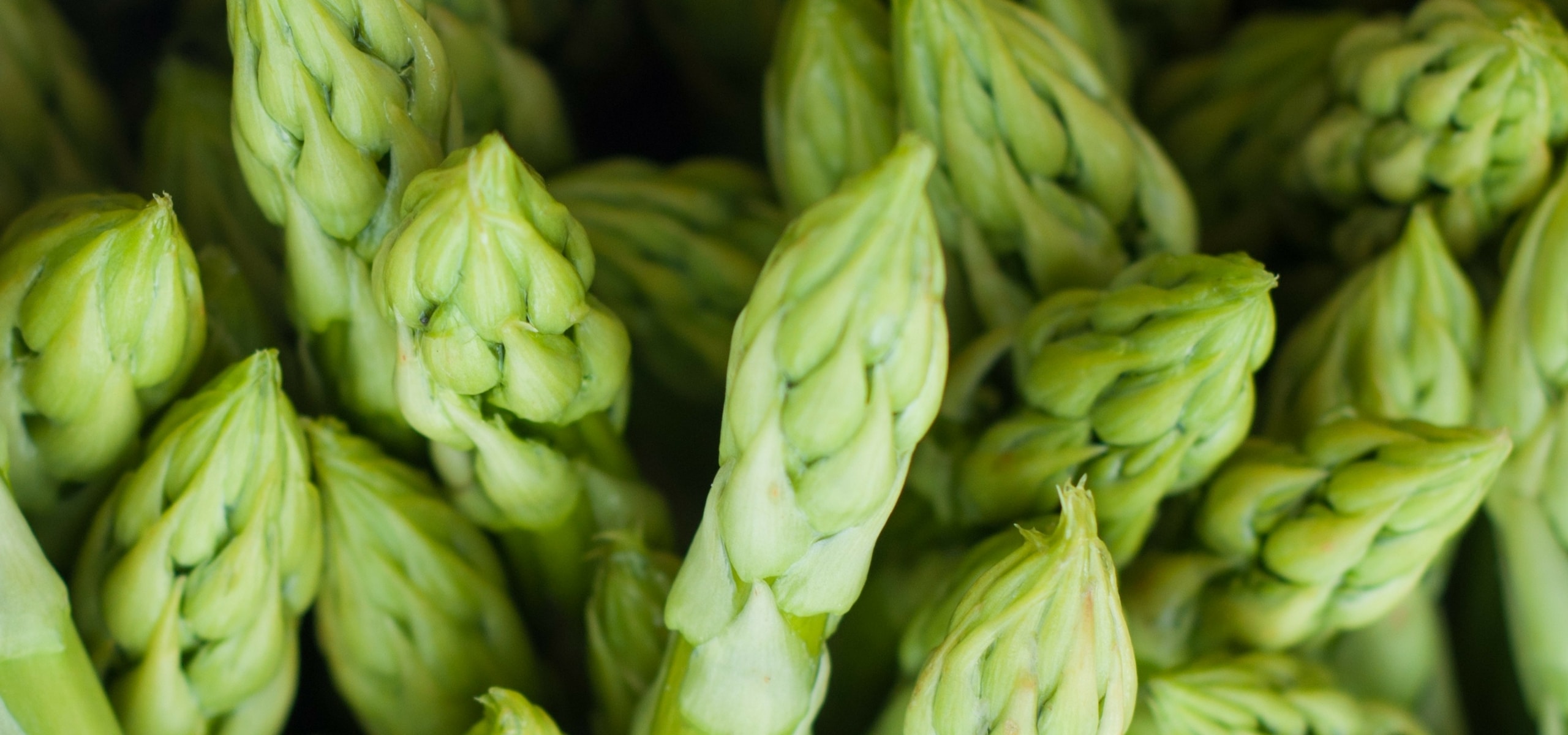
Mary Washington Green Asparagus is a variety dating back to 1919 that has retained some of the qualities of wild Asparagus officinalis, including its robustness, resistance to rust, and the unique flavour of its shoots. It produces numerous thin, long, and uniform shoots of a bright green colour. It is a tall variety (1.50 m (5ft)) that can also be cultivated as white asparagus by keeping it away from light. It is a fertile female asparagus variety whose seeds can be re-sown. The crowns are planted in the soil in March-April, after preparing the soil the previous fall. Wait until the 3rd year to start harvesting, and then harvest every year from April to June for 10 to 15 years. Once cooked, asparagus can be consumed cold as an appetizer or hot according to your preferences: in soups, gratins, sauces, etc.
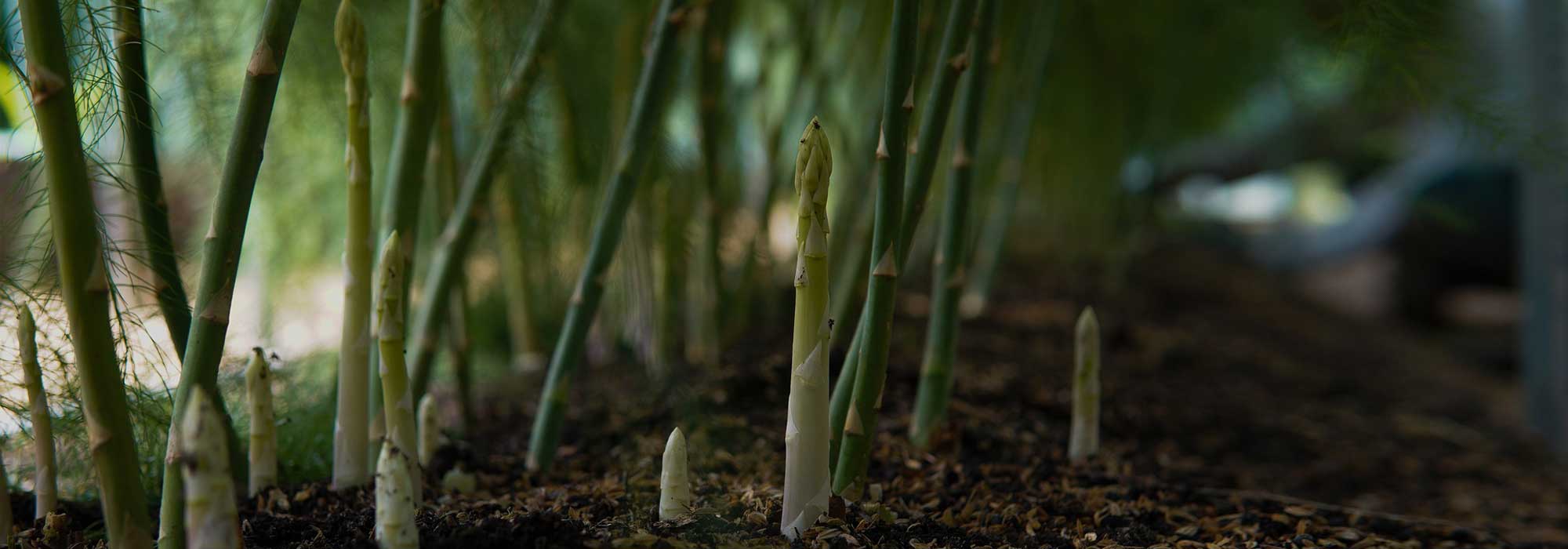
Asparagus, in Latin Asparagus officinalis, is a plant of the asparagus family originating from central and southern Europe, western Asia, and North Africa. It is present in France on sandy soils, in fallow land and uncultivated areas. The term "asperge" (asparagus) commonly refers to its edible shoots called "turions," which develop from rhizomes. Each spring, underground buds emerge from the rhizomes, giving rise to the shoots that grow into leafy stems that can reach up to 1m (3ft) above the ground.
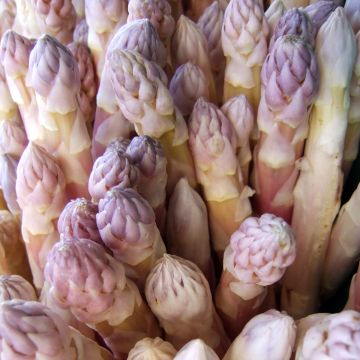
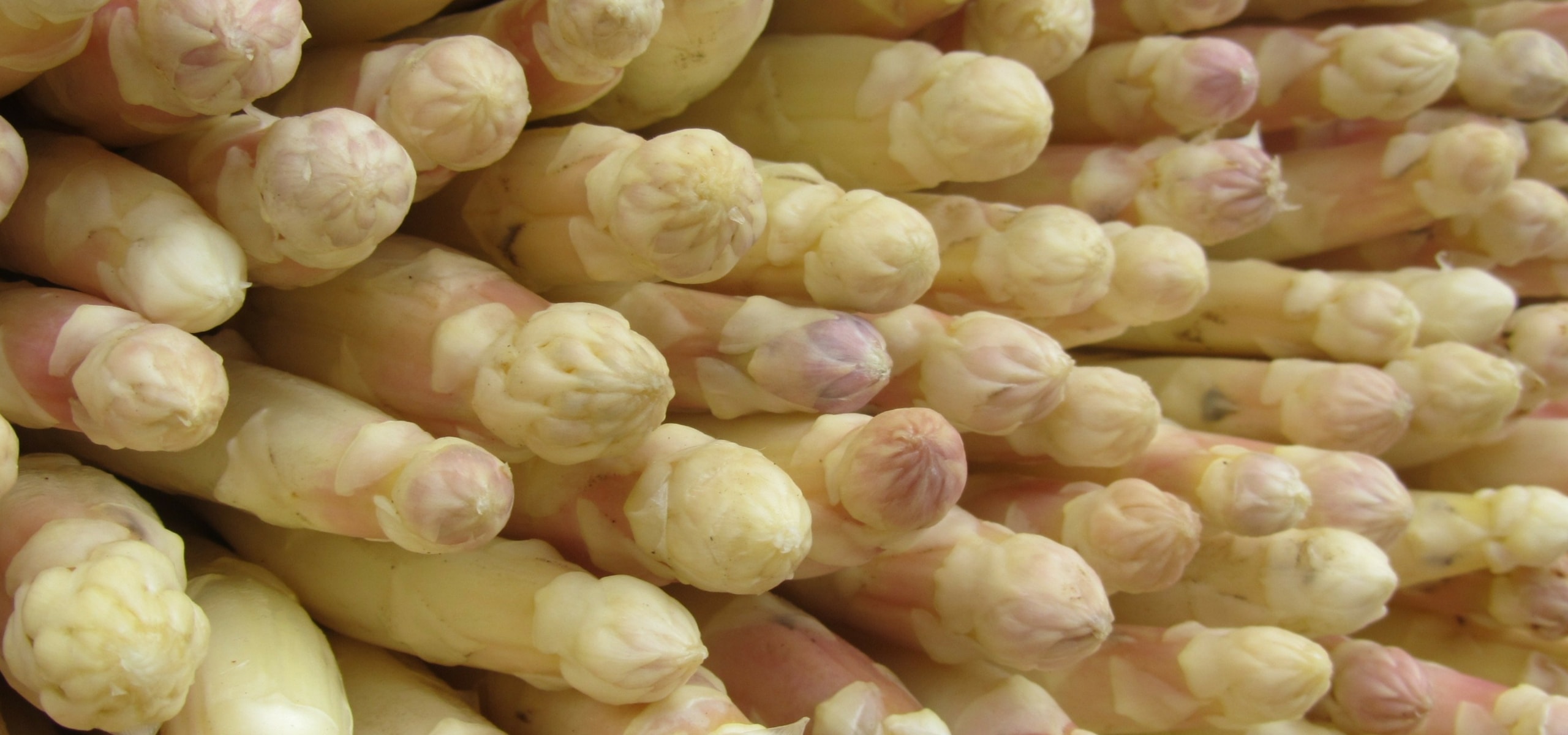
The colour of asparagus, in Latin Asparagus officinalis, is not only determined by its variety, but also by the amount of light it receives. White asparagus grows entirely underground and is harvested as soon as the tip is flush with the soil. Purple asparagus is harvested a little later when the tip emerges from the ground. They have a purple head and a white stem. Green asparagus, on the other hand, grows in the light and turns green thanks to photosynthesis. Purple asparagus is cultivated in the same way as green asparagus. Its colour will actually change from purple to green during cooking. Each variety can therefore produce white asparagus or green asparagus, depending on the cultivation method, although it is often recommended for a specific colour.
Asparagus is rich in fibre, vitamin B9, and minerals. It can be cooked and consumed cold (as an appetizer, with mayonnaise or vinaigrette) or hot (in soups, omelettes, sautés, gratins, sauces, etc.). Green asparagus has a slightly stronger taste and does not need to be peeled.
Asparagus is planted in the form of crowns in the soil. A crown is a cluster of underground roots. It will give rise to several young asparagus shoots, called turions. Choose carefully where you want to plant asparagus, as the production lasts for 10 to 15 years. In summer, after harvesting, feathery foliage will appear. This foliage can be used in flower arrangements.
Harvesting: Asparagus is harvested in May and June (from April for early varieties) when they have a diameter of at least 1cm (0in). To harvest white and purple asparagus, use an asparagus knife. Insert it into the ground and make a lever motion to cut the asparagus. Green and purple asparagus can be snapped off by hand. In the first two years, do not harvest anything. In the 3rd year, harvest every other shoot. Then, from the 4th year onwards, only harvest 2/3 of the shoots to allow the plant to continue growing.
Storage: To fully enjoy their flavour, consume asparagus quickly after harvesting. Asparagus can be stored in the refrigerator for a few days, wrapped in a damp cloth. For long-term storage, you can freeze them or preserve them.
Gardener's tip: From the 3rd year onwards, you can plant other crops, such as green manure, between the rows of asparagus. They will provide nitrogen to the soil and limit weed growth. However avoid clover and alfalfa, as they are susceptible to purple rhizoctone like asparagus. Cut down the green manure in autumn and incorporate it superficially into the soil.
Age: Asparagus crowns are already 2 years old and can start producing in the 3rd year.
Harvest
Plant habit
Foliage
Botanical data
Asparagus
officinalis
Mary Washington
Asparagaceae
Garden asparagus, Asparagus, Sparrow grass
Cultivar or hybrid
Perennial
Planting and care
Installation – 1st year:
Mary Washington asparagus should be planted in March and April (or as early as February in mild climates). They generally require a sandy, light, and well-drained soil. Plant the crowns in a sunny location, preferably where there have been no root vegetables in previous years.
In the autumn, dig a trench 40 cm (16in) wide and 25 cm (10in) deep for white or purple asparagus (15 cm (6in) for green and purple asparagus that do not require mounding). Make sure to separate the topsoil from the subsoil. The trenches should be spaced 1.50 m (5ft) apart. Add well-rotted compost and mix it with the soil. If the soil is clayey, add sand to the bottom of the trench.
The following spring, within the trench, form mounds that are 10 cm (4in) high (one mound every 60 cm (24in)). Install a 1m (3ft) tall stake at the base of each mound to mark the location of the crowns and to secure the stems in case of wind.
Place the crowns on the mounds, with the tip pointing upwards, and spread the roots to form a star shape. Completely cover the crowns with the subsoil, up to 5 to 10 cm (2 to 4in). Firmly press down on the sides. Water thoroughly. Do not cultivate anything between the rows during the first two years, except for garlic and onions. Weed as needed. Do not harvest anything.
2nd year: fill the trench with the topsoil. Wait for another year before starting to harvest.
From the 3rd year onwards:
In the spring, apply a natural fertiliser rich in phosphorus and potassium. Incorporate it superficially. Mound the stems up to 30 cm (12in) (except for green and purple asparagus).
Harvesting begins from the 3rd year.
In the autumn: Cut the stems 10 cm (4in) above the ground with pruners. Burn them to prevent the spread of asparagus fly larvae, among other pests. Lightly hoe the soil surface to break up the crust. Flatten the mounds. Apply well-rotted compost and incorporate it into the surface.
Cultivation
Care
Intended location
Planting & care advice

-
, onOrder confirmed
Reply from on Promesse de fleurs
Recently viewed products
Haven't found what you were looking for?
Hardiness is the lowest winter temperature a plant can endure without suffering serious damage or even dying. However, hardiness is affected by location (a sheltered area, such as a patio), protection (winter cover) and soil type (hardiness is improved by well-drained soil).
In temperate climates, pruning of spring-flowering shrubs (forsythia, spireas, etc.) should be done just after flowering.
Pruning of summer-flowering shrubs (Indian Lilac, Perovskia, etc.) can be done in winter or spring.
In cold regions as well as with frost-sensitive plants, avoid pruning too early when severe frosts may still occur.
The harvesting period indicated on our website applies to countries and regions in USDA zone 8 (France, England, Ireland, the Netherlands).
In colder areas (Scandinavia, Poland, Austria...) fruit and vegetable harvests are likely to be delayed by 3-4 weeks.
In warmer areas (Italy, Spain, Greece, etc.), harvesting will probably take place earlier, depending on weather conditions.
The sowing periods indicated on our website apply to countries and regions within USDA Zone 8 (France, UK, Ireland, Netherlands).
In colder areas (Scandinavia, Poland, Austria...), delay any outdoor sowing by 3-4 weeks, or sow under glass.
In warmer climes (Italy, Spain, Greece, etc.), bring outdoor sowing forward by a few weeks.
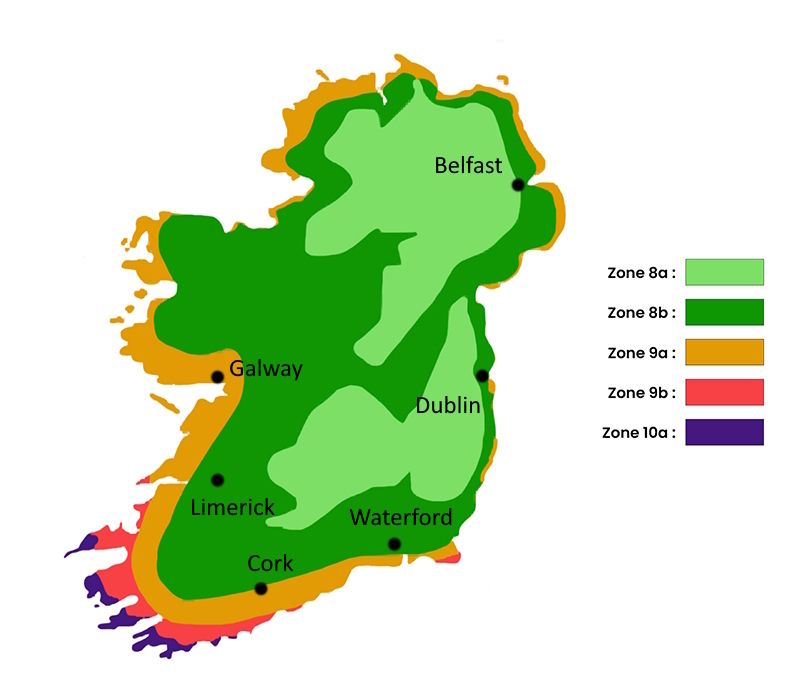
The planting period indicated on our website applies to regions in USDA Zone 9a (East Coast and Midlands: Dublin, Wexford, Waterford, Kilkenny, Portlaoise). It will vary depending on where you live:
- On the west coast and in the north-west (Galway, Limerick, Sligo, Donegal, Westport), delay planting by 1 to 2 weeks in spring and bring it forward by 1 to 2 weeks in autumn compared to the dates given, preferably choosing periods without strong winds.
- In the inland hills and plateaus (Wicklow Mountains, Macgillycuddy’s Reeks, Connemara, Killarney), it is best to plant in spring (April–May) or autumn (September–October), avoiding periods of waterlogged soil in winter and strong winds, which pose the main risk to newly planted trees in these areas.
The flowering period indicated on our website applies to regions in USDA Zone 9a, such as the East Coast and Midlands, including Dublin, Wexford, Waterford, Kilkenny and Portlaoise.
This will vary depending on where you live:
- On the west coast and in the northwest (Galway, Limerick, Sligo, Donegal and Westport), it will be delayed by one to two weeks compared to the given dates, due to stronger Atlantic winds and less spring sunshine.
- In the inland hills and plateaus (the Wicklow Mountains, the Macgillycuddy's Reeks, Connemara and Killarney), flowering will be delayed by two to three weeks. Flowering mainly occurs between May and July, with the limiting factors being less frost and more of the excessive humidity, strong winds and lack of sunshine that are characteristic of these areas.
Shipping country and language
Your country of residence may be:
Your country of residence is:
For a better user experience on our website, you can select:
Your shipping country:
-
 Austria
-
 Belgium
-
 Bosnia & Herzegovina
-
 Bulgaria
-
 Croatia
-
 Cyprus
-
 Czechia
-
 Denmark
-
 Estonia
-
 Finland
-
 France
-
 Germany
-
 Greece
-
 Hungary
-
 Iceland
-
 Ireland
-
 Italy
Italy
-
 Latvia
-
 Liechtenstein
-
 Lithuania
-
 Luxembourg
-
 Malta
Malta
-
 Netherlands
-
 Poland
-
 Portugal
-
 Romania
-
 Serbia
-
 Slovakia
-
 Slovenia
-
 Spain
Spain
-
 Sweden
-
 Switzerland
Language:
-
French
-
 English
-
Spanish
-
Italian
-
German
-
Portuguese
-
Dutch
-
Finnish
My Account
Hello
My wish lists
My cart
Log in / Register
Existing customer?
This form is protected by reCAPTCHA - the Google Privacy Policy and Terms of Service apply.
New customer?
Create an account to track your orders, access our customer service and, if you wish, make the most of our upcoming offers.