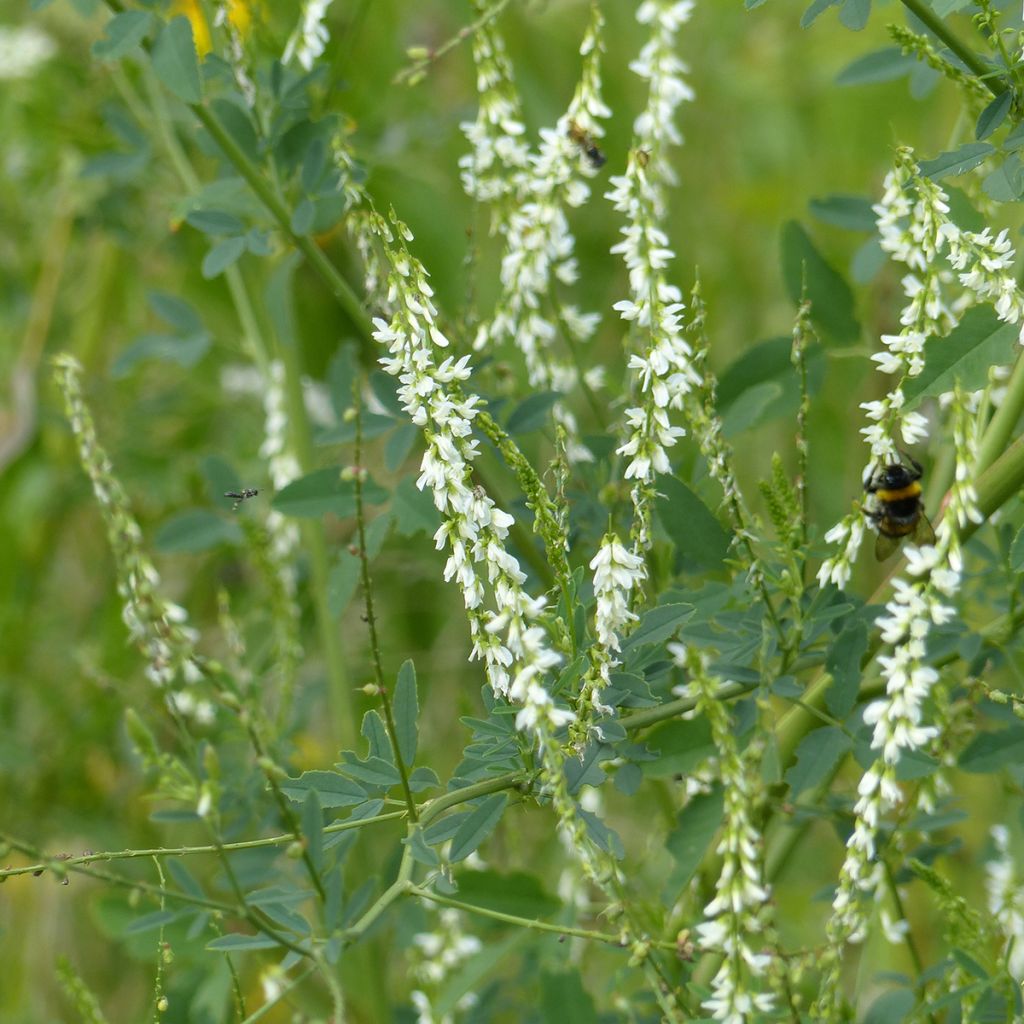
White Melilot Seeds - Melilotus albus
White Melilot Seeds - Melilotus albus
Melilotus albus
White sweet clover, Bokhara clover, Honey clover, White melilot
Back-to-school special offer!
Get €10 off for every €50 you spend! And get up to €40 off on a single order.
How does it work?
1. Shop your favourites
Add your favourite plants to your basket. For every €50 you spend (excluding delivery charges, store credit and the plastic-free option), you’ll receive a €10 voucher.
€50 spent = €10 voucher
€100 spent = €20 voucher
€150 spent = €30 voucher
€200 spent = €40 voucher
2. Place your order
Once your basket reaches one of the spending thresholds, place your order. You can even choose your delivery date!
3. Receive your voucher
As soon as your order has been shipped, you’ll receive an email containing your personal voucher code and its value.
4. Use it on your next order
Your voucher is valid for 90 days from the date you receive it. It can be used once only, on a new order worth at least the value of the voucher, excluding delivery charges.
Please note: Vouchers can be combined with other offers, but cannot be split or refunded.
Home or relay delivery (depending on size and destination)
Important: You may be charged customs duties by your country’s customs authorities upon delivery.
Schedule delivery date
and select date in basket
This plant carries a 6 months recovery warranty
More information
We guarantee the quality of our plants for a full growing cycle, and will replace at our expense any plant that fails to recover under normal climatic and planting conditions.
Description
Melilotus albus, also known as white sweet clover, is an annual or biennial herbaceous plant. Characterised by its white summer flowering, trifoliate leaves, and taproot, it is used as a nitrogen-fixing forage plant, green manure, and nectar-rich plant that provides excellent honey yields. It is also an edible plant. It grows in all types of soil, even very dry ones. The only conditions that are not suitable for it are shade and acidic soils.
It belongs to the Fabaceae family. It is native to a large part of Asia and southern Europe, from France and Spain to Kazakhstan and Myanmar, as well as northeastern Africa. It grows in limestone clearings, lightly wooded cliffs, meadows, weed-infested pastures, open and disturbed sites, road edges, ditches, vacant lots, and fallow land. It is a honey-bearing herbaceous plant, reaching a height of 30cm (12in) to 1.2m (4ft), depending on growing conditions. It develops leaves with 3 leaflets. The light green stems are round or slightly furrowed and often branched. The alternate leaves are trifoliate and scattered along the stem. The upper stems end in narrow racemes of white flowers that tend to hang down from the central peduncle of the raceme. Each flower measures about 8.5mm long and consists of 5 white petals and a light green calyx with 5 teeth. The flowers are small, soft, tubular at the base, and widen towards the outer edges. Its clusters of white flowers appear from June to September. The plants usually flower and die during the second year of growth. It is cold-resistant down to -15°C (5°F) and drought-tolerant. It is distinguished by its deep roots that help to loosen soil.
It is adapted to a wide range of climatic conditions and grows in virtually all types of soils, including very poor ones. It prefers soils with a neutral pH or a tendency towards alkaline. It only needs adequate moisture during germination. It can develop in extremely dry conditions. It can be invasive and precautions should be taken to remove the flowers before they spread. This plant nourishes and improves the soil by providing various nutrients and stimulating soil microbial life. Its roots will loosen soil, break it up, and aerate it. Used as green manure, it also protects soils from leaching (nutrient loss in sandy soils), rain compaction (crusting in loamy soils), and erosion (due to runoff in case of heavy rains on sloping terrain). This vegetative cover also helps limit weed growth. Green manures are sown on uncultivated plots or intercropped between rows of vegetables. They are either naturally destroyed by frost or mowed before seed formation. Once destroyed, they can be left in place as mulch, be shredded and incorporated into the surface layers of the soil, or be collected and added to compost.
It is an edible plant that is rich in vitamin C. Its leaves emit a sweet smell reminiscent of coumarin, a characteristic hay smell. Its young raw leaves can be eaten in small quantities in salads, and its seeds as spices. Although white sweet clover has medicinal properties, it is strongly advised not to harvest it and dry it yourself for use as a "treatment". Improperly dried coumarin transforms into dicoumarol, a highly toxic compound. It is antispasmodic, antiseptic, and diuretic. It is also used to aid sleep and calm nervousness. Consumed in very high doses, white sweet clover can be toxic.
Harvest
Plant habit
Foliage
Botanical data
Melilotus
albus
Fabaceae
White sweet clover, Bokhara clover, Honey clover, White melilot
Central Europe
Perennial
Planting and care
Sow the seeds in spring. It prefers soils with a neutral pH or a tendency towards limestone.
If your soil is compact, loosen it to help the long roots to establish. Similarly, remove as many unwanted weeds as possible before sowing to ensure good germination.
Sow by broadcasting. Cover the seeds with soil using a rake. Firm the soil with the back of the rake and water lightly.
It does not require any specific maintenance during cultivation or watering.
Seedlings
Care
Intended location
Planting & care advice
-
-
-
-
-
-

-
-

This item has not been reviewed yet - be the first to leave a review about it.
Recently viewed products
Haven't found what you were looking for?
Hardiness is the lowest winter temperature a plant can endure without suffering serious damage or even dying. However, hardiness is affected by location (a sheltered area, such as a patio), protection (winter cover) and soil type (hardiness is improved by well-drained soil).
In temperate climates, pruning of spring-flowering shrubs (forsythia, spireas, etc.) should be done just after flowering.
Pruning of summer-flowering shrubs (Indian Lilac, Perovskia, etc.) can be done in winter or spring.
In cold regions as well as with frost-sensitive plants, avoid pruning too early when severe frosts may still occur.
The harvesting period indicated on our website applies to countries and regions in USDA zone 8 (France, England, Ireland, the Netherlands).
In colder areas (Scandinavia, Poland, Austria...) fruit and vegetable harvests are likely to be delayed by 3-4 weeks.
In warmer areas (Italy, Spain, Greece, etc.), harvesting will probably take place earlier, depending on weather conditions.
The sowing periods indicated on our website apply to countries and regions within USDA Zone 8 (France, UK, Ireland, Netherlands).
In colder areas (Scandinavia, Poland, Austria...), delay any outdoor sowing by 3-4 weeks, or sow under glass.
In warmer climes (Italy, Spain, Greece, etc.), bring outdoor sowing forward by a few weeks.
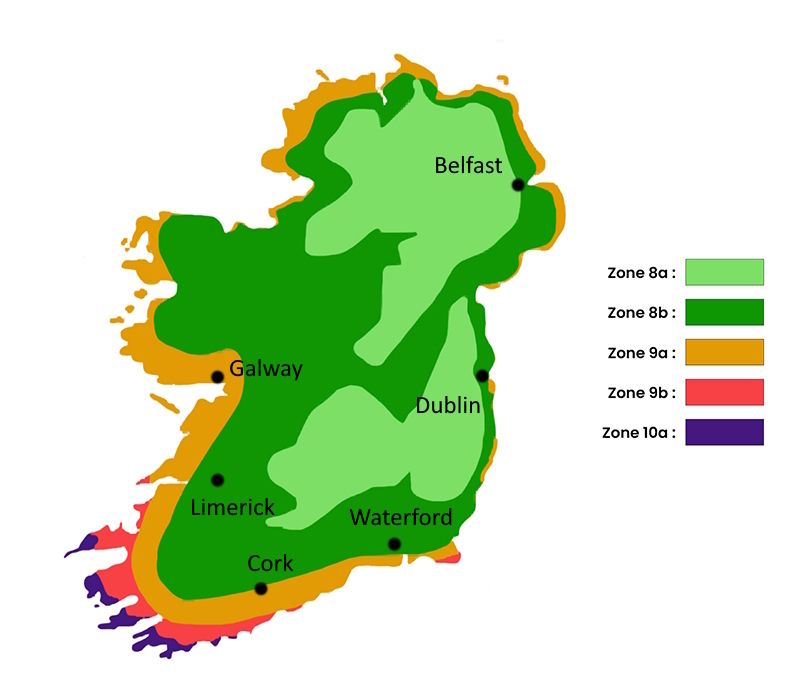
The planting period indicated on our website applies to regions in USDA Zone 9a (East Coast and Midlands: Dublin, Wexford, Waterford, Kilkenny, Portlaoise). It will vary depending on where you live:
- On the west coast and in the north-west (Galway, Limerick, Sligo, Donegal, Westport), delay planting by 1 to 2 weeks in spring and bring it forward by 1 to 2 weeks in autumn compared to the dates given, preferably choosing periods without strong winds.
- In the inland hills and plateaus (Wicklow Mountains, Macgillycuddy’s Reeks, Connemara, Killarney), it is best to plant in spring (April–May) or autumn (September–October), avoiding periods of waterlogged soil in winter and strong winds, which pose the main risk to newly planted trees in these areas.
The flowering period indicated on our website applies to regions in USDA Zone 9a, such as the East Coast and Midlands, including Dublin, Wexford, Waterford, Kilkenny and Portlaoise.
This will vary depending on where you live:
- On the west coast and in the northwest (Galway, Limerick, Sligo, Donegal and Westport), it will be delayed by one to two weeks compared to the given dates, due to stronger Atlantic winds and less spring sunshine.
- In the inland hills and plateaus (the Wicklow Mountains, the Macgillycuddy's Reeks, Connemara and Killarney), flowering will be delayed by two to three weeks. Flowering mainly occurs between May and July, with the limiting factors being less frost and more of the excessive humidity, strong winds and lack of sunshine that are characteristic of these areas.
Shipping country and language
Your country of residence may be:
Your country of residence is:
For a better user experience on our website, you can select:
Your shipping country:
-
 Austria
-
 Belgium
-
 Bosnia & Herzegovina
-
 Bulgaria
-
 Croatia
-
 Cyprus
-
 Czechia
-
 Denmark
-
 Estonia
-
 Finland
-
 France
-
 Germany
-
 Greece
-
 Hungary
-
 Iceland
-
 Ireland
-
 Italy
Italy
-
 Latvia
-
 Liechtenstein
-
 Lithuania
-
 Luxembourg
-
 Malta
Malta
-
 Netherlands
-
 Poland
-
 Portugal
-
 Romania
-
 Serbia
-
 Slovakia
-
 Slovenia
-
 Spain
Spain
-
 Sweden
-
 Switzerland
Language:
-
French
-
 English
-
Spanish
-
Italian
-
German
-
Portuguese
-
Dutch
-
Finnish
My Account
Hello
My wish lists
My cart
Log in / Register
Existing customer?
This form is protected by reCAPTCHA - the Google Privacy Policy and Terms of Service apply.
New customer?
Create an account to track your orders, access our customer service and, if you wish, make the most of our upcoming offers.