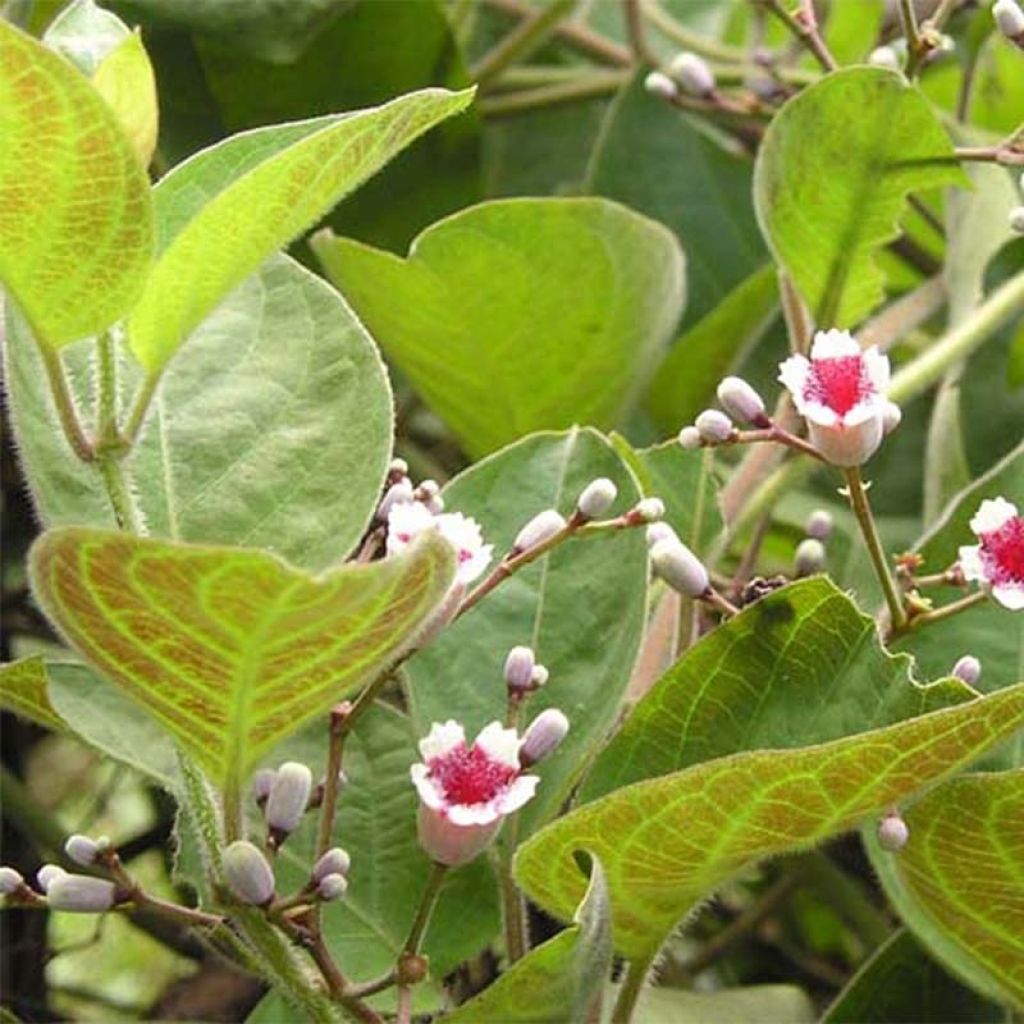
Paederia lanuginosa
Paederia lanuginosa
Paederia lanuginosa
Skunk vine
Very nice well-developed plant, I haven't found its place yet????
Odile, 04/07/2022
Back-to-school special offer!
Get €10 off for every €50 you spend! And get up to €40 off on a single order.
How does it work?
1. Shop your favourites
Add your favourite plants to your basket. For every €50 you spend (excluding delivery charges, store credit and the plastic-free option), you’ll receive a €10 voucher.
€50 spent = €10 voucher
€100 spent = €20 voucher
€150 spent = €30 voucher
€200 spent = €40 voucher
2. Place your order
Once your basket reaches one of the spending thresholds, place your order. You can even choose your delivery date!
3. Receive your voucher
As soon as your order has been shipped, you’ll receive an email containing your personal voucher code and its value.
4. Use it on your next order
Your voucher is valid for 90 days from the date you receive it. It can be used once only, on a new order worth at least the value of the voucher, excluding delivery charges.
Please note: Vouchers can be combined with other offers, but cannot be split or refunded.
Why not try an alternative variety in stock?
View all →
Available in 0 sizes
Available in 1 sizes

Available in 2 sizes
Available in 1 sizes
Available in 1 sizes
Available in 1 sizes

Available in 1 sizes
Available in 1 sizes
Available in 1 sizes
Available in 0 sizes
This plant carries a 6 months recovery warranty
More information
We guarantee the quality of our plants for a full growing cycle, and will replace at our expense any plant that fails to recover under normal climatic and planting conditions.

Description
The Cheese Plant, with its unpronounceable Latin names Paederia lanuginosa or Hondbesseion lanuginosum, is an unusual Vietnamese climbing plant that is very popular among advocates of a 100% plant-based diet. Completely edible, its young leaves, which taste like Camembert, are mainly consumed raw or cooked, to flavor cuisine. Its velvety foliage, rust-colored with green veins, is both flavorful and charming, as are its clusters of curious, hairy little bells that bloom in summer. Plant it in a warm, sheltered, sunny location with moist soil. Its root system can withstand temperatures down to -8/-10°C (17.6/14°F) in the ground, under a thick layer of mulch. In colder climates, it can be easily grown in a pot and overwintered in a cold greenhouse or a minimally heated conservatory.
Paederia lanuginosa is native to open forests in China (Yunnan), Thailand, and Vietnam. In Asia, this vine, locally known as Mo Long, has long been used for its digestive medicinal properties. It belongs to the large Rubiaceae family and is a cousin of the coffee plant, bedstraw, and woodruff. While not demanding in terms of soil type, the cheese plant prefers fertile and fresh soil. In its natural habitat, under a subtropical to tropical climate, its stems can reach a length of 12 meters (39 feet). In our latitudes, its dimensions will remain more modest, especially if it is grown in a pot, pruned, or cut back by frost each winter.
The hairy, velvety stems of Paederia are a violet-brown color. They are voluble and twine around available supports (stakes, shrubs). Without support, they can also creep along the ground or spill over pots. The plant reaches an average height of 1.50 meters (5 feet) or a spread of 60 cm (24in), depending on growing conditions. It tolerates pruning well, which helps control its growth. Its foliage consists of oval, hairy leaves measuring 8 to 20 cm (3 to 8in) in length and 4.5 to 15 cm (2 to 6in) in width, arranged opposite each other on the stems. The lamina, marked by prominent veins, is green tinged with rust when young. Mature leaves are dark green with a purple underside. It blooms in summer, from June to September-October depending on growing conditions and climate. The inflorescences emerge in the axils of the leaves on the main stems or at the ends of secondary stems. They are small panicles of bell-shaped flowers measuring approximately 1.5 to 2 cm (1in) in length. The corolla combines various colors: pale green, dull white, pink, reddish-purple, or dark purple. After pollination by insects, oblong to elliptical fruits form, laterally flattened and measuring about 1 cm (0in) in length. They turn brown when ripe, and their small winged seeds are dispersed by the wind. The cheese-like aroma is due to the presence of a sulphur compound in the plant's tissues, which also aids digestion.
Harvesting: Pick as needed, when the leaves are young, from spring until frost or all year round if your cheese plant is protected from freezing temperatures. Harvest leaf by leaf, by hand or with a knife. The leaves of Paederia can be consumed raw, cooked, or dried.
Usage: The cheese plant is widely used in traditional Vietnamese cuisine, where it flavors soups and rice. Raw leaves can be chopped and added to toasted and buttered bread, scrambled eggs, pasta, tofu, or yogurt. You can also make a simple Vietnamese omelette by beating eggs with sliced leaves and onions. Young leaves can be used to make pesto. While the unique aroma of this plant can replace the flavor of cheese in everyday recipes, it will never provide the creamy texture of melted cheese to your dishes!
Gardening tip: To reduce the need for watering, we recommend mulching the soil with thin, successive layers of grass clippings mixed with dead leaves, if possible. This protective layer keeps the soil moist and fertile while also reducing the need for weeding.

Harvest
Plant habit
Foliage
Planting and care
Paederia lanuginosa appreciates fresh, light, and rich soils. It thrives in any good garden soil enriched with leaf compost and well decomposed compost. Choose a sunny or semi-shaded location, sheltered from strong and cold winds. Planting is preferably done in spring (from March to May), but can be done all year round for plants grown in pots.
In the ground: If necessary, add compost a few months before planting by scratching the soil to a depth of 5 cm (2in) after loosening it. The plants should be spaced 1m (3ft) apart. Dig a hole (3 times the volume of the root ball), place the root ball in it, and cover with fine soil. Pack down and water to keep the soil moist.
Regularly weed and hoe, especially at the beginning of cultivation. Water and mulch in case of high temperatures or drought. In early spring, add compost on the surface.
In a pot: Place a layer of gravel at the bottom of the pot (minimum diameter of 30 cm (12in)) to facilitate drainage. Fill it with a mixture of potting soil and compost. Place the root ball, cover with soil, and pack down well.
Water regularly. Repot every year. Protect your plant from frost by placing it in a lightly heated veranda or greenhouse with bright exposure. Reduce watering slightly without letting the soil completely dry out.
Pruning: Paederia tolerates pruning well, which helps to limit its size when storing it in winter.
Cultivation
Care
Intended location
Planting & care advice
-
-

-

-
-
-

-
-

-
, onOrder confirmed
Reply from on Promesse de fleurs
Recently viewed products
Haven't found what you were looking for?
Hardiness is the lowest winter temperature a plant can endure without suffering serious damage or even dying. However, hardiness is affected by location (a sheltered area, such as a patio), protection (winter cover) and soil type (hardiness is improved by well-drained soil).
In temperate climates, pruning of spring-flowering shrubs (forsythia, spireas, etc.) should be done just after flowering.
Pruning of summer-flowering shrubs (Indian Lilac, Perovskia, etc.) can be done in winter or spring.
In cold regions as well as with frost-sensitive plants, avoid pruning too early when severe frosts may still occur.
The harvesting period indicated on our website applies to countries and regions in USDA zone 8 (France, England, Ireland, the Netherlands).
In colder areas (Scandinavia, Poland, Austria...) fruit and vegetable harvests are likely to be delayed by 3-4 weeks.
In warmer areas (Italy, Spain, Greece, etc.), harvesting will probably take place earlier, depending on weather conditions.
The sowing periods indicated on our website apply to countries and regions within USDA Zone 8 (France, UK, Ireland, Netherlands).
In colder areas (Scandinavia, Poland, Austria...), delay any outdoor sowing by 3-4 weeks, or sow under glass.
In warmer climes (Italy, Spain, Greece, etc.), bring outdoor sowing forward by a few weeks.
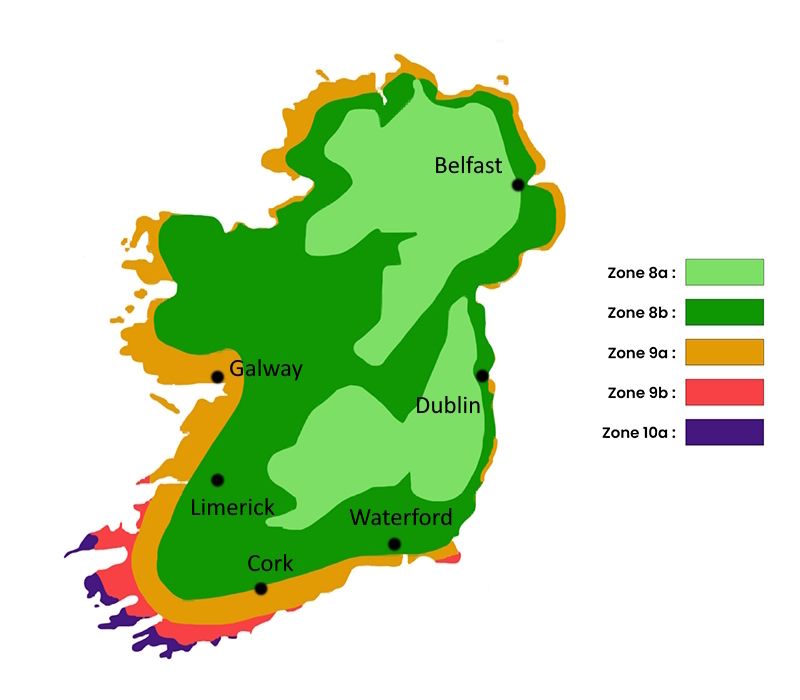
The planting period indicated on our website applies to regions in USDA Zone 9a (East Coast and Midlands: Dublin, Wexford, Waterford, Kilkenny, Portlaoise). It will vary depending on where you live:
- On the west coast and in the north-west (Galway, Limerick, Sligo, Donegal, Westport), delay planting by 1 to 2 weeks in spring and bring it forward by 1 to 2 weeks in autumn compared to the dates given, preferably choosing periods without strong winds.
- In the inland hills and plateaus (Wicklow Mountains, Macgillycuddy’s Reeks, Connemara, Killarney), it is best to plant in spring (April–May) or autumn (September–October), avoiding periods of waterlogged soil in winter and strong winds, which pose the main risk to newly planted trees in these areas.
The flowering period indicated on our website applies to regions in USDA Zone 9a, such as the East Coast and Midlands, including Dublin, Wexford, Waterford, Kilkenny and Portlaoise.
This will vary depending on where you live:
- On the west coast and in the northwest (Galway, Limerick, Sligo, Donegal and Westport), it will be delayed by one to two weeks compared to the given dates, due to stronger Atlantic winds and less spring sunshine.
- In the inland hills and plateaus (the Wicklow Mountains, the Macgillycuddy's Reeks, Connemara and Killarney), flowering will be delayed by two to three weeks. Flowering mainly occurs between May and July, with the limiting factors being less frost and more of the excessive humidity, strong winds and lack of sunshine that are characteristic of these areas.
Shipping country and language
Your country of residence may be:
Your country of residence is:
For a better user experience on our website, you can select:
Your shipping country:
-
 Austria
-
 Belgium
-
 Bosnia & Herzegovina
-
 Bulgaria
-
 Croatia
-
 Cyprus
-
 Czechia
-
 Denmark
-
 Estonia
-
 Finland
-
 France
-
 Germany
-
 Greece
-
 Hungary
-
 Iceland
-
 Ireland
-
 Italy
Italy
-
 Latvia
-
 Liechtenstein
-
 Lithuania
-
 Luxembourg
-
 Malta
Malta
-
 Netherlands
-
 Poland
-
 Portugal
-
 Romania
-
 Serbia
-
 Slovakia
-
 Slovenia
-
 Spain
Spain
-
 Sweden
-
 Switzerland
Language:
-
French
-
 English
-
Spanish
-
Italian
-
German
-
Portuguese
-
Dutch
-
Finnish
My Account
Hello
My wish lists
My cart
Log in / Register
Existing customer?
This form is protected by reCAPTCHA - the Google Privacy Policy and Terms of Service apply.
New customer?
Create an account to track your orders, access our customer service and, if you wish, make the most of our upcoming offers.