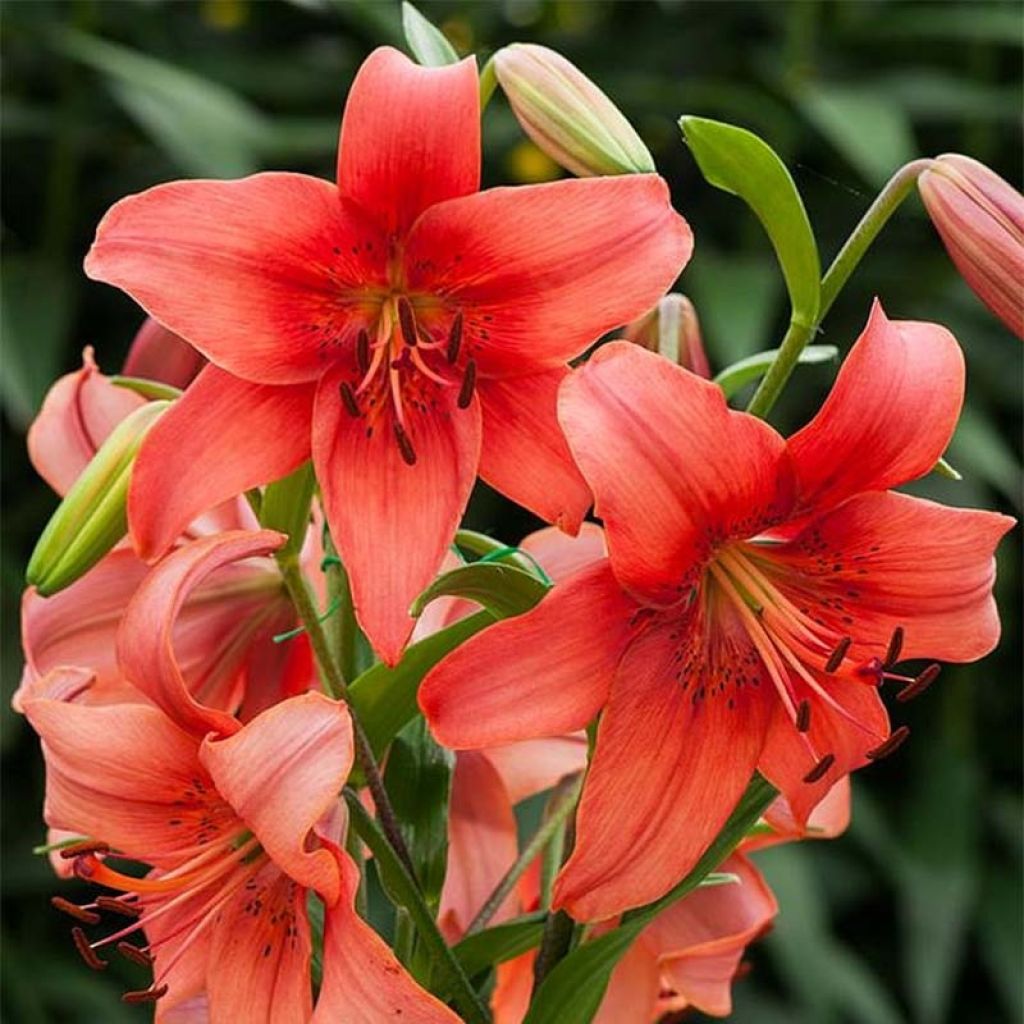
Lilium Pearl Loraine - Lily
Lilium Pearl Loraine - Lily
Lilium x asiatica Pearl Loraine
Asiatic Lily
Beautiful bulbs, planted as soon as they arrived, and I had magnificent flowers. Thank you.
Anouck, 10/08/2025
Back-to-school special offer!
Get €10 off for every €50 you spend! And get up to €40 off on a single order.
How does it work?
1. Shop your favourites
Add your favourite plants to your basket. For every €50 you spend (excluding delivery charges, store credit and the plastic-free option), you’ll receive a €10 voucher.
€50 spent = €10 voucher
€100 spent = €20 voucher
€150 spent = €30 voucher
€200 spent = €40 voucher
2. Place your order
Once your basket reaches one of the spending thresholds, place your order. You can even choose your delivery date!
3. Receive your voucher
As soon as your order has been shipped, you’ll receive an email containing your personal voucher code and its value.
4. Use it on your next order
Your voucher is valid for 90 days from the date you receive it. It can be used once only, on a new order worth at least the value of the voucher, excluding delivery charges.
Please note: Vouchers can be combined with other offers, but cannot be split or refunded.
Why not try an alternative variety in stock?
View all →
Available in 1 sizes
Available in 1 sizes
Available in 2 sizes

Available in 1 sizes

Available in 1 sizes

Available in 1 sizes
Available in 1 sizes

Available in 1 sizes

Available in 1 sizes

Available in 1 sizes
This plant carries a 6 months recovery warranty
More information
We guarantee the quality of our plants for a full growing cycle, and will replace at our expense any plant that fails to recover under normal climatic and planting conditions.

Does this plant fit my garden?
Set up your Plantfit profile →
Description
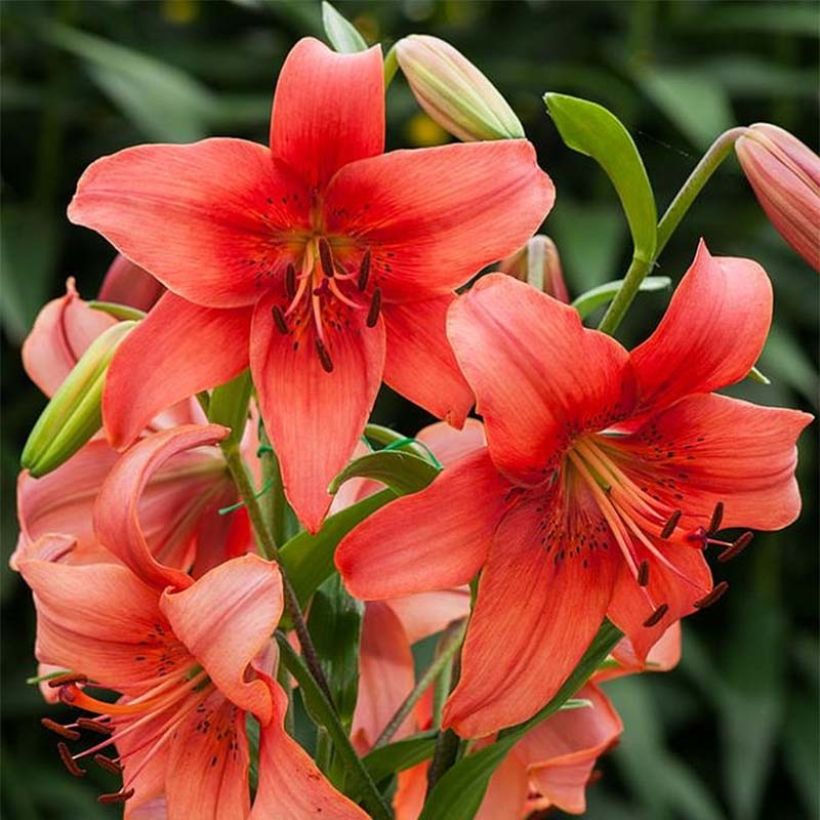
Lilium 'Pearl Loraine' Asiatic Lily belongs to a series of hybrid lilies called 'Pearl', which are vigorous, floriferous, and easy to grow, in a palette of particularly refined colours. The flowers of 'Pearl Loraine' are very large, beautifully directed outward, and salmon-pink, an exquisite colour rarely seen in lilies. They bloom for several weeks in summer, carried by exceptionally strong stems. Once well established, this lily blooms faithfully every year and quickly naturalises in borders, pots, or even large rockeries. Its flowers are beautiful in bouquets.
The genus Lilium belongs to the family Liliaceae, its representatives are bulbous plants generally very resistant to cold in soils that do not retain excessive water in winter. 'Pearl Loraine', introduced in 2008, is a very recent hybrid obtained by cross-breeding various Asian species, including Lilium longiflorum which is vigorous and very accommodating. This bulbous plant spends the winter resting underground. Vegetation starts to appear around April, to produce a leafy stem. It will reach 1 to 1.20 metres (3 to 4 feet) high when in flower, and the clump will spread without theoretical limit over time, as the bulbs produce bulblets through vegetative multiplication. Its spectacular flowers appear from mid-June to mid-July, for about 4 weeks. On the leafy stems, numerous flowers with 6 recurved petals appear, up to 15 cm (6in) in diameter on a mature plant. Their colour is a soft watermelon red, darker towards the discreetly speckled black heart of the flower. Filaments of the same dark salmon red are covered with dark brown pollen, completing the harmony of colours. The stems are covered with alternate, dark green, narrow and shiny leaves.
This wonderful lily thrives in light, fertile, well-balanced and well-prepared soil where it will flourish year after year. You can plant it with perennial plants as it likes having its base shaded. 'Pearl Loraine' will blend in a small romantic bed with other orange, pink or white lilies, campanulas, daylilies in the same shades, foxgloves, or a Cloud Cabbage (Crambe cordifolia), for example. Creeping Phlox, rock cress, or silverweed will cover its base with an elegant carpet. This tall and beautiful lily is superb in tall borders or with shrubs. It is also an excellent cut flower.

Lilium Pearl Loraine - Lily in pictures
Plant habit
Flowering
Foliage
Botanical data
Lilium
x asiatica
Pearl Loraine
Liliaceae
Asiatic Lily
Cultivar or hybrid
Planting and care
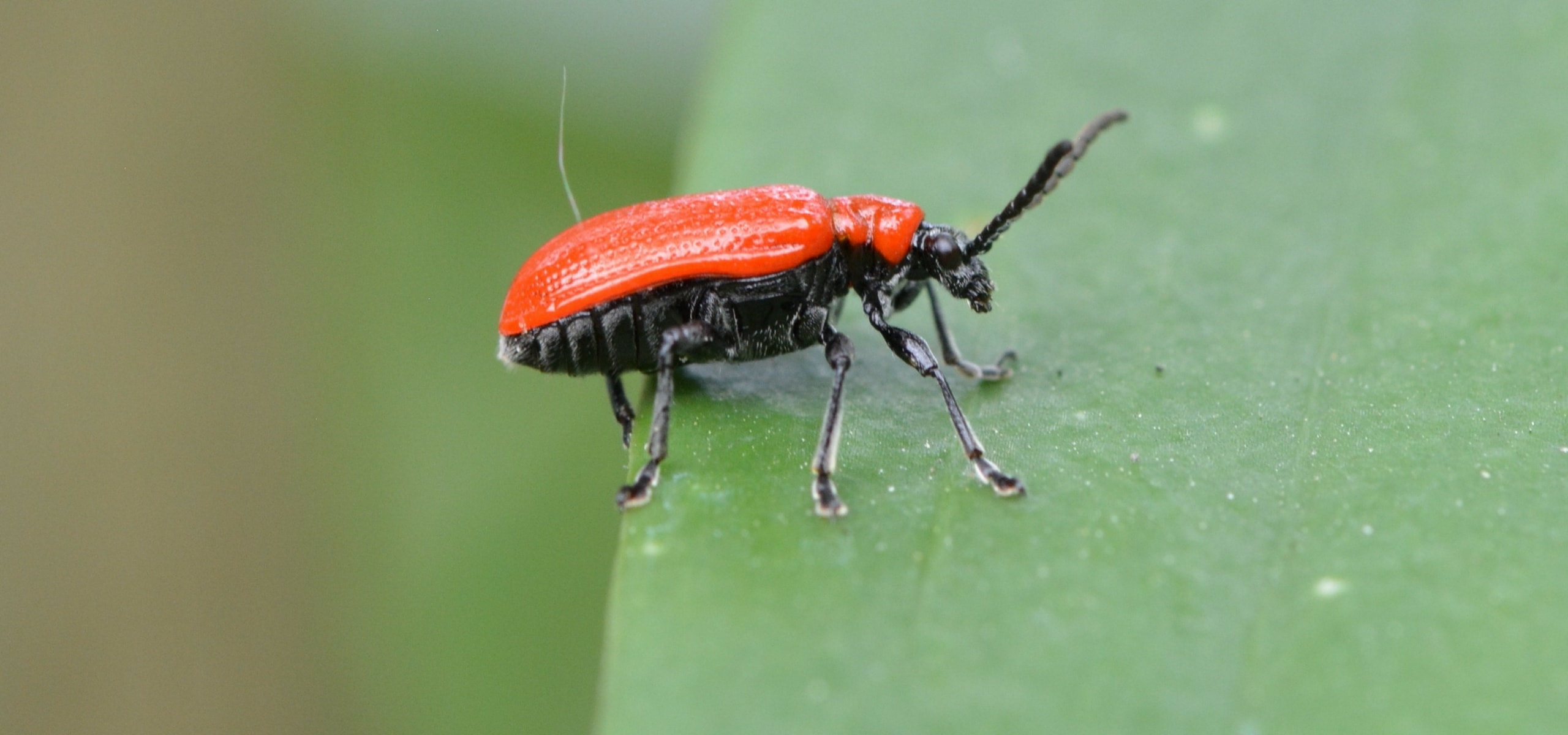
The 'Pearl Loraine' lily is not fussy about soil, as long as it is properly drained and not excessively chalky or acidic. It likes rich and light soils. Plant the bulbs in full sun, with the roots in the shade, preferably in spring, 15 cm (6in) deep in a pocket of soil mixed with leaf compost. Surround them with a layer of sand that will protect them from rot and slug attacks, while allowing them to grow more easily. Mark the planting location, as growth only starts in April. If red lily beetles appear, treat them immediately, as their larvae can devour all the leaves. The most effective method is to catch them manually but be careful as they drop as soon as they are touched.
After flowering, it is a good idea to cut the faded flowers halfway down so that the bed remains beautiful during the summer.
Tips for planting lilies in compact soil: The scaly bulbs of lilies hate clay soils that suffocate them and cause rot. In Eastern Europe, the following technique is used to help these bulbs survive the winter. Plant them on 'terraces' built above ground level. These terraces are made up of a first layer of gravel, on which tightly packed branches are placed. Then cover it all with a thick layer of compost 20 to 30 cm (8 to 12in) deep. Plant the bulbs in the compost, on which you can also have some ground cover plants.
On the terrace, you can create sumptuous pots with lilies. Choose a container that is large and deep enough (at least 16 cm (6in) in diameter for 1 bulb). Fill it with a mixture of garden soil, leaf compost, and sand. Plant the lilies in groups of 3 to 5 bulbs, 10-15 cm (4-6in) apart, then water thoroughly. Place the pots in a cool room, or outside once the frost has passed. The ambient temperature should be around 12°C (53.6°F). When shoots appear, move the pot to a conservatory or a very bright room, at a temperature of around 18°C (64.4°F). Apply liquid fertiliser twice a month until the appearance of flower buds.
Planting period
Intended location
Care
Planting & care advice






-
, onOrder confirmed
Reply from on Promesse de fleurs
Recently viewed products
Haven't found what you were looking for?
Hardiness is the lowest winter temperature a plant can endure without suffering serious damage or even dying. However, hardiness is affected by location (a sheltered area, such as a patio), protection (winter cover) and soil type (hardiness is improved by well-drained soil).
In temperate climates, pruning of spring-flowering shrubs (forsythia, spireas, etc.) should be done just after flowering.
Pruning of summer-flowering shrubs (Indian Lilac, Perovskia, etc.) can be done in winter or spring.
In cold regions as well as with frost-sensitive plants, avoid pruning too early when severe frosts may still occur.
The harvesting period indicated on our website applies to countries and regions in USDA zone 8 (France, England, Ireland, the Netherlands).
In colder areas (Scandinavia, Poland, Austria...) fruit and vegetable harvests are likely to be delayed by 3-4 weeks.
In warmer areas (Italy, Spain, Greece, etc.), harvesting will probably take place earlier, depending on weather conditions.
The sowing periods indicated on our website apply to countries and regions within USDA Zone 8 (France, UK, Ireland, Netherlands).
In colder areas (Scandinavia, Poland, Austria...), delay any outdoor sowing by 3-4 weeks, or sow under glass.
In warmer climes (Italy, Spain, Greece, etc.), bring outdoor sowing forward by a few weeks.
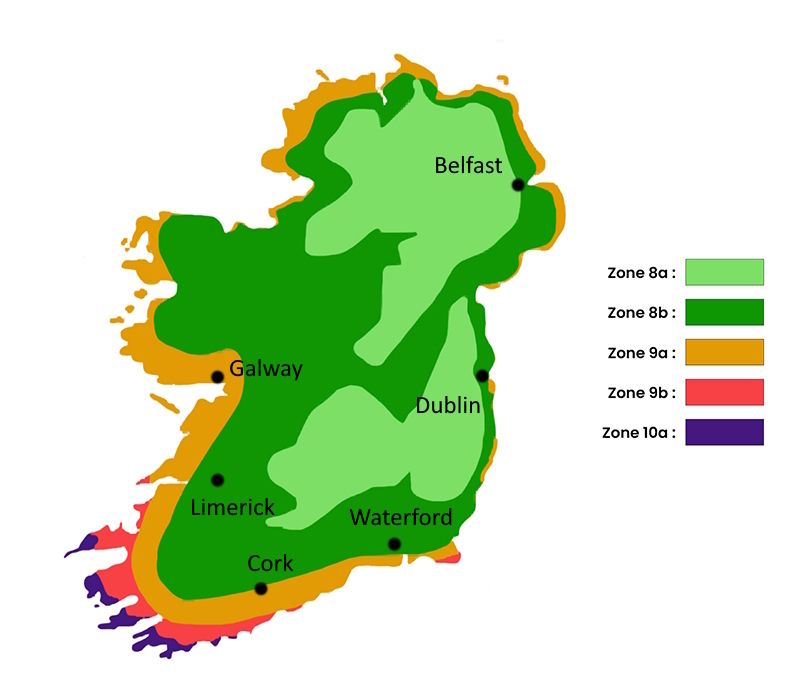
The planting period indicated on our website applies to regions in USDA Zone 9a (East Coast and Midlands: Dublin, Wexford, Waterford, Kilkenny, Portlaoise). It will vary depending on where you live:
- On the west coast and in the north-west (Galway, Limerick, Sligo, Donegal, Westport), delay planting by 1 to 2 weeks in spring and bring it forward by 1 to 2 weeks in autumn compared to the dates given, preferably choosing periods without strong winds.
- In the inland hills and plateaus (Wicklow Mountains, Macgillycuddy’s Reeks, Connemara, Killarney), it is best to plant in spring (April–May) or autumn (September–October), avoiding periods of waterlogged soil in winter and strong winds, which pose the main risk to newly planted trees in these areas.
The flowering period indicated on our website applies to regions in USDA Zone 9a, such as the East Coast and Midlands, including Dublin, Wexford, Waterford, Kilkenny and Portlaoise.
This will vary depending on where you live:
- On the west coast and in the northwest (Galway, Limerick, Sligo, Donegal and Westport), it will be delayed by one to two weeks compared to the given dates, due to stronger Atlantic winds and less spring sunshine.
- In the inland hills and plateaus (the Wicklow Mountains, the Macgillycuddy's Reeks, Connemara and Killarney), flowering will be delayed by two to three weeks. Flowering mainly occurs between May and July, with the limiting factors being less frost and more of the excessive humidity, strong winds and lack of sunshine that are characteristic of these areas.
Shipping country and language
Your country of residence may be:
Your country of residence is:
For a better user experience on our website, you can select:
Your shipping country:
-
 Austria
-
 Belgium
-
 Bosnia & Herzegovina
-
 Bulgaria
-
 Croatia
-
 Cyprus
-
 Czechia
-
 Denmark
-
 Estonia
-
 Finland
-
 France
-
 Germany
-
 Greece
-
 Hungary
-
 Iceland
-
 Ireland
-
 Italy
Italy
-
 Latvia
-
 Liechtenstein
-
 Lithuania
-
 Luxembourg
-
 Malta
Malta
-
 Netherlands
-
 Poland
-
 Portugal
-
 Romania
-
 Serbia
-
 Slovakia
-
 Slovenia
-
 Spain
Spain
-
 Sweden
-
 Switzerland
Language:
-
French
-
 English
-
Spanish
-
Italian
-
German
-
Portuguese
-
Dutch
-
Finnish
My Account
Hello
My wish lists
My cart
Log in / Register
Existing customer?
This form is protected by reCAPTCHA - the Google Privacy Policy and Terms of Service apply.
New customer?
Create an account to track your orders, access our customer service and, if you wish, make the most of our upcoming offers.