Symphorycarpos chenaultii Fiesta Berry
Symphorycarpos chenaultii Fiesta Berry
Symphorycarpos chenaultii ‘RANT02’ Fiesta Berry
Chenault Coralberry, Snowberry
Back-to-school special offer!
Get €10 off for every €50 you spend! And get up to €40 off on a single order.
How does it work?
1. Shop your favourites
Add your favourite plants to your basket. For every €50 you spend (excluding delivery charges, store credit and the plastic-free option), you’ll receive a €10 voucher.
€50 spent = €10 voucher
€100 spent = €20 voucher
€150 spent = €30 voucher
€200 spent = €40 voucher
2. Place your order
Once your basket reaches one of the spending thresholds, place your order. You can even choose your delivery date!
3. Receive your voucher
As soon as your order has been shipped, you’ll receive an email containing your personal voucher code and its value.
4. Use it on your next order
Your voucher is valid for 90 days from the date you receive it. It can be used once only, on a new order worth at least the value of the voucher, excluding delivery charges.
Please note: Vouchers can be combined with other offers, but cannot be split or refunded.
Home or relay delivery (depending on size and destination)
Important: You may be charged customs duties by your country’s customs authorities upon delivery.
Schedule delivery date,
and select date in basket
This plant carries a 24 months recovery warranty
More information
We guarantee the quality of our plants for a full growing cycle, and will replace at our expense any plant that fails to recover under normal climatic and planting conditions.
Does this plant fit my garden?
Set up your Plantfit profile →
Description
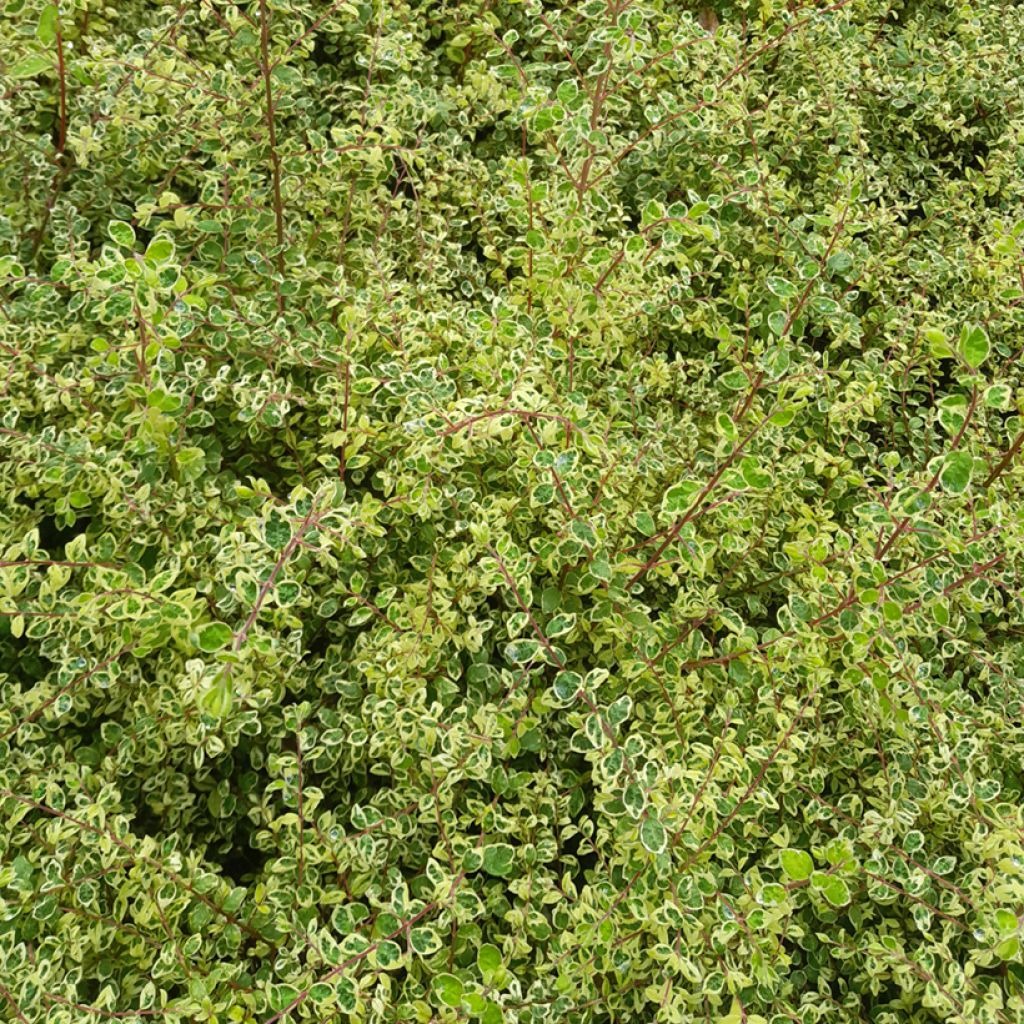
Symphoricarpos chenaultii 'Fiesta Berry' is a recent Dutch variety of Chenault's Snowberry, easily identifiable by its variegated foliage. The compact and bushy, shrub has a bright appearance that truly shines in the shaded areas it favours. Its relatively insignificant flowering gives way to small, decorative purple-red berries in autumn. Easy to cultivate in most ordinary soils, it thrives in both sun and shade, making it a virtually maintenance-free plant.
Snowberry is a member of the Caprifoliaceae family, like Honeysuckles (Lonicera) or Weigela. The genus Symphoricarpos, named by the famous French agronomist Henri Louis Duhamel du Monceau, comprises 15 species, all native to North America, except for one from China, named Symphoricarpos sinensis. It was an Orléans nurseryman, Chenault, who, by crossing the species S. orbiculatus and S. microphyllus around 1910, created a new hybrid, named S. x chenaultii. The bush forms a shrub 1.50 to 2 m tall, with supple and abundant branches, and small ovate leaves (1 to 2 cm).
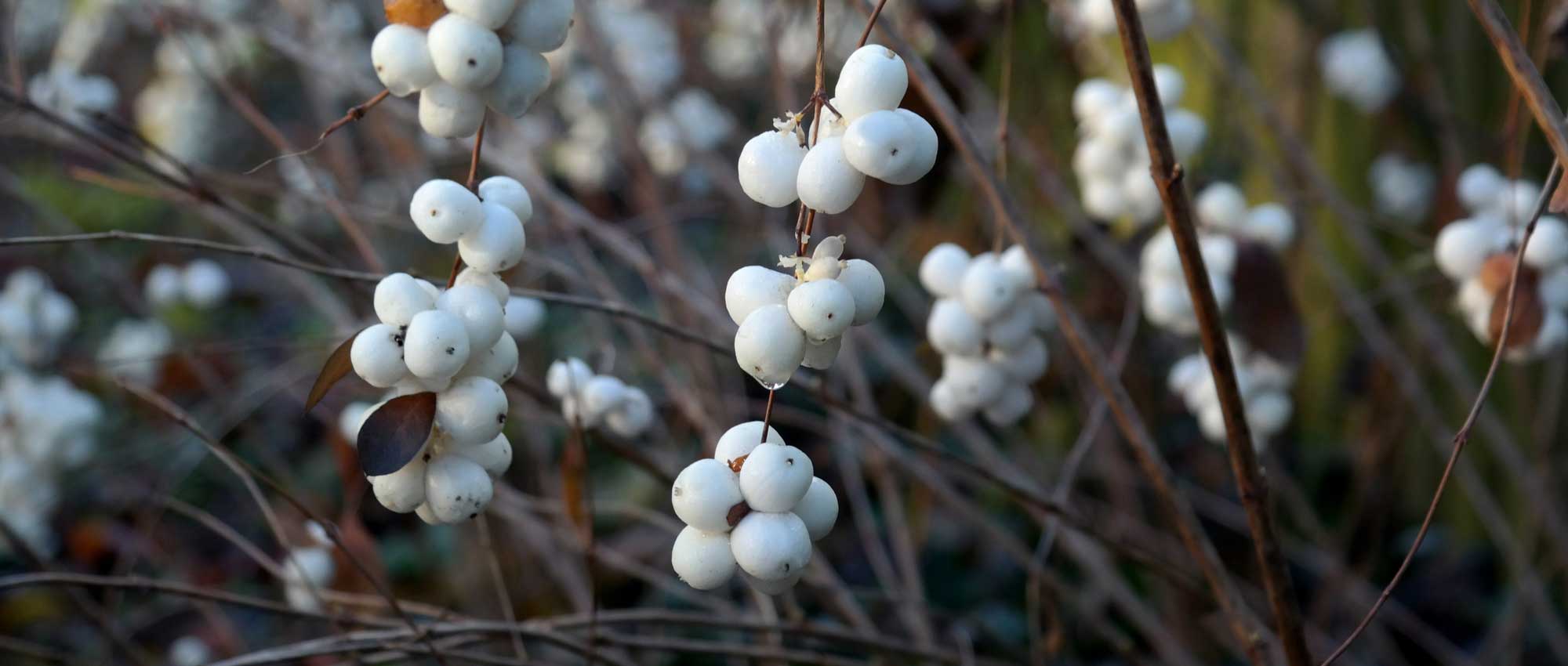
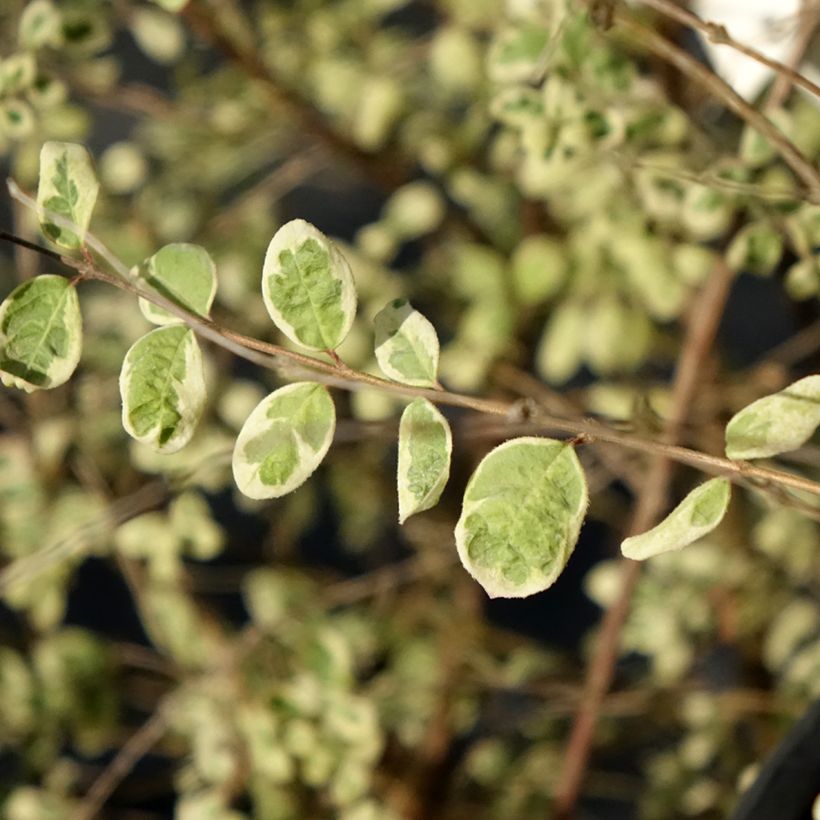
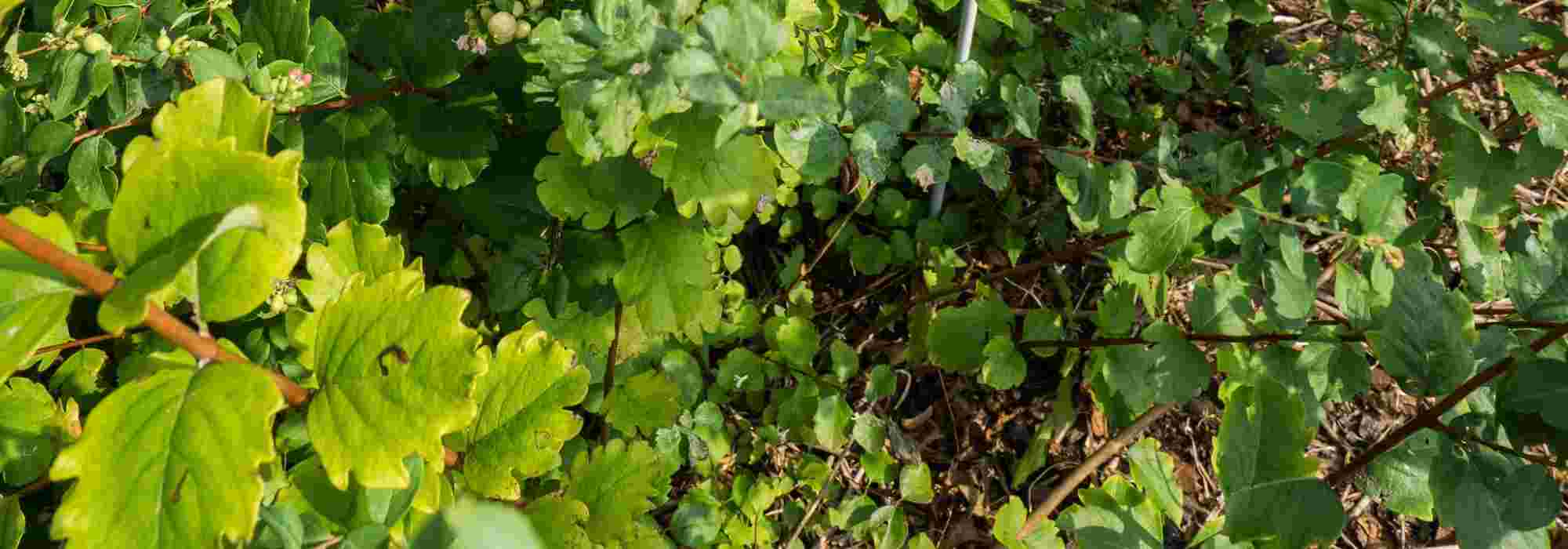
'Fiesta Berry' is a horticultural variety obtained in the Netherlands by Ronny Antonissen and won a silver medal in 2022 at the professional nursery fair GrootGroenPlus during its market launch. It is the first variegated cultivar of Chenault's Snowberry. The shrub has a bushy habit, as wide as it is tall, with somewhat unruly branches that extend in all directions, giving it a slightly wild appearance. Of relatively rapid growth, it reaches about 1 m in all directions. The slender branches sometimes take on pinkish or mahogany brown tones, which beautifully complement the variegation of the leaves. Small, ovate, and oppositely arranged two by two on the branches, the lovely medium to dark green leaves are adorned with an irregular cream-white margin that creates a striking contrast. This variegated bush does well in full sun, unlike many others (the variegation, which corresponds to a lack of chlorophyll, makes the leaves sensitive), and also thrives very well in partial shade, even in full shade. In this situation, it is particularly valuable, as it brings light to somewhat dark areas of the garden. The flowering in late spring or early summer is discreet and relatively insignificant. It makes up for this by producing small ornamental purple-red berries from September to November, sometimes longer. This fruiting creates a superb contrast with the variegated foliage before it eventually falls to the ground as the Snowberry is deciduous.
Easy plants par excellence, Snowberries are favoured by beginners because they are decorative, require little maintenance and demonstrate great hardiness. 'Fiesta Berry' adds extra appeal with its stunning variegation that will bring brightness to a shaded bed. Plant it at the foot of a Viburnum tinus 'Purpureum', a Laurustinus whose young purple and bronze shoots in spring will create a very interesting colour combination, while its dark green foliage later on will perfectly highlight your Snowberry. Its white flowering in late winter is also attractive at a time still lacking in flowers. For an even stronger contrast, pair it with Physocarpus opulifolius 'Black Light', a small bushy shrub with almost black purple foliage, which in June-July is adorned with corymbs of small white flowers. To cover the ground in the foreground, choose from the range of Heucheras that will delight you with their colourful foliage as well as their graceful and airy flowerings.
Symphorycarpos chenaultii Fiesta Berry in pictures
Plant habit
Flowering
Foliage
Botanical data
Symphorycarpos
chenaultii
‘RANT02’ Fiesta Berry
Caprifoliaceae
Chenault Coralberry, Snowberry
Cultivar or hybrid
Planting and care
Symphoricarpos chenaultii 'Fiesta Berry' adapts to almost all exposures: it tolerates shade, but its foliage will be more colourful in partial shade or in full sun, which it handles well, unlike some other variegated plants. It is a very hardy bush that is easy to cultivate and suitable for any good garden soil. It even copes with dry soils riddled with roots found beneath large trees and at the foot of hedges. However, it prefers neutral, slightly calcareous or even slightly acidic areas, but without excess. It dislikes overly heavy, clayey soils that retain too much water. When planting, add a bit of potting soil to the existing soil and possibly some gravel at the bottom to promote drainage if necessary. You prune for balance at the end of winter. You may also remove the suckers to limit the bush's growth; this operation is not difficult.
Planting period
Intended location
Care
Planting & care advice
-
-

-
-

-

-
-
-

This item has not been reviewed yet - be the first to leave a review about it.
Recently viewed products
Haven't found what you were looking for?
Hardiness is the lowest winter temperature a plant can endure without suffering serious damage or even dying. However, hardiness is affected by location (a sheltered area, such as a patio), protection (winter cover) and soil type (hardiness is improved by well-drained soil).

In temperate climates, pruning of spring-flowering shrubs (forsythia, spireas, etc.) should be done just after flowering.
Pruning of summer-flowering shrubs (Indian Lilac, Perovskia, etc.) can be done in winter or spring.
In cold regions as well as with frost-sensitive plants, avoid pruning too early when severe frosts may still occur.
The harvesting period indicated on our website applies to countries and regions in USDA zone 8 (France, England, Ireland, the Netherlands).
In colder areas (Scandinavia, Poland, Austria...) fruit and vegetable harvests are likely to be delayed by 3-4 weeks.
In warmer areas (Italy, Spain, Greece, etc.), harvesting will probably take place earlier, depending on weather conditions.
The sowing periods indicated on our website apply to countries and regions within USDA Zone 8 (France, UK, Ireland, Netherlands).
In colder areas (Scandinavia, Poland, Austria...), delay any outdoor sowing by 3-4 weeks, or sow under glass.
In warmer climes (Italy, Spain, Greece, etc.), bring outdoor sowing forward by a few weeks.
The planting period indicated on our website applies to regions in USDA Zone 9a (East Coast and Midlands: Dublin, Wexford, Waterford, Kilkenny, Portlaoise). It will vary depending on where you live:
- On the west coast and in the north-west (Galway, Limerick, Sligo, Donegal, Westport), delay planting by 1 to 2 weeks in spring and bring it forward by 1 to 2 weeks in autumn compared to the dates given, preferably choosing periods without strong winds.
- In the inland hills and plateaus (Wicklow Mountains, Macgillycuddy’s Reeks, Connemara, Killarney), it is best to plant in spring (April–May) or autumn (September–October), avoiding periods of waterlogged soil in winter and strong winds, which pose the main risk to newly planted trees in these areas.
The flowering period indicated on our website applies to regions in USDA Zone 9a, such as the East Coast and Midlands, including Dublin, Wexford, Waterford, Kilkenny and Portlaoise.
This will vary depending on where you live:
- On the west coast and in the northwest (Galway, Limerick, Sligo, Donegal and Westport), it will be delayed by one to two weeks compared to the given dates, due to stronger Atlantic winds and less spring sunshine.
- In the inland hills and plateaus (the Wicklow Mountains, the Macgillycuddy's Reeks, Connemara and Killarney), flowering will be delayed by two to three weeks. Flowering mainly occurs between May and July, with the limiting factors being less frost and more of the excessive humidity, strong winds and lack of sunshine that are characteristic of these areas.
Shipping country and language
Your country of residence may be:
Your country of residence is:
For a better user experience on our website, you can select:
Your shipping country:
-
 Austria
-
 Belgium
-
 Bosnia & Herzegovina
-
 Bulgaria
-
 Croatia
-
 Cyprus
-
 Czechia
-
 Denmark
-
 Estonia
-
 Finland
-
 France
-
 Germany
-
 Greece
-
 Hungary
-
 Iceland
-
 Ireland
-
 Italy
Italy
-
 Latvia
-
 Liechtenstein
-
 Lithuania
-
 Luxembourg
-
 Malta
Malta
-
 Netherlands
-
 Poland
-
 Portugal
-
 Romania
-
 Serbia
-
 Slovakia
-
 Slovenia
-
 Spain
Spain
-
 Sweden
-
 Switzerland
Language:
-
French
-
 English
-
Spanish
-
Italian
-
German
-
Portuguese
-
Dutch
-
Finnish
My Account
Hello
My wish lists
My cart
Log in / Register
Existing customer?
This form is protected by reCAPTCHA - the Google Privacy Policy and Terms of Service apply.
New customer?
Create an account to track your orders, access our customer service and, if you wish, make the most of our upcoming offers.