Pieris japonica Polar passion® - Japanese Andromeda
Pieris japonica Polar passion® - Japanese Andromeda
Pieris japonica Polar passion®
Japanese andromeda, Lily of the valley shrub, Japanese pieris
Back-to-school special offer!
Get €10 off for every €50 you spend! And get up to €40 off on a single order.
How does it work?
1. Shop your favourites
Add your favourite plants to your basket. For every €50 you spend (excluding delivery charges, store credit and the plastic-free option), you’ll receive a €10 voucher.
€50 spent = €10 voucher
€100 spent = €20 voucher
€150 spent = €30 voucher
€200 spent = €40 voucher
2. Place your order
Once your basket reaches one of the spending thresholds, place your order. You can even choose your delivery date!
3. Receive your voucher
As soon as your order has been shipped, you’ll receive an email containing your personal voucher code and its value.
4. Use it on your next order
Your voucher is valid for 90 days from the date you receive it. It can be used once only, on a new order worth at least the value of the voucher, excluding delivery charges.
Please note: Vouchers can be combined with other offers, but cannot be split or refunded.
Home or relay delivery (depending on size and destination)
Important: You may be charged customs duties by your country’s customs authorities upon delivery.
Schedule delivery date,
and select date in basket
This plant carries a 24 months recovery warranty
More information
We guarantee the quality of our plants for a full growing cycle, and will replace at our expense any plant that fails to recover under normal climatic and planting conditions.
Does this plant fit my garden?
Set up your Plantfit profile →
Description
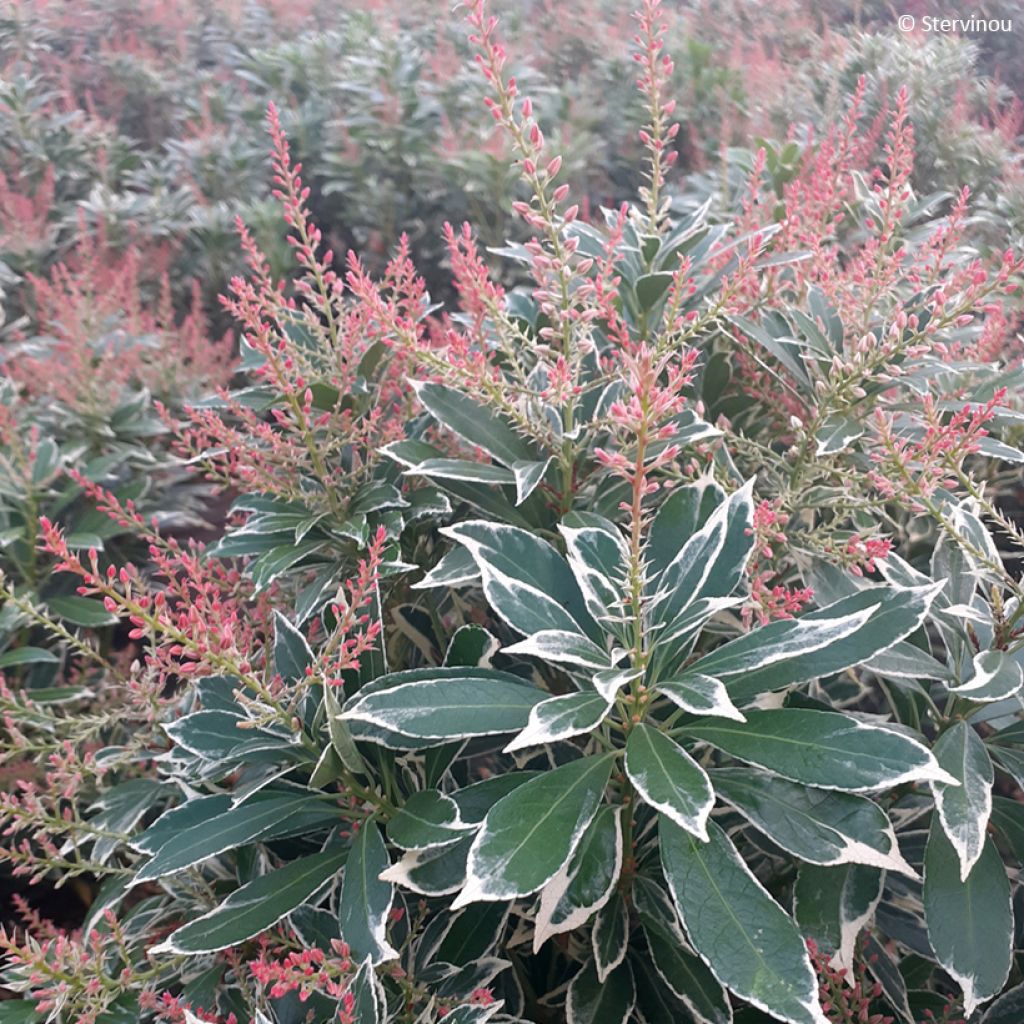
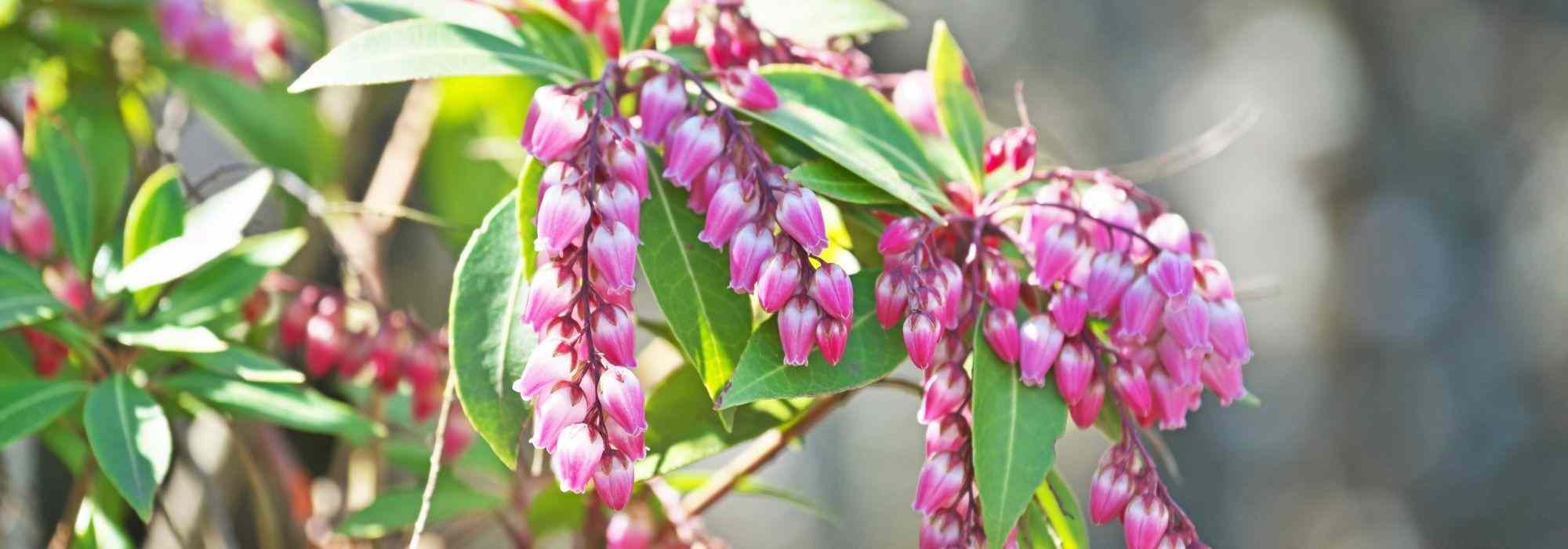
The Pieris japonica 'Polar Passion' is a variety of Japanese Andromeda, noteworthy for its dark pink almost red flowering. It blooms in March-April in the form of numerous clusters of small bell-shaped flowers that develop at the ends of each shoot. The foliage is equally decorative with its creamy white variegation enhancing the green of the slender leaves, while the young shoots take on pink and red hues before turning to green and white. Ornamental all year round, this compact and evergreen shrub is perfectly suited for container cultivation, in areas where the soil conditions are not ideal. It thrives in rather acidic and moist soils, in a sheltered position away from strong sunlight.
Pieris belongs to the Ericaceae family, rich in about a hundred genera, many of which are ornamental (Rhododendron, Kalmia, Enkianthus...) and some fruit-bearing, like the Blueberry Bush (Vaccinium). There are eight species of Pieris, a genus established by the English botanist David Don from the Andromeda genus, which still exists as such (Andromeda polifolia is one species). Pieris species are native to North America, the Himalayas, and East Asia. This is the case for Pieris japonica, which as its species name suggests, grows naturally in Japan, commonly known as Japanese Andromeda. Adding to the confusion, other Ericaceae genera are also referred to as Andromedas, such as Enkianthus campanulatus (Campanulate Andromeda) or Oxydendron arboreum (Tree Andromeda). This is due to the resemblance of their bell-shaped flowers in small clusters hanging down.
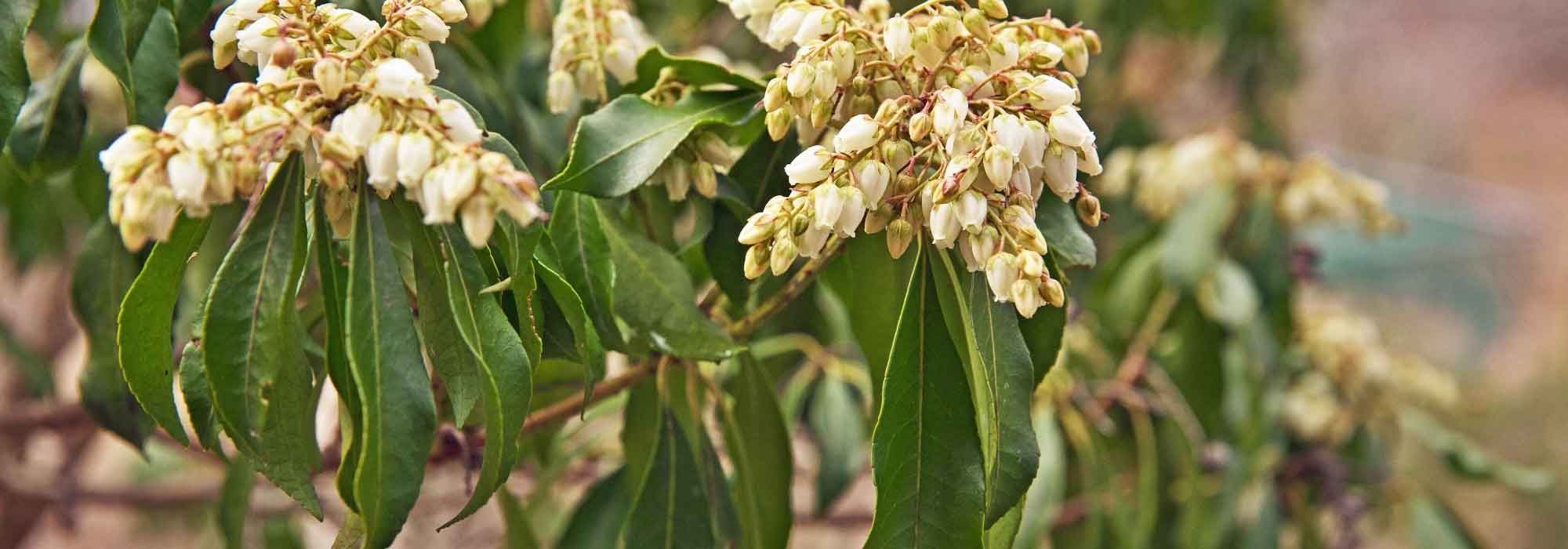
Pieris japonica is found in the wild on the hills of the Japanese islands of Honshu, Shikoku, and Kyushu where summers are warm. It forms a small shrub 2 to 3 m in height, with spreading, brownish branches. It produces copper-colored shoots, which then turn green and bear lanceolate leaves 3 to 9 cm long, 1 to 2 cm wide. The flowers appear in clusters 7 to 15 cm long, bell-shaped due to the petals being fused almost along their entire length (hence termed gamopetalous).
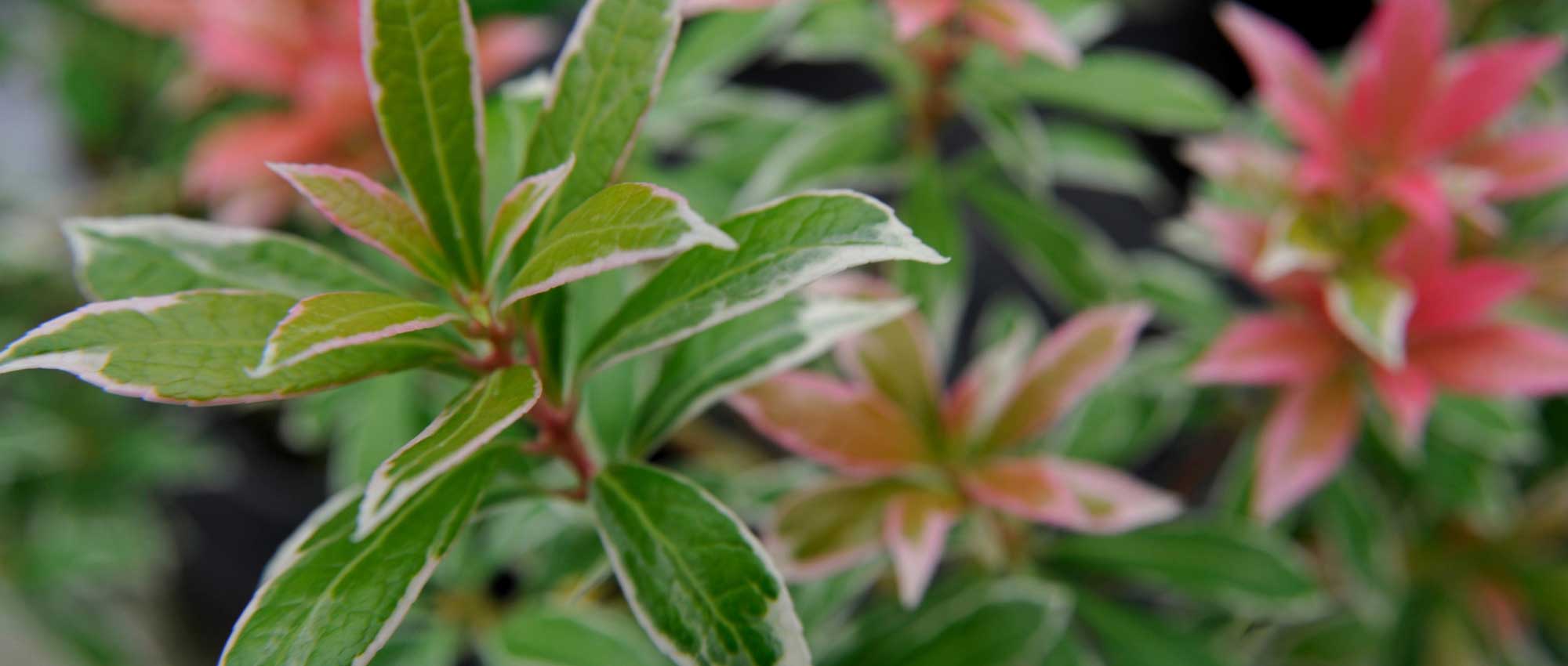
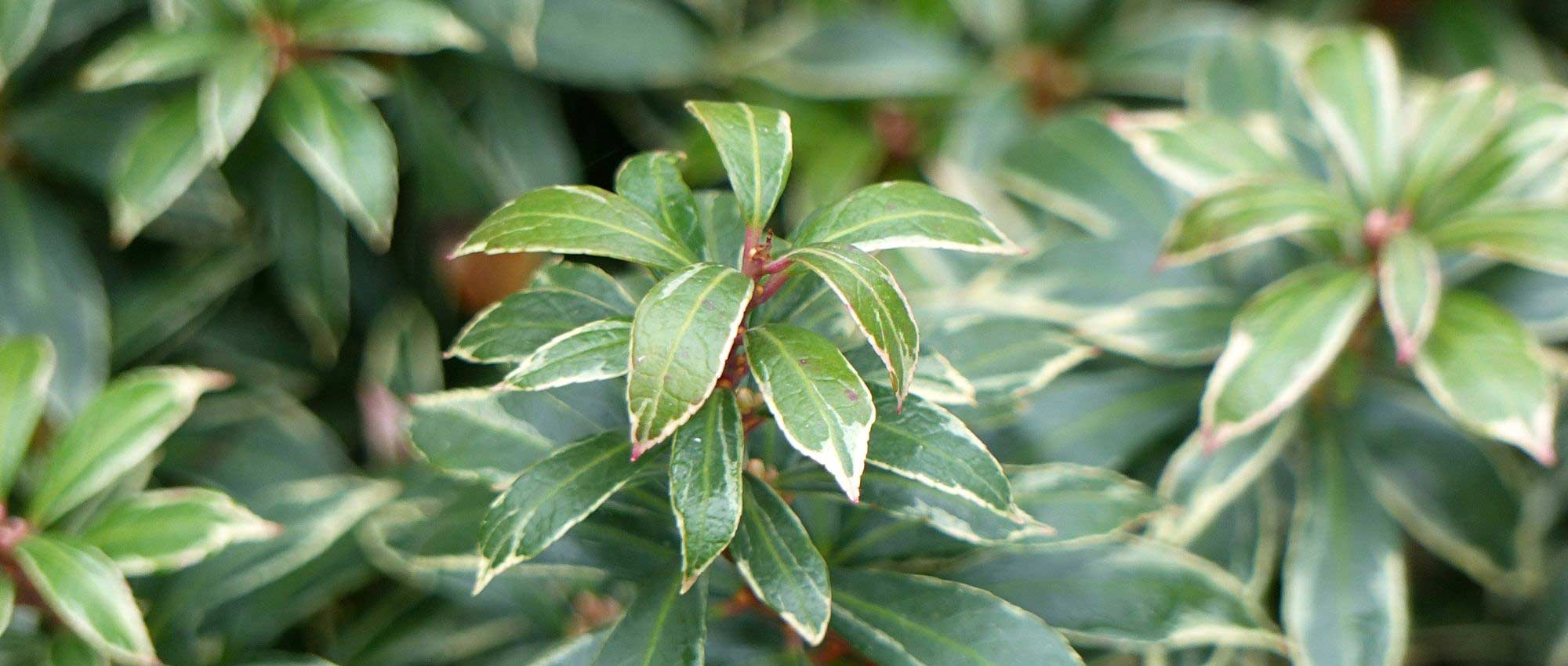
'Polar Passion' is a recent horticultural variety that combines all the qualities of Pieris. Compact in size, this shrub reaches approximately 1 m in height and 80 cm in width after ten years of cultivation in soil. Slow-growing, it adapts well to pot cultivation, allowing enjoyment even if the garden soil is limestone, as this plant requires slightly acidic soil. The numerous flexible branches with a relatively upright habit bear very elongated and narrow lanceolate leaves. With a medium to dark green colour, the leaf blade is adorned with a creamy white margin, giving the evergreen shrub great ornamental value all year round. The young shoots turn pink-red before changing to green and white, an additional attraction of the plant. In spring, from March onwards, the raspberry pink flowering appears, almost red, very unique among Pieris. The numerous small bell-shaped flowers under 1 cm long are clustered generously over the vegetation, blooming until April, thus celebrating the arrival of spring in a beautiful way.
When grown in a container, Pieris japonica 'Polar Passion' forms a superb flowering pot that will nicely embellish your terrace, when placed away from direct sunlight. If your soil allows it, it will be perfect alongside heather soil plants, in the foreground of a dedicated bed. Plant together with Autumn Camellias (Camellia sasanqua) that will delight you with their flowering from October, lasting through the winter. Blooming at the same time, Magnolia stellata 'Rosea' will provide a lovely contrast in shape and size with its large star-shaped flowers, in a charming light pink. To create a beautiful colour combination, opt for the changing foliage of Acer palmatum 'Shaina', a small Japanese Maple ranging from orange-red to crimson and violet-brown. And to liven up the summer, nothing beats one or two Hydrangeas with their variety of flower shapes and colours that leave no one indifferent.
Plant habit
Flowering
Foliage
Botanical data
Pieris
japonica
Polar passion®
Ericaceae
Japanese andromeda, Lily of the valley shrub, Japanese pieris
Cultivar or hybrid
Planting and care
The Pieris japonica 'Polar Passion' appreciates a semi-shaded exposure or gentle sunlight, as well as an acidic, fresh, light, humus-bearing, and well-drained soil. With good hardiness, it can withstand temperatures down to -15°C in perfectly drained soil, but its young shoots may be damaged by late frosts. It is advisable to plant it in a sheltered position from the cold, drying winter winds. Install a thick mulch at its base in autumn, in severe climates or in locations exposed to winter winds. A thick layer of fern fronds, dead leaves, and pine needles would be ideal. If its young foliage has been damaged by frost, it should be pruned back to stimulate the growth of new shoots. Preferring good humidity, it thrives in constantly moist soil, but not in the stagnant moisture of clayey soils. It especially fears atmospheric dryness, which is why shading provided by taller plants is beneficial, as it helps maintain a certain air humidity. In order to prevent soil drying out, regular watering with non-calcareous water is necessary, especially in the first year after planting and during the summer. Planting should be done in spring or autumn, in a mixture of garden soil, turf, and heather soil. In spring, it is advisable to top-dress with heather soil and compost around its roots and possibly apply a base fertilizer in the form of a handful of dried blood. Ensure that enough space is given to this Pieris japonica to ensure its proper development, respecting a planting distance of 0.70 cm to 1 m around its base. After flowering, remove faded flowers to avoid unnecessarily exhausting the plant with seed production. Also, lightly prune any bare branches that compromise the bushy habit of the Pieris japonica. If any non-variegated branches appear, remove them at the base.
```Planting period
Intended location
Care
Planting & care advice
-
-
-
-

-
-

-

-
This item has not been reviewed yet - be the first to leave a review about it.
Recently viewed products
Haven't found what you were looking for?
Hardiness is the lowest winter temperature a plant can endure without suffering serious damage or even dying. However, hardiness is affected by location (a sheltered area, such as a patio), protection (winter cover) and soil type (hardiness is improved by well-drained soil).
In temperate climates, pruning of spring-flowering shrubs (forsythia, spireas, etc.) should be done just after flowering.
Pruning of summer-flowering shrubs (Indian Lilac, Perovskia, etc.) can be done in winter or spring.
In cold regions as well as with frost-sensitive plants, avoid pruning too early when severe frosts may still occur.
The harvesting period indicated on our website applies to countries and regions in USDA zone 8 (France, England, Ireland, the Netherlands).
In colder areas (Scandinavia, Poland, Austria...) fruit and vegetable harvests are likely to be delayed by 3-4 weeks.
In warmer areas (Italy, Spain, Greece, etc.), harvesting will probably take place earlier, depending on weather conditions.
The sowing periods indicated on our website apply to countries and regions within USDA Zone 8 (France, UK, Ireland, Netherlands).
In colder areas (Scandinavia, Poland, Austria...), delay any outdoor sowing by 3-4 weeks, or sow under glass.
In warmer climes (Italy, Spain, Greece, etc.), bring outdoor sowing forward by a few weeks.
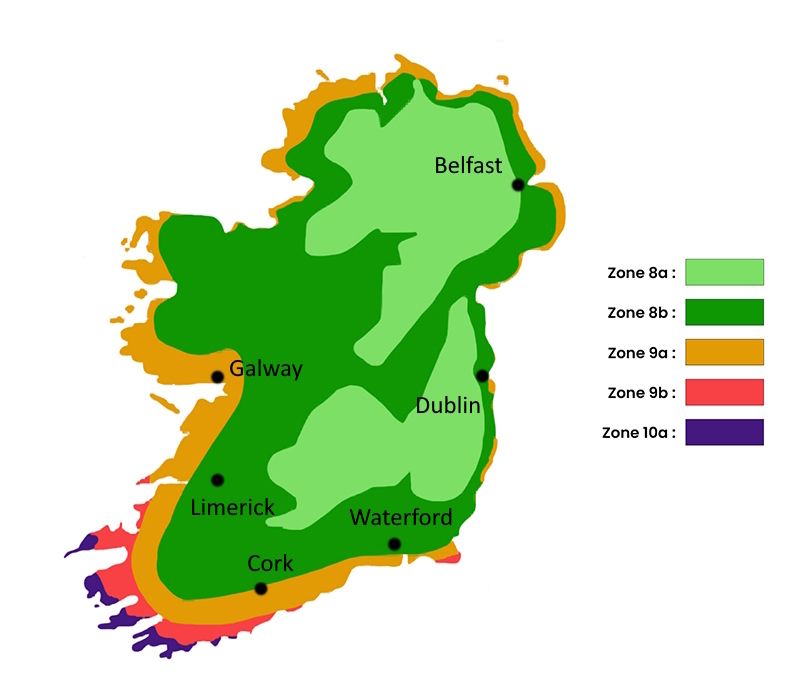
The planting period indicated on our website applies to regions in USDA Zone 9a (East Coast and Midlands: Dublin, Wexford, Waterford, Kilkenny, Portlaoise). It will vary depending on where you live:
- On the west coast and in the north-west (Galway, Limerick, Sligo, Donegal, Westport), delay planting by 1 to 2 weeks in spring and bring it forward by 1 to 2 weeks in autumn compared to the dates given, preferably choosing periods without strong winds.
- In the inland hills and plateaus (Wicklow Mountains, Macgillycuddy’s Reeks, Connemara, Killarney), it is best to plant in spring (April–May) or autumn (September–October), avoiding periods of waterlogged soil in winter and strong winds, which pose the main risk to newly planted trees in these areas.
The flowering period indicated on our website applies to regions in USDA Zone 9a, such as the East Coast and Midlands, including Dublin, Wexford, Waterford, Kilkenny and Portlaoise.
This will vary depending on where you live:
- On the west coast and in the northwest (Galway, Limerick, Sligo, Donegal and Westport), it will be delayed by one to two weeks compared to the given dates, due to stronger Atlantic winds and less spring sunshine.
- In the inland hills and plateaus (the Wicklow Mountains, the Macgillycuddy's Reeks, Connemara and Killarney), flowering will be delayed by two to three weeks. Flowering mainly occurs between May and July, with the limiting factors being less frost and more of the excessive humidity, strong winds and lack of sunshine that are characteristic of these areas.
Shipping country and language
Your country of residence may be:
Your country of residence is:
For a better user experience on our website, you can select:
Your shipping country:
-
 Austria
-
 Belgium
-
 Bosnia & Herzegovina
-
 Bulgaria
-
 Croatia
-
 Cyprus
-
 Czechia
-
 Denmark
-
 Estonia
-
 Finland
-
 France
-
 Germany
-
 Greece
-
 Hungary
-
 Iceland
-
 Ireland
-
 Italy
Italy
-
 Latvia
-
 Liechtenstein
-
 Lithuania
-
 Luxembourg
-
 Malta
Malta
-
 Netherlands
-
 Poland
-
 Portugal
-
 Romania
-
 Serbia
-
 Slovakia
-
 Slovenia
-
 Spain
Spain
-
 Sweden
-
 Switzerland
Language:
-
French
-
 English
-
Spanish
-
Italian
-
German
-
Portuguese
-
Dutch
-
Finnish
My Account
Hello
My wish lists
My cart
Log in / Register
Existing customer?
This form is protected by reCAPTCHA - the Google Privacy Policy and Terms of Service apply.
New customer?
Create an account to track your orders, access our customer service and, if you wish, make the most of our upcoming offers.