Fraxinus excelsior Aarsee - Common Ash
Fraxinus excelsior Aarsee - Common Ash
Fraxinus excelsior Aarsee
Ash, Common Ash, European Ash
Back-to-school special offer!
Get €10 off for every €50 you spend! And get up to €40 off on a single order.
How does it work?
1. Shop your favourites
Add your favourite plants to your basket. For every €50 you spend (excluding delivery charges, store credit and the plastic-free option), you’ll receive a €10 voucher.
€50 spent = €10 voucher
€100 spent = €20 voucher
€150 spent = €30 voucher
€200 spent = €40 voucher
2. Place your order
Once your basket reaches one of the spending thresholds, place your order. You can even choose your delivery date!
3. Receive your voucher
As soon as your order has been shipped, you’ll receive an email containing your personal voucher code and its value.
4. Use it on your next order
Your voucher is valid for 90 days from the date you receive it. It can be used once only, on a new order worth at least the value of the voucher, excluding delivery charges.
Please note: Vouchers can be combined with other offers, but cannot be split or refunded.
Home or relay delivery (depending on size and destination)
Important: You may be charged customs duties by your country’s customs authorities upon delivery.
Schedule delivery date
and select date in basket
This plant carries a 24 months recovery warranty
More information
We guarantee the quality of our plants for a full growing cycle, and will replace at our expense any plant that fails to recover under normal climatic and planting conditions.
Does this plant fit my garden?
Set up your Plantfit profile →
Description
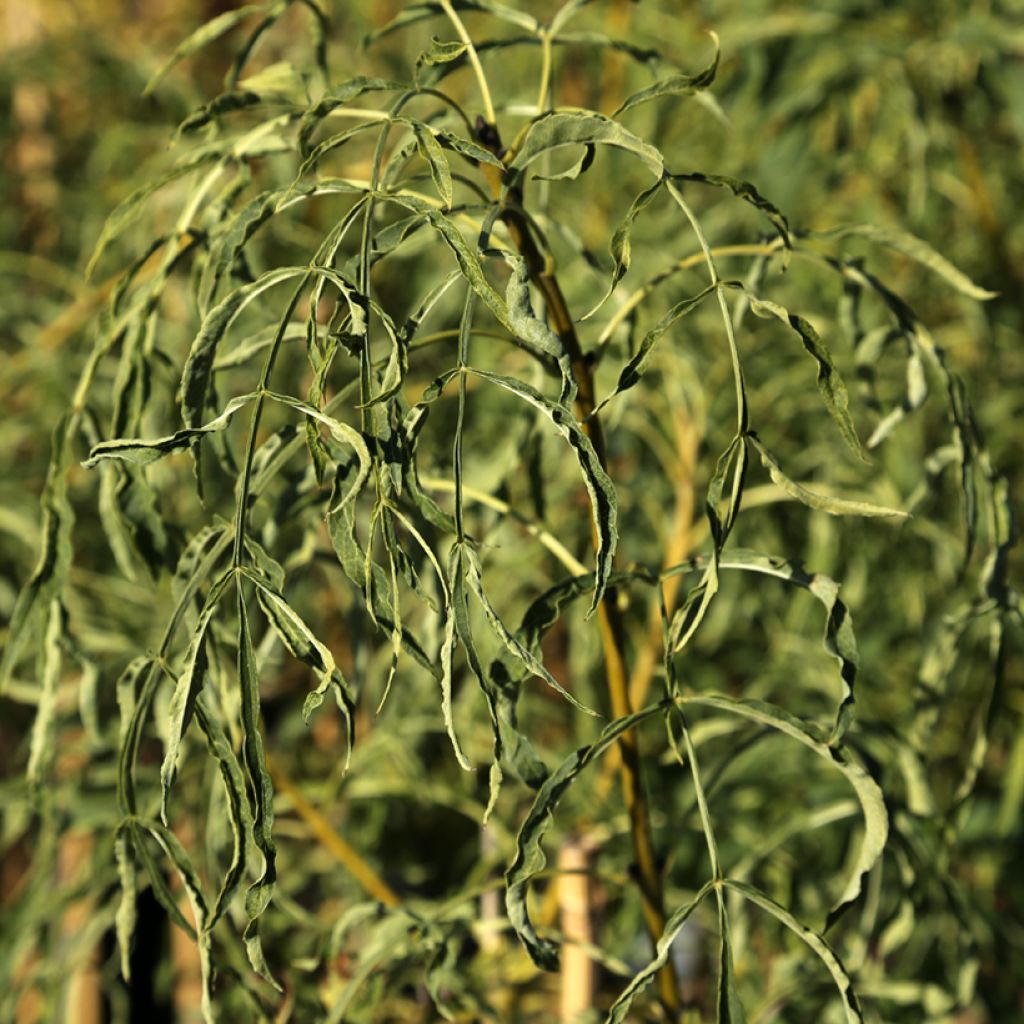
Fraxinus excelsior 'Aarsee' is a botanical oddity, a variety of Common Ash that will astonish many. This small tree with slow to moderate growth is remarkable for its compound foliage with very small leaflets. On the current year's growth, the leaves can even be reduced to just the veins, giving the plant an extremely bizarre, vaguely ghostly appearance. More curious than truly beautiful, it will mostly appeal to plant enthusiasts looking for something out of the ordinary. Easy to cultivate in most moist soils, it can be planted alone or in a bed with other unique plants.
The Ash belongs to the Olive family, which includes many ornamental plants, often fragrant, such as Jasmines (Jasminum) or Lilacs (Syringa), as well as the venerable Olive tree (Olea) from which it gets its name. There are about sixty-five species of Ash, mostly trees and a few shrubs, recognisable (with rare exceptions) by their odd-pinnate leaves (composed of an odd number of leaflets due to the terminal leaflet), generally opposite or sometimes grouped in threes. Fraxinus excelsior is our Common Ash, one of the tallest trees in Europe, reaching heights of up to 30m. Its generally straight trunk has initially grey and smooth bark, which darkens and fissures as it ages. Its compound leaves measure 20 to 30cm in length and have 7 to 13 lanceolate leaflets. The yellow-greenish flowers develop into elliptical samaras measuring 3 to 4cm in length. It is common in forests and along riverbanks and can live for 150 to 200 years.
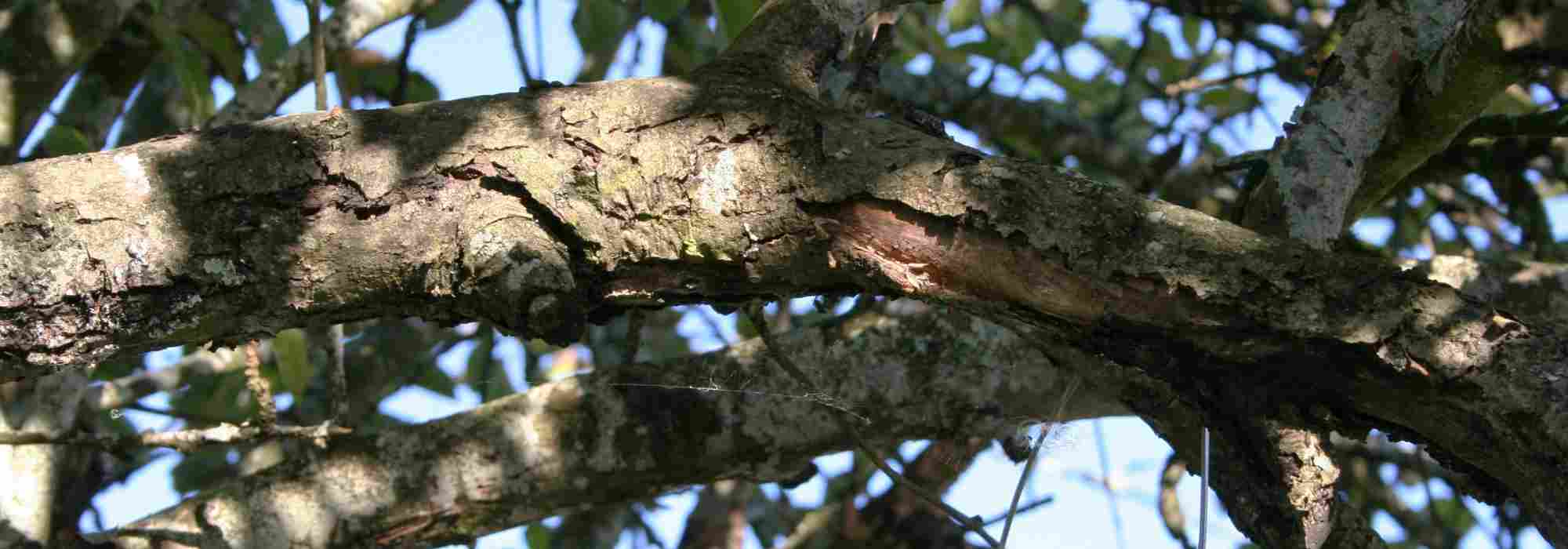
Fraxinus excelsior 'Aarsee' has a very different appearance from the typical species. It is smaller and will only reach a height of 5 to 10m after 10 to 20 years of cultivation, with a crown width of 5 to 7m. Its growth is slower than the botanical species due to its reduced leaf surface area, resulting in lower photosynthetic activity. However, its moderate growth is still faster than dwarf cultivars. Its branches, initially green at the tips, turn grey as they age. They tend to grow more or less horizontally before straightening upwards, giving the crown a more or less spherical shape, resembling a loose dome.
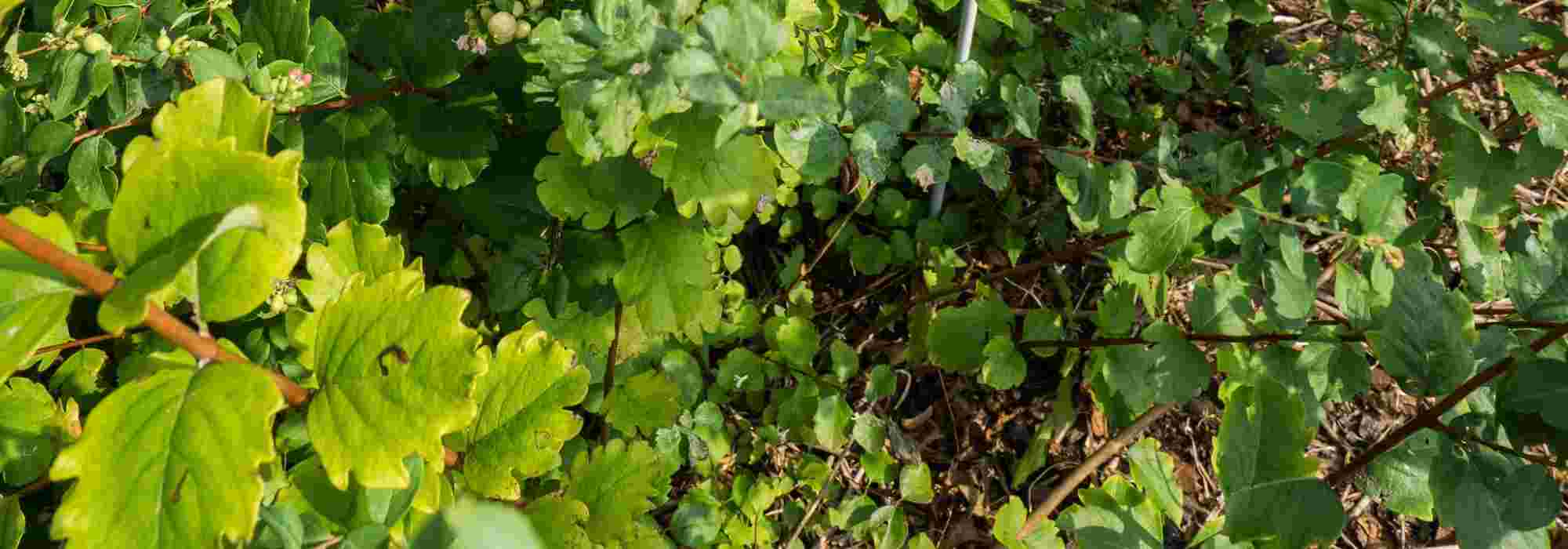
The foliage appears quite late in spring, as is often the case with Ash trees. The leaves are composed of 5 to 11 leaflets and exhibit various morphologies. On older branch segments, they are relatively "normal," simply slightly smaller than those of the wild species and occasionally slightly deformed. However, on the current year's growth, the leaflets are very narrow, giving the leaves a narrow appearance, and in the most extreme cases, the leaf blade is reduced to just the veins! These shoots often have a crinkled appearance, with slight yellowish discolouration resembling certain virus symptoms. It's a love-it-or-hate-it plant! The inconspicuous flowering has no ornamental value.
The 'Aarsee' Common Ash is a unique plant that will appeal to collectors. This small tree is very hardy (down to -30 °C) and can be integrated into a "bizarretum" composed of other plants with strange silhouettes. Its finely divided foliage provides light shade, which is suitable for plants that prefer partial sun. Plant a Cryptomeria japonica 'Cristata' next to it, a Japanese conifer that forms rooster-like crests of fused young shoots at the ends of its branches, and will compete in strangeness with your Ash tree. The Twisted Hazel (Corylus avellana 'Contorta'), with its winter silhouette characterised by branches that undulate like snakes, will also be a beautiful specimen to incorporate into your scene. Another botanical curiosity, Robinia pseudoacacia 'Twisty Baby', is a small Black Locust tree with a fine and twisted branching pattern that perfectly complements the effect of your plant arrangement.
Report an error about the product description
Plant habit
Flowering
Foliage
Safety measures
Botanical data
Fraxinus
excelsior
Aarsee
Oleaceae
Ash, Common Ash, European Ash
Cultivar or hybrid
atteinterespiratoire
Cette plante peut entraîner des symptômes allergiques.
Evitez de la planter si vous ou vos proches souffrez de rhinite saisonnière ("rhume des foins").
Davantage d'informations sur https://plantes-risque.info
Planting and care
Plant Fraxinus excelsior 'Aarsee' in autumn or early spring, choose an open location in a sunny or partially shaded position. If necessary, create a drainage pit with rocks if your soil is very clayey and suffocating. If your soil is poor, adding leaf compost and planting compost will be beneficial in increasing water retention, as it prefers moist to even wet conditions. Water regularly during the summer after planting and ensure it is protected from prolonged droughts for another year, mulching can help retain moisture at the base and reduce the need for watering. This tree requires consistently moist soil, at least at depth. It is perfectly hardy to about -30°C. Pruning is not necessary, but can be done if you want to give it a particular shape to enhance its overall uniqueness.
Planting period
Intended location
Care
Planting & care advice
-

-
-
-
-
-
-

-
This item has not been reviewed yet - be the first to leave a review about it.
Recently viewed products
Haven't found what you were looking for?
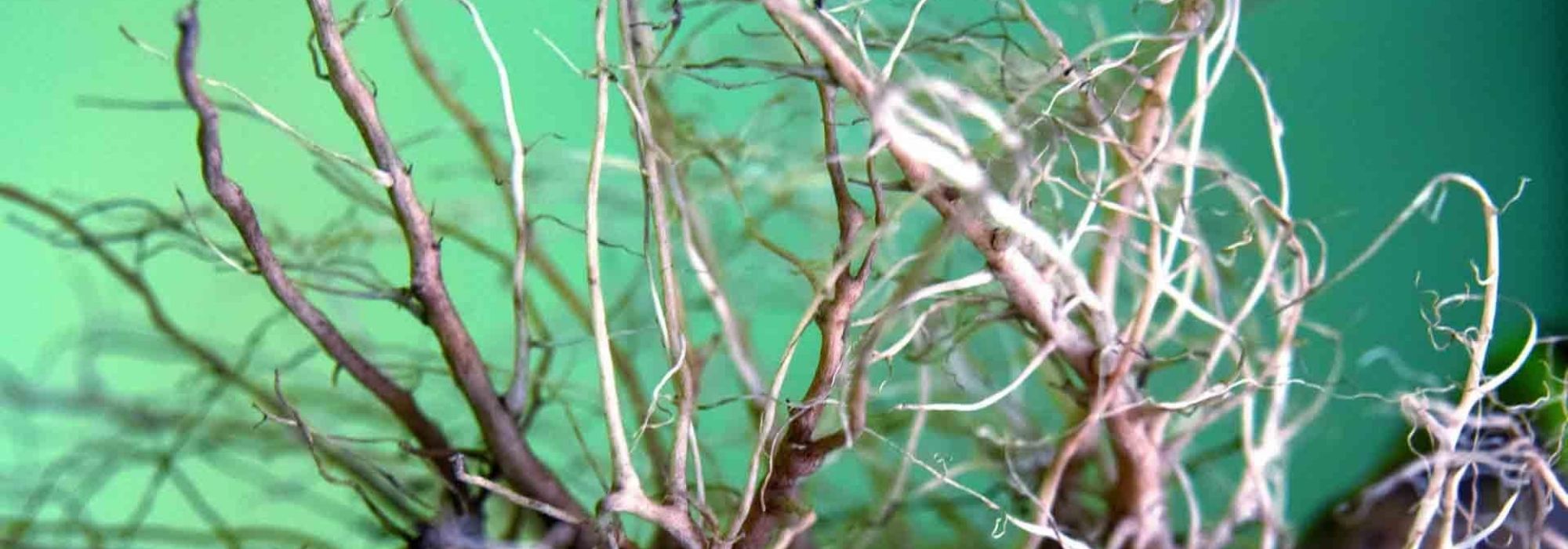
Hardiness is the lowest winter temperature a plant can endure without suffering serious damage or even dying. However, hardiness is affected by location (a sheltered area, such as a patio), protection (winter cover) and soil type (hardiness is improved by well-drained soil).
In temperate climates, pruning of spring-flowering shrubs (forsythia, spireas, etc.) should be done just after flowering.
Pruning of summer-flowering shrubs (Indian Lilac, Perovskia, etc.) can be done in winter or spring.
In cold regions as well as with frost-sensitive plants, avoid pruning too early when severe frosts may still occur.
The harvesting period indicated on our website applies to countries and regions in USDA zone 8 (France, England, Ireland, the Netherlands).
In colder areas (Scandinavia, Poland, Austria...) fruit and vegetable harvests are likely to be delayed by 3-4 weeks.
In warmer areas (Italy, Spain, Greece, etc.), harvesting will probably take place earlier, depending on weather conditions.
The sowing periods indicated on our website apply to countries and regions within USDA Zone 8 (France, UK, Ireland, Netherlands).
In colder areas (Scandinavia, Poland, Austria...), delay any outdoor sowing by 3-4 weeks, or sow under glass.
In warmer climes (Italy, Spain, Greece, etc.), bring outdoor sowing forward by a few weeks.
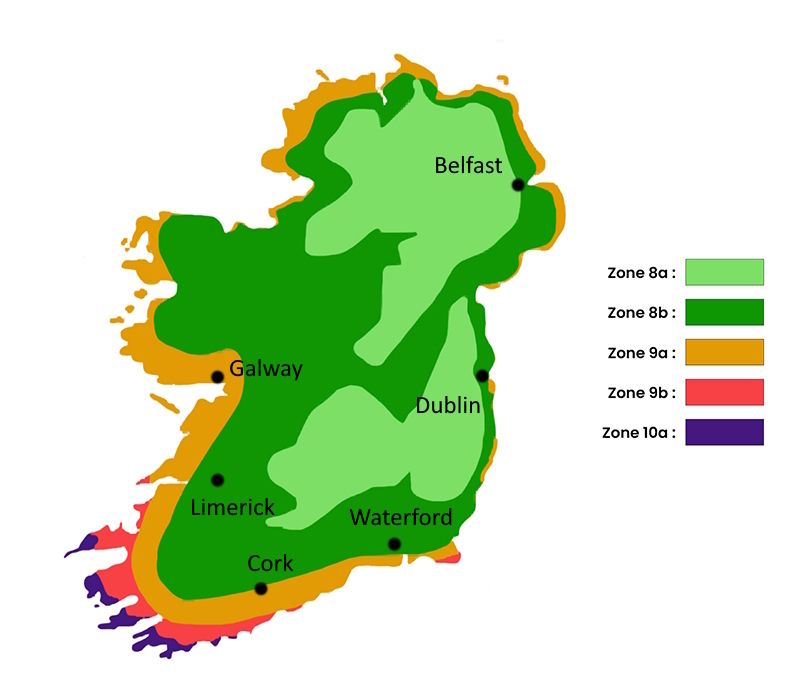
The planting period indicated on our website applies to regions in USDA Zone 9a (East Coast and Midlands: Dublin, Wexford, Waterford, Kilkenny, Portlaoise). It will vary depending on where you live:
- On the west coast and in the north-west (Galway, Limerick, Sligo, Donegal, Westport), delay planting by 1 to 2 weeks in spring and bring it forward by 1 to 2 weeks in autumn compared to the dates given, preferably choosing periods without strong winds.
- In the inland hills and plateaus (Wicklow Mountains, Macgillycuddy’s Reeks, Connemara, Killarney), it is best to plant in spring (April–May) or autumn (September–October), avoiding periods of waterlogged soil in winter and strong winds, which pose the main risk to newly planted trees in these areas.
The flowering period indicated on our website applies to regions in USDA Zone 9a, such as the East Coast and Midlands, including Dublin, Wexford, Waterford, Kilkenny and Portlaoise.
This will vary depending on where you live:
- On the west coast and in the northwest (Galway, Limerick, Sligo, Donegal and Westport), it will be delayed by one to two weeks compared to the given dates, due to stronger Atlantic winds and less spring sunshine.
- In the inland hills and plateaus (the Wicklow Mountains, the Macgillycuddy's Reeks, Connemara and Killarney), flowering will be delayed by two to three weeks. Flowering mainly occurs between May and July, with the limiting factors being less frost and more of the excessive humidity, strong winds and lack of sunshine that are characteristic of these areas.
Shipping country and language
Your country of residence may be:
Your country of residence is:
For a better user experience on our website, you can select:
Your shipping country:
-
 Austria
-
 Belgium
-
 Bosnia & Herzegovina
-
 Bulgaria
-
 Croatia
-
 Cyprus
-
 Czechia
-
 Denmark
-
 Estonia
-
 Finland
-
 France
-
 Germany
-
 Greece
-
 Hungary
-
 Iceland
-
 Ireland
-
 Italy
Italy
-
 Latvia
-
 Liechtenstein
-
 Lithuania
-
 Luxembourg
-
 Malta
Malta
-
 Netherlands
-
 Poland
-
 Portugal
-
 Romania
-
 Serbia
-
 Slovakia
-
 Slovenia
-
 Spain
Spain
-
 Sweden
-
 Switzerland
Language:
-
French
-
 English
-
Spanish
-
Italian
-
German
-
Portuguese
-
Dutch
-
Finnish
My Account
Hello
My wish lists
My cart
Log in / Register
Existing customer?
This form is protected by reCAPTCHA - the Google Privacy Policy and Terms of Service apply.
New customer?
Create an account to track your orders, access our customer service and, if you wish, make the most of our upcoming offers.